
 Worksheets
DBMS QUIZ
Total questions: 85
Worksheet time: 53mins
The data model which describes how the data is actually stored is
internal model
external model
logical model
none of these
Data about data is normally termed as
directory
data bank
meta data
none of the above
The database administrator is, in effect, the coordinator between them ____ and the ____
(A) Database, users
(B) Application program; database
(C) DBMS; database
(D) Application programs; users
Where will we find the referential integrity command?
(A) Table
(B) Tools
(C) Format
(D) None of these
Which of the following component of a computer system is the most important to a database management system?
(A) High speed, large capacity disk
(B) High resolution video display
(C) Mouse
(D) Printer
In a relational schema, each tuple is divided into fields called
(A) Domains
(B) Queries
(C) Relations
(D) None of these
An indexing operation
(A) Establishes an index for a file
(B) Sorts a file using two keys
(C) Sorts a file using a single key
(D) Both (b) and (c)
The modify operation is likely to be done after
(A) Insert
(B) Delete
(C) Look-up
(D) None of these
The method of file organization in which data records in a file are arranged in a specified order according to key field is known as the
(A) Sequential access method
(B) Queuing method
(C) Predetermined method
(D) Direct access method
External database is
(A) Database created using DBMS package
(B) Database created in MS-Word
(C) Database created in EXCEL
(D) All of the above
ROLLBACK in a database is ____ statement.
(A) DDL
(B) DML
(C) DCL
(D) TCL
The logical data structure with a one-to-many relationship is a
(A) Tree
(B) Chain
(C) Network
(D) All of these
The following are components of a database except _____
(A) reports
(B) indexes
(C) metadata
(D) user data
The smallest logical data entity is called a data item or data
(A) Field
(B) Collection
(C) Base
(D) Bank
E.F. Codd represented _____ rules that a database must obey if it has to be considered truly relational.
(A) 6
(B) 8
(C) 10
(D) 12
The distinguishable parts of a record are called
(A) Fields
(B) Files
(C) Data
(D) All of these
The command to convert a numeric number to characters is
(A) STR ()
(B) CHR ()
(C) ASC ()
(D) All of these
What is not true about a view?
a. It is a definition of a restricted portion of the database
b. It is a security mechanism
c. It is always updatable like any other table
d. All are true
In a relational database a referential integrity constraint can be specified with the help of
a. primary key
b. foreign key
c. secondary key
d. none of the above
4NF is designed to cope with
a. Transitive dependency
b. Join dependency
c. Multi valued dependency
d. None of these
Which command is used to add a column to an existing table?
a. Create
b. Update
c.Alter
d. None of these
Rollback of transactions is normally used to
a. recover from transaction failure
b. update the transaction
c. retrieve old records
d. repeat a transaction
In the architecture of the Database System, external level is the
Physical level
Logical level
Conceptual level
View level
In Hierarchical Model records are organized as
Graph
List
Links
Tree
In an ER diagram, attributes are represented by?
Rectangle
Square
Ellipse
Triangle
A logical Schema
is the entire database.
is a standard way of organizing the information into accessible parts.
describes how data actually stores on the disc
options 1 & 3
In an ER diagram, Entity types are represented by
rectangle
ellipse
diamond box
circle
A relational database developer refers to a record as
Criteria
a relation
a tuple
an attribute
An advantage of DBMS approach is
data is dependent on programs
data redundancy increases
data can be integrated and can be accessed by multiple programs
none of the above
Which of the following are the properties of entities?
Groups
Tables
Attributes
Switchboards
In ER diagram relationship type is represented by
Ellipse
Dashed Ellipse
Rectangle
Diamond
What database level is closest to the user
External
Internal
Physical
Conceptual
Enter Your Email id
Which of the following is generally used for performing tasks like creating the structure of the relations, deleting relation?
DML(Data Manipulation Language)
Query
Relational Schema
DDL(Data Definition Language)
The given Query can also be replaced with_______:
SELECT name, course_id FROM instructor, teaches WHERE instructor_ID= teaches_ID;
Select name,course_id from teaches,instructor where instructor_id=course_id;
Select name, course_id from instructor natural join teaches;
Select name, course_id from instructor;
Select course_id from instructor join teaches;
Which one of the following given statements possibly contains the error?
select * from emp where empid = 10003;
select empid from emp where empid = 10006;
select empid from emp;
select empid where empid = 1009 and Lastname = 'GELLER';
A Database Management System is a type of _________software.
It is a type of system software
It is a kind of application software
It is a kind of general software
Both A and C
The term "FAT" is stands for_____
File Allocation Tree
File Allocation Table
File Allocation Graph
All of the above
Which one of the following refers to the "data about data"?
Directory
Sub Data
Warehouse
Meta Data
Which of the following refers to the level of data abstraction that describes exactly how the data actually stored?
Conceptual Level
Physical Level
File Level
Logical Level
To which of the following the term "DBA" referred?
Data Bank Administrator
Database Administrator
Data Administrator
None of the above
In general, a file is basically a collection of all related______.
Rows & Columns
Fields
Database
Records
The term "Data" refers to:
The electronic representation of the information( or data)
Basic information
Row Facts and figures
Both A and C
RAID stand for _________
Redundant Arrays of Idempotent Data
Redundant Arrays of Independent Disks
Redundant Arrays of Independent Data
Redundant Arrays of Isolated Disks
The files with variable length records make use of (a) structure for storage.
To preserve the integrity and consistency of data, the database system must ensure
Atomicity
Isolation
Durability
Consistency
All of the above
Consider the following action:
TRANSACTION.....
Commit;
ROLLBACK;
What does Rollback do?
Undoes the transactions before commit
Clears all transactions
Redoes the transactions before commit
No action
If a schedule S can be transformed into a schedule S' by a series of swaps of non-conflicting instructions, we say that S and S' are
Conflict serializable
Conflict equivalent
View serializable
Serializable
Consider the two transactions T1 and T2 and four schedules S1, S2, S3, S4 of T1 and T2 as given below
S1: R1(X); R2(X); R2(Y); W1(X); W1(Y); W2(Y)
S2: R1(X); R2(X); R2(Y); W1(X); W2(Y); W1(Y)
Here R1(X) denotes read operation on X by the transaction T1 and W1(X) denotes write operation on X by the transaction T1.
Which of the schedules(s) are conflicts serializable?
S1 and S2
S2 only
S1 only
Neither S1 nor S2

For the given schedule, which is the equivalent serial schedule?
T1 - T2 - T3
T1 - T3 - T2
T2 - T1 - T3
T3 - T1 - T2
The column ‘C’ has to be indexed. What is the content of the bitmap index?
A B C
a1 b1 c2
a1 b1 c2
a2 b4 c1
a3 b2 c3
Identify the options which are true for Immediate-modification scheme
Allows updates of an uncommitted transaction to be made to the buffer, or the disk itself, before the transaction commits.
Update log record must be written after a database item is written
Output of updated blocks to disk storage can take place at any time before or after transaction commit
Performs updates to buffer/disk only at the time of transaction commit

Consider the state of the transactions in the diagram and the statements given below:
A. T1 can be ignored.
B. T2 and T3 redone
C. T4 undone
D. T4 redone
Mark the correct group of statements from the options below
A, B, D
A, B, C
Only A and B but not C
Only B and C but not A
Identify the incorrect statement based on checkpoint
All updates are stopped while doing checkpoint
Continue scanning backwards till a record <Ti start> is found for every transaction Ti in L
Scan backwards from end of log to find the most recent <checkpoint L> record
Scan from starting of log to find the most recent <checkpoint L> record
What is the effect of the UNDO operation corresponding to a log record
< Ti; Y; S; K >
where Ti is the transaction, and S and K are the old and new values respectively of a data location
No change to Y
Writes the value S to Y
Writes the value K to Y
Sets Y to 0

Based on the figure above, identify the number of tuples that will be returned by the following relational algebra query : σ Type = 'Saving' (Account)
2
3
6
0
Choose the CORRECT symbol of SELECT in the Relational Algebra
x
π
∩
σ

Identify the CORRECT output for table (Student Difference Lecturer) or (Student - Lecturer) in table above


Write the CORRECT relational algebra expression base on the figure above
π managerID, managerName ( σ workExprience = 5) (MANAGER)
σ managerID, managerName ( π workExprience = 5) (MANAGER)
undefined managerID, managerName (undefined workExprience > 5) (MANAGER)
undefined managerID, managerName (undefined workExprience > 5) (MANAGER)

Write the relational algebra to list student's number and student'a name whose age is 20 years old or state in Terengganu.
π StudentID, Name ( σ Age=20 AND State = "Terengganu" (STUDENT)
undefined StudentID, Name (undefined Age=20 OR State = "Terengganu" (STUDENT)
σ StudentID, Name ( π Age=20 AND State = "Terengganu" (STUDENT)
undefined StudentID, Name (undefined Age=20 OR State = "Terengganu" (STUDENT)

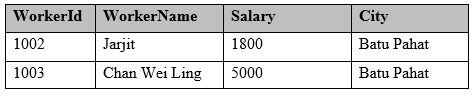
Base on the table given, identify output that will be produced when, σ Salary > 3000 ˅ City = ‘Batu Pahat’ (WORKER).



Relational Algebra is a __________ query language that takes two relations as input and produces another relation as an output of the query.
Relational
Structural
Procedural
Fundamental

Is equivalent to


Sailors (sid, name, rating, age)
Boats (bid, name, color)
Reserves (sid, bid, day)
List names of boats.
π ( Boats)
σ name(Boats)
πname ( Boats)
σ (Boats)
Which of the following are relational algebra operators?


Relational Algebra is a __________ query language that takes two relations as input and produces another relation as an output of the query.
Relational
Structural
Procedural
Fundamental
Which of the following is used to denote the selection operation in relational algebra?
Pi
Sigma
Lambda
Omega
For select operation the ________ appear in the subscript and the ___________ argument appears in the paranthesis after the sigma.
Predicates, relation
Relation, Predicates
Operation, Predicates
Relation, Operation
The ___________ operation, denoted by −, allows us to find tuples that are in one relation but are not in another.
Union
Set Difference
Division
Intersection
Which is a join condition contains an equality operator:
Equi Join
Cartesian
Natural
Left
In precedence of set operators, the expression is evaluated from
Left to Right
Right to Left
From user specification
Left & Right both in parallel
Find the ID, name, dept name, salary for instructors whose salary is greater than $80,000
{t | t ε instructor ∧ t[salary] > 80000}
Э t ∈ r (Q(t))
{t | Э s ε instructor (t[ID] = s[ID]∧ s[salary] > 80000)}
None of these
A query in the tuple relational calculus is expressed as:
{t | P() | t}
{P(t) | t }
{t | P(t)}
All of these
Which of the following symbol is used in the place of except?
^
v
¬
*
“Find all students who have taken all courses offered in the Biology department.” The expressions that matches this sentence is :
Э t ε r (Q(t))
∀ t ε r (Q(t))
¬ t ε r (Q(t))
~ t ε r (Q(t))
Which of the following is the comparison operator in tuple relational calculus
⇒
=
ε
All of these
An expression in the domain relational calculus is of the form
{P(x1, x2, . . . , xn) | < x1, x2, . . . , xn >}
{x1, x2, . . . , xn | < x1, x2, . . . , xn >}
{x1, x2, . . . , xn | x1, x2, . . . , xn}
{< x1, x2, . . . , xn > | P(x1, x2, . . . , xn)}
In domain relational calculus “there exist” can be expressed as
(P1(x))
(P1(x)) Э x
V x (P1(x))
Э x (P1(x))
A set of possible data values is called
Attribute
Degree
Tuple
Domain
When we want to display records with attributes from many relations then we use:
SELECT operation
PROJECT operation
JOIN operation
PERFORM operation
Relational Calculus describes about
'How' to evaluate a query
'What' is to be retrieved
'When' to evaluate a query
'Not' to evaluate a query
SELECT operator works _____ wise whereas PROJECT operator works _______ wise.
Row, Column
Column, Row
Row, Row
Column, Column
In order to perform Union operation on two relations, both operand and relations must be
Union compatible
Set compatible
Difference compatible
User compatible
Relational Calculus is of ______ types
2
3
4
5
QBE stands for
Query By Example
Query By Entity
Question By Example
Question By Entity

