wayground logo

Free Printable Worksheets

Font size

S
M
L
XL
Worksheets

Spring 2024 Final Review

Total questions: 163

Worksheet time: 3hrs 49mins

Name
Class
Date
1.

What type of waves are sound waves? (pick two)

a)

Mechanical

b)

Electromagnetic

c)

Longitudinal

d)

Transverse

2.

What is the distance between the resting position and the maximum displacement of a wave called?

a)

Frequency

b)

Wavelength

c)

Amplitude

d)

Period

3.

What is the high point of a wave called?

a)

Amplitude

b)

Crest

c)

Wavelength

d)

Trough

4.

What is the time needed for a wave to make one complete cycle of motion called?

a)

Wavelength

b)

Period

c)

Frequency

d)

Amplitude

5.

What is the velocity of a wave with a period of 3.0 s and a wavelength of 2.1 m?

a)

6.3 m/s

b)

0.7 m/s

c)

0.63 m/s

d)

7.0 m/s

6.

What is the frequency of a wave with a velocity of 10.0 m/s and a wavelength of 2.0 m?

a)

5.0 Hz

b)

20.0 Hz

c)

10.0 Hz

d)

0.5 Hz

7.

The distance traveled by a wave in one complete vibration/cycle is called

a)

Trough

b)

Crest

c)

Wavelength

d)

Magnitude

8.

Which measurement does not correspond to wavelength

a)

from crest to crest

b)

from trough to trough

c)

from rest position to maximum displacement

d)

from strating point to ending point along the equilibrium position

9.

What is the symbol for wavelength?

a)

µ

b)

Ɛ

c)

λ\lambda  

d)

Σ\Sigma  

10.

What is the symbol for frequency?

a)

Q

b)

Ɛ

c)

ƒ

d)

λ

11.

The number of oscillations(cycles) per second is called

a)

period

b)

frequency

c)

wavelength

d)

amplitude

12.

A wave with a higher amplitude has more energy

a)

TRUE

b)

FALSE

13.

The dashed line in the picture represents wave's

a)

crest

b)

equilibrium position

c)

trough

d)

amplitude

14.

Which wave's frequency is the highest?

a)

Red

b)

Orange

c)

Blue

d)

Purple

15.

Which wave's frequency is the lowest?

a)

Red

b)

Orange

c)

Blue

d)

Purple

16.

Which wavelength is the shortest?

a)

Red

b)

Orange

c)

Blue

d)

Purple

17.

Which wavelength is the longest?

a)

Red

b)

Orange

c)

Blue

d)

Purple

18.

Waves transfer

a)

matter

b)

energy

c)

energy and matter

d)

objects from one medium to another

19.

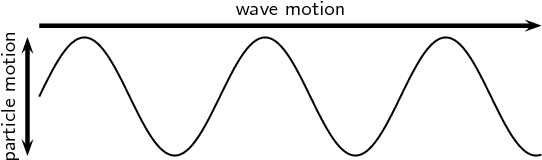
The particles in a transverse wave _________ as the wave moves horizontally.

a)

move up and down

b)

move left and right

c)

don't move

d)

stay at equilibrium position

20.

Which of the following is an example of a wave medium?

a)

Air molecules and other gases

b)

Water

c)

A slinky

d)

All of the above

21.
What kind of wave is pictured below?
a)
compressional wave
b)
transverse wave
c)
sound wave
d)
mechanical wave
22.
Waves are a transfer of what?
a)
Heat
b)
Light
c)
Energy
d)
Food
23.
Amplitude reflects the amount of ____________________ in a wave.
a)
energy
b)
compression
c)
rarefaction
d)
speed
24.
The units for frequency are measured in _____________.
a)
hertz
b)
seconds
c)
m/s
d)
m
25.
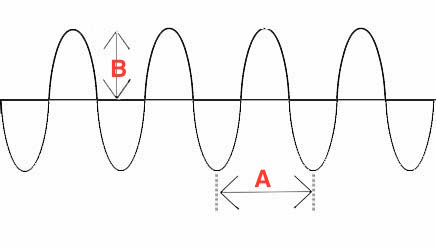
What property of this wave is represented by the letter "A"
a)
amplitude
b)
crest
c)
trough
d)
wavelength
26.
The highest point on a wave is:
a)
the crest
b)
the trough
c)
the top
d)
the coast 
27.
The lowest point on a wave is the:
a)
Amplitude
b)
Crest
c)
Trough
d)
Wavelength
28.
The number of wavelengths that pass a point each per second is:
a)
frequency
b)
period
c)
longitudinal 
d)
transverse wave 
29.
The type of waves that require medium to pass:
a)
Mechanical Waves
b)
Electromagnetic Waves
30.
When the frequency of a wave increases, what happens to the wavelength?
a)
The wavelength is not directly affected by the frequency of a wave.
b)
The wavelength increases.
c)
The wavelength decreases.
d)
More specific information is needed to form a conclusion about the wavelength.
31.
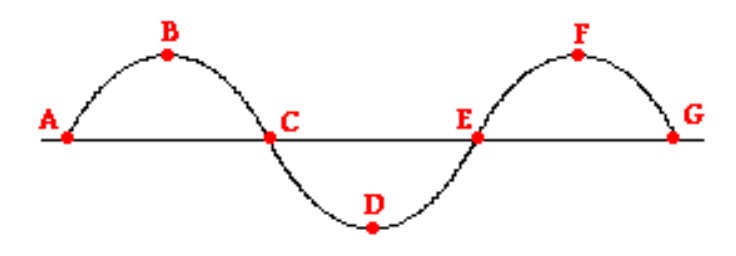
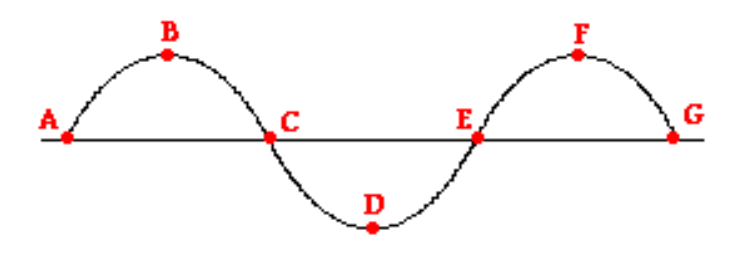
Which letter(s) represent the trough of the wave?
a)
A
b)
B & D
c)
D
d)
C & G
32.
Which letter(s) represent the crest of the wave?
a)
A
b)
B & D
c)
B & F
d)
F
33.
Which of the following can sound travel through?
a)
solid
b)
liquid
c)
gas
d)
all of the above
34.
The SI unit for frequency is ________.
a)
m
b)
m/s
c)
hertz
d)
s
35.
Which harmonic is shown?
a)
1st
b)
2nd
c)
3rd
d)
4th
36.
The stationary dot is called:
a)
a node.
b)
an anti-node.
c)
the amplitude.
d)
the not moving bit.
37.
When a guitar is tuned to adjust its pitch, what is it that is changed?
a)
The wavelength of the fundamental.
b)
The frequency of the fundamental.
c)
The amplitude of the fundamental.
38.
When two waves combine to form a new wave with a smaller amplitude, it is called 
a)
Refraction
b)
Constructive Interference
c)
Resonance
d)
Destructive Interference
39.
A wave in which the particles of the medium move perpendicularly to the direction the wave is traveling
a)
A. surface wave
b)
B. transverse wave
c)
C. electromagnetic  wave
d)
D. longitudinal wave
40.
What kind of wave is pictured?
a)
Transverse
b)
Longitudinal
c)
surface
d)
none of the above
41.

How many antinodes does this standing wave have?

a)

5

b)

6

c)

7

d)

8

42.

In the diagram which letters represent the nodes

a)

A B C

b)

A C E

c)

B D

d)

B D E

e)

A C D

43.
______ is how high or low a sound is; depends on the frequency.
a)
pitch
b)
frequency
c)
sound
d)
medium
44.
A wave that requires a medium through which to travel
a)
mechanical wave
b)
chemical wave
c)
electromagnetic wave
d)
pitch
45.
______ is how loud or soft a sound is; depends on the amplitude.
a)
pitch
b)
frequency
c)
loudness
d)
medium
46.
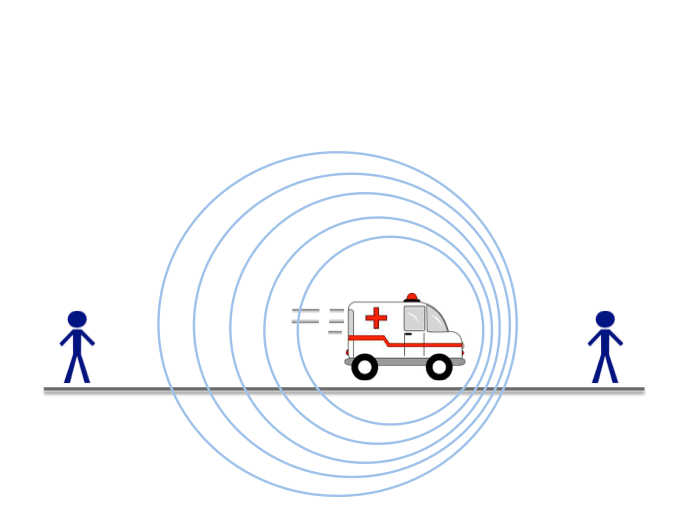
What best describes the doppler effect?
a)
An apparent change in frequency of a wave due to the relative motion between a wave source and an observer
b)
When sound changes pitch
c)
When light changes color
d)
An apparent change in the amplitude of a wave due to the relative motion between a wave source and an observer.
47.
When the car moves AWAY from you, its horn seems...
a)
Low pitched
b)
High pitched
c)
Normal
48.
When an ambulance move TOWARD you it sounds ________ pitched. 
a)
high
b)
low
c)
medium
49.
How are light waves and sound waves similar?
a)
The both carry matter & energy
b)
They both carry energy.
c)
They both travel in vacuums.
d)
They both carry matter.
50.
A ray of light traveling from air into crown glass strikes the surface at an angle of 30 degrees. What is the angle of refraction? (air n=1, crown glass n=1.532)
a)
39.7 degrees
b)
19.2 degrees
c)
59.1 degrees
d)
12.3 degrees
51.
According to the Law of reflection, a light ray striking a mirror
a)
continues moving through the mirror in the same direction
b)
moves into the mirror at a slightly different angle
c)
bounces off the mirror toward the direction it came from
d)
bounces off the mirror at the same angle it hits.
52.
Glass has a _____________ index of refraction than air.
a)
Equal
b)
Greater
c)
Less
d)
Impossible to say
53.
The fact the two angles are the same is an example of....
a)
Refraction
b)
Angle of Incidence
c)
Law of reflection
d)
Magnification
54.
The measure of how much light refracts is called...
a)
Refraction
b)
Law of reflection
c)
reflected ray
d)
Index of refraction
55.
This shows the phenomenon known as....
a)
reflection
b)
refraction
c)
mirrors
d)
focal point
56.

Light travels through a liquid at 2.25 x10⁸ m/s. What is the index of refraction of the liquid?

a)
1.33
b)
1.0
c)
1.523
d)
2.45
57.

Light traveling through  air encounters a second medium which slows the light to 1.88 x 10⁸ m/s.  What is the index of refraction the second medium?

a)
1.00
b)
1.498
c)
2.45
d)
1.60
58.
The velocity of light in vacuum is _______ m/s.
a)
3x10⁸
b)
3x10¹²
c)
3x10⁶
d)
3x10¹⁰
59.

The index of refraction of any medium is always _______.

a)
less than 1
b)
greater than 1
c)
1
d)
0
60.
The formula to calculate the refractive index is
a)
n=cv
b)
n=v/c
c)
n=c/v
d)
v=nc
61.
What is the index of refraction of a refractive medium if the angle of incidence in the air is 40 degrees and the angle of refraction is 29 degrees?
a)
1.32
b)
2.06
c)
1.523
d)
1.586
62.
What is the index of refraction of a refractive liquid if the angle of incidence in the air is 35 degrees and the angle of refraction is 14 degrees?
a)
1.33
b)
2.21
c)
2.37
d)
1.72
63.
If the angle of incidence of light traveling through air, and then striking water is 30 degrees what is the angle of refraction? (n=1 air, n=1.33 water)
a)
15 degrees
b)
22 degrees
c)
43 degrees
d)
17 degrees
64.

Light travels at 1.76 x10⁸ m/s through a medium.  What is the medium?
diamond n=2.45
flint glass n=1.70
barium glass n=1.60
crown glass n=1.523

a)
Crown Glass
b)
Barium Glass
c)
Flint Glass
d)
Diamond
65.
What is the refractive medium if a ray coming from air at an angle of incidence of 50 degrees is refracted through an angle of 35 degrees?
flint glass n=1.70
barium glass n=1.60
crown glass n=1.523
water n=1.33
a)
flint glass
b)
barium glass
c)
crown glass
d)
water
66.
Light has the highest velocity in which medium?
flint glass n=1.70
barium glass n=1.60
crown glass n=1.523
water n=1.33
diamond n=2.45
a)
diamond
b)
water
c)
flint glass
d)
barium glass
67.
Light has the lowest velocity in which medium?
flint glass n=1.70
barium glass n=1.60
crown glass n=1.523
water n=1.33
diamond n=2.45
a)
diamond
b)
water
c)
flint glass
d)
barium glass
68.
The _________ of light can change when light is refracted because the medium changes.
a)
frequency
b)
medium
c)
wavelength
d)
transparency
69.
When light passes at an angle to the normal from one material into another material in which its speed is higher 
a)
it is bent toward the normal.
b)
it always lies along the normal.
c)
it is unaffected.
d)
it is bent away from the normal.
70.
When light passes at an angle to the normal from one material into another material in which its speed is lower
a)
it is bent towards the normal.
b)
it always lies along the normal.
c)
it is unaffected.
d)
it is bent away from the normal.
71.
Why does the lower part of the child appear so much different in size from the upper part?
a)
The light rays that travel through water and then into air are refracted.
b)
The light rays that travel through water and then into air are enlarged.
c)
The light rays that travel through air and then into water are reflected.
d)
The light rays that travel through air and then into water are reduced.
72.
What do all waves have in common?
a)
nothing
b)
they carry energy
c)
they absorb light
d)
you can see them
73.
A ray of light traveling from air into crown glass strikes the surface at an angle of 30 degrees. What is the angle of refraction? (air n=1, crown glass n=1.532)
a)
39.7 degrees
b)
19.2 degrees
c)
59.1 degrees
d)
12.3 degrees
74.
What is the index of refraction of a refractive liquid if the angle of incidence in the air is 35 degrees and the angle of refraction is 14 degrees?
a)
1.33
b)
2.21
c)
2.37
d)
1.72
75.
If the angle of incidence of light traveling through air, and then striking water is 30 degrees what is the angle of refraction? (n=1 air, n=1.33 water)
a)
15 degrees
b)
22 degrees
c)
43 degrees
d)
17 degrees
76.
What is this image an example of?
a)
Reflection
b)
Diffusion
c)
Refraction
77.
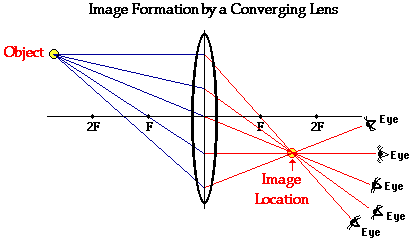
Compared to the object in front the lens, its image is.....
a)
inverted and smaller
b)
inverted and larger
c)
not inverted and smaller
d)
not inverted and larger
78.
What type of image is formed when rays of light actually intersect?
a)
real
b)
virtual
c)
projected
d)
curved
79.
An image that you can see , but does not really exist is called which of the following?
a)
Real Image
b)
Fake Image
c)
Virtual Image
d)
Digital Image
80.
A real image...
a)
is produced by virtual rays and can be projected on a screen
b)
is produced by real rays and cannot be projected on a screen
c)
is produced by virtual images and cannot be projected on a screen
d)
is produced by real rays and can be projected on a screen
81.
Which one is a convex lens?
a)
A
b)
B
82.
What type of image is formed in a plane mirror?
a)
Real
b)
Virtual
c)
Enlarged
d)
Small
83.
If an image formed by a convex lens is inverted, it is most likely what type of image?
a)
Real
b)
Virtual
c)
None of the above
84.
As you move an object further away from a convex lens, its image would become which of the following?
a)
Larger and virtual
b)
Larger, only
c)
Smaller, only
d)
Smaller and virtual
85.
Which of the following does not refract light?
a)
prism
b)
convex lens
c)
concave lens
d)
mirror
86.
What kind of image will you get if you put an object right at F, the focal point of this lens?
a)
Virtual, larger
b)
Real, smaller
c)
Real, larger
d)
No image
87.

The process of light bouncing off a surface

a)

refraction

b)

reflection

c)

diffraction

d)

diffusion

88.
Individuals that are farsighted need to have prescription lenses that are _________. 
a)
convex
b)
concave
c)
plane
d)
flat
89.
Individuals that are nearsighted need to have prescription lenses that are ___________. 
a)
convex
b)
concave
c)
plane 
d)
flat
90.
The point where the rays meet is known as....
a)
Fire
b)
the focal point
c)
refraction
d)
Plane of the lens
91.
This image is...
a)
Inverted and smaller
b)
Inverted and larger
c)
not inverted and smaller
d)
not inverted and larger
92.
This image is...
a)
Inverted and smaller
b)
Inverted and larger
c)
not inverted and smaller
d)
not inverted and larger
93.
A real image having a size of 10 cm is formed by a concave mirror. The size of the object is 5 cm.The magnification of the object is
a)
-5
b)
5
c)
2
d)
-2
94.

An object is placed 10 cm from a convex lens. Its image is formed 5 cm behind the mirror. The focal length of the given convex lens is

a)
-5 cm
b)
5 cm
c)

3.33 cm

d)
-10cm
95.

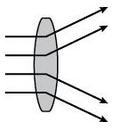
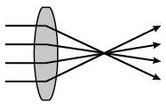
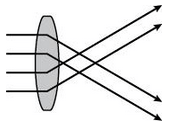
Which figure represents the path light takes through a converging lens?
a)
b)
c)
d)
96.

Which lens represents the path light takes through a diverging lens?

a)
b)
c)
d)
97.
What type of image does this lens form?
a)
Virtual image
b)
Real Image
c)
No Image
98.
Compared to the object in front the lens, its image is.....
a)
inverted and smaller
b)
inverted and larger
c)
not inverted and smaller
d)
not inverted and larger
99.
A ______ telescope uses a glass to focus light. 
a)
reflecting
b)
refracting
c)
radio
d)
spectrum
100.
A ______ telescope uses a mirror to focus light onto a small area.
a)
reflecting
b)
refracting
c)
radio
d)
spectrum
101.
Reflecting telescopes differ from refracting telescopes in having
a)
no eyepiece lens.
b)
two large objective lenses.
c)
a mirror instead of an objective lens.
d)
one large objective lens.
102.
What type of telescope is this?
a)
Refractor
b)
Reflector
c)
Non-Optical
d)
X- Ray
103.
What type of telescope is this?
a)
Refractor
b)
Reflector
c)
Non-Optical
d)
X- Ray
104.

Why do we put telescopes in space?

a)
So it can be closer to the stars it magnifies
b)
They have very large optical lenses
c)
So its images arent distorted by Earth's atmosphere 
d)
So it can be operated by astronauts 
105.
Opens and closes to adjust the total amount of light entering the eye.
a)
Pupil
b)
Sclera
c)
Cornea
d)
Human lens
106.

Cornea is abnormally curved, causes blurry vision because of multiple focal points.

a)
Temporarily Blind 
b)
Blindness
c)
Eye
d)
Astigmatism
107.
What is the innermost layer and most delicate layer of the eyeball where photoreceptors are located?
a)
Sclera
b)
Choroid
c)
Retina
d)
Cornea
108.
Which nerve transmits information from the eye to the brain?
a)
Optic
b)
Olfactory
c)
Occulomotor
d)
Trigeminal
109.
Nearsightedness is also known as ....
a)
Myopia
b)
Hyperpopia
c)
Presbyopia
d)
none of the above
110.

What is the function of the iris in the human eye?

a)

To control the shape of the lens

b)

To regulate the amount of light entering the eye

c)

To process visual information

d)

To protect the eye from debris

111.

Which of the following is a characteristic of a diverging lens?

a)

Forms only real images

b)

Forms only virtual images

c)

Can form both real and virtual images

d)

Does not form any images

112.

What phenomenon explains the bending of light as it passes from one medium to another?

a)

Reflection

b)

Refraction

c)

Diffraction

d)

Polarization

113.

What is true about about "charge" in general?

a)

It is always positive.

b)

It is a single type.

c)

It comes in two types.

d)

It can be destroyed.

114.

Why do new charges arise when objects are rubbed together? (Like a balloon on your head.)

a)

A) New charges are created

b)

B) Charges are destroyed

c)

C) No new charges are created; they are only separated

d)

D) Charges are transferred without separation

115.

What particles make up an atom?

a)

Protons, neutrons, electrons

b)

Protons, neutrons, positrons

c)

Neutrons, electrons, muons

d)

Protons, muons, gluons

116.

What is located at the center of an atom?

a)

Electrons

b)

Nucleus

c)

Protons

d)

Neutrons

117.

What are the components of the nucleus?

a)

Protons and electrons

b)

Neutrons and muons

c)

Protons and neutrons

d)

Electrons and positrons

118.

Where do electrons reside in an atom?

a)

Inside the nucleus

b)

In the empty space around the nucleus

c)

Attached to protons

d)

Outside the atom

119.

What is true about atoms?

a)

Atoms are mostly solid space.

b)

Atoms consist mainly of electrons.

c)

Atoms are almost all empty space.

d)

Atoms are completely filled with neutrons.

120.

What is the charge of a neutron?

a)

Positive

b)

Negative

c)

Neutral

d)

Variable

121.

Why are atoms generally electrically neutral?

a)

They contain no protons

b)

They contain an equal number of protons and electrons

c)

They contain no electrons

d)

They contain an unequal number of protons and electrons

122.

What type of charges are free to move between objects?

a)

A) Neutron charges

b)

B) Proton charges

c)

C) Electron charges

d)

D) Nuclear charges

123.

How do opposite charges behave?

a)

They do not interact

b)

They repel

c)

They attract

d)

They cancel each other out

124.

What is the magnitude of charge on an electron compared to a proton?

a)

Greater

b)

Less

c)

Equal

d)

Variable

125.

What is the charge of an electron?

a)

+e

b)

-e

c)

0

d)

+2e

126.

What is the charge of a proton?

a)

+e

b)

-e

c)

0

d)

+2e

127.

Which of the following is not a unit used to measure small amounts of charge?

a)

mili-Coulombs (mC)

b)

micro-Coulombs (μC)

c)

nano-Coulombs (nC)

d)

mega-Coulombs (MC)

128.

What is the established value of the elementary charge "e"?

a)

1.602 x 10^-18 Coulombs

b)

1.602 x 10^-19 Coulombs

c)

1.602 x 10^-20 Coulombs

d)

1.602 x 10^-21 Coulombs

129.

How can electrons behave in conductors?

a)

They are locked into position.

b)

They are free to move through the solid.

c)

They move short distances.

d)

They act as insulators.

130.

How do electrons behave in insulators compared to conductors?

a)

They move freely through the solid.

b)

They are not bound to any specific atom.

c)

They are bound to their atoms and move short distances.

d)

They act as semiconductors.

131.
A balloon has a negative charge.  The glass rod has a positive charge.  What will happen when the glass rod is brought near the balloon?
a)
The balloon will be attracted to the rod
b)
The balloon will be repelled by the rod
c)
The balloon will remain in place
d)
The balloon will spin in circles
132.
To demonstrate static electricity, a teacher takes an inflated balloon and rubs it against his hair.  The rubber balloon picks up electrons from his hair, which makes his hair have
a)
a net negative charge
b)
a magnetic force
c)
a net positive charge
133.

Which is the value of the constant in Coulomb's equation?

a)

k = 9·10-9

b)

k = 9.8

c)

k = 6.67·10-11

d)

k = 9 ·109

134.
The Electric Force is strongest when charges are...
a)
close together
b)
far apart
c)
the electric force is constant everywhere
135.
Calculate the force exerted between two charged objects separated by a distance of 0.6 m. One object has a charge of -5 C and the other has a charge of +2.0 C.
a)
-1.5E-11 N
b)
2.5E-11 N
c)
-2.5E11 N
d)
-7.5E-10 N
136.
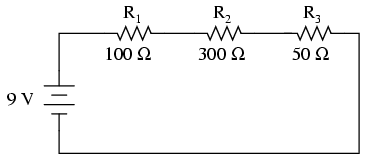
The picture shows an electrical circuit. This circuit is a series circuit because: 
a)
It has 3 light bulbs.
b)
The same current flows through all three light bulbs.
c)
It uses a single battery.
d)
The electrical current is divided between the three light bulbs.
137.
The total resistance in this circuit is 
a)
100 ohms
b)
450 ohms
c)
400 ohms
d)
30 ohms
138.
The total current through this circuit is
a)
0.02 amps
b)
0.09 amps
c)
50 amps
d)
9 amps
139.
What is the total resistance (RT) across this circuit?
a)
3 kΩ
b)
10 kΩ
c)
13 kΩ
d)

18 kΩ

140.
The voltage dropped across the 300 ohm resistor is 
a)
6 V
b)
9 V
c)
2 V
d)
30 V
141.
As resistors are added in series to a circuit, the total resistance will...
a)
increase
b)
decrease
c)
stay the same
142.
As the resistance of a circuit increases, the current will...
a)
increase
b)
decrease
c)
stay the same
143.

In a parallel circuit which of the following is the same value across each resistor?

a)
Voltage
b)
Current
c)
Resistance
d)
Charge
144.
What will happen if one light bulb is removed from this circuit?
a)
The other bulbs will go out.
b)
The other bulbs will stay on
c)
The other bulbs will get dimmer.
d)
The battery will become stronger.
145.
Does this diagram represent a series or parallel circuit?
a)
series circuit
b)
parallel circuit
146.

What is the energy of the circuit if it is running for 40 seconds?

a)

0.3 J

b)

3.3 J

c)

120 J

d)

480 J

147.
Which appliance transfers the most energy per second? 
a)
Clock
b)
Lamp
c)
Desktop Computer
d)
Iron
148.

What is the equivalent or total resistance (Re) across this circuit?

a)

3 kΩ

b)

10 kΩ

c)

13 kΩ

d)

18 kΩ

149.

Which of the following is the correct relationship among power, current, and voltage?

a)

P = I/V

b)

V = P * I

c)

P = I * V

d)

E = P * t

150.

Which of the following is the correct equation to calculate electrical energy?

a)

P = I/V

b)

V = P * I

c)

P = I * V

d)

E = P * t

151.

What type of circuit is shown?

a)

Parallel

b)

Series

c)

Open

152.

How many paths does a series circuit have?

a)

4

b)

3

c)

2

d)

1

153.
What kind of circuit is this?
a)
Series
b)
Consecutive
c)
Parallel
d)
Training
154.

How much does it cost to watch a plasma TV rated at 400 W for 5 hours if each unit (kWh) of electricity costs $1.10?

(Use E=Pt, then Energy->$$)

a)

$2.2

b)

$22

c)

$220

d)

$2200

155.

A heating element resistance is 24 ohms. The current measures 10 Amps. What is the power? (P=IV=I2R)

a)
240 watts
b)
1,200 watts
c)
1,000 watts
d)
2,400 watts
156.

Electric energy is measured in

a)

kWh

b)

Amps

c)

Ohms

d)

Watts

157.

Electric power is measured in

a)

kWh

b)

Amps

c)

Ohms

d)

Watts

158.

Since there are multiple pathways the current can take from the positive side of the battery to the negative side, in a ​ (a)   circuit, the ​ (b)   is divided up among the pathways, but the potential is the same for each pathway. ​In ​ (c)   circuits with only one pathway for the current, the ​ (d)   is divided up among the different elements.

Choose from the below words
parallel
current
series
potential
159.
a)
Circuit X is brighter than circuit Y
b)
Circuit Y is brighter than circuit X
c)
Both circuits have the same brightness
d)
Neither circuit will light the bulbs
160.
What size resistor would produce a 3 Amp current flow with a 12 Volt battery
a)
1 Ohm
b)
3 Ohms
c)
4 Ohms
d)
12 Ohms
161.

Match the following quantities with their units.

a)

Current, I

1.

Amps, A

b)

Voltage, V

2.

Volts, V

c)

Resistance, R

3.

Ohms, Ω

d)

Energy, E

4.

Joules, J

162.

What is the total resistance in the circuit?

a)

10 ohms

b)

6 ohms

c)

4 ohms

d)

2.4 ohms

163.

Solve for the current that is flowing through Resistor one

a)

2 A

b)

154 mA

c)

154 A

d)

77 mA