
 Worksheets
Biofluid Dynamics in Heart and Cardiovascular System Questions
Total questions: 10
Worksheet time: 5mins
Which of the following is true about heart function phases?
Oxygenated blood enters from the pulmonary vein (lung) to the right atrium.
Oxygenated blood is transported from the right atrium to the left ventricle.
Oxygenated blood is pumped to the vena cava for systemic and coronary systems.
Deoxygenated blood enters from the vena cava to the right atrium.
In the four phase cardiac cycle, which phase involves the highest blood pressure?
Period of isovolumetric
relaxation
Filling period
Period of ejection
Period of isovolumetric
contraction
Which of the following is NOT indicating heart problems?
Ventricular Tachycardia
Mature Ventricular
Complex
Atrial Fibrillation
AV Block
What are the two methods used to measure ventricular pressure?
Swan-Ganz and Simple
Catheter
Doppler Ultrasound and
Echocardiography
Catheter and Microelectrodes
Simple Catheter and Doppler
Ultrasound
How is the stroke volume (SV) calculated?
SV = LVESV - LVEDV
SV = LVEDV - LVESV
SV = LVEDV + LVESV
SV = LVEDV / LVESV
These are valves that connect the atriums to the ventricles.
Semilunar or inflow valve
AV or outflow valve
AV or inflow valve
Semilunar or outflow valve
What is the rate of the oxygen consumption per tissue mass of the human heart at rest?
10 mL O2/min/100g
10 mL O2/min/10g
100 mL O2/min/100g
100 mL O2/min/10g
Which of the following is true for coronary blood flow?
The blood flow within left coronary arteries decreases during diastole and
increases during systole.
The blood flow within left coronary arteries increases during diastole and
decreases during systole.
The blood flow within left coronary arteries is constant during diastole and
systole.
The blood flow within right coronary arteries increases during diastole and
decreases during systole.
In this disease, the heart valves do not close completely, which permits blood to flow
backward across the valves.
Heart Valve Stenosis
Valve Regurgitation
Heart Failure
Hypotension
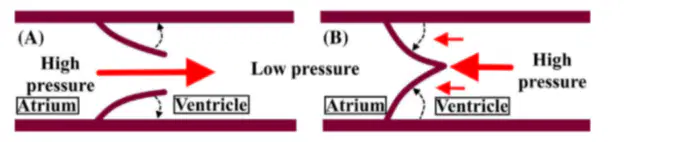
What is being implied by the picture shown below?
(A) Blood flows from the atrium towards the ventricle and (B) the backflow of
blood causes the heart valve to close
(A) Blood flows unidirectionally but (B) it has tendencies of flowing backwards
(A) High pressure in the atrium helps to open the heart valve and (B) as the
blood accumulates in the ventricle, high pressure in the ventricle helps to
close the valve.
All of the above

