
 Worksheets
History of East Germany Quiz
Total questions: 75
Worksheet time: 39mins
What event in 1989 marked a significant change in East Germany's policy, allowing East Germans to move to the West?
The signing of the Treaty of Berlin
The breach of the Berlin Wall
The establishment of the European Union
The election of Mikhail Gorbachev
Which Soviet leader's liberalizing reforms influenced the political landscape of East Germany in 1989?
Vladimir Putin
Leonid Brezhnev
Mikhail Gorbachev
Josef Stalin
Through which country's newly opened border did East Germans first escape to the West in 1989?
Czechoslovakia
Poland
Austria
Switzerland
Who was the West German Foreign Minister responsible for helping East Germans seek asylum in the West German embassy in Prague in 1989?
Helmut Kohl
Hans-Dietrich Genscher
Gerhard Schröder
Angela Merkel
What significant event occurred in Leipzig that contributed to the fall of the Berlin Wall?
Economic reforms
Mass demonstrations
A military coup
A peace treaty signing
On what date did the Berlin Wall officially open, allowing passage between East and West Berlin?
October 3, 1989
November 10, 1989
December 25, 1989
September 9, 1989
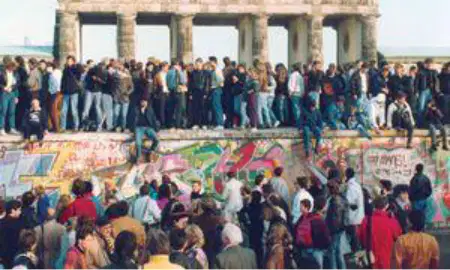
What is depicted in the image related to the Berlin Wall opening?
The signing of a peace treaty
The construction of the Berlin Wall
People gathering as the Berlin Wall opened
A protest against the Berlin Wall
Who was replaced by Egon Krenz in mid-October during the deterioration of the SED Politburo's position?
Mikhail Gorbachev
Günter Schabowski
Erich Honecker
Helmut Kohl
What was the mistaken announcement made by Günter Schabowski about East Germans' travel to West Germany?
They would need a visa
They could travel freely without any conditions
They would need special permission
They could only travel during working hours
On what date did Günter Schabowski make the announcement that led to the opening of the Berlin Wall?
November 9
October 3
December 25
September 1
What was the public reaction in East Berlin following the announcement on the opening of the Berlin Wall?
Immediate evacuation of the city
A night of revelry with tens of thousands celebrating
A formal ceremony
Protests against the decision
Who was the first democratically elected prime minister of East Germany following the 1990 parliamentary elections?
Angela Merkel
Helmut Kohl
Lothar de Maizière
Walter Ulbricht
What significant event in East Germany is associated with the year 1990?
Fall of the Berlin Wall
Introduction of the deutsche mark
First free parliamentary elections
Signing of the Unification Treaty
What was introduced in East Germany as depicted in the image?
Euro currency
Deutsche Mark currency
Soviet Ruble
East German Dollar
What event in 1990 marked a significant step towards the reunification of Germany?
The fall of the Berlin Wall
The introduction of the euro
The signing of the Treaty of Versailles
The establishment of the European Union
Who replaced Hans Modrow as a leader after the large demonstrations in East Germany?
Angela Merkel
Mikhail Gorbachev
Lothar de Maizière
Helmut Kohl
Which party suffered a crushing defeat in the March 1990 elections in East Germany?
Christian Democratic Union
Social Democrats
Party of Democratic Socialism
Free Democrats
What was formed as a result of the negotiations between East and West Germany that aimed at reunification?
European Economic Area
Warsaw Pact
Monetary union
Schengen Agreement
What significant event in German history did Helmut Kohl play a crucial role in, according to the text?
The signing of the Treaty of Versailles
The reunification of Germany
The establishment of the European Union
The fall of the Berlin Wall
In July 1990, what did Helmut Kohl convince Gorbachev to agree to, which was crucial for German reunification?
The dissolution of NATO
The withdrawal of Russian troops from East Germany
A unified Germany within the NATO alliance
The signing of the Maastricht Treaty
Which treaty was ratified by the Bundestag and the People's Chamber that facilitated German reunification?
The Treaty of Lisbon
The Schengen Agreement
The Unification Treaty
The Treaty of Rome
As a result of German reunification, how many new Länder (states) joined the Federal Republic of Germany?
Three
Four
Five
Six
Which of the following was not one of the new Länder formed after the reunification of Germany?
Brandenburg
Mecklenburg-West Pomerania
Saxony
Bavaria
What significant political change occurred in Germany in December 1990?
Introduction of the Euro
All-German free election
Formation of the European Union
Unification of East and West Germany
Which treaty was instrumental in establishing the European Union?
Treaty of Versailles
Maastricht Treaty
Treaty on European Union
Treaty of Berlin
What was a major consequence of national unification in Germany during the 1990s?
Decreased global competition
Reduced social welfare costs
Increased unemployment in traditional industrial sectors
Economic boom in all sectors
What unexpected financial burden did Germany face after unification?
The cost of introducing the Euro
Expenses related to unifying the east and west
Investments in renewable energy
Reduction in military spending
What was a major issue with the eastern German economy after the fall of the Berlin Wall?
It was highly competitive on the world market
It was efficient and environmentally friendly
It was inefficient and environmentally destructive
It had a surplus of employment opportunities
What did the East German economy heavily rely on after its collapse?
Private investments
Federal subsidies
Foreign aid
Technological advancements
What was required for future economic growth in East Germany post-unification?
Decrease in population
Reduction in industrial output
Massive capital investment in infrastructure
Elimination of all subsidies
How did many easterners feel about the west Germans after unification?
Indifferent
Welcoming
Resentful
Appreciative
What term came to imply different approaches to the world in Germany, referring to competitive and aggressive versus passive and indolent behaviors?
Easterner
Westerner
Elbow society
Communist society
Which organization was known for its extensive network of informants in East Germany?
German People's Union
Federal Constitutional Court
Stasi
SPD
Who became the German chancellor in 1998 after Kohl's defeat?
Gerhard Schröder
Roman Herzog
Helmut Kohl
Gerhard Frey
What was the significant political change in Germany in 1994 regarding the presidency?
Helmut Kohl was re-elected
Roman Herzog was elected as president
Gerhard Schröder became chancellor
The SPD won a majority
What year did Gerhard Schröder's government face a series of revelations about illegal campaign contributions that overshadowed its initial problems?
1998
1999
2000
2001
Which party was known for its internal dissension within Gerhard Schröder's coalition?
The Green Party
The CDU
The SPD
The FDP
Who became the CDU party leader in April 2000, becoming the first former East German and first woman to lead a major political party in Germany?
Joschka Fischer
Gerhard Schröder
Angela Merkel
Wolfgang Schäuble
Who was forced to resign their leadership posts due to the scandal involving illegal campaign contributions?
Angela Merkel
Gerhard Schröder
Joschka Fischer
Wolfgang Schäuble
What was one of the main goals of Schröder's government in reforming the German social welfare system and economy?
To increase the population growth rate
To reduce the costs of the welfare system
To increase the number of beneficiaries
To raise taxes and labour costs
By what year did the government plan to phase out the use of nuclear power?
2010
2022
2030
2050
Which challenge was faced by the German government when the 2002 election campaign began?
Low unemployment rates
Decreased economic growth
Successful economic reforms
Vigorous challenge from Edmund Stoiber
What was the primary reason for the early elections in Germany in 2005?
Economic prosperity
A coalition government formation
Worsening economy
Military action in Iraq
Who became the first woman to hold the office of Chancellor in Germany?
Angela Merkel
Gerhard Schröder
Helmut Kohl
Konrad Adenauer
Which political party did Gerhard Schröder belong to?
The Greens
SPD
CDU
CSU
What was a significant aspect of Germany's role in Europe as mentioned in the text?
Decreasing its military involvement
Leading economic and political integration
Reducing its participation in NATO
Isolating from the European Union
Which party was forced into opposition after the 2009 parliamentary elections in Germany?
CDU
CSU
SPD
FDP
Who was elected as the president of Germany in March 2012?
Nicolas Sarkozy
Horst Köhler
Joachim Gauck
Peer Steinbrück
What significant political shift occurred in Lower Saxony in January 2013?
The Green Party lost its majority.
The SPD and the Greens gained a majority in the upper house.
The CDU won an absolute majority.
The FDP secured the chancellorship.
What was Angela Merkel's reaction to the Fukushima nuclear accident in March 2011?
She supported the use of nuclear power.
She pledged to phase out nuclear power by 2022.
She ignored the incident.
She promoted nuclear power enhancements.
Which party captured enough support to form a government in Baden-Württemberg in 2011?
The Green Party
The SPD
The CDU
The FDP
What was Peer Steinbrück's role before becoming a candidate for chancellor?
President of Germany
Finance Minister under Merkel
Leader of the Green Party
Defense Minister
What significant political achievement did Angela Merkel accomplish in the September 22, 2013, election in Germany?
She became the Chancellor for the first time.
Her party, the CDU and CSU, won nearly 42% of the vote.
She resigned from her position as Chancellor.
Her party lost the majority in the parliament.
What was the threshold percentage that Merkel's junior partner, the FDP, failed to reach in the postwar period elections?
10%
5%
15%
20%
Which party finished just behind The Left Party in the 2013 German elections?
The Green Party
The SPD
The FDP
The CDU
What was one of the stated priorities for the new government formed after the 2013 elections in Germany?
Exiting the European Union
Reducing military spending
Transitioning to renewable energy sources
Increasing the number of political parties
What was the main reason for the anti-austerity protests in Athens in February 2015?
To support Angela Merkel's policies
To demand a better bailout deal from Germany
To protest against the Syrian Civil War
To celebrate the Schengen Agreement
Which conflict was discussed by world leaders in Minsk, Belarus, in February 2015?
The Syrian Civil War
The Ukraine crisis
The ongoing strife in Libya
The economic crisis in Greece
Which of the following was NOT a leader present at the Minsk meeting in February 2015?
Angela Merkel
Francois Hollande
Petro Poroshenko
Barack Obama
What was a significant consequence of the conflicts mentioned in the text during Merkel's third term?
Decrease in internal border controls within the EU
Influx of refugees in Europe
Strengthening of the Schengen Agreement
Decrease in the number of migrants entering Germany
Which country expressed dissatisfaction with the terms of the Schengen Agreement in 2015?
Germany
Syria
Libya
Greece
What event in 2015 involving Angela Merkel is mentioned in the text?
Merkel's election as Chancellor
Merkel brokering a cease-fire in Ukraine
Merkel's resignation announcement
Merkel's visit to the United States
Which party is described as Euroskeptic and anti-Islamic in the text?
SPD
CDU-CSU
The Greens
Alternative for Germany (AfD)
What was the result of the CDU-CSU in the general elections held on September 24, 2017?
They won a clear majority
They captured the most votes but fell short of a majority
They lost to the SPD
They did not participate
Which party returned to government with more than 10 percent of the vote in the 2017 elections?
The Greens
The Left
FDP
AfD
What action did Martin Schulz take after the collapse of talks between Merkel and the FDP?
He joined the coalition with Merkel
He resigned from his party leadership
He reversed his decision against forming a coalition
He supported Merkel's resignation
Who was the first Kaiser of the German Empire according to the chronological list provided?
Frederick III
William I
William II
Friedrich Ebert
Which leader was in power in Germany at the time of reunification in 1990?
Konrad Adenauer
Ludwig Erhard
Kurt Georg Kiesinger
None of the above
Who served as the President of the Weimar Republic immediately before the Third Reich began?
Friedrich Ebert
Paul von Hindenburg
Adolf Hitler
William II
During which years did Adolf Hitler lead as part of the Third Reich?
1934-45
1949-63
1963-66
1966-69
Who served as the Chancellor of the Federal Republic of Germany from 1990 to 1998?
Gerhard Schröder
Angela Merkel
Helmut Kohl
Willy Brandt
Which individual was the First Secretary of the Socialist Unity Party of East Germany from 1971 to 1989?
Walter Ulbricht
Erich Honecker
Egon Krenz
Helmut Schmidt
Who was the Chancellor of Germany immediately before Angela Merkel?
Helmut Kohl
Gerhard Schröder
Willy Brandt
Olaf Scholz
During which years did Willy Brandt serve as the Chancellor of Germany?
1969-74
1974-82
1982-90
1990-98
The Eastern European countries of Poland, Czechoslovakia, Hungary, Romania, and Bulgaria became (a) of the Soviet Union.

