
 Worksheets
Math 2 Review Extravaganza
Total questions: 120
Worksheet time: 4hrs 0mins
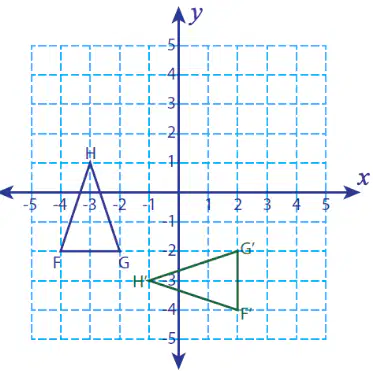
What transformation is this?
Vertical Transformation
90° CCW
270° CCW
Reflection over y-axis
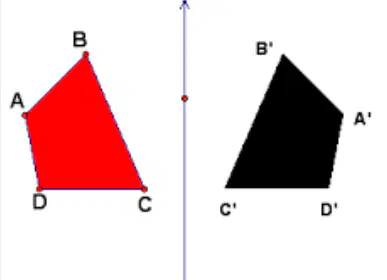
Which figure is the image?
Black
Red
Which transformation has an orientation change?
(a)
What TYPES of transformations have no shape or size change?
(a)
Given a size transformation with a scale factor K > 1, the perimeter (or corresponding length) of the image is _______ times longer than the pre-image.
K²
3
9
K
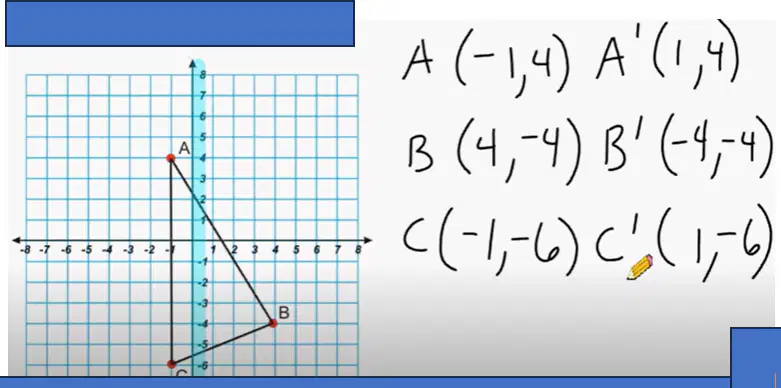
△ABC is the pre-image. What ordered pair rule is being shown with the coordinates?
180° Rotation
Reflection across the y-axis
Reflection across the x-axis
90° CCW Rotation/270° CW Rotation
What is the Ordered Pair Rule for a Translation?
(x,y)-->(y,x)
(x,y)-->(kx,ky)
(x,y)-->(x+h,y+k)
(x,y)-->(x+k,y+h)
What is the Ordered Pair Rule for a Rotation 270° CCW?
(x,y)-->(y,-x)
(x,y)-->(-y,x)
(x,y)-->(-x,y)
(x,y)-->(kx,ky)
What is the Ordered Pair Rule for a Reflection across the y-axis?
(x,y)-->(-x,y)
(x,y)-->(-y,x)
(x,y)-->(x,-y)
(x,y)-->(x+h,y+k)
What is the Ordered Pair Rule for a Rotation 180°?
(x,y)-->(-y,-x)
(x,y)-->(y,x)
(x,y)-->(-x,-y)
(x,y)-->(-x,y)
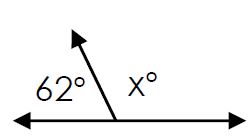
Find the value of x.
x = 118
x = 108
x = 28
x = 58
x = 62

Name the angle relationship.
Congruent

Name the angle relationship.

Name the angle relationship.
Two vertical angles are opposite each other. One has an angle measure of 55 degrees. What measure does the other angle have?
45 degrees
35 degrees
55 degrees
90 degrees
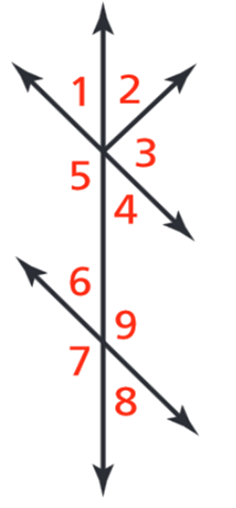
Which angle is a linear pair with ∠1 ?
∠2
∠3
∠4
∠5
∠6
Which angle is a vertical angle to with ∠7 ?
∠1
∠5
∠3
∠6
∠9
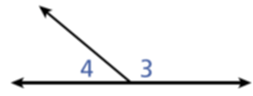
What type of angles are these? (select 3)
Adjacent Angles
Linear Pair
Complementary Angles
Supplementary Angles
Vertical Angles
Angles A and B are COMPLEMENTARY. Angle A has a measure of 30 degrees, what is the angle measure of angle B?
30 degrees
60 degrees
90 degrees
180 degrees
Angles C and D are SUPPLEMENTARY. Angle C has a measure of 30 degrees, what is the angle measure of angle D?
30 degrees
60 degrees
150 degrees
180 degrees


Are the triangles similar?
Yes
No
There is not enough information.

which is true?


Which of the following is a correct statement and reason for the proof shown?
DC≅DC ; Reflexive Property
∠A≅∠B ; Base Angles of Isosceles Triangle are Congruent
∠1≅∠2 ; Reflexive Property
AD≅DB ; Definition of Bisect
Choose the direct variation graph


Choose the Inverse variation graph
Choose the Direct variation equation
y=22x
y=x14
y=5x
y=30−2x
Choose the Inverse variation equation
y=22x
y=x14
y=5x
y=30−2x

Direct or Inverse Variation?
Direct Variation
Inverse Variation

Direct or inverse?
Direct Variation
Inverse Variation
The number of people on the dance floor and the amount of personal space you have to dance?
Direct Variation
Inverse Variation
The retail price of sweatshirt and the amount of sales tax you pay?
Direct Variation
Inverse Variation
The number of girls scout cookies sold, and the amount of money raised?
Direct Variation
Inverse Variation
The number of chaperones on a school trip, and the number of students each chaperone is responsible for?
Direct Variation
Inverse Variation

Ms. Avery is practicing her free throws at the gym. The graph shown models the height of the basketball in ft, over time in seconds.
What is the starting height of the basketball?
(a)
Ms. Avery is practicing her free throws at the gym. The graph shown models the height of the basketball in ft, over time in seconds.
What is the maximum height the basketball reaches?
(a)
Ms. Avery is practicing her free throws at the gym. The graph shown models the height of the basketball in ft, over time in seconds.
How long does it take for the basketball to hit the ground?
(a)

Find the x-intercept and y-intercept from the table above.
x-int: (0, 1) y-int: (-1, 0)
x-int: (-1, 0) y-int: (0, 1)
x-int: (1, 0) y-int: (0, -1)
x-int: (0, -1) y-int: (1, 0)

Determine the domain and range of the function
Domain: (−∞, ∞) Range: (−∞, ∞)
Domain: [−4. ∞) Range: undefined
Domain: (−∞, ∞) , Range: [−4, ∞)
Domain: [−1, 5] , Range: [−4, ∞)

State the domain and range.
Domain: (−∞,∞) , Range: (−∞, 5]
Domain: undefined , Range: (−∞,∞)
Domain: (−∞, ∞) , Range: (−∞, 1]
Domain: (−∞, ∞) , Range: [5, ∞)

State the interval of increase.
(−5, ∞)
(−∞, −5)
(−∞, ∞)
[−8, ∞)
State the interval of decrease.
(−5, ∞)
(−∞, −5)
(−∞, ∞)
[−8, ∞)
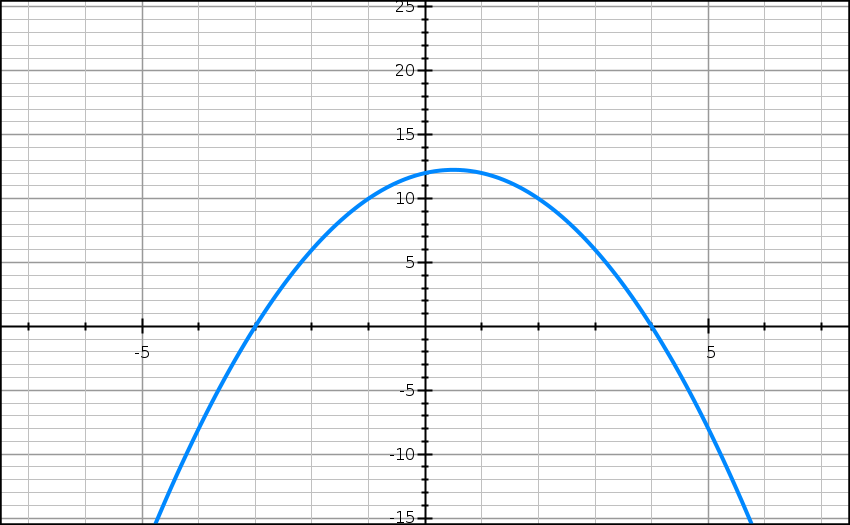
Write the equation of the graph in factored form.
y=(x-4)(x+3)
y=-(x+3)(x-4)
y=(x+4)(x-3)
y=-(x-3)(x+4)
What are the transformations of the function: f(x)=3(x+4)2+6
Stretch of 3
Left 4
Up 6
Stretch of 3
Right 4
Up 6
Stretch of 3
Left 4
Down 6
Stretch of 3
Right 4
Up 6
What is the vertex of the function:
f(x)=−4(x−1)2
(4,−1)
(−4,1)
(−1,0)
(1,0)
What is the axis of symmetry of the function:
f(x)=3(x+6)2
x=−3
x=3
x=6
x=−6
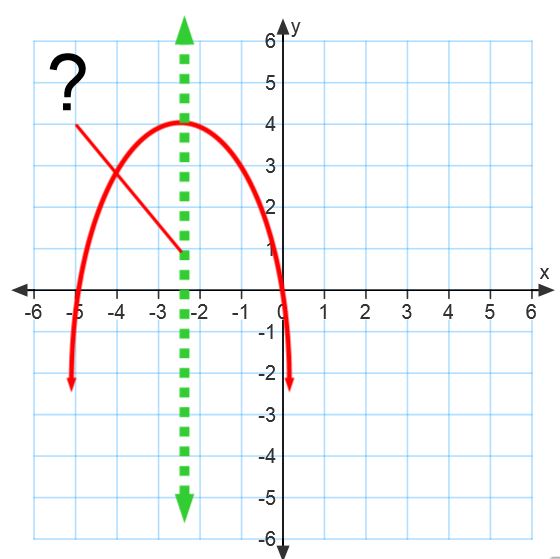
Where is the axis of symmetry?
What are the transformation of the function: f(x)=−31(x+7)2
Reflection
Stretch of 31
Right 7
Reflection
Stretch of 31
Left 7
Reflection
Compression of 31
Left 7
Reflection
Compression of 31
Right 7
Convert to Standard Form:
f(x) = (x+7)(x-3)
f(x) = x2 +10x +21
f(x) = x2 -10x -21
f(x) = x2 +4x -21
f(x) = x2 +4x +21
Convert to standard form: y=(x+5)2−15
y=x2+10
y=x2+10x +10
y=x2+25
y=x2+10x+25
3x2 + 18x +15
x2 + 18x + 9
Complete the square for
x2 + 12x + ____
(find the missing number in the blank)
x2 + 12x + 144
x2 + 12x + 36
x2 + 12x - 36
x2 + +12x - 144
Complete the square for
x2 - 14x + ____
(find the missing value that goes in the blank)
- 196
49
- 49
28

The tiles in this picture show how to complete the square for one of the following equations.
Which equation corresponds to these tiles?
x2+2x−1
x2+2x−3
x2+2x−4
x2−2x+3
Identify the vertex form represented by these tiles.
(x+1)2−3
(x+1)2
(x+1)2−4
(x−1)2+4
Convert to vertex form:
y = x2 + 4x + 10
y = (x + 4)2 + 6
y = (x + 2)2 + 6
y = (x + 4)2 - 6
y = (x + 2)2 - 6
Convert to vertex form:
y = x2 + 8x + 2
y = (x + 4)2 - 14
y = (x + 4)2 - 6
y = (x + 4)2 - 18
y = (x + 4)2 + 6

Now Bonnie is working on converting to vertex form. Her completing the square work is shown in the picture. Does she have any mistakes?
no, no mistakes, and she brushed her teeth this time
yes, she should've factored the x2-6x+9 to (x-6)2
yes, the c value should've been -6
yes, she should've subtracted the 9 at the end instead of adding

Fill in the missing numbers (order doesn't matter)
1,3
-1, -3
3, 12
-1, 12
12x + 6
Which function is equivalent to f(x)= x2 - 6x + 10?
f(x) = (x + 3)2 - 1
f(x) = (x - 3)2 + 1
f(x) = (x + 6)2 - 10
f(x) = (x - 6)2 + 10
What would you add to the quadratic to make it a perfect square?
f(x)=x2+11x+?
121
4121
211
−4121
x2 + 44 = -15x
{-8, 2}
{-7, 5}
{-11, -4}
{-11}
(x-11)(5x+1) = 0
When using the Quadratic Formula method, what are a, b, and c for the equation: 9x2-x+7=2?
a=9, b = -1, c =7
a=1, b = 0, c =7
a=9, b = -1, c =5
a=9, b = 7, c =2
Which of the following cannot be solved with the Square Root method?
x2-9=0
x2-15=0
x2-9x=0
6x2-15=0
(h - 2)2 = 9
What is the discriminant and how many solutions would this quadratic have?
-4x2 - 8x - 8 = -4
0, No Solutions
0, 1 Solution
128, 2 Solutions
128, 1 Solution
x² +12 = 5
If the graph of a quadratic does not touch the x-axis at any point, then it has:
1 Real Solution
2 Real Solutions
Half a Solution
No Real Solution / Imaginary solutions
x2−6x +12 =0
Solve the given equation using the Quadratic Formula. Make sure you fully simplify your answer.
3±i3
3± 3
26±−12
3±i
When solving using the quadratic formula, if a = 2, b = 4 and c = 10, what are the errors in
24 ±16 − 4(2)(−10)
The 4 outside the radical should be negative.
The denominator should be 4, not 2.
10 should be positive and not negative.
All of the above
Simplify completely using exponent properties: (7−1a−5)−2
Use the ^ symbol (press shift and the number 6 key at the same time) to write an exponent. Don't include any extra spaces!
(a)
Simplify completely using exponent properties: (3a5)2⋅(ab)3
Use the ^ symbol (press shift and the number 6 key at the same time) to write an exponent. Don't include any extra spaces!
(a)
Simplify completely using exponent properties: 3x−5y102y−3
3y72x5
2y133x5
3y132x5
6y−13x−5

The n on the radical symbol is called the (a) .

The x under the radical symbol is called the (a) .
Rewrite as a single radical expression: x52y56
5x2y6
5xy
(x2y6)5
(x2y6)51
Rewrite using rational exponents: 3t4r
r31t341
r31t34
t34r31
r

A student started to simplify the given radical and wrote the prime factorization, but then got stuck. What will the final answer look like?
2x2 8xy3
2x2y 8x
xy3 82x2
2x2 8xy
Simplify completely: −3 3xy2 + 3xy2+ 4 3xy2
2 6xy2
2 3xy2
8 3xy2
2 6x3y6
Simplify completely: x2⋅5y2x2y
5y3x4
x2 5y1
x 45y21
x2 5y

Given the figure, what is the approximate value of h?
h = 8.07 feet
h = 8.97 feet
h = 6.65 feet
h = 0.12 feet

Given the figure, what is the trigonometric ratio for tan(C)? Give your answer as a REDUCED FRACTION!
tanC=1824
tanC=53
tanC=34
tanC=3018

The figure shows an angle in standard position and the point (21,15) is on the terminal side of the angle.
What is the measure (in degrees) of the missing angle? Round to the nearest hundredth and enter your answer as numbers only.
(a)
Which type of trig functions do we use to solve for missing angles?
sine / cosine / tangent
INVERSE trig functions
( sin−1 / cos−1 / tan−1 )

Calculate r, the distance from the origin to the green point. Round your answer to the nearest tenth.
(a)

Choose the correct values for x and y in the right triangle.
x=12
x=122
y = 24
y=122

Choose the correct values for x and y in the right triangle.
x=33
x=6
y = 33
y=6


Find the length of the hypotenuse.
3⋅2
6⋅2
6⋅3
6

Find the value of d.
8
16
8⋅2
4⋅2
The probability of a New York teenager owning a skateboard is 0.37, of owning a bicycle is 0.81 and of owning both is 0.36. If a New York teenager is chosen at random, what is the probability that the teenager owns a skateboard or a bicycle?
1.18
0.7
0.82
None of the above

The outcomes for rolling two number cubes numbered 1 through 6 are shown above. What is the probability the sum of the number cubes will be 7 or 4?
121
61
41
3611


You pick a marble from this bag.
What is the probability you will choose either a solid black or solid white marble?
P(solid black or solid white)=
3/5
9/100
1/10
2/5

Based upon the definition of independence, determine if the set of events are independent:
P(A)=0.12 P(B)=0.56 P(A∩B)=0.0672
Yes, they are independent
No, they are not independent


if the outcome of one event has no effect on the outcome of a second event, then the two events are called ____.
Probability
Independent Events
Dependent events
Conditional probability
There are 9 movies showing at a theater. Two are action movies, two are children’s movies, and the other movies are comedies. Ashley randomly selects 2 different movies to see. What is the probability that the first movie is an action movie and the second movie is a comedy?
181
8110
365
97
Anna has a bag of marbles for her little sister. It contains 12 red marbles, 6 white marbles, and 2 blue marbles. She drops the bag and three marbles roll out. What is the probability that all 3 marbles are white?
1201
571
34315
203

The spinner below is divided into 4 equal parts. It is spun once, and the coin is flipped once. What is the probability of obtaining red on the spinner followed by heads on the coin?
81
41
43
87

