
Font size
 Worksheets
Bonding Patterns Practice Quiz
Total questions: 21
Worksheet time: 11mins
What elements generally make an ionic bond?
metal and nonmetal
metal
2 nonmetals
none of the answers
What elements generally make a covalent bond?
metal and nonmetal
metal
2 nonmetals
none of the answers

Predict the bond that will form between Be and F
Ionic
Polar Covalent
Non Polar Covalent
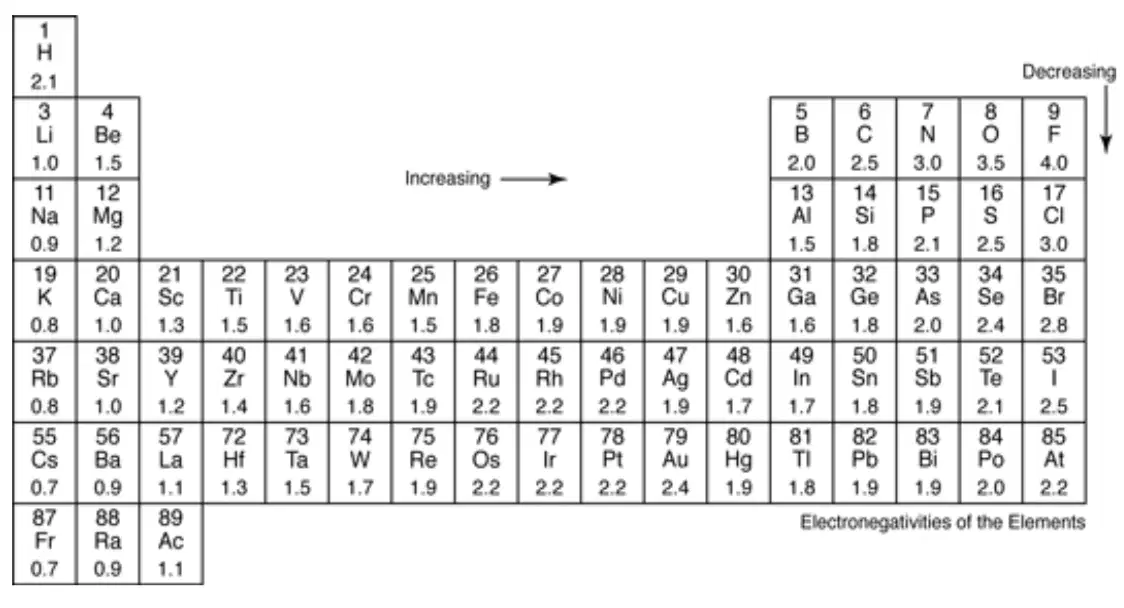
Predict the bond that will form between Se and Cl
Nonpolar Covalent
Polar Covalent
Ionic

What type of bond is formed by S and Br?
Polar Covlalent
Nonpolar Covalent
Ionic
How many more valence electrons does S need in order to have a full outer shell and what is it's charge?
1, positive
1, negative
2, positive
2, negative
Will Beryllium gain or lose electrons when it bonds with other elements? What is it's charge before it bonds?
lose/ +1
lose/ +2
gain/ +1
gain/ -1
What happens when an atom looses an electron?
It becomes negatively charged
It remains neutral because the proton also leaves
It becomes positively charged
It stays the same
The number of _____ is most important in determining how an atom will bond.
neutrons
valence electrons
protons
electrons in the innermost shell
What types of chemically bonded molecules are soluble (blend into the water so you can't see the substance anymore) in water? TWO correct answers.
Ionic
Polar Covalent
Non polar Covlanet
Metallic bonds (metals)
What types of chemically bonded molecules or compounds have both high melting points and are soluble in water?
ionic
polar covlalent
non polar covalent
Nitrogen has (a)_____ valence electrons, which means it has (b) _____ bonding places to make covalent bonds with other nonmetals.
a. 5
b. 2
a. 5
b. 3
a. 4
b. 4
a. 7
b. 1
Which of the following intermolecular forces are the strongest?
Ion-dipole
Hydrogen (a type of dipole-dipole)
Dispersion
What is an isomer?
When a chemical's molecular formula is the same as another chemical's molecular formula.
When a chemical's molecular formula is the same as another chemical's molecular formula but it's molecular structure is different.
When a chemical's molecular formula is different than another chemical's molecular formula.
When a chemical's molecular formula is the same as another chemical's molecular formula and it's molecular structure is the same.
Which of the following best describes the formation of an ionic bond?
Two atoms share their valence electrons equally.
An atom donates its valence electron to another atom, creating ions that attract each other.
Two atoms exchange neutrons to achieve stability.
Electrons are shared unequally between two atoms.
In a covalent bond, what happens to the valence electrons?
They are transferred from one atom to another.
They are shared between atoms.
They are lost to the surrounding environment.
They are used to form ionic bonds.
What is the primary reason ionic compounds are solid at room temperature?
The covalent bonds between the atoms are very strong.
The ionic bonds create a rigid lattice structure that is hard to break.
The molecular bonds are flexible, allowing them to move freely.
Ionic compounds are not solid at room temperature.
Which of the following is a property of ionic compounds?
Low melting and boiling points.
Poor electrical conductivity in solid state.
High melting and boiling points.
Easily vaporized.
Why are ionic compounds typically more brittle than covalent compounds?
The molecular bonds in ionic compounds are very flexible.
The ionic bonds form a rigid lattice that can shatter when stressed.
Covalent bonds are much weaker than ionic bonds.
Ionic compounds are not more brittle; it is the other way around.
Which of the following compounds is likely to have ionic bonds?
CO2 (Carbon dioxide)
NaCl (Sodium chloride)
O2 (Oxygen gas)
CH4 (Methane)
What role do valence electrons play in chemical bonding?
They are irrelevant to the bonding process.
They are the innermost electrons that participate in bonds.
They are the outermost electrons and participate in the formation of chemical bonds.
They stabilize the nucleus during the bonding process.

