
NEW
Font size
 Worksheets
Yr10 Genetics Pop Quiz
Total questions: 22
Worksheet time: 11mins
Which of the following is a correct definition of genetics?
The study of transmission of traits from parent to offspring
The study of variation between members of a species
The study of genes and traits defined by genes
The study of DNA
The human genome is distributed across 24 chromosomes.
True
False
Which statement concerning a pair of alleles for a gene controlling a single characteristic in humans is true?
Both genes come from the father.
Both genes come from the mother.
One gene comes from the mother and one gene comes from the father.
The genes come randomly in pairs from either the mother or father.
Which combination of sex chromosomes results in a male human being?
XX
YY
XY
either XX or YY
The different forms of a gene are called
alleles
factors
masks
traits
Scientists call an organism that has two different alleles for a trait a
factor
hybrid
Purebred
trait
An individual who has two of the same allele is said to be
homozygous
heteromologous
homologous
heterozygous
An individual who has two different alleles is said to be
homozygous
heteromologous
homologous
heterozygous
A carrier is a person who has
one recessive and one dominant allele for a trait
two recessive alleles for a trait
two dominant alleles for a trait
more than two alleles for a trait
Where two alternatives for a trait are tall and short, and tall is dominant, the genotype of a heterozygous individual should be expressed as
a) Ss
b) sS
c) Tt
d) tT
The appearance resulting from a given gene combination is referred to as the
alleleotype
genotype
phenotype
phototype
stereotype
The two alternatives for a trait are red and white, and red is dominant. However, white is the most common trait. What is the genotype of a homozygous dominant individual?
WW
RR
Rr
Ww
rr
Where the two alternatives for a trait are broad and narrow, and broad is dominant, the phenotype of a homozygous dominant individual would be expressed as
a) BB
b) NN
c) broad
d) narrow
What does a Punnett square show?
all of Mendel’s discoveries about genetic crosses
all the possible outcomes of a genetic cross
only the dominant alleles in a genetic cross
only the recessive alleles in a genetic cross
In garden peas, height is determined by a single gene with tall being dominant to short. If two heterozygous plants are crossed, what proportion of the tall progeny will be homozygous dominant?
1/4
1/3
2/4
2/3
If a homozygous black guinea pig (BB) is crossed with a homozygous white guinea pig (bb), what is the probability that an offspring will have black fur?
25 %
50 %
75 %
100 %
An extra finger in humans is rare but is due to a dominant gene. When one parent is normal and the other parent has an extra finger but is heterozygous for the trait, what is the probability that the first child will be normal?
0%
25%
50%
75%
In drosophila (fruit flies), eye colour is X-linked and red eye colour is dominant to white eye colour. Which of the following are not possible in a cross between a red-eyed male and a heterozygous female?
Red-eyed male
White-eyed male
Carrier female
Homozygous white-eyed female
What is a pedigree?
a chart that tracks which members of a family have a particular trait
a geneticist who studies the inheritance of traits in humans
an allele passed from parent to child on a sex chromosome
a picture of all of the chromosomes in a cell
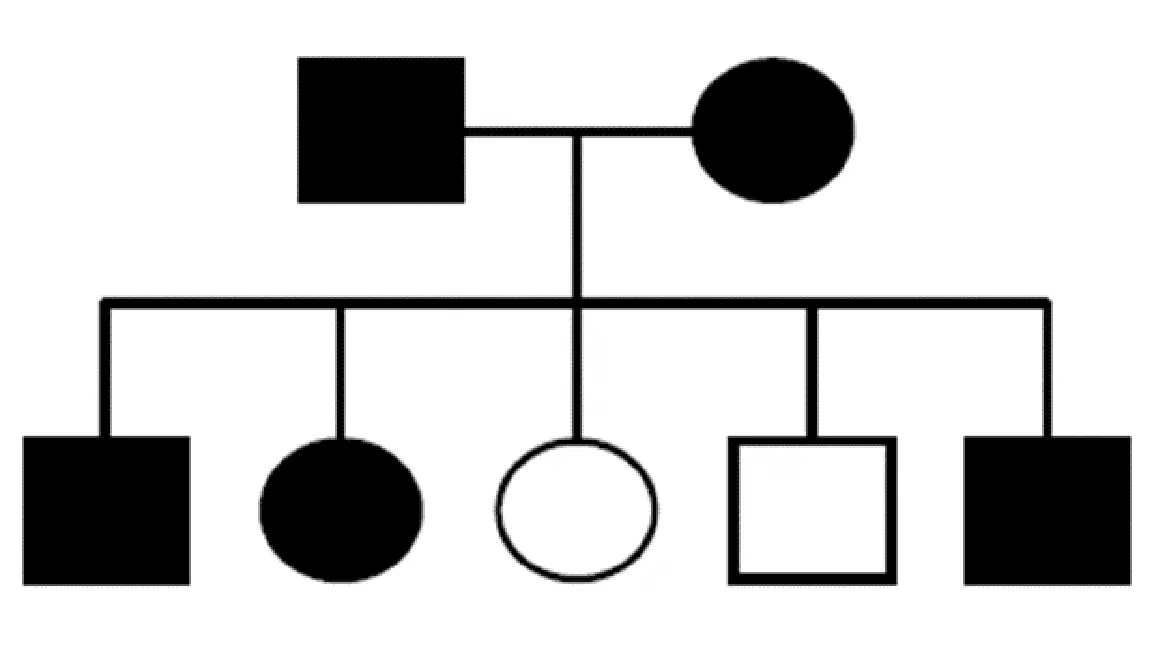
Refer to the pedigree chart to answer the following question. The illness is expressed by a dominant allele. The characteristics indicated by the filled symbols is probably:
dominant
recessive
non-dominant
sex-linked recessive
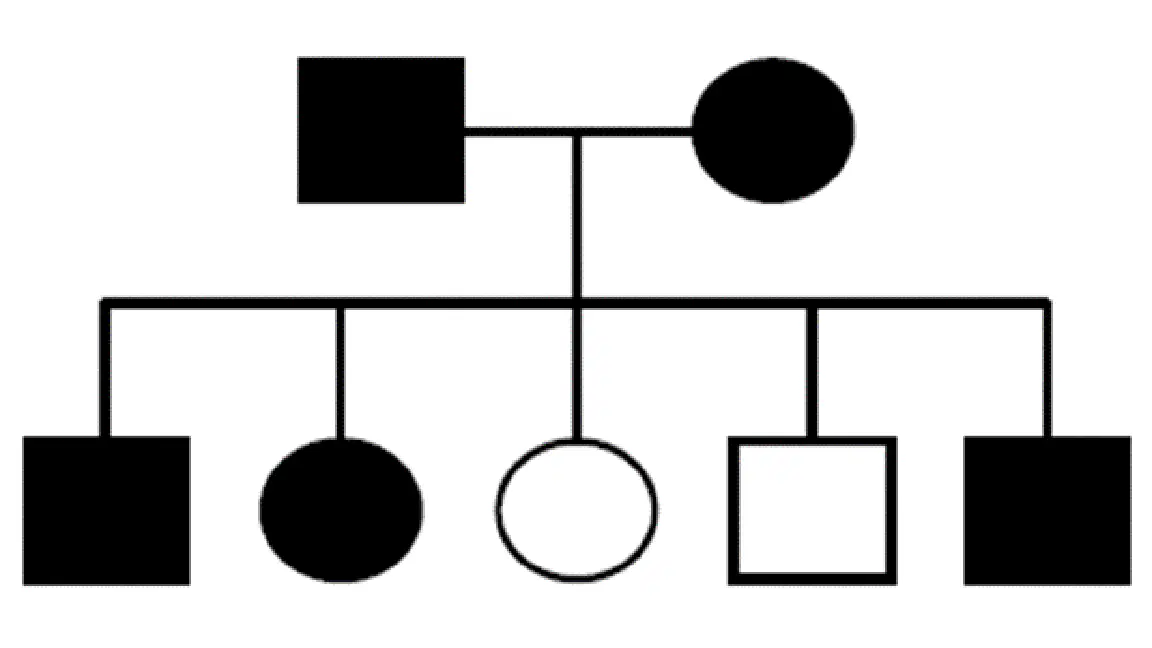
Refer to pedigree chart to answer the question. The illness is expressed by a dominant allele. What are the genotype of the parents?
Both are homozygous
Both are heterozygous
Both are homozygous recessive
heterozygous recessive
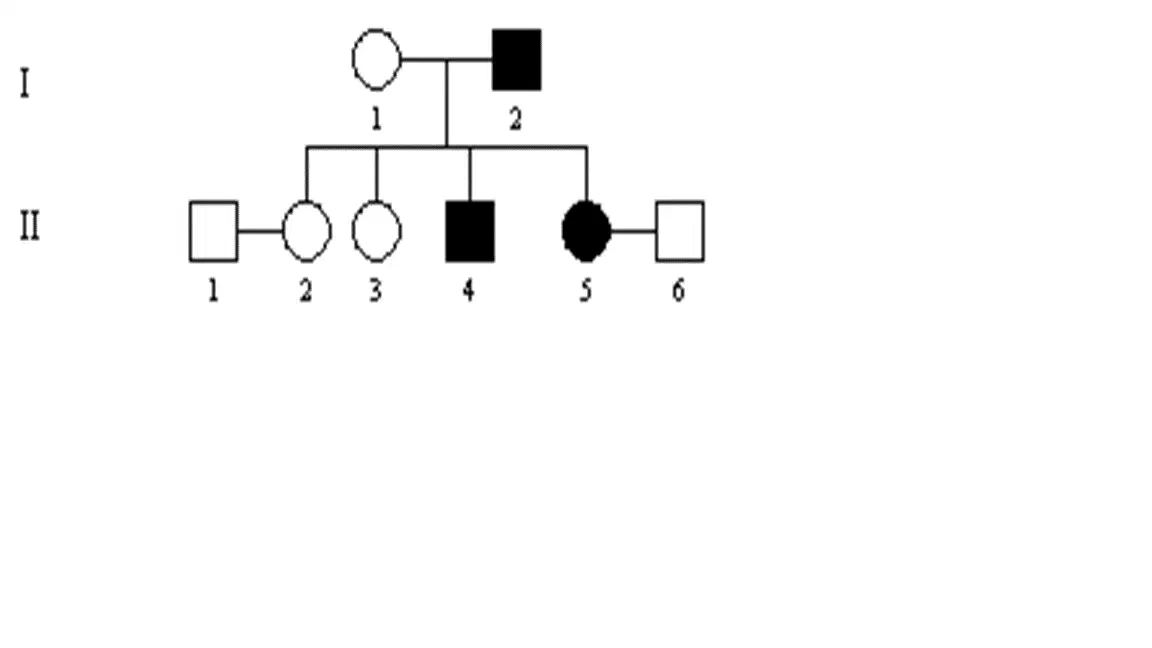
Widow's peak is an autosomal dominant condition. The pedigree chart given shows a family in which shaded individuals have the condition.
Individual I1 is heterozygous for the trait
Any child if II5 and II6 will show the trait
At least one parent of I2 has the trait
Any child of II! and II2 has 50% chance of having the trait

