
 Worksheets
General Physics 2 Q4 Exams
Total questions: 45
Worksheet time: 34mins
It is the unit of capacitance
Coulomb
Volts
Farad
Ampere
Which of the following refers to the function of a capacitor?
It dissipates voltage across the circuit.
It absorbs and stores electrical charge.
It acts as the main source of electric potential
It allows DC signals to pass through.
Capacitor stores which type of energy?
kinetic energy
potential energy
vibrational energy
heat energy
Why does capacitor block dc signal at steady state?
Due to high frequency of dc signal.
Due to zero frequency of dc signal.
Capacitor does not pass any current at steady state.
Due to zero frequency of dc signal.
If a parallel plate capacitor of plate area 2 m2 and plate separation of 1 m stores the charge of 1.77 x 10⁻¹¹ C, what is the voltage across the capacitor?
1 V
2 V
3 V
4 V
Which of the following is a passive device?
Transistor
Rectifier
Capacitor
Vacuum Tubes
What is the value of capacitance of a capacitor which has a voltage of 4V and has 16C of charge?
2 F
4 F
6 F
8 F
Of which medium is capacitance high?
Air
Mica
Water
Metal
What is the voltage of a battery connected to a parallel plate capacitor with a plate area of 2.0 cm2 and a plate separation of 2 mm if the charge stored on the plates is 4.0 pC?
4.4 V
4 V
4.2 V
4.5 V
A typical capacitor in a memory cell have a capacitance of 3 x 10-14 F. If the voltage across the capacitor is 0.5 V, what is the number of electrons that must move to the capacitor to charge it?
93750
94500
92350
96430
What is the value of capacitance of a capacitor which has a voltage of 8V and has 16 C of charge?
2 F
4 F
6 F
8 F
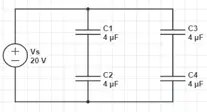
Evaluate the circuit shown. What is the charge of capacitor C3?
30 uC
40 uC
50 uC
60 uC
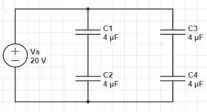
What is the voltage across C4?
5 V
10 V
15 V
20 V
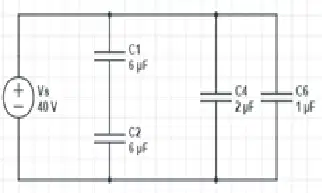
Evaluate the circuit shown. What is the voltage across C1?
5 V
10 V
15 V
20 V
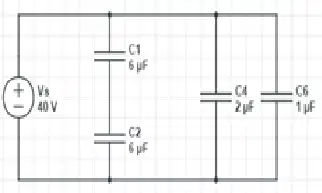
15. Refer to the diagram. What is the charge of C4?
60 uC
80 uC
50 uC
70 uC
A potential difference of 100 mV exists between the outer and inner surfaces of a cell membrane. The inner surface is negative relative to the outer. How much work is required to move a sodium ion Na+ outside the cell from the interior? (Express your answer in electron volts. A singly-charged ion has a charge of eV, 1 eV = 1.6 × 10⁻¹⁹ J.)
0.1 eV
0.2 eV
-1.0 eV
-0.2 eV
A parallel-plate capacitor has 4.00 cm2 plates separated by 6.00 mm of air. If a 12.0V battery is connected to this capacitor, how much energy does it store in Joules?
4.25 × 10⁻¹¹ J
4 × 10-11 J
4.5 × 10⁻¹¹ J
3.9 × 10⁻¹¹ J
It sets rules on determining the total and individual current, voltage, and/or resistance of resistors and emfs arranged in a complex circuits.
Malus’ Law
Kirchhoff's Rules
Lenz's Law
Ampere's Law
Which of the following statements about Kirchhoff's Rules is correct?
The total current entering a junction is equal to the total current leaving a junction.
The total voltage around a loop is equal to zero.
A junction is a point on the circuit where 2 or more wires are connected.
All of the above.
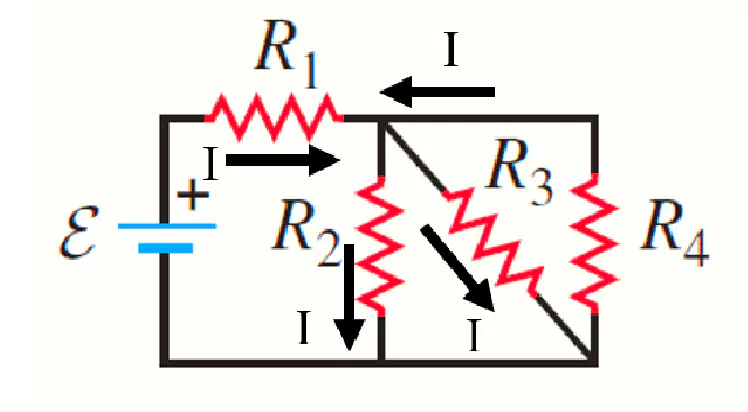
How many junctions are in the circuit shown?
One
Two
Three
Four
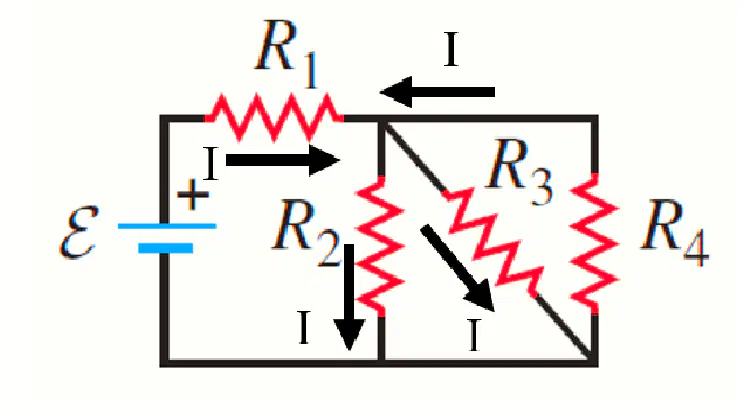
How many loops can be formed in the circuit shown?
One
Two
Three
Four
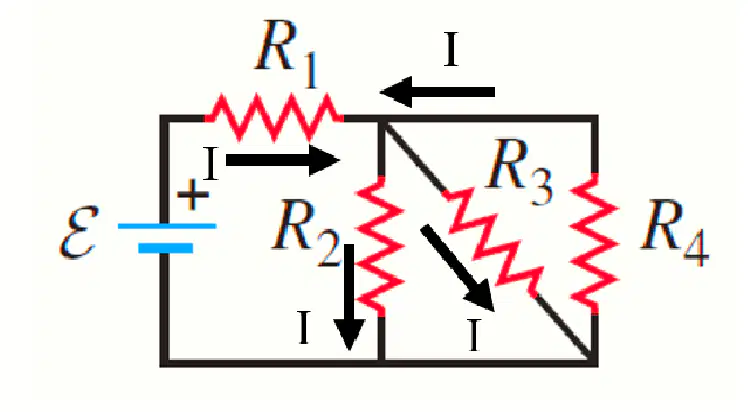
Which of the following equations are correct about total voltage in the biggest/ outermost loop?


A magnet attracts _____.
all metals
iron, cobalt, and nickel
iron, zinc, and tin
paper, wood, cork
The strength of a magnet is _____________.
greatest in the middle
greatest at the poles
the same all over
greatest at only one area
A magnet can be made by _______________.
heating an iron nail
rubbing an iron nail with a magnet
placing an iron nail in the earth
striking an iron nail
When a bar magnet is broken in half, _____________.
it loses its magnetism
both halves are magnets
one half has one pole and the other half has another pole
one half has two south poles and the other half has two north poles
Magnets lose their magnetism when they are ____________.
heated
cooled
put in water
broken into pieces
All magnets are characterized with _____________.
two south poles
a shape like a bar
permanent magnetism
a magnetic field around them
It is a device that acts like a magnet when a electricity flows through it.
Electromagnetism
Electronegativity
Electromagnet
Electric magnet
The total magnetic flux through a closed surface is _____________.
always maximum
infinite
dependent on the size of the closed surface
zero
A compass points to _____________.
magnetic north
geographic east
geographic north
magnetic east
The motion of a charged particle under the action of a magnetic field alone is always motion with ______________.
constant rate
constant speed
constant velocity
constant acceleration
The magnetic force on a current-carrying conductor depends on the following EXCEPT
current flowing in the conductor
length of the conductor
mass of the conductor
magnetic field
Magnetic fields do not interact with
moving electric charges
moving permanent magnet
stationary electric charges
cannot be determined
A charged particle initially moving north in a vertically downward magnetic field is deflected toward the east. What is the sign of the charged particle?
positive
negative
neutral
cannot be determined
A long straight wire is placed in a region of uniform magnetic field. What should be its angle with respect to the magnetic field lines so that it will experience maximum magnetic force?
zero degrees
45 degrees
90 degrees
120 degrees
A Gaussian surface enclosing an electromagnet will always have a magnetic flux which is _____.
maximum
minimum
zero
insufficient information
Which of the following is an accurate statement?
A current-carrying loop of wire tends to line up with its plane parallel to an external field.
Magnetic field lines have as their sources north and south poles.
The magnetic force on a current-carrying wire is greatest when the wire is parallel to the magnetic field.
The magnetic force on a moving charge does not change its energy.
The relationship between electricity and magnetism can be seen in all of the following except:
a battery converts chemical energy into electrical energy
a magnet pushed inside a loop of wire produces current in the wire
a compass needle is deflected when placed near a current carrying wire
electric current set up in a coil of wire affects another coil placed near the first one
Which determines the direction of the force on a current-carrying wire in a magnetic field?
I. direction of current in the wire
II. amount of current in the wire
III. direction of magnetic field
I only
I and II only
I and III
II and III
A current is flowing west along a power line. If we neglect the earth’s field, the direction of the magnetic field below it is
East
North
South
West
The magnetic field of a bar magnet most closely resembles of a
current carrying loop
horseshoe magnet
straight current carrying wire
stream of electrons moving parallel to one another
What angle should a current-carrying wire make an angle with the magnetic field for the force to be maximum?
0 degrees
45 degrees
90 degrees
120 degrees
When a current-carrying wire is in uniform magnetic field with the direction of current the same as that of the field,
there is a force on the wire that tends to move it parallel to the magnetic field
there is a force on the wire that tends to move it perpendicular to the magnetic field
there is a torque on the wire that tends to rotate it until the plane is perpendicular to the field
there is neither a force nor a torque on the wires
The field/s surrounding a moving electric charge
depends on the space where the charge is moving
electric field
magnetic field
both electric and magnetic fields

