
 Worksheets
Systems in Space
Total questions: 35
Worksheet time: 18mins
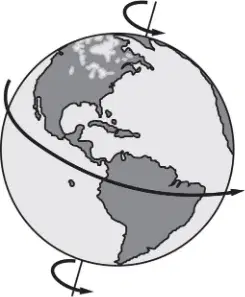
The diagram shows Earth spinning on its axis. What would happen if Earth spun on its axis faster than it does now?
Earth would be hotter.
A day would be shorter than 24 hours.
A year would be longer than 365 days.
There would be more than four seasons.
The diagram shows Earth spinning on its axis. Which phenomena is caused by this motion?
Day and Night
Moon Phases
Seasons
Years
Why do the length and direction of shadows change throughout the day?
because of the revolution of Earth around the sun
because of the revolution of the moon around Earth
because of the rotation of the Earth
because of the apparent movement of stars in a circle
The sun appears to rise in the east. Which of these causes this phenomenon?
Earth’s rotation on its axis
The sun’s rotation on its axis
Earth’s movement around the sun
The moon’s movement around the sun
Which of these is responsible for the apparent movement of stars in the sky during one night?
Earth’s tilt
Earth orbiting the sun
the moon orbiting Earth
Earth rotating about its axis
Which of these cycles does the spinning motion of Earth cause?
the cycle of the tides
the cycle of the seasons
the day-and-night cycle
the phases-of-the-moon cycle

Mars
Earth's rotation
What is the name of the imaginary line that Earth rotates around?
Axis
Mason Dixon Line
North Pole
Revolution
Why does the shadow of a tree in your yard change throughout the day?
the Earth rotates
the Earth revolves
the moon revolves
the sun rotates
Which of these are caused by the rotation of the Earth?
Four Seasons
The Moon phases
Day and Night
A year
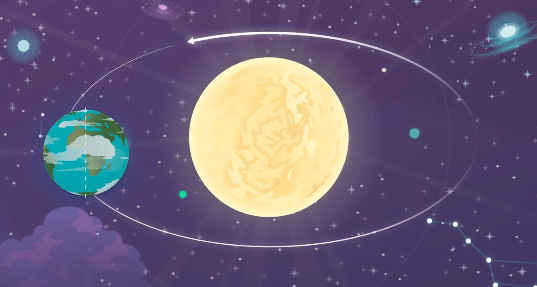
Which diagram shows how Earth rotates each day?


Which diagram shows how Earth revolves each year?
Which season is it in the Northern Hemisphere when the North Pole is tilted towards the Sun?
Winter
Summer
Spring
Autumn
The earth is tilted on its _____
line
axis
equator
core
A ___________ is one complete trip of a planet along an orbit.
rotation
revolution
orbit
axis
What happens to your shadow during the day as the Earth rotates?
It gets shorter and then longer.
It moves around you.
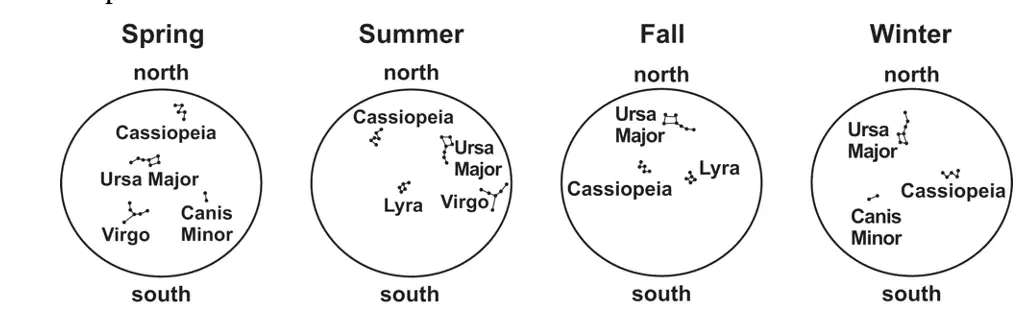
The maps shows some constellations seen from North America in different seasons. Why is the constellation Ursa Major in different locations on the maps.
The stars move around our sun, appearing in different locations at different times of the year.
Earth moves around the sun, causing the stars to appear to move when really Earth is moving
The stars move around their individual suns at a different rate than Earth moving around the sun.
Earth moves closer to and farther away from different constellations at different times of the year.
The sun is a medium-size star, but it appears much larger than other stars. Why does the sun appear to be so large?
The sun is hotter than other stars.
The sun produces more light than other stars.
The sun is much closer to Earth than other stars.
The sun is affected by Earth’s gravity more than other stars are.
All visible stars in the night sky are many times larger than Earth. Why do they look like tiny points of light in the night sky?
They are moving very fast.
The atmosphere blocks most of their light.
The stars visible at night are located very far from Earth.
Most of the light from stars is absorbed by galaxies, so it does not reach Earth.
When compared to other stars, the sun is not very unusual. However, the sun is very important to humans. What makes the sun more important than the other stars?
Unlike other stars, the sun is very large.
When compared to other stars, the sun is the hottest.
Unlike other stars, the sun is the right color for living things.
When compared to other stars, the sun is very close to Earth.
Which season is the warmest season and has the most hours of daylight? The sun's energy strikes parts of the Northern Hemisphere almost straight on.
Winter
Spring
Summer
Fall
Which season is the warmest season and has the most hours of daylight because the sun's energy strikes parts of the Northern Hemisphere almost straight on.
Winter
Spring
Summer
Fall

How long does it take for Earth to make 1 revolution?
24 hours
365 1/4 days
1 month
1 day
The sun is highest in the sky (when viewed at the same time & place) during which season?
winter
spring
summer
fall
Which movement is responsible for the fact that we see different constellations during different times of year?
The Earth's rotation
The Earth's revolution
The moon's rotation
The moon's revolution
Which movement is responsible for the fact that we see constellations move across the sky throughout the night?
The Earth's rotation
The Earth's revolution
The moon's rotation
The moon's revolution
If you see a full moon on April 12, which is the most likely date to see the next full moon?
April 20th
April 28th
May 5
May 12
Gravity is a force that pulls all objects dropped near the surface of the Earth
down
toward the center of the Earth
south
away from Earth
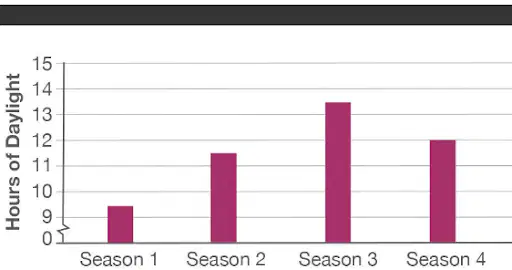
Which season is summer?
Season 1
Season 2
Season 3
Season 4

