
 Worksheets
Last Science
Total questions: 214
Worksheet time: 2hrs 23mins
The energy that an object or substance has because of its position or condition.
Thermal energy
Temperature
Potential energy
Fuel
The energy that an object or substance has because of motion
Potential energy
Fossil fuel
Conduction
Kinetic energy
The measure of average kinetic energy of the particles in a substance
Thermal expansion
Energy
Temperature
Thermometer
The property of a substance which kinetic energy increases without changing the state of a substance
Radiation
Thermal expansion
Convection
Heat
The amount of thermal energy needed to raise the temperature of one gram of water one degree.
Fuel
Energy
Calorie
Thermal energy
The transfer of movement of thermal energy from one substance to another
Heat
Radiation
Conduction
Convection
The heat that occurs when the particles of a substance bump into each other.
Heat
Thermal expansion
Kinetic energy
Conduction
A substance that does not allow heat to move through it easily
Radiation
Potential energy
Insulator
Convector
A substance that allows heat to move easily through it.
Fossil fuel
Conductors
Calorie
Thermometer
A substance that releases energy when burned
Heat
Calorie
Insulators
Fuel
A file formed when the remains of plants and animals are buried quickly
Convection
Potential energy
Fossil fuel
Decomposition fuel
The phase change from water vapor to liquid water is known as ____.
Sublimation
Condensation
Evaporation
Precipitation
What do you call a change from solid to gas without passing through a liquid state?
Sublimation
Freezing
Evaporation
Condensation
A change of state from a liquid to a solid is called ______.
Melting
Freezing
Precipitation
Evaporation
What is deposition?
A change from solid to gas without passing through a liquid state.
A change from gas to solid without passing through the liquid state.
A change from liquid to gas.
A change of state from a liquid to a solid.
A change from solid to liquid is known as _____.
Freezing
Deposition
Melting
Evaporation
What is the scientific term for burning?
Corrosion
Decomposition
Digestion
Combustion
The following are the evidence of chemical change, EXCEPT.
Color change
Odor change
Changes in Shape
Gas Production
Which of the following waste management limit the amount of trash you throw away?
Reduce
Repair
Reuse
Recycle
When you reuse, it means that you _____.
Fix the broken items.
Use the object by shredding in order to make a new product.
Use old objects again for another purpose.
Sell the objects to earn money.
Which of the following spheres involves all of the bodies of water on the earth?
hemisphere
hydrosphere
atmosphere
geosphere
stratosphere
Which of the following spheres involves all of the land on the earth?
biosphere
hydrosphere
atmosphere
geosphere
mesosphere
Which of the following spheres involves all living things (plants, animals, insects, etc.) on the earth?
biosphere
hydrosphere
atmosphere
geosphere
lithosphere
Which of the following spheres involves all of the air and gases on the earth?
biosphere
hydrosphere
atmosphere
geosphere
hemisphere
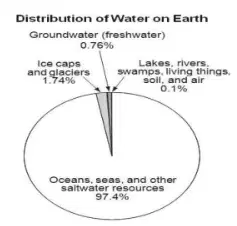
Based on this graph, what can you conclude about water on earth?
10% of earth's water is fresh
10% of earth's water is salty
97.4% of earth's water is fresh
97.4% of earth's water is salty
Which of these are fresh water sources? Select all that apply
oceans
rivers
reservoirs
aquifers
Which statement best describes where fresh water is found?
earth's freshwater is spread evenly between frozen and surface water
most of earth's fresh water is found under ground
earth's freshwater is mostly found on the surface in rivers and lakes
most of earth's freshwater is frozen in glaciers and ice caps
How does freshwater move through the ecosystem?
precipitation, condensation, evaporation, transpiration
condensation, evaporation, precipitation. transpiration
evaporation, transpiration, condensation, precipitation
transpiration, condensation, evaporation, precipitation
Where does water go when it evaporates from a puddle on the street?
into space
into rivers and streams
into the street
into the atmosphere
What can happen when water interacts with rocks? Select all that apply
climate changes
canyons form
rain falls
sediment forms
Amna goes to the same beach every year. this year she notices that the beach is smaller. What could have caused this?
oxygen in the air reacted with the sand
a volcano erupted and flowed onto the beach
wind and water eroded the beach
cold weather changed the beach
What is an example of a process that can SLOWLY change the earth?
volcanoes
glaciers
earthquakes
landslides
The shape of land can be changes by:
standing water
flowing water
_______________ can be caused by winds and waves from hurricanes, forcing water onshore.
A floodplain
A storm surge
____________ can harm living things.
Polluted water
Clean water
What is caused by burning fuel that mixes with the clouds?
precipitation
acid rain
clean snow
white clouds
What will happen if a lake becomes polluted?
There will be more fish in the lake.
The pollution will not harm the plants and animals.
The animals will die.
It will change the soil into pebbles
Which of earth's systems interacts in a landslide? Select all that apply
atmosphere
biosphere
geosphere
hydrosphere
Which of earth's systems interact in a tornado? Select all that apply
atmosphere
biosphere
geosphere
hydrosphere
What happens in a warm front?
warm air pushes over cold air
cold air pushes under warm air
warm and cold air don't move
warm and cold air mix together
Which layer of the earth is a solid metal?
crust
mantle
outer core
inner core

The change in a objects position is ________.
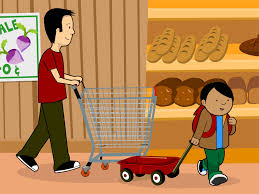
A food web is consists of?

The distance and direction of an object's change in position from a starting point.
displacement
distance
motion
reference point
Jermaine runs exactly 2 laps around a 400 meter track. What is the displacement?
800
400
200
0
A place or object (like a stop sign or mailbox) used for comparison to determine if another object is in motion is called a _____.
comparison point
point of view
reference point
motion detector

The standard (SI) unit for measuring distance is the ________ .
mile
foot
kilometer
meter
This is a form of energy that causes materials to become warmer or hotter.
Temperature
Heat
Thermometer
What is the greatest source of heat?
Boiling Water
Sun
Fire
Which of the following statements is true?
The faster the particles move, the lower the temperature.
The faster the particles move, the higher the temperature.
The slower the particles move, the higher the temperature.
Without the Sun, which of the organisms could no longer survive?
Producers
Consumers
Producers and Consumers
All organisms
What are biotic factors in an ecosystem?
Dead things
Weather
Animals
Soil
Where do plants get their energy?
Air
Temperature
Soil
The Sun
These are the animals that need sunlight to keep their body warm, except …
Frogs
Earthworms
Lizards
Turtles
What would happen when an ecosystem doesn’t have enough water resources?
The land will polluted
The bacteria will multiply
The ecosystem still works well
plants and animals will be died
If there was an increase in the owl population. As a result the mouse population will …
Eat the predators
Increase
Decrease
Stay the same
Polar bears live on Arctic ice. Warm temperatures make the ice melt. This is a change in …
Climate that harms a population
Food supply that helps a population
Available soil that helps a population
Available sunlight that harms a population

Organisms, like seaweed, that make food through the process of photosynthesis
consumers
producers
decomposers
omnivores

Organism, like fish, that get energy from eating other organisms.
consumers
producers
decomposers
All answers are correct
It absorbs water and minerals from the soil_______
root
fruit
leaf
stem
It produces a new plant___________
stem
root
seed
leaf
They use water, air, and sunlight to produce food for the plant.
flowers
leaves
stems
roots

Biome is
small area of land that has specific weather, plants and animals
small area of land that has the same weather, plants and animals
large area of land that has specific weather, plants and animals
Desert is ----------------- biome with little rain
(a)
Cactus can live in the desert because it has -------------------
a hump to store food
small roots
a thick stem
Tundra has frozen ground all the year
True
False
Deciduous forest has only two seasons
True
False
Which of these is NOT a Biome?
stratosphere
temporate forest
ocean
savanna
The system that contains all living things on Earth.
Biosphere
Atmoshpere
Hydrosphere
Geosphere
The effects of people and their actions on the biosphere is called
human impact
biome
environmental change
Mr. Price taking a nap.
Regions of the planet with similar types of life and climates are called
biomes
kingdoms
spheres
systems
Science places all living things into broad categories called:
kingdoms
spheres
biomes
systems
The biosphere includes plants and animals that live
on land
on land and in the water
on land, in water, and in the air
in water
The prefix "Bio" in Biosphere means:
life
water
Earth
air
Which of the following is an example of a human impact on the biosphere?
Hunting
Rain falling from the clouds
a volcano erupting
an earthquake
When water wears away parts of the geosphere causing it to change it is called
erosion
lifting
wind funnel
hydropshere
Which body system processes food into usable source of energy?
Respiratory System
Digestive System
Skeletal System
Circulatory System
Which characteristic of a dog is most likely a result of its environment?
Its color.
Its length of ears.
Its food preference.
Its ability to see in the dark.
Matt is a tall, eleven-year-old boy. He has a scar on his right cheek. Matt is a tall, eleven-year-old boy. He has a scar on his right cheek. He is intelligent and an excellent drummer. Which of his traits did he most likely inherit?
his height
his scar on his right cheek
his intelligence
his ability to play drums
A litter of kittens have traits that are both similar to a mother and father cat. Which best explains the situation?
The kittens are provided with the same kind of milk by their mother as they grow.
The kittens inherited some of the traits from their mother and some from their father.
The kittens are kept in the same temperatures by their mother when they were first born.
The kittens are taught by their parents to have similar traits.
Which is an example of a learned characteristic?
hair type
eye color
reading music
dimples
Which is the correct order of how organisms are arranged?
cells --- organs ---- tiossues ---- systems
cells ---- tissues ---- organs --- systems
systems--- organs ---- tissues --- cells
tissues --- cells ---- organs ---- systems
Which of the following statements is true of aquatic biomes?
Freshwater and marine biomes are evenly distributed on Earth
Freshwater biomes supply a greater portion of Earth's oxygen than marine biomes.
Freshwater biomes are a vital source of drinking water.
Marine biomes include streams, rivers, ponds, and lakes.
has 4 seasons, plants lose their leaves during autumn
animals such as raccoon, squirrels, and deer
mid-latitudes
Choose the right term to associate
temperate deciduous forest
tropical rainforest
desert
grassland
They are organisms that make their own food by the process of photosynthesis.
decomposers
herbivores
consumers or heterotrophs
producers or autotrophs
They are the non-living components in the ecosystem such as air, temperature, sunlight, water, that affect the life of organisms in the ecosystem.
living things
abiotic factors
biotic factors
world
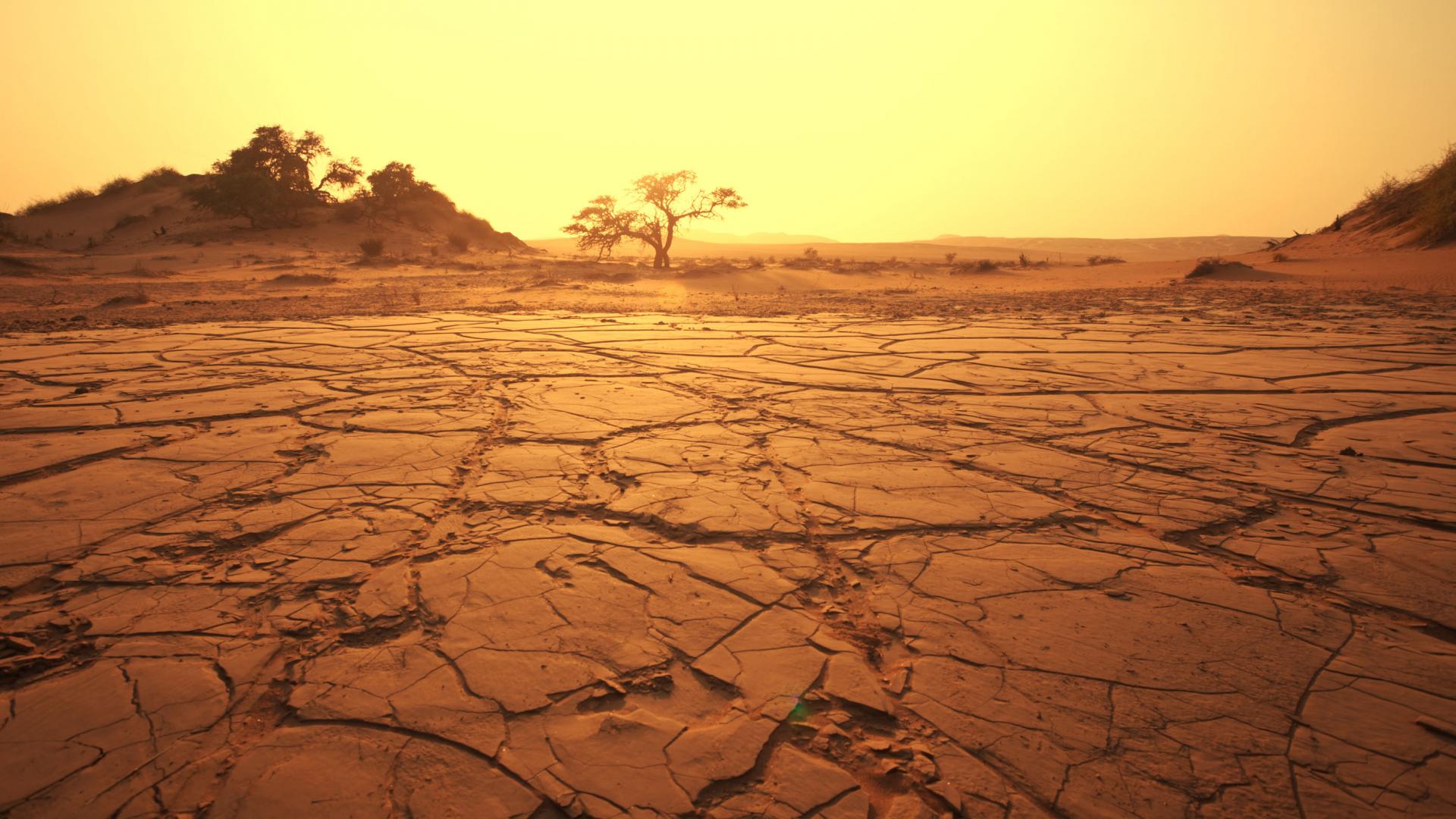
Which biome is hot all year with wet and dry seasons?
tropical rainforest
arctic tundra
temperate grassland
desert

Which biome is hot and humid all year round with plenty of rain?
Tundra
Tropical Rain Forest
Taiga
Temperate Forest

Which biome is sandy and/or rocky with very little rain?
Desert
Tundra
Grassland
Tropical Rain Forest

Which biome has tree leaves that change color and drop off as the season changes from fall to winter?
Tropical Rain Forest
Deciduous Forest
Tundra
Coniferous Forest
What is an abiotic factor?
living
nonliving
dead
animals
What is a biotic factor?
living
nonliving
dead
air

Melting Ice
Physical Change
Chemical Change
Cutting Paper
Physical Change
Chemical Change
What is the process by which a chemical change occurs?
Conservation of Matter
Physical Change
Chemical reaction
Condensation
What always happens during a chemical change?
The material and its properties change
The material dissolves
The total mass of the material changes
The material changes state from a solid to a liquid
What is the best definition of a chemical change?
A change in the state of matter in which the form changes but the properties stay the same.
A change in the state of matter in which the material changes into an entirely different material with properties that are different from the original material.
A change in the state of matter in which the material is still the same just in a different form.
Which is not a sign that a chemical reaction has occurred.
A change in mass
bubbling
production of an odor or smell
change in color
Which is not evidence that a chemical reaction has occured
Production of flames
Change in temperature or heat
freezing
Production of light
The total mass after a chemical reaction is that same as the total mass before a chemical reaction
True
False
Why are some acids used in food?
To sweeten the food.
To make it salty
So there will be a sour taste.
So there will be a bitter taste.
How can you make a dull penny shiny?
Dip it in vinegar.
Wash it with soapy water
Put it in salt and water.
Dip it in a vinegar and salt solution.
Kayla has a wooden rod, a steel rod, and a glass rod. How could she compare the materials to find out which transfers thermal energy BEST?
Submerge each rod in ice water to find out which loses the most heat.
Place the three rods in a freezer to find out which becomes the coldest.
Place one end of each rod in very hot water to find out which becomes hot the fastest.
Place the rods on a table in a warm room and find out which feels warmest after a period of time.
How does the sun warm a person’s face?
through evaporation
through radiation
through conduction
through convection
Which best describes heat transfer due to convection??
It occurs with direct contact.
It occurs only during the day.
It occurs with movement of a fluid.
It occurs only when something is burning.
Which causes surface water in a lake to heat up during the hot summer?
conduction
convection
evaporation
radiation
Which container will be less likely to feel cold on the outside when filled with ice?
a foam cup
a glass cup
a metal cup
a paper cup

Which best explains how a fluid is heated?
conduction
convection
radiation
evaporation

When a warm plate is placed onto a cool counter, which most likely occurs?
The plate gains heat and the countertop gains heat.
The plate loses heat and the countertop gains heat.
The plate gains heat and the countertop loses heat.
The plate loses heat and the countertop loses heat.
Which best explains why a metal ice cream scoop works more efficiently than a plastic ice cream scoop when dipped in warm water prior to scooping the ice cream?
The metal heats more quickly than the plastic.
The plastic heats more quickly than the metal.
The metal insulates against heat.
The plastic conducts heat.

Which force is slowing the race car down the most?
friction
gravity
air resistance
pull

Which force is slowing the drag car down?
gravity
pull
air resistance
push

What force is most important in the sport of curling?
gravity
push
pull
magnetic
Which TWO forces make a paper plane fly?
push and pull
gravity and air resistance
pull and friction
push and air resistance

Which TWO forces are at work here?
push and gravity
gravity and air resistance
friction and pull
push and air resistance

What force is acting on the rope?
gravity
push
friction
tension

Which TWO forces enables the athlete to benefit from this activity?
tension and push
pull and tension
pull and push
pull and elastic

Which force most affects the movement of the arrow?
friction
tension
air resistance
gravity

Which TWO forces are evident in this picture?
air resistance and buoyancy
tension and elastic
buoyancy and pull
fraction and buoyancy
Which sentence describes the differences between plant and animal cells?
Plant cells have a nucleus but animal cells do not.
Plant cells have chloroplasts but animal cells do not.
Plant cells do not have a nucleus but animal cells do.
Plant cells do not have chloroplasts but animal cells do.
What is true for all bacteria?
They do not have a nucleus
They can be seen without a microscope.
They are all harmful
They only live in hot water.
Identify the pigment in plants leaves that captures the energy of sunlight.
Oxygen
Carbon Dioxide
Chlorophyll
During photosynthesis plants make sugar and....
Carbon Dioxide
Dirt
Oxygen
What does chlorophyll capture?
Chlorophyll captures water from the air.
Chlorophyll captures carbon dioxide from the air.
Chlorophyll captures the energy of sunlight.
During photosynthesis, what form does the food take?
The food takes the form of sugar.
The food takes the form of carbon dioxide.
The food takes the form of soil.
Which best describes why winds at the beach change direction between day and night
because the temperatures over land and water change
because warm air over land sinks and stays in place over land
because cool air rises and is replaced by warm air over the ocean
because cool air sinks and stays in place over land
which will most likely result from a low-pressure system?
warm temperatures
cloudy conditions
clear conditions
cool temperatures
Molten rock below the Earth's surface is called....
Lava
Magma
Granite
Feldspar
The word igneous comes from the Latin word for...
melted
very hot
solid
fire

Geologists have classified rocks into three major groups of rocks which are:
inorganic, organic and chemical rocks
igneous, sedimentary and metamorphic rocks
metamorphic, chemical and non chemical rocks
sedimentary, inorganic and igneous rocks
The process by which metamorphic rock changes to igneous rock begins with
melting
erosion
deposition
crystallization
Which cycle describes what plants and animals breathe in and out?
Nitrogen Cycle
Food Web
Life-Death Cycle
Carbob Dioxide-Oxygen Cycle
Which of the following are decomposers? Check all that apply.
Rose Bush
Mushrooms
Fungi
Bacteria
Living things in an ecosystem are known as;
alive
abiotic factors
biotic factors
plants and animals
Biotic factors need abiotic factors for;
food
shelter
survival
complanionship
What is it between biotic and abiotic factors that makes an ecosystem?
interactions
they don't need each other
companionship
numbers of each
Which would not be considered a population?
35 cows grazing in a field
15 chickens laying eggs
two eagles making a nest
a bunch of rabbits playing in the yard
What population would not be found in a school community?
bus drivers
athletic coaches
sailors
cooks
students
In order to be an ecosystem, every ecosystem must have;
abiotic factors
interactions
biotic factors
all of the above
______ is the green pigment in plants that makes it possible for them to make food from carbon dioxide and water.
Photosynthesis
Chlorphyll
Nutrients
Hydroponics
_______ is made up of all the different populations that live and interact in an area.
Pou
Community
Invasive Species
Delta
_______ is a species that has been brought to a new place by people and can harm the environment.
Population
Community
Invasive Species
Delta
an early stage in the life cycle of an organism that will undergo complete metamorphosis.
Incomplete Metamorphosis
Complete Metamorphosis
Larva
Nymph
Pupa
populations of different species of organisms living together in the same geographic area.
Behavior
Community
Population
Consumer
all members of the same species living together at the same time in the same area.
Behavior
Community
Population
Consumer

Things that harm an ecosystem by taking space, using natural resources and producing waste.
Human Activities
Extinction
biotic
habitat

An organism's complete role, or function in its ecosystem including all the ways an organism survives.
secondary succession
invasive species
community
Niche

All the organisms living in a place together with their environment
ecosystem
niche
habitat
population

Gradual change of an organism within an ecosystem
diversity
succession
activity
extinction

A group of organisms of the same species within an ecosystem
niche
habitat
primary succession
population

To be different in kind, an ecosystem needs these differences to support many populations of species
diversity
ecosystem
secondary succession
population decrease

Population of the species grows quickly and takes food and space away from other species. This is called
invasive species
limiting factors
human activities
seconday activities

Which of the following is NOT something that quickly modifys an environment?
drought
flooding
earthquakes
thunder storm

A place where an organism lives within an ecosystem
biotic
limiting factor
habitat
drought