
 Worksheets
Tranportation Management
Total questions: 25
Worksheet time: 13mins
The business practice of hiring a party outside a company to perform services or create goods that were traditionally performed in-house by the company's own employees and staff.
Third Party Logistics
Outsourcing
Contractual
Inbound Logistics
This refers to the outsourcing of logistics and supply chain management functions
to external companies or service providers.
Third Party Logistics
Outsourcing
Contractual
Inbound Logistics
This refers to the process of receiving and storing raw materials
and components that are needed for production.
Third Party Logistics
Outsourcing
Contractual
Inbound Logistics
Identifying and selecting suppliers that can provide the materials or components
needed for production at a competitive price and with reliable delivery.
Transportation
Purchasing
Sourcing
Storage
Negotiating purchase agreements with suppliers, including pricing, delivery schedules, and payment terms.
Transportation
Purchasing
Sourcing
Storage
Coordinating the movement of goods from suppliers to the company’s warehouses or production facilities. This may involve working with freight carriers, customs brokers, and other logistics providers to ensure timely and cost-effective delivery.
Transportation
Purchasing
Sourcing
Storage
Organizing and storing materials in a way that allows for efficient retrieval and use in the production process. This may involve using store equipment such as pallet racks or shelving and implementing inventory management systems to track the movement of materials.
Transportation
Purchasing
Sourcing
Storage
Order processing, Custom packaging and labeling,
Shipping and delivery coordination; and
E-commerce order fulfillment are services offered in ______.
Returns Management
Freight Management
Order Fufillment
Supply Chain Consulting
Strategic supply chain planning,
Process optimization and improvement; and
Network design and reconfiguration are services offered in ______.
Returns Management
Freight Management
Order Fufillment
Supply Chain Consulting
Return authorization and processing,
Inspection and assessment of returned goods; and
Disposal or recycling of returned items are services offered in ______.
Returns Management
Freight Management
Order Fufillment
Supply Chain Consulting
Rate negotiation with carriers, Freight audit and payment; and
Carrier selection and management are services offered in ______.
Returns Management
Freight Management
Order Fufillment
Supply Chain Consulting
Customization and kitting, Product assembly and packaging; and
Quality control and inspection are services offered in ______.
Reverse Logistics
Customs Brokerage and Compliance
Technology Solutions
Value-Added Services
Management of goods from end customers back to the manufacturer or reseller; and
Recycling, refurbishing, or disposal of returned products are services offered in ______.
Reverse Logistics
Customs Brokerage and Compliance
Technology Solutions
Value-Added Services
Transportation management systems (TMS), Electronic data interchange (EDI) integration; and
Analytics and reporting are services offered in ______.
Reverse Logistics
Customs Brokerage and Compliance
Technology Solutions
Value-Added Services
Import and export documentation and clearance; and
Customs compliance and regulatory support are services offered in ______.
Reverse Logistics
Customs Brokerage and Compliance
Technology Solutions
Value-Added Services
TRUE or FALSE: Dependency, Restricted Insight and Lack of Common Ground
are some disadvantages of Inbound Logistics.
True
False
Inbound Logistics Challenge:
Poor quality materials or components can lead to defects in the finished product, which can have a negative impact on customer satisfaction and the company’s reputation. Ensuring the quality of materials is a crucial challenge in inbound logistics.
Shipping Inefficiency
Quality Issues
Supply & Demand Balance
Information Vacuum
Capacity Constraints
Inbound Logistics Challenge:
Insufficient storage or production capacity can limit a company’s ability to manage inbound logistics efficiently. This can lead to delays in the production process and may require the company to invest in additional facilities or equipment.
Shipping Inefficiency
Quality Issues
Supply & Demand Balance
Information Vacuum
Capacity Constraints
Inbound Logistics Challenge:
Delays or disruptions in the transportation of goods can lead to increased costs and reduced efficiency in the production process. Traffic congestion, bad weather, or problems with the transportation provider can cause these delays.
Shipping Inefficiency
Quality Issues
Supply & Demand Balance
Information Vacuum
Capacity Constraints
Inbound Logistics Challenge:
Lack of visibility into the movement of goods can make it challenging to track progress and identify potential problems. This can be caused by a need for more communication between the company, its suppliers, or logistics providers or problems with tracking systems.
Shipping Inefficiency
Quality Issues
Supply & Demand Balance
Information Vacuum
Capacity Constraints
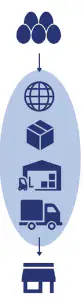
The image shown is an example of ______.
1PL
2PL
3PL
4PL
5PL

The image shown is an example of _____.
1PL
2PL
3PL
4PL
5PL

The image shown is an example of _____.
1PL
2PL
3PL
4PL
5PL

The image shown is an example of _____.
1PL
2PL
3PL
4PL
5PL

The image shown is an example of _____.
1PL
2PL
3PL
4PL
5PL

