
 Worksheets
Final Review: Part 1
Total questions: 20
Worksheet time: 10mins
Which factor contributed most to the development of the Renaissance in Italy?
City-states in Italy had become wealthy from trade.
Nobles in Italy had been military leaders in the Crusades.
The Catholic Church provided political stability to the region.
The region had become politically unified under one Italian king.
Which new approach to scientific thought is illustrated in the excerpt?
Rejecting religious teachings about the physical world
Employing laboratories to confirm the results of theories
Using direct observation instead of relying on previous beliefs
Adhering to the practices passed down by the Greeks and Romans
The changing social views that emphasized the growing individualism and secularism emerging during the European Renaissance came to be known as —
enlightenment
humanism
rebirth
reformation
What economic change in Europe during the Renaissance facilitated the flourishing of art that characterized the time period?
Introduction of paper currency that was in higher demand by artists
Creation of a barter system that allowed artists to trade more easily
Growth of a merchant class with additional income used to patron the arts
Development of government programs that paid for the education of artists
How did the Catholic Church respond to the religious changes brought about by the Reformation?
It allowed Catholic priests to marry.
It launched a Counter-Reformation.
It replaced the Pope with a new leader.
It issued an English translation of the Bible.
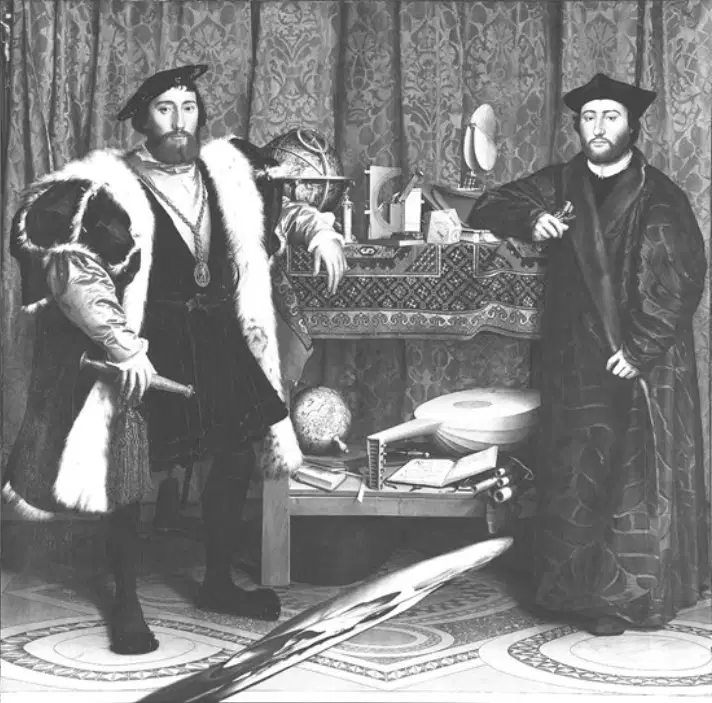
In what way does the painting illustrate advances that were being made during the Renaissance?
The subjects are both trained navigators.
Many pictured items were discovered in the Americas.
Two globes and navigational instruments are pictured.
Influences from Greek and Roman architecture can be seen.
Which action most contributed to the onset of the Scientific Revolution in sixteenth-century Europe?
Invention of the new methods of accounting
Creation of a navigation school by Prince Henry
Introduction of new products from the Americas
Publication/collaboration of new theories related to astronomy
When Europeans witnessed an explosion of progress in art, literature, science, and philosophy from 1350 to 1550, they were experiencing a Renaissance or 'rebirth' of —
Enlightenment viewpoints
ancient Egyptian culture
Greek and Roman ideals
Eastern religions
One of the primary motivations for European exploration in the fifteenth and sixteenth centuries was to —
engage directly in international trade for profit
conquer other people to serve as forced laborers
locate remote islands for the relocation of criminals
find new sources of food for Europe’s growing population
The main reason for the loss of lives described in the excerpt is that American Indians —
were shipped to Europe as slaves
experienced a series of famines
exhausted their supplies of natural resources
were not immune to European diseases
A direct result of European exploration was —
a unified European system of paper currency
the creation of a large European free trade zone
the division of European states over religious issues
a competition for colonies among European leaders
One characteristic of an absolute monarchy includes —
the glorification of the nation by all citizens
a sharing of power between a ruler and a parliament
centralized control of all political processes by the ruler
an elected representative body for passage of legislation
As a result of the Columbian Exchange, western Europeans were introduced to —
the Incan practice of terrace farming
advanced military technologies from the Aztecs
new food crops that improved the European diet
diseases that drastically reduced the population of Europe
Which of the following encouraged European explorers to attempt ocean crossings?
Improved food preservation techniques
Chinese maps of North American coastlines
New navigational technologies and ship construction
Fears that Chinese treasure fleets would dominate the spice trade
One way the Catholic Church aided the Spanish conquest of the Americas was by —
arguing for the protection of native groups
employing priests as guides for expeditions
providing the funds for conquistadores to travel
sending missionaries to convert native populations
One cultural similarity shared by the Aztec and Incan civilization was that both —
created a written language
enslaved conquered peoples
produced extensive literary works
developed advanced mathematical skills
The Enlightenment philosophers inspired later political revolution because of their support for —
mercantilism
natural rights
imperialist policies
divine right of kings
The European response to the rise and fall of Napoleon’s empire helped to spread the idea of —
nationalism
human rights
freedom of the press
constitutional government
How was Simón Bolívar influenced by the American and French Revolutions?
He wrote a Declaration of Rights for Latin American countries ruled by France.
He observed the American Revolution's successes and brought democracy to Cuba.
He adopted Enlightenment ideals and began revolutions against Spanish authority.
He fought in the French Revolution and returned to Mexico to lead a revolution himself.
How did the ideas of Enlightenment philosophers, such as the separation of powers, influence the political revolutions of the eighteenth century?
The ideas became the focus of debates between monarchs and parliaments.
The ideas were used to create a series of slogans and mottos to rally the troops.
The ideas were used by monarchs to argue against the changes made by revolutionary leaders.
The ideas became incorporated into constitutional documents produced during the revolutions.

