wayground logo

Free Printable Worksheets

Font size

S
M
L
XL
Worksheets

Spring 2024 Advance Chemistry Final

Total questions: 94

Worksheet time: 3hrs 29mins

Name
Class
Date
1.
Find the percentage composition of  Mg in Mg3(PO4)2.
   

a)
27.48% Mg
b)
43.11% Mg
c)
16.00% Mg
d)
12.63% Mg
2.

Calculate the molar mass of Ba(C2H3O2)2

a)

255.3 g/mol

b)

237.3 g/mol

c)

228.3 g/mol

d)

196.3 g/mol

3.
The chemical formula of magnesium hydroxide is
a)
MgOH₂
b)
Mg(OH)₂
c)
Mg(OH)
d)
MgH₂
4.
The chemical formula of ammonium carbonate is
a)
NH₃CO₃
b)
NHCO
c)
NH₄CO₃
d)
(NH₄)₂CO₃
5.
The chemical formula of tetraphosphorus decaoxide is
a)
F₄O₁₀
b)
P₄O₁₀
c)
PO
d)
P₁₀O₄
6.
What is the percent composition on Oxygen in NO2? (rounded)
a)
40%
b)
50%
c)
60%
d)
70%
7.

The 6.02 x 10²³ particles in 1 mole is also known as

a)

Avogadro's Lunch

b)

Avogadro's Number

c)

Avogadro's Mass

8.
How many grams are there in 1.6 moles of CaO? (rounded)
a)
35
b)
56
c)
90
d)
0.286
9.
How many moles are there in 8.1 x 1024 molecules of NH3?
a)
1.346
b)
13.46
c)
134.6
d)
0.1346
10.
How many moles are there in 58 g of MgF2?
a)
62.3
b)
3613.4
c)
.931
d)
1.07
11.
How many molecules are there in 0.04 moles of CaF?
a)
2.4 x 10²³
b)
2.4 x 10²²
c)
2.36
d)
1450
12.
What is the molar mass of C2H4O2?
a)
40g
b)
50g
c)
60g
d)
68g
13.
Subatomic particles with a positive charge
a)
neutrons
b)
atomic mass
c)
protons
d)
isotopes
14.
Discovered the nucleus of the atom through the Gold Foil Experiment
a)
Rutherford
b)
Chadwick
c)
Thomson
d)
Dalton
15.
Created the Planetary Model of the atom
a)
Bohr
b)
Dalton
c)
Rutherford
d)
Chadwick
16.
The charge of the nucleus of all atoms or ions
a)
positive
b)
negative
c)
neutral
d)
sometimes positive and sometimes negative
17.
The atom's mass is determined by the number of 
a)
protons and neutrons
b)
protons and electrons
c)
neutrons and electrons
18.

What does the 6 represent?

a)

Atomic mass

b)

atomic number

c)

chemical symbol

d)

element name

19.

An atom has 10 protons, 15 neutrons and 10 electrons what is its mass number.

a)

20

b)

10

c)

35

d)

25

20.
An element with a mass number of 11 and an atomic number of 5 has how many neutrons?
a)
11
b)
5
c)
6
d)
16
21.
Ions are: 
a)
atoms with a positive or negative charge
b)
atoms with no charge
c)
atoms with ONLY a positive charge
d)
atoms with ONLY a negative charge
22.
When an atom loses a valence electron, it becomes a(n) _____________ ion.
a)
positive
b)
negative
c)
neutral
d)
polyatomic
23.
Negative ions form when atoms _________ valence electrons.
a)
lose
b)
gain
c)
share
24.
Nitrogen will ____ valence electrons when forming an ionic bond.
a)
gain 1
b)
lose 1
c)
gain 3
d)
lose 3
25.
How many valence electrons does Lithium have?
a)
1
b)
2
c)
3
d)
4
26.
How many valence electrons does Carbon have?
a)
4
b)
12
c)
6
d)
14
27.
Which is the correct name for CaBr2?
a)
Calcium Bromine
b)
Bromine Calcium
c)
Calcium Bromide
d)
Carbon and Bromine
28.
What is the name for LiF?
a)
Lithium Fluoride
b)
Lithium Fluorine
c)
Fluorine Lithide
29.

What charge do electrons have?

a)

Positive

b)

Negative

c)

Neutral

30.

Ions have the same number of protons but different number of _________________

a)

neutrons

b)

electrons

c)

protons

d)

toes

31.

How many valence electrons does Oxygen (O) contain?

a)

6

b)

5

c)

8

d)

2

32.

The direction of the dipole arrow in this image tells us that

a)

H is the more electronegative atom in the bond

b)

Cl is the more electronegative atom in the bond

c)

H is the more polar atom in the bond

d)

Cl is the more polar atom in the bond

33.

Which electronegativity difference would you expect for a polar covalent bond?

a)

From 0.0 to 0.4

b)

From 1.9 to 3.3

c)

From 0.5 to 1.8

34.

Which electronegativity difference would you expect for a nonpolar covalent bond?

a)

From 0.0 to 0.4

b)

From 1.9 to 3.3

c)

From 0.5 to 1.8

35.

The electrons in a polar covalent molecule are shared...

a)

Evenly

b)

Unevenly

c)

Electrons are not shared

d)

None of the Above

36.

The electrons in a nonpolar covalent molecule are shared...

a)

Evenly

b)

Unevenly

c)

Electrons are not shared

d)

None of the Above

37.

The polarity of a bond is determined by...

a)

The sum of the electronegativities of the two atoms

b)

The difference in the electronegativities of the two atoms

c)

The charges of the atoms

d)

None of the Above

38.

Which is the only nonmetal with 4 bonding places?

a)

Oxygen

b)

Carbon

c)

Nitrogen

d)

Hydrogen

39.
What two types of atoms make a covalent bond?
a)
2 Nonmetals
b)
1 Nonmetal and 1 Metal
c)
2 Metals
d)
2 Noble Gases
40.
How are covalent bonds explained?
a)
When one atom takes the other atom's electron
b)
When the atom shares an electron with an another atom
c)
When the two nucleus merge
d)
When the neutrons leave the nucleus
41.
What is a diatomic element?
a)
a metal bonded with a nonmetal
b)
2 or more nonmetals bonded together
c)
2 or more metals bonded together
d)
2 atoms of the same element bonded together
42.

What is it called if there are three-pairs of electrons being shared?

a)

Triple bond

b)

Trigonal bond

c)

Tri-bond

d)

Three bonds

43.
What is the correct chemical name for the ionic compound: Fe3N2
a)
Iron nitride
b)
Iron (III) nitride
c)
Iron (II) nitride
d)
TriIron dinitride
44.
What is the correct chemical name for the ionic compound: CuS
a)
copper sulfide
b)
copper (I) sulfide
c)
copper (II) sulfide
d)
copper monosulfide
45.
What is the correct chemical name for the molecular compound:  CS2
a)
Carbon Sulfide
b)
Carbon diSulfide
c)
diCarbide diSulfide
d)
Carbon (II) Sulfide
46.
What is the correct chemical name for the molecular compound:  SF4
a)
Sulfur Fluoride
b)
Sulfur TetraFluoride
c)
TetraSulfide Fluoride
d)
Sulfur (IV) Fluoride
47.
Name the following ionic compound: MgSO4
a)
magnesium sulfoxide
b)
magnesium sulfide
c)
magnesium sulfate
d)
magnesium oxide
48.
Name the following ionic compound: Cr(NO2)3
a)
chromium nitrite
b)
chromium nitride
c)
chromium III nitride
d)
chromium III nitrite
49.
Co+2  combines with NO2-  to form
a)
Co2(NO2)
b)
Co(NO2)2
c)
NO(Co)2
d)
Co(NO)3
50.

What is the correct chemical name for the molecular compound:  P4O10

a)

Phosphorus Oxide

b)

Phosphorus (IV) Oxide

c)

Tetraphosphorus Decaoxide

d)

Phosphorus (X) Oxide

51.
What is the formula for potassium carbonate?
a)
P2CO3
b)
PCO3
c)
KCO3
d)
K2CO3
52.
Which is the correct name of K₂Cr₂O₇?
a)
Potassium (VII) Chromate
b)
Potassium Dichromate
c)
Potassium Chromide
d)
Potassium Chromium Oxide
53.

The substance ClO3is best described as

a)

a molecule

b)

a polyatomic ion

c)

a polyatomic molecule

d)

a mixture

54.
 A lone pair is defined as
a)
A pair of bonding electrons
b)
One non-bonding electron
c)
A pair of non-bonding electrons
d)
A pair of electrons on the central atom
55.
What is the VSEPR theory used to predict?
a)
Bond Strength
b)
Polarity
c)
Molecular Shape
d)
Electronegativity
56.
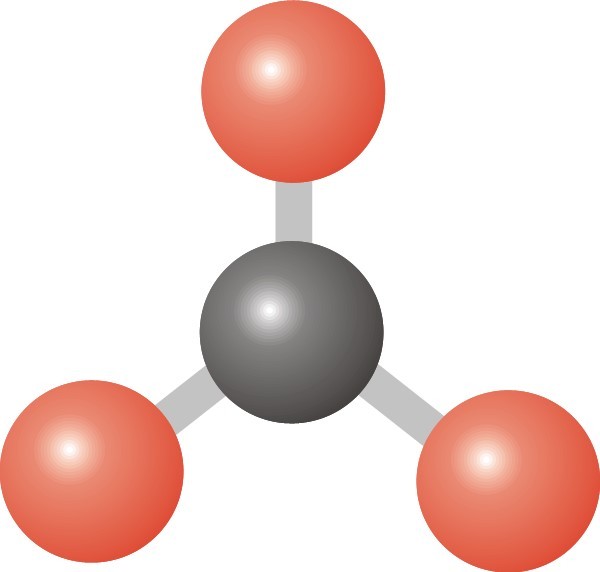
What molecule could this be? 
a)
BF3
b)
CH4
c)
H2O
d)
CO2
57.

What molecular geometry would PH3 have?

a)

Trigonal Pyramidal

b)

Trigonal Bipyramidal

c)

Bent

d)

Linear

58.
What molecular shape is the structure shown here? (H2O)
a)
tetrahedral
b)
trigonal planar
c)
bent
d)
trigonal pyramidal
59.

When determining molecular geometry, how many electron groups are around the central atom of this structure?

a)

1

b)

2

c)

3

d)

4

60.

When determining molecular geometry, how many electron groups are around the central atom of this structure?

a)

1

b)

2

c)

3

d)

4

61.

How many total valence electrons are participating in bonding in the molecule above?

a)

8

b)

4

c)

2

d)

3

62.

NH3 has how many lone pairs?

a)

0

b)

1

c)

2

d)

3

63.
How many electrons should Calcium have around its Lewis dot model?
a)
1
b)
2
c)
7
d)
8
64.
What is this element? 
1s22s22p63s23p6
4s23d104p6
a)
Argon
b)
Krypton
c)
Selenium
d)
Bromide
65.
How many electrons should Flourine have around its Lewis dot model?
a)
5
b)
6
c)
7
d)
8
66.
How many electrons should Neon have around its Lewis dot model?
a)
5
b)
6
c)
7
d)
8
67.
An element with five valence electrons is
a)
phosphorus
b)
oxygen
c)
beryllium
d)
rubidium
68.

What element does this Lewis Dot Digram represent?

a)

Li

b)

Al

c)

C

d)

Be

69.

This could be the dot diagram of

a)

Si

b)

Br

c)

B

d)

S

70.

Balance the following equation with the correct coefficients:

___ SnO₂ + ___ H₂ → ___ Sn + ___ H₂O

a)

1, 2, 1, 2

b)

2, 1, 1, 2

c)

1, 1, 1, 1

d)

2, 2, 3, 2

71.

When reacting Na with Cl2, we calculated that the theoretical yield should be 13 grams. Our actual yield was 12.5 grams. What is the percent yield?

a)

90.4%

b)

104%

c)

96.15%

d)

1.04%

72.

The weight of a table measured by a student is 20 Kg. The theoretical weight of the table is 23 Kg. What is the percent error in the student's measurement?

a)

43 %

b)

3%

c)

15%

d)

13%

73.
When 12 moles of O2 reacts with 1.1 mole of C10H8 what is the limiting reactant?  C10H8 + 12 O2 --> 10 CO2 + 4 H2O
a)
Oxygen
b)
C10H8
c)
Water
d)
Carbon Dioxide
74.

CH4 + 2H2O → CO2 + 4H2

How many grams of CO2 will form when 20.0 g of CH4 reacts with 15.0 g of H2O?

a)

65.3 g

b)

18.3 g

c)

54.8 g

d)

15.0 g

75.

4NH3 + 5O2 → 4NO + 6H2O

How many grams of NO are formed if 6.30 g of ammonia react with 1.80 g of oxygen?

a)

0.370 g

b)

0.0450 g

c)

1.35 g

d)

11.1 g

76.

__ Al + __ FeO → Al2O2 + __ Fe

a)

1, 1, 2

b)

2,1,2

c)

2, 2, 2

d)

2,4,2

77.
Balance this equation.
_CF+ _Br-- _CBr+ _F2
a)
2,1,2,1
b)
1,2,2,1
c)
1,2,1,2
d)
2,2,2,2
78.
What is the little number after an element in a chemical equation called.
Example: H2
a)
Coefficient 
b)
Subscript
c)
Atom
d)
Equation
79.
Balance this equation
_Al +_HCl --> _H+_AlCl3
a)
2, 6, 3, 2
b)
it is already balanced
c)
4, 12, 3, 4
d)
2, 1, 4, 5
80.
Balance this equation.
_CH4 + _O--> _CO+ _H2O
a)
1,2,1,1
b)
2,1,2,1
c)
1,2,1,2
d)
0,2,0,2
81.

Which equation is balanced?

a)

PbO2 + 2H2--> H2SO4

b)

SO2 + H20 --> H2SO4

c)

2Na + 2H2O --> 2NaOH + H2

d)

2Na + 2H2O --> 2NaOH + H

82.

Convert: 150 ⁰F to ⁰C: (a)  

Choose from the below words
66 ⁰C
101 ⁰C
339 ⁰C
118 ⁰F
83.

Convert: -45.9 ⁰C to K: (a)  

Choose from the below words
227.1 K
400 K
0 K
373 K
84.

Convert 20.0⁰C to Kelvin. (a)  

Choose from the below words
293 K
273 K
298 K
20 K
85.

Covert 180. kPa to Torr (a)  

Choose from the below words
1350 Torr
1078 Torr
1.78 Torr
1.35 Torr
86.

Convert 1350 mmHg to atm (a)  

Choose from the below words
1770 atm
17.7 atm
1026000 atm
1.78 atm
87.

How much is 944 Torr in atm? (a)  

Choose from the below words
1.24 atm
717000 atm
9.32 atm
1650 atm
88.

Convert 242 kPa to atm (a)  

Choose from the below words
2.4 atm
2.39 atm
24500 atm
24515 atm
89.

1 CH4 + 2 O2 → 1 CO2 + 2 H2O

How many moles of carbon dioxide (CO2) are produced from the combustion of 110.0 g of CH4 (molar mass = 16 g)?

a)

13.7 mol

b)

2.75 mol

c)

6.85 mol

d)

6.11 mol

90.
Using the balanced equation in question 1,
Mg(s)   +   HCl(aq)  -->   MgCl₂(aq)   +   H₂(g)
How many grams of HCl are consumed by the reaction of 2.50 moles of magnesium?
a)
5.00 g
b)
7.29
c)
182 g
d)
218 g
91.
2H2   +   O2  →  2H2O
How many moles of water can be produced if 8 moles H2 are used?
a)
4 moles
b)
8 moles
c)
16 moles
d)
2 moles
92.
For the Balanced Reaction: 3 Mg + 1 Fe2O3 → 3 MgO + 2 Fe; What is the Ratio of moles of MgO to moles Fe?
a)
3mol Mg / 2 mol Fe
b)
2 mol Mg/ 3 mol Fe
c)
1 mol Fe/ 2 mol Fe
d)
3 mol MgO / 2 mol Fe
93.
B2H6 + 3O2 -->2 HBO2 + 2 H2O
 What mass of O2 will be needed to burn 36.1 g of B2H6?

a)
13.8 g O2
b)
3.86 mol of O2
c)
125.2 g O2
94.
How many grams are in 7.8 moles of NaCl?
a)
476grams
b)
460 grams
c)
452 grams
d)
462 grams