wayground logo

Free Printable Worksheets

Font size

S
M
L
XL
Worksheets

2nd semester HS sci final exam study guide

Total questions: 190

Worksheet time: 8hrs 58mins

Name
Class
Date
1-12.
1.

Which type of energy is due to the motion of atoms and molecules within substances?

a)

sound energy

b)

kinetic energy

c)

chemical energy

d)

electromagnetic energy

2.

Which of the following correctly describes an energy transformation that can be observed in an everyday situation?

a)

Gasoline burns and powers a car engine when the bonds are broken between the molecules and the free electrons flow. This is a transformation between electromagnetic energy and chemical energy.

b)

Ice in soda glass melts when it is placed in sunlight on a window sill. Radiant energy from the sun is absorbed by the water molecules, which increases the speed that the molecules move. This is a transformation between light energy and kinetic energy.

c)

A pot of water is heated by a stove as the heat energy moves from the stove top to the metal of the pot. This is a transformation between mechanical energy and thermal energy.

d)

The sun is powered by the fusion of large atomic nuclei that creates heat and light for the solar system. This is a transformation between chemical energy and light energy.

3.

What type of energy transformation occurs when ice in a soda glass melts in sunlight?

a)

Chemical energy to thermal energy

b)

Light energy to kinetic energy

c)

Electrical energy to mechanical energy

d)

Potential energy to kinetic energy

4.

Which of the following is the energy transformation that occurs when gasoline is burned to power a car?

a)

Heat energy to sound energy

b)

Chemical energy to sound energy

c)

Heat energy to mechanical energy

d)

Chemical energy to mechanical energy

5.

Which of the following actions could a person do to show how heat moves through conduction?

a)

A camper melts some marshmallows by holding them over a campfire.

b)

A person uses an electric blanket to warm up on a cold evening.

c)

A chef waits as pasta noodles rise and fall in a pot of boiling water.

d)

A farmer heats up a metal rod to use as a brand by placing it into a fire.

6.

Marcus wants to investigate how thermal energy can be transferred by convection. Which of the following scenarios would be a reasonable investigation?

a)

Studying the transfer of heat by sticking a metal spoon into a cup of hot water to determine if the handle of the spoon will heat up or not.

b)

Studying the transfer of heat by taking the temperature of the air beside a fire and farther away from a fire to determine how far away the heat can be detected.

c)

Studying the transfer of heat by measuring the temperature of the water at the top of a body of water and at the bottom to determine which way the warm water will flow.

d)

Studying the transfer of heat by taking the temperature on the outside and the inside of a wooden door facing the sun to determine if the heat can move through the door.

7.

What is the purpose of measuring the temperature of water at the top and bottom of a body of water in a study?

a)

To determine the pH level of the water

b)

To measure the salinity of the water

c)

To determine which way the warm water will flow

d)

To check the oxygen levels in the water

8.

What concept is being investigated by studying the transfer of heat in water?

a)

Radiation

b)

Conduction

c)

Convection

d)

Evaporation

9.

Why does warm water rise in a body of water during the study of heat transfer?

a)

Because it is more dense

b)

Because it is less dense

c)

Because it is heavier

d)

Because it is colder

10.

What is specific heat?

a)

the amount of heat energy needed to boil one gram of a substance

b)

the amount of heat energy needed to raise the temperature of one gram of water by one degree Celsius

c)

the amount of heat energy needed to raise the temperature of one gram of a substance by one degree Celsius

d)

the amount of heat energy needed to raise the temperature of one milliliter of a substance by one degree Celsius

11.

Which of the following describes a thermal insulator?

a)

A. A thermal insulator prevents the transfer of energy in the form of temperature.

b)

B. A thermal insulator prevents the transfer of energy in the form of electricity.

c)

C. A thermal insulator prevents the transfer of energy in the form of sound.

d)

D. A thermal insulator prevents the transfer of energy in the form of heat.

12.

Using the data from the table, which statement BEST supports the use of copper instead of aluminum in modern cookware?

a)

Aluminum is less toxic than copper.

b)

Aluminum is less expensive than copper.

c)

Aluminum requires less heat per unit mass to reach the desired cooking temperature.

d)

Copper requires less heat per unit mass to reach the desired cooking temperature.

13.

Which device is commonly used to transform electrical energy into thermal energy?

a)

Electric motor

b)

Solar panel

c)

Electric heater

d)

Wind turbine

14.

During nuclear fission, what type of energy transformation occurs?

a)

Chemical to nuclear

b)

Nuclear to thermal

c)

Thermal to mechanical

d)

Mechanical to electrical

15.

What type of energy transformation occurs in a combustion engine?

a)

Chemical to mechanical

b)

Mechanical to thermal

c)

Solar to chemical

d)

Electrical to mechanical

16.

As the skateboarder goes back down a “frictionless” ramp, his

a)

kinetic energy will decrease.

b)

gravitational potential energy will decrease.

c)

mechanical energy will decrease.

d)

chemical energy will decrease.

17.
The movement of thermal energy from a region of _________________ temperature to a region of _____________________ temperature is called heat.
a)
higher, lower
b)
cooler, warmer
c)
lower, higher
d)
medium, medium
18.

What energy transformation occurs when a crock pot is plugged into an outlet and then the control knob is turned "on"?

a)

thermal to electrical

b)

mechanical to thermal

c)

electrical to thermal

d)

electrical to sound

19.

A cook heats a meal in a microwave oven. What energy transformations occur between the microwave oven and the meal?

a)

Electrical energy to light energy to chemical energy

b)

Chemical energy to thermal energy to light energy

c)

Electrical energy to electromagnetic energy to thermal energy

d)

Chemical energy to electromagnetic energy to chemical energy

20.

David was driving when a dog ran out in front of him. He slammed on his brakes. During this quick stop, most of the kinetic energy of his motion was changed into _____________ as the car stopped.

a)

thermal energy

b)

electrical energy

c)

nuclear energy

d)

light energy

21.

Which description of the energy conversions in this process is correct?

a)

The chemical energy in the fuel-air mixture is converted to thermal energy, which is then converted to mechanical energy

b)

The mechanical energy in the fuel-air mixture is converted to electrical energy, which is then converted to thermal energy

c)

The electrical energy in the fuel-air mixture is converted to mechanical energy, which is then converted to thermal energy

d)

The thermal energy in the fuel-air mixture is converted to electrical energy, which is then converted to mechanical energy

22.
Kim puts an ice cube in a beaker and it melts. This is a good example of:
a)
a physical change.
b)
a chemical change.
c)
an experiment.
d)
an analysis.
23.
Energy associated with the vibration of the particles that make up an object
a)
Kinetic Energy
b)
Mechanical Energy
c)
Non-mechanical Energy
d)
Potential Energy
e)
Thermal Energy
24.

This energy comes from the movement of atoms and molecules in a substance

a)

Thermal

b)

Mechanical

c)

Sound

d)

Gravitational

e)

Electrical

25.

Symbol that indicates that energy is released.

a)

U

b)

Q

c)

-Q

d)

W

26.

When you eat fruits and vegetables, chemical bonds are releasing stored energy, this is...

a)

a. thermal energy

b)

b. sound energy

c)

c. electrical energy

d)

d. chemical energy

27.

Which is designed to transform electrical energy into thermal energy?

a)

parallel circuit

b)

series circuit

c)

resistor

d)

battery

28.
What unit do you use to measure Thermal Energy?
a)
J/Kg ºC
b)
Kg
c)
ºC
d)
J
29.

Energy is the ability to do __________

a)

bonds

b)

work

c)

atoms

d)

molecules

30.
Transforms kinetic energy into thermal energy
a)
Friction
b)
Energy
c)
Gravitational Field
d)
Joule
31.
When a car engine is started, gasoline is mixed with air and burned. Heat, sound, and chemical products are released. As the engine operates, which of these remains constant?
a)
the masses of compounds found in the engin
b)
the amount of heat in the engine
c)
the total mass of gasoline
d)
the total amount of energy
32.
The amount of energy required to raise the temperature 1ºC for every kilogram is called____?
a)
Thermal Energy
b)
Specific Heat
c)
Temperature
d)
Kinetic Energy
33.
When a  piece of aluminum foil is taken out of the oven and cools from 100° C to 50°C, What is the change in temperature?
a)
50°
b)
c)
100°
d)
150°
34.

If we have 250,000 J of change in thermal energy in an unknown substance, and the substance starts at -5 degrees C and heats up to 25 degrees Celsius, and the mass of the substance is 10 kg, what is the specific heat of the substance?

a)

120 J / (kg * C)

b)

415 J / (kg * C)

c)

1265 J / (kg * C)

d)

833 J / (kg * C)

35.
Copper, Stainless Steel, Carbon Steel, and Zinc were all heated using the same thermal energy.  What material would be the coolest after being heated?
a)
Copper
b)
Carbon Steel
c)
Zinc
d)
Stainless Steel
36.
Copper, Stainless Steel, Carbon Steel, and Zinc were all heated using 10,000 JOULES of thermal energy.  What material would be have the LARGEST change in temperature?
a)
Copper
b)
Carbon Steel
c)
Zinc
d)
Stainless Steel
37.
A substance with a high specific heat:
a)
Is always extremely hot.
b)
Requires a lot of energy to become hot.
c)
Is not heavy.
d)
Does not requires a lot of energy to become hot.
38.
 How many joules of heat are needed to raise the temperature of 10.0 g of aluminum from 22°C to 55°C, if the specific heat of aluminum is 0.90 J/gx°C?    
a)
297 Joules
b)
0.003 Joules
c)
297 J/gx°C
d)
0.003 J/gx°C
39.
The specific heat of aluminum is 0.21 cal/g°C.  How much heat(Q) is released when a 10 g piece of aluminum foil is taken out of the oven and cools from 100° to 50°?
a)
105 J
b)
10.5 J
c)
1.05 J
d)
50 J
40.

If you had to cool an object SLOWLY, what would you want the specific heat of the coolant to be, assuming that the same amount of coolant will be used?

a)

We would want a high specific heat for our coolant to cool this as efficiently as possible

b)

We would want a low specific heat for our coolant to cool this as quickly as possible

c)

We would want a low specific heat for our coolant to cool this as slow as possible

d)

We would want a high specific heat for our coolant to cool this as slow as possible

41.
Which of the following would be the best insulator?
a)
air
b)
aluminum
c)
copper
d)
silver
42.
Which has a higher specific heat capacity, water or sand?
a)
Sand
b)
Water
c)
They both have the same specific heat capacity.
43.

A 0.3 g piece of copper is heated and fashioned into a bracelet. The amount of energy transferred by heat to the copper is 66,300 J. If the specific heat of copper is 390 J/g 0C, what Is the change of the copper's temperature?

a)

566.7 °C

b)

77 °C

c)

432 °C

d)

266.5 °C

44.
Q=mc∆T is the equation we use for specific heat.
a)
True
b)
False
45.
A high specific heat means...
a)
It heats up quickly with energy added
b)
It requires more energy to change temperature
c)
It gets hotter than an object with a low specific heat
d)
It won't get as hot as an object with a low specific heat
46.

The specific heat of copper is 0.385 J/g·°C. Which equation set up below would you use to calculate the amount of heat needed to raise the temperature of 0.75 g of copper from 7°C to 29°C?

a)

Q = 0.385 J/g·°C x (22°C)

b)

Q = 0.75 g x 0.385 J/g·°C x (7°C – 29°C)

c)

Q = 0.75 g x 0.385 J/g·°C x (29°C – 7°C)

d)

Q = 0.75 g x 0.385 J/g·°C x (29°C + 7°C)

47.

This energy comes from the movement of atoms and molecules in a substance

a)

Thermal

b)

Mechanical

c)

Sound

d)

Gravitational

e)

Electrical

48.

Why do coastal areas have a milder climate compared to inland areas?

a)

Because water has a lower specific heat than land. The water helps the surrounding area resist change less.

b)

Because water has a higher specific heat than land. The water helps the surrounding area resist change more.

c)

Because water evaporates faster than land

d)

Because land absorbs more sunlight than water

49.
Water has a specific heat of 4.184 J/gºC.  Wood has a specific heat of 1.760 J/gºC.  What material needs more energy to raise the temperature 1ºC
a)
Wood
b)
Water
c)
Both are the same
d)
Not enough information provided
50.

Which of the following best explains why the sand at the beach is hotter than the water?

a)

Sand has a higher specific heat than water.

b)

Sand has a lower specific heat than water.

c)

There is more water than sand at the beach.

d)

There is more sand than water at the beach.

51.

Material - Specific heat (J/gºC)

water 4.184

aluminum 0.900

steel 0.470

silver 0.235

According to the information above, which material listed would require the least amount of energy to raise the temperature of 100 grams of the material by 20° C?

a)

water

b)

steel

c)

aluminum

d)

silver

52.
What state(s) of matter are present at D-E?
a)
Solid-liquid
b)
Liquid
c)
Liquid-gas
d)
Gas-Solid
53.
True or false: melting and freezing occur at the same temperature!
a)
True
b)
False
c)
I don't know
54.
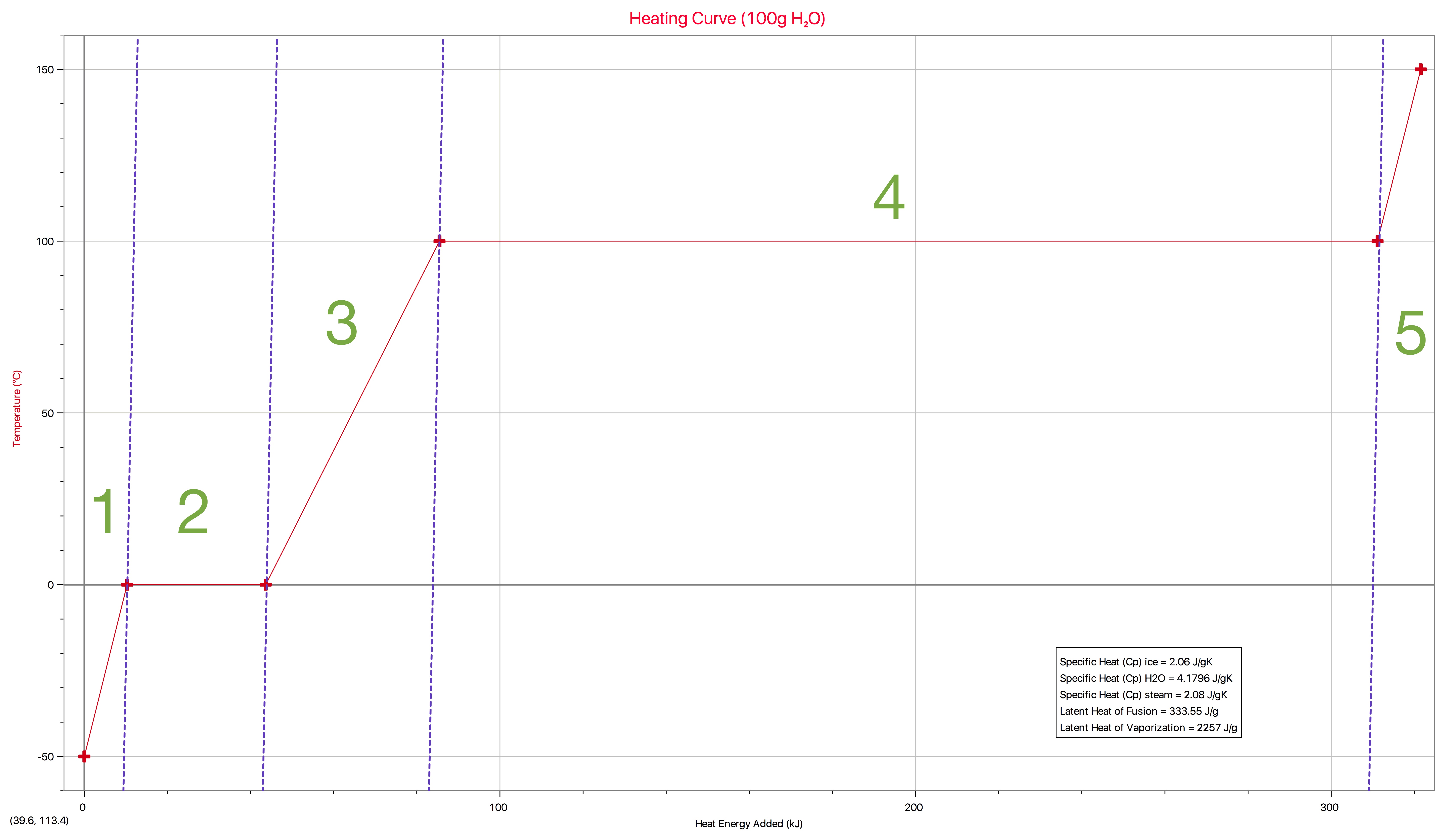
A substance's heating curve is shown in the graph.  What is its boiling point?
a)
100 C
b)
60 C
c)
80 C
d)
20 C
55.

The melting point of the sample is

a)

-60 ºC

b)

-100 ºC

c)

60 ºC

d)

100 ºC

56.
In which region(s) does temperature remain constant?
a)
Region 1, 3, & 5
b)
Region 2 & 4
c)
Region 1 only
d)
Region 1 & 2
57.
In which region(s) does temperature increase?
a)
Region 1, 3, & 5
b)
Region 2 & 4
c)
Region 1 only
d)
Region 1 & 2
58.
In which region(s) of the graph would the substance be a solid only?
a)
Region 1
b)
Region 2
c)
Region 3
d)
Region 4
59.
In which region(s) of the graph would the substance be a gas only?
a)
Region 2
b)
Region 3
c)
Region 4
d)
Region 5
60.

What state of matter/phase change is occurring during line segment D on the graph?

a)

Gas

b)

Condensation

c)

Liquid

d)

Freezing

e)

Solid

61.

At what temperature does the substance in the graph condense?

a)

140°C

b)

100°C

c)

40°C

d)

0°C

62.

At what temperature does the substance in the graph freeze?

a)

140°C

b)

100°C

c)

40°C

d)

0°C

63.

At what temperature does the substance in the graph melt?

a)

0°C

b)

1500°C

c)

2800°C

d)

3500°C

64.

At what temperature does the substance in the graph boil/vaporize?

a)

0°C

b)

1500°C

c)

2800°C

d)

3500°C

65.
(Final Speed - Initial Speed) / Take Taken
=
a)
Speed
b)
Acceleration
c)
Velocity
66.
(Final Speed - Initial Speed) / Take Taken
=
a)
Speed
b)
Acceleration
c)
Velocity
67.
Speed =
a)
Distance/Time
b)
Time/Distance
c)
Time * Distance
d)
Distance * Time
68.
Velocity is speed with...
a)
No friends
b)
A distance
c)
A direction
69.
What happens after 6 seconds in this graph?
a)
The car speeds up
b)
The car has stopped
c)
The car reverses
d)
The car slows but is still moving
70.
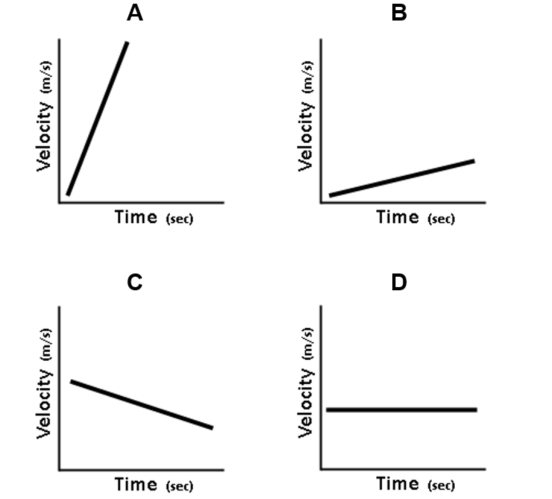
Which graph shows: A car travelling at a constant speed.
a)
A
b)
B
c)
C
d)
D
71.
Which graph shows: a car slowing down and coming to a stop.
a)
A
b)
B
c)
C
d)
D
72.
A train is travelling 10m/s accelerates to 20m/s in 5 seconds, what is it's acceleration? 
A = Change in Speed/Change in Time
a)
1m/s/s
b)
10m/s/s
c)
5m/s/s
d)
2m/s/s
73.
A runner races in the 100 meter dash.  It takes her 10 seconds to finish.  What is her average speed?
a)
10 m/s
b)
1000 m/s
c)
100 seconds
d)
10 seconds
74.
Shona cycles at an average speed of 8km/h. How far has she travelled if she cycles for 4 hours?
a)
55km
b)
32km
c)
43km
d)
32miles
75.
What is the slope of the line?
a)
10 m/s
b)
50 m/s
c)
3 m/s
d)
4.53 m/s
76.
Which graph represents zero acceleration (constant velocity)?
a)
A
b)
B
c)
C
d)
D
77.
Which graph represents the greatest acceleration?
a)
A
b)
B
c)
C
d)
D
78.
What kind of quantity has both a magnitude and a direction?
a)
scalar
b)
vector
c)
frame of reference
d)
time
79.
Which shows a velocity? 
a)
10 m
b)
10 m/s
c)
10 m/s north 
d)
10 m/s squared 
80.

A bicyclist, traveling with a constant speed, covers 50.0m in 10.0s. What was the average speed?

a)

500. m/s

b)

50.0 m/s

c)

5.0 m/s

d)

0.5 m/s

81.

A car travels at a constant speed of 15.0m/s for 20.0 seconds. How far does it travel?

a)

300. m

b)

35.0 m

c)

5.0 m

d)

500 m

82.

A marble rolls 20 cm across the table with a constant speed of in 4.0 cm/s. How long does the marble roll?

a)

80 s

b)

5.0 s

c)

24 s

d)

4.0 s

83.

A bicyclist averages 4m/s, as she steadily slows to a stop. What was her initial velocity?

a)

0 m/s

b)

8 m/s

c)

2.0 m/s

d)

4.0 m/s

84.

A dictionary weighing 15 Newtons is placed on a desk.

What is the force that the desk exerts on the dictionary?

a)

none

b)

15 N

c)

1.5 N

d)

150 N

85.

Force=Mass x Acceleration

a)

Newton's First Law

b)

Newton's Second Law

c)

Newton's Third Law

86.
The tendency of an object to resist changes in its motion is...
a)
inertia
b)
force
c)
acceleration
d)
velocity
87.
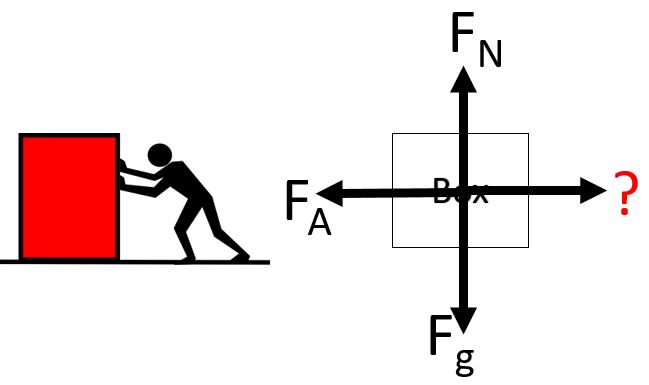
Name the missing force....
a)
weight force
b)
normal force
c)
frictional force
d)
tension force
88.
Name the missing force...
a)
frictional force
b)
weight force
c)
thrust
d)
buoyant force
89.
What is the net force in this diagram?
a)
8N right
b)
2 N right
c)
8N left
d)
2N left
90.
If the net force acting on any moving object is zero, the object will
a)
accelerate
b)
come to a stop
c)
continue in motion in a straight line
d)
move in a circular path
91.
This person bought coffee and put it on the seat next to them. If they stopped quickly and the coffee spilled which law would that represent?
a)
Newton's 1st Law
b)
Newton's 2nd Law
c)
Newton's 3rd Law
92.
An archer shoots an arrow. The action force is the bowstring against the arrow, the reaction force is...
a)
Air resistance against the bow
b)
the arrow's push against the bowstring
c)
the grip of the archer's hand on the bow
93.

The gravitational attraction between an object and the Earth.

a)

Friction

b)

Weight

c)

Normal

d)

Tension

94.

A swimmer pushes backward on the water in order to move forward. This is an example of Newton's ________ Law.

a)

1st

b)

2nd

c)

3rd

95.

What is the net force?

a)

800 N

b)

600 N

c)

400 N

d)

400 N down

96.

Which formula would you use to find the acceleration of a bike rider with a mass of 50kg who pushes off with a force of 25 Newtons.

a)

f = ma

b)

V= d/t

c)

y=mx + b

97.

A cart was pushed with a force of 50 N, if its mass is around 3.4 kg, how much was the acceleration produced? F= MA

a)

14.7 m/s2

b)

53 m/s2

c)

0.068 m/s2

d)

170 m/s2

98.

If a 10 kilogram object accelerates suddenly at 15 m/s2, how much force was applied to the object? F=MA

a)

150 Newtons

b)

15 Newtons

c)

150 kilograms

d)

100 kilograms

99.

Find how much force the man will need to exert to move the car.

a)

5000 N

b)

50 N

c)

20,000 N

d)

500 N

100.

Abigail Roller skates 8km in 4 hours What is her average speed in kilometers per hour? V=d/t

a)

10 km /h

b)

.5 km/h

c)

32 km/ h

d)

2 km/h

101.
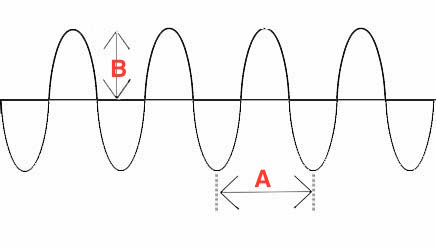
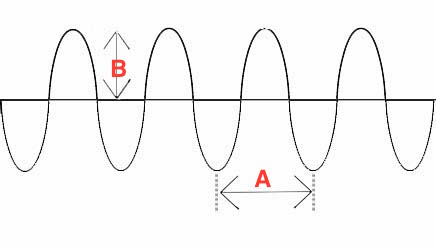
What property of this wave is represented by the letter "A"
a)
amplitude
b)
crest
c)
trough
d)
wavelength
102.
What property of the wave is represented by the letter "B"?
a)
amplitude
b)
crest
c)
trough
d)
wavelength
103.
The highest point on a wave is:
a)
the crest
b)
the trough
c)
the top
d)
the coast 
104.
The lowest point on a wave is the:
a)
Amplitude
b)
Crest
c)
Trough
d)
Wavelength
105.
The type of waves that require medium to pass:
a)
Mechanical Waves
b)
Electromagnetic Waves
106.
What types of waves carry energy at a right angle or perpendicular to the direction of the energy flow?
a)
Longitudinal waves
b)
Transverse waves
c)
Sound waves
d)
P-waves
107.
What do waves carry from place to place?
a)
Energy, but not matter or particles
b)
Energy and matter or particles
c)
Matter or particles but not energy
d)
Neither energy nor matter or particles
108.
The most dense part of a longitudinal wave.
a)
Density
b)
Compression
c)
Rarefaction
d)
Amplitude
109.
What are the parts of a longitudinal wave?
a)
Compressions and rarefactions
b)
Crests and troughs
c)
Compressions and crests
d)
Rarefactions and troughs
110.
Which wave is pictured?
a)
Transverse
b)
Longitudinal
c)
Both
d)
Neither
111.
Sound is an example of which type of wave?
a)
Transverse
b)
Longitudinal
c)
Both
d)
Neither
112.
How would you describe the movement of a transverse wave?
a)
Up and down
b)
Back and forth
c)
In zigzags
d)
Linear
113.
Light is an example of which type of wave?
a)
Transverse
b)
Longitudinal
c)
Both
d)
Neither
114.
Which wave travels parallel in relation to a medium?
a)
Transverse
b)
Longitudinal
c)
Both
d)
Neither
115.
Sound needs a medium to travel through.  What is a medium?
a)
solid, liquid, gas
b)
open space
c)
waves
d)
nothing
116.
When the frequency of a wave increases, what happens to the wavelength?
a)
The wavelength is not directly affected by the frequency of a wave.
b)
The wavelength increases.
c)
The wavelength decreases.
d)
More specific information is needed to form a conclusion about the wavelength.
117.
A mechanical wave cannot travel through...
a)
a vacuum(empty space).
b)
water.
c)
air. 
d)
glass.
118.
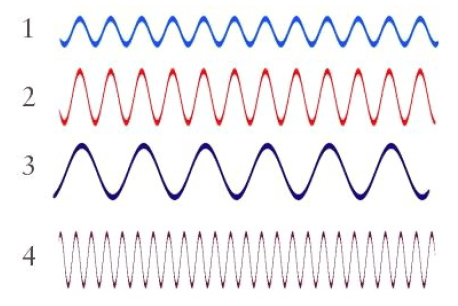
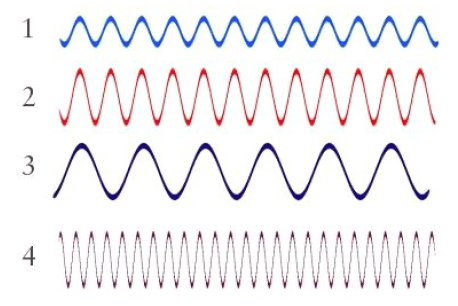
Which wave in the diagram has the greatest frequency?
a)
1
b)
2
c)
3
d)
4
119.
Which wave in the diagram has the greatest wavelength?
a)
1
b)
2
c)
3
d)
4
120.
Which of the following can sound travel through?
a)
solid
b)
liquid
c)
gas
d)
all of the above
121.
Electromagnetic waves include the following except
a)
radio waves
b)
X-rays
c)
doing the wave at a football game
d)
microwaves
122.
When a wave bends as it passes through at an angle from one medium to another.(example: pencil in a glass of water-)
a)
medium
b)
refraction
c)
reflection
d)
interference
123.

Which EM waves have the longest wavelength?

a)

radio

b)

x-rays

c)

ultraviolet

d)

gamma rays

124.

Which EM waves have the shortest wavelength?

a)

radio

b)

x-rays

c)

ultraviolet

d)

gamma rays

125.

Which EM waves are invisible? (more than one correct answer)

a)

radio

b)

visible

c)

ultraviolet

d)

gamma rays

126.

Which EM waves are have a SHORTER wavelength than visible?

a)

radio

b)

none

c)

infrared

d)

x-rays

127.

Which EM waves are have the lowest frequency?

a)

radio

b)

none

c)

infrared

d)

x-rays

128.

Which EM waves are have the highest energy & are the most dangerous?

a)

radio

b)

gamma rays

c)

infrared

d)

x-rays

129.

Which color waves have the lowest frequency?

a)

red

b)

yellow

c)

green

d)

violet

130.

Which color waves have the shortest wavelength?

a)

red

b)

yellow

c)

green

d)

violet

131.

What happens to frequency when wavelength decreases?

a)

stays the same

b)

decreases

c)

increases

d)

There is no relationship between wavelength & frequency.

132.

Which type of electromagnetic wave travels fastest through a vacuum?

a)

radio

b)

gamma rays

c)

visible light

d)

They all travel at the same speed.

133.

The diagram shows a person observing a thunderstorm located several kilometers away. The person hears the thunder several seconds after seeing the lightning. Which statement accurately explains the difference in observations of sound and light by the observer?


a)

Human eyes see light faster than their ears can hear sound.

b)

The medium the waves are traveling through is different for each type of wave.

c)

Light waves travel faster than sound waves.

d)

Sound waves travel faster than light waves.

134.
A wave with a large wavelength will have a ______ frequency and _____ energy
a)
high, low
b)
high, high
c)
low, high
d)
low, low
135.
High frequency waves have _________ wavelengths.
a)
varying
b)
long
c)
the same
d)
short
136.
The distance between two crests or two troughs of a wave is called:
a)
frequency
b)
amplitud
c)
wavelength
d)
hertz
137.

How fast does light travel?

a)

100,000 km/s

b)

200,000 km/s

c)

300,000 km/s

d)

400,000 km/s

138.
Select the correct order of waves on the EMS from the longest wavelength to the shortest wavelength
a)
Radio, Micro, Infra, Visible, Ultra, X-ray, Gamma
b)
Gamma, X-ray, Ultra, Vis, Infra, Micro, Radio
c)
Vis, Micro, Infra, Ultra, X-ray, Gamma, Radio
d)
Micro, Radio, Vis, Infra, Ultra, X-ray, Gamma
139.

Which color has the longest wavelength?

a)

Yellow

b)

Red

c)

Green

d)

Purple

140.
As the frequency of an electromagnetic wave increases, the amount of energy in that wave...
a)
increases.
b)
decreases.
c)
stays the same.
141.

This illustration best depicts which of the following behaviors?

a)

Reflection

b)

Refraction

c)

Diffraction

d)

Resonance

142.

This image best depicts which of the following wave behaviors?

a)

Reflection

b)

Refraction

c)

Diffraction

d)

Resonance

143.

This image depicts which of the following wave behaviors?

a)

Reflection

b)

Refraction

c)

Diffraction

d)

Resonance

144.

Definition: When one object vibrating at the same natural frequency of a second object forces that second object into vibrational motion.

a)

Reflection

b)

Refraction

c)

Diffraction

d)

Resonance

145.

The image depicts which of the following wave behaviors?

a)

Resonance

b)

Doppler Effect

c)

Polarization

d)

Diffraction

146.

The image depicts which of the following wave behaviors?

a)

Resonance

b)

Doppler Effect

c)

Interference

d)

Polarization

147.

The two blue and purple waves will undergo _________________ when they meet.

a)

Constructive interference

b)

Destructive interference

148.

The image of the two waves depicts

a)

Constructive interference

b)

Destructive interference

149.

Definition: the change in direction of a wave passing from one medium to another

a)

Reflection

b)

Refraction

c)

Diffraction

d)

Polarization

150.

Definition: when a wave reaches the interface between two different media, typically some of the wave will bounce back into the original medium.

a)

Reflection

b)

Refraction

c)

Diffraction

d)

Polarization

151.

Definition: The spreading out of waves as they pass through an opening or around objects.

a)

Reflection

b)

Refraction

c)

Diffraction

d)

Resonance

152.

The two forms that waves can take are...

a)

Transverse

b)

Circular

c)

Diamond

d)

Longitudinal

153.

Light waves and sound waves are similar in that...

a)

They are both longitudinal waves

b)

They are both transverse waves

c)

They both transmit energy

d)

They both can travel through space.

154.

Which of the pictured is responsible for us being able to see objects?

a)

Transmission

b)

Reflection

c)

Refraction

d)

Scattering

e)

Absorption

155.
Which letter(s) represent the crest of the wave?
a)
A
b)
D
c)
B & F
d)
F
156.
Which letter(s) represent the trough of the wave?
a)
A
b)
D
c)
B & F
d)
F
157.
crest to crest or trough to trough
a)
crest
b)
trough
c)
amplitude
d)
wavelength
158.
When a sound wave experiences reflection, we hear
a)
a louder sound
b)
an echo
c)
a quieter sound
d)
nothing
159.
What property of the wave is represented by the letter "B"?
a)
amplitude
b)
crest
c)
trough
d)
wavelength
160.
Which wave behavior do noise cancelling headphones use?
a)
diffraction
b)
refraction
c)
constructive interference
d)
destructive interference
161.

Why did this simple electric motor work?

a)

The current from the battery induces a magnetic field in the copper loop, turning it into an electromagnet that repels from/attracts to the permanent magnet

b)

The electromagnet on top of the battery pulls on the magnetic copper wire

c)

The magnet induces a current in the copper loop which makes it rotate.

d)

The magnetic field from the battery induces an electric current in the copper loop, turning it into an electromagnet that repels from/attracts to the permanent magnet

162.
Based on this picture, which side will have a higher voltage?
a)
Secondary
b)
Primary
c)
Both sides have the same voltage
d)
Cannot be determined
163.
What is the relationship between electrical current and magnetic field strength in an electromagnet?
a)
When current is increased, magnetic field strength increases
b)
When current is increased the strength of magnetic field decreases
c)
When the current is decreased, the strenght of the magnetic field is increased.
d)
There is an "indirect proportion," meaning, if the value of one goes up, the value of the other goes down.
164.
Does this diagram represent a series or parallel circuit?
a)
series circuit
b)
parallel circuit
165.
What will happen if one light bulb is removed from this circuit?
a)
The other bulbs will go out.
b)
The other bulbs will stay on
c)
The other bulbs will get dimmer.
d)
The battery will become stronger.
166.
Pick the correct sentence.
a)
This circuit will work because it is a closed circuit.
b)
Energy will freely flow in this circuit.
c)
This circuit will not work because there is no energy source.
d)
This circuit will not work because there is no switch.
167.
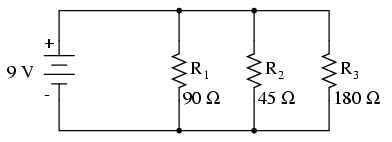
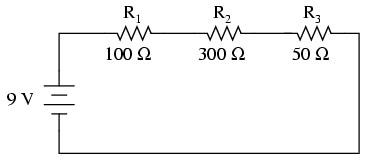
The total current going through the battery of this circuit is
a)
0.35 amps
b)
0.0286 amps
c)
0 amps
d)
9 amps
168.
The total resistance of this circuit is 
a)
25.7 ohms
b)
315 ohms
c)
324 ohms
d)
90 ohms
169.
As the resistance of a circuit increases, the current will...
a)
increase
b)
decrease
c)
stay the same
170.
As resistors are added in series to a circuit, the total resistance will...
a)
increase
b)
decrease
c)
stay the same
171.
The voltage dropped across the 300 ohm resistor is 
a)
6 V
b)
9 V
c)
2 V
d)
30 V
172.
The total current through this circuit is
a)
0.02 amps
b)
0.09 amps
c)
50 amps
d)
9 amps
173.
The picture shows an electrical circuit. This circuit is a series circuit because: 
a)
It has 3 light bulbs.
b)
The same current flows through all three light bulbs.
c)
It uses a single battery.
d)
The electrical current is divided between the three light bulbs.
174.
The best conductors for electricity are made of...
a)
wood
b)
plastic
c)
rubber
d)
metal
175.
Which circuit (s) are parallel?
a)
A
b)
A and B
c)
B and C
d)
C
176.
Which one will still function if one light bulb goes out?
a)
A-Series
b)
B-Parallel
c)
A-Parallel
d)
B-Seriese
177.
If I add more light bulbs to a series circuit what happens?
a)
The current speeds up and the lights get brighter
b)
The current slows down and the lights dim lower
c)
The current speeds up and the lights dim lower
d)
The current slows down and the lights get brighter
178.

In a closed circuit, how does battery voltage affect current?

a)

As voltage increases, current increases.

b)

As voltage increases, current decreases.

c)

Voltage has no affect on current.

d)

If voltage exceeds current, a short circuit circuit will develop.

179.
An incomplete circuit is shown.
To complete the circuit, a wire should be placed from —
a)
Point D to Point C
b)
Point B to Point C
c)
Point A to Point D
d)
Point B to Point D
180.
This circuit has a battery, buzzer, and switch.
When the switch is closed the buzzer will sound because -
a)
the switch gives energy to the battery
b)
the buzzer is made of special plastic
c)
the wires are cooled by the surrounding air
d)
electricity can flow in a complete path
181.
Which of the following can work as an energy source?
a)
Battery
b)
Light bulb
c)
Wire
d)
All of them
182.
What will happen if one light bulb is removed from this circuit?
a)
The other bulbs will go out.
b)
The other bulbs will stay on
c)
The other bulbs will get dimmer.
d)
The battery will become stronger.
183.

How many light bulbs would be ON with this complete circuit?

a)

1

b)

3

c)

2

d)

4

184.

How many light bulbs would be ON if the wire of this circuit was cut where the scissors are?

a)

1

b)

3

c)

2

d)

0

185.

How many light bulbs would be ON if the wire of this circuit was cut where the scissors are?

a)

1

b)

3

c)

2

d)

0

186.

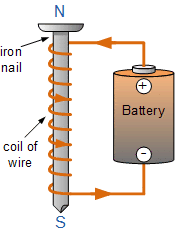
What are the components of the electromagnets?

a)

battery, wire and bulb

b)

battery , copper wire and paper clips

c)

battery, copper wire and iron nail

d)

battery, wire and aluminum

187.

What would happen if you took one end of the wire off the battery?

a)

The nail will be a magnet.

b)

The nail would no longer be a magnet

c)

Nothing will happened.

d)

The nail will heats up.

188.

Which part of the electromagnets turned into a magnet when electricity flows through a coiled wire?

a)

Battery

b)

Copper wire

c)

Iron Nail

d)

Bulb

189.

Electric currents produce _____________

a)

electron clouds

b)

magnetic fields

c)

sound waves

190.

How can the strength of an electromagnet be increased? (mark all that apply)

a)

increase the current flowing through the coil

b)

increase the number of coils

c)

add an amplifier to it

d)

put iron core inside the coil

191.
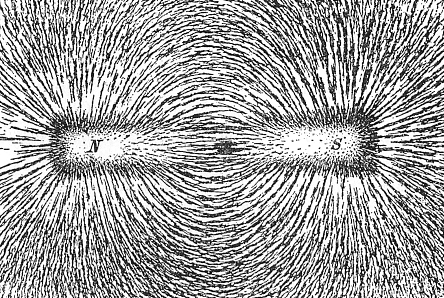
Surrounding every magnet is a __________  __________.
a)
magnetic field
b)
electrical current
c)
another magnet
d)
an enemy
192.
What effect will the south pole of one magnet have on the south pole of another magnet?
a)
Repulsive
b)
Attractive
c)
Combative
d)
No effect
193.
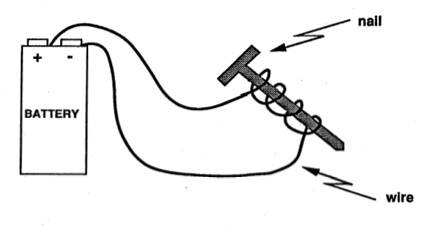
This is a picture of a simple electromagnet. How can the electromagnet be made stronger?
a)
Add more coils of wire to the nail.
b)
Use a smaller battery.
c)
Reverse the poles of the magnet.
d)
Remove all the coils and the nail.
194.
In order for an electromagnet to be formed, an __________ current must pass through a coil of __________ wrapped around an ________ core.
a)
wire, iron, electric
b)
electric, wire, iron
c)
iron, electric, wire
d)
excited, hair, apple
195.

Which electromagnet is stronger?

a)

A

b)

B

196.

Why do we have a stronger gravitational attraction with Earth than the Sun?

a)

the sun has a larger mass

b)

the Earth has a larger mass

c)

we are closer to center of sun

d)

we are closer to center of Earth

197.
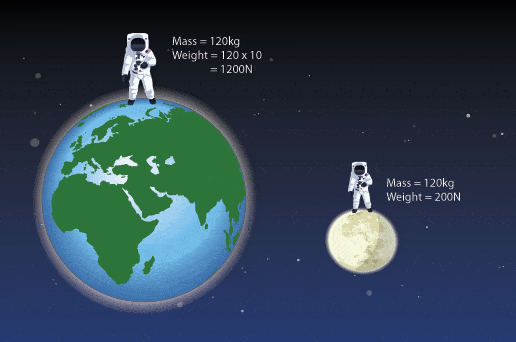
Which of the following will not change in different gravitational fields?
a)
weight
b)
force
c)
mass
d)
pounds
198.
A force of attraction between 2 object that is directly related to mass and indirectly related to distance.
a)
mass
b)
weight
c)
gravity
d)
kilogram
199.
As mass increases, what happens to gravitational force?
a)
increases
b)
decreases
c)
stays the same
d)
i don't know
200.
When an object is falling, and it reaches it's maximum speed because air resistance is equal to the force of gravity, the object has reached __________________________.
a)
Free Fall
b)
Terminal Velocity
c)
Projectile Motion
d)
Orbit
201.
If a bowling ball and a feather were dropped at the same time, in a room with no air resistance (vacuum), which object will hit the ground first?
a)
Bowling Ball
b)
Feather
c)
Both would hit at the same time
d)
Neither one would hit the ground because air is what pushing things down.