
 Worksheets
Air and Flight Unit Test
Total questions: 26
Worksheet time: 13mins
Name
Class
Date
1.
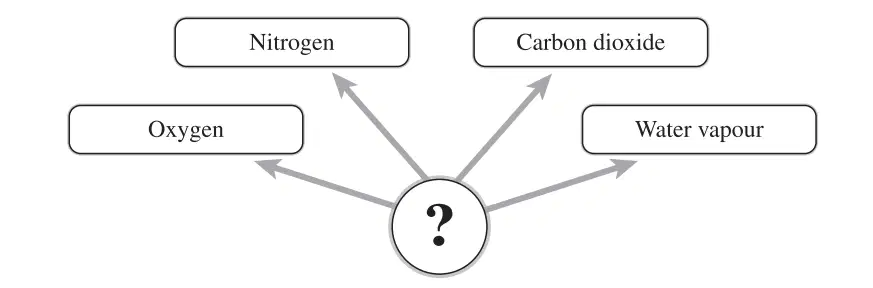
Which of the following titles would most accurately complete the missing information in the concept map above?
a)
Volume of air
b)
Components of air
c)
Atmospheric pressure
d)
Rocket-fuel ingredients
2.
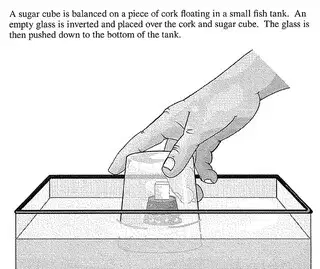
When the glass reaches the bottom of the tank, the sugar cube will most likely
a)
stay dry, because the air in the glass will expand.
b)
stay dry, because the air in the glass will take up space.
c)
get wet, because the water will exert less pressure than the air.
d)
get wet, because the water will exert more pressure than the air.
3.
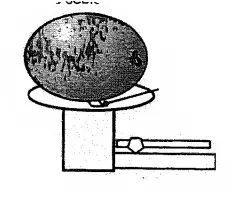
If we put an empty balloon on a scale, then blow it up and put it on the scale again, what property of air will best be illustrated?
a)
Air has mass
b)
Air is invisible
c)
Air occupies space
d)
Air can be compressed
e)
Option 5
4.
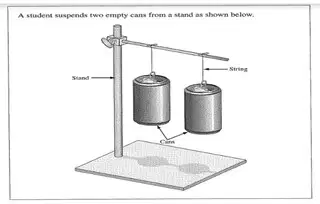
If a constant stream of air is blown in between the two cans, then the cans will most likely move
a)
up and down.
b)
back and forth.
c)
toward each other.
d)
away from each other.
5.
The studets in 6W designed paper airplanes and conducted a test to see which paper airplane would travel the farthest distance. Each student also attempted to describe Bernoulli's Principle. Which student correctly described Bernoulli's Principle?
a)
Nico: "Low pressure is caused by slower moving air."
b)
Kaci: "High air pressure is a result of faster moving air."
c)
Chloe: "The slower the air moves, the more air pressure descreases."
d)
Chase: "Faster moving air lower air pressure."
6.
Airplanes and sports cars both of streamlined designs in order to
a)
reduce gravitational forces
b)
increase thrust forces
c)
reduce drag forces
d)
increase lift forces
7.
Which wing design shown below would produce the greatest lift?
a)
A
b)
B
c)
C
d)
D
8.
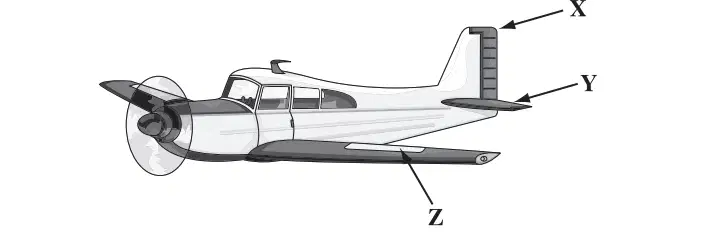
To turn an airplane right, a pilot must use the __i__ labelled __ii__, and to raise an airplane’s nose, a pilot must use the ___iii__ labelled ____iv____.
a)
rudder X elevators Y
b)
ailerons X rudder Z
c)
ailerons Z elevators X
d)
rudder Y elevators Z
9.
Which of the following modifications to an airplane would produce more thrust for the aircraft?
a)
A
b)
B
c)
C
d)
D
10.
Which of the modifications to a model airplane would increase drag?
a)
Using a smaller fuselage.
b)
Using larger wings.
c)
Adding a parachute.
d)
Adding wheels.
11.
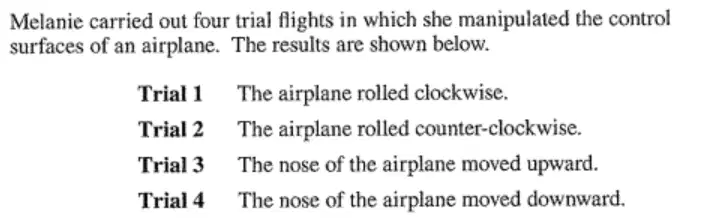
In which trials did the control surfaces act as elevators?
a)
Trials 1 and 2
b)
Trials 1 and 4
c)
Trials 2 and 3
d)
Trials 3 and 4
12.
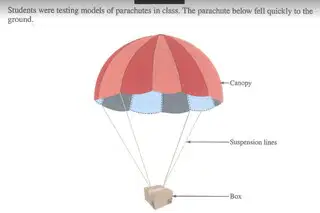
Which of the following modifications would be expected to slow the parachute's fall the most?
a)
Increase canopy size and decrease box size.
b)
Increse canopy size and remove some suspension lines.
c)
Decrease canopy size and increse box size.
d)
Decrease canopy size and add more suspension lines.
13.
Parachutes cause objects to fall to the ground more slowly because they
a)
increase air resistance
b)
decrease air resistance
c)
increase the force of gravity
d)
decrease the force of gravity
14.
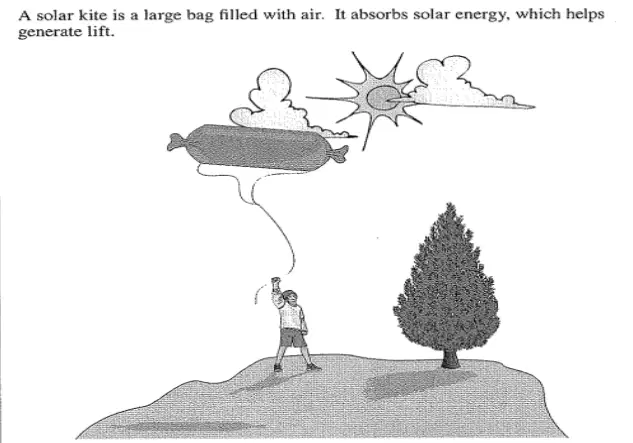
A solar kite rises because the air inside the kite
a)
expands and becomes less dense.
b)
contracts and becomes less dense.
c)
expands and becomes more dense.
d)
contracts and becomes more dense.
15.
A hot air balloon is a floater?
a)
True
b)
False
16.
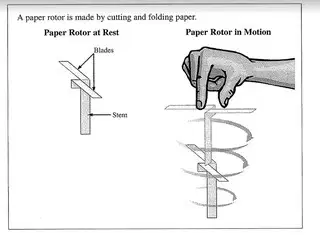
Which force causes the downward movement of the paper rotor?
a)
Gravity
b)
Thrust
c)
Lift
d)
Drag
17.
Helicopters are very different than airplanes because the large rotor blades allows the helicopters to (choose all that apply)
a)
hover in one spot.
b)
go straight up or down.
c)
land without a runway.
d)
fly in space.
e)
fly in extreme temperatures and windy conditions.
18.
The purpose of the fin on a rocket is to
a)
reduce drag.
b)
generate lift.
c)
provide stability.
d)
streamline shape.
19.
What is the meaning of lift as it relates to an airplane?
a)
Backward force
b)
Upward force
c)
Downward force
d)
forward force
20.
Which is NOT an example of an adaptation that helps a bird to fly?
a)
feathers
b)
hollow bones
c)
skin
d)
wings
21.
The part of a bird that acts most like a rudder of an airplane is the bird's
a)
curved wings.
b)
hollow bones.
c)
long tail feathers.
d)
strong chest muscles.
22.
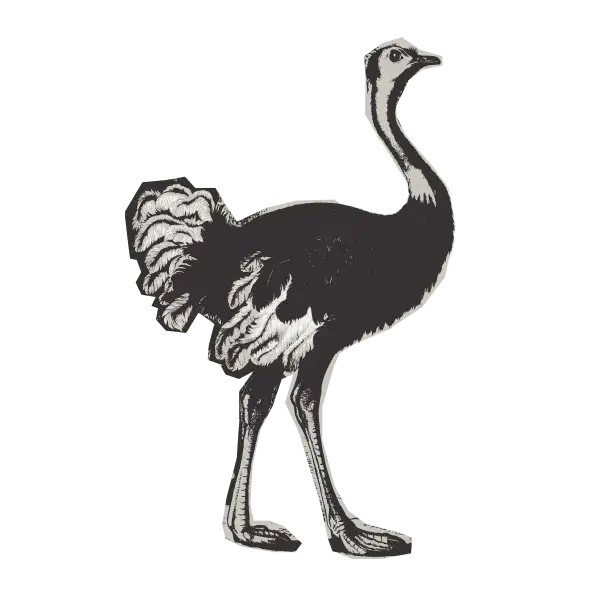
Which of the following factors explains why ostriches cannot fly?
a)
Their bodies are not streamlined enough to overcome air resistance.
b)
Their wings do not generate enough lift to overcome gravity.
c)
They cannot generate enough speed to overcome gravity.
d)
They cannot tuck in their legs enough to decrease drag.
23.
Which of the following relationships between forces would allow a bird that is flying to maintain the same height in the sky while increasing speed as it moves forward?
a)
Thrust and drag are equal; lift is less than gravity.
b)
Thrust and drag are equal; lift is greater than gravity.
c)
Gravity and lift are equal; thrust is less than drag.
d)
Gravity and lift are equal; thrust is greater than drag.
24.
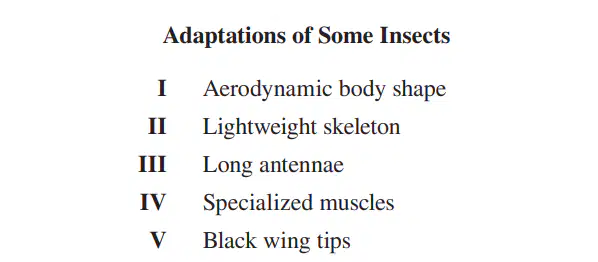
Which of the adaptations listed above do not improve the ability of an insect to fly?
a)
I and II
b)
II and V
c)
III and IV
d)
III and V
25.
State one difference between an airplane and a rocket.
4 lines
26.
What was your favorite activity that we completed throughout this unit and what did it teach you about air and flight?
4 lines
100 %

