
 Worksheets
Advanced Physics Final Review
Total questions: 100
Worksheet time: 2hrs 40mins


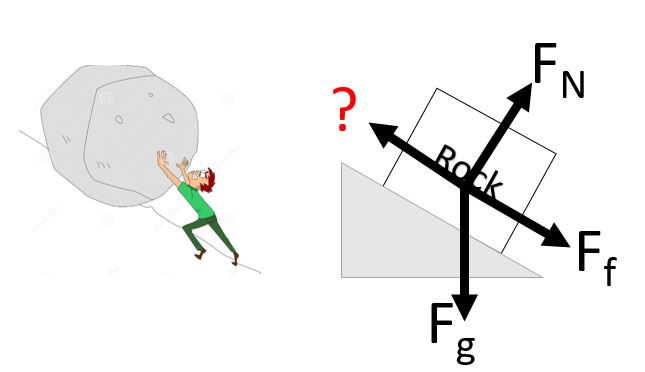
What is the magnitude of the force causing the box to accelerate? What direction will it accelerate?
ΣF = 65N North
ΣF = 15N North
ΣF = 15N South
ΣF = 0N @ Equilibrium
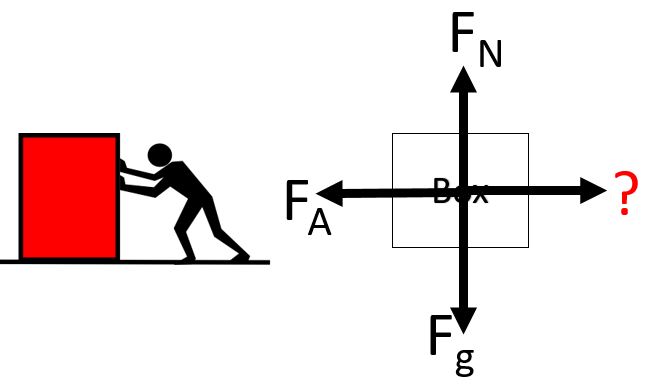
What is the magnitude of the force causing the box to accelerate? What direction will it accelerate?
ΣF = 65N North
ΣF = 15N North
ΣF = 15N South
ΣF = 0N @ Equilibrium
What do the arrows or vectors represent?
forces acting on the object
all the acceleration acting on the object
all the ways an object can move
Is force a vector?
yes
no
What is the upward force called ?
Force of Gravity
Force of Fricton
Normal Force
Force Applied
What is the downward force?
Force of gravity
Force applied
Force of Friction
Normal Force

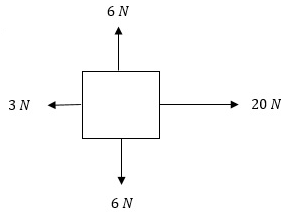
What is the NET FORCE of this diagram?
17 N, right
17 N, left
23 N, right
12 N, up
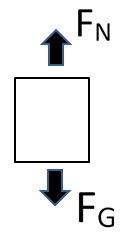
Which of the following is true about this free-body diagram?
the forces are are balanced
the object is free-falling
the object is moving upward
the forces are unbalanced

What law is best described
1st
2nd
3rd
law of motion


A pilot experiences centripetal acceleration of 2g's (2 x 9.8 m/s2) while maneuvering a loop at a speed of 400 m/s. What is the radius of the loop?
203 m
8163 m
80,003 m
23 m
Two factors that determine work are...
Force
Mass
Velocity
Distance
Fred kicks a ball with a force of 20N to George, who is 5M away.
How much work was done to the ball?
25 J
100 J
4 J
75 J
If you push a cart with a force of 60 N for 2 m... how much work have you done?
120 J
30 J
120 N
30 N

If the ball has a mass of 4kg, what would be the velocity of the ball at the position indicated by the blue circle?
KE = 21mv2
0 m/s
5 m/s
25 m/s
Match the variables with the correct answer.
W = F x d
F = 20 N
d = 5 m
100 J
W = 15 J
d = 5 m
3 N
W = 20 J
F = 2 N
10 m
F = 8 N
d = 4 m
32 J

30 watts
3 watts
120 watts
270 watts
0.125 s
8 s
64800 s
80 s
An engine's output of energy is 2250 Joules every 3 seconds. How much power did the engine develop in that time?
3 Watts
750 Watts
250 Watts
2250 Watts
Which type of energy has to do with objects in motion?
Potential
Kinetic

When gasoline is burned in a car engine, ________ energy is converted into _________ energy.
thermal, chemical
chemical, potential
mechanical, chemical
chemical, mechanical

What energy conversion is taking place in this picture?
solar energy to thermal energy
thermal energy to chemical energy
chemical energy to thermal and radiant (light) energy
Match these conversions

kinetic to electrical

chemcial to radiant/thermal

electrical to thermal

chemical to thermal/kinetic

chemical to electromagnetic
What is the correct unit for energy?
meters (m)
kilogram meters per second (kg m/s)
Newtons (N)
Joules (J)

Determine the kinetic energy of an 80 kg skydiver falling at a terminal speed of 55 m/s.
2200 J
43,120 J
121,000 J
242,000 J
Calculate the kinetic energy of a moving 4 kg object travelling at a velocity of 3 m/s.
18 J
36 J
12 J
6 J

A cheetah can run briefly with a speed of 31.0 m/s. Suppose a cheetah with a mass of 47.0 kg runs at this speed. What is the cheetah’s kinetic energy?
1457 Joules
22,584 Joules
15 Joules
45,167Joules
Which of the variables control the amount of momentum an object has?(Multiple answers)
displacement
Velocity
Mass
Magnetic Fields
A car 5kg crashes into the wall going 6m/s. If the car needs to exert 50N of force on the wall, how much force is the wall applying to the car?
300N
80N
30N
50N

What is the momentum if the mass of an object is 50.0 kg and it has a velocity of 25.0 m/s?
2.00 kg·m/s
125 kg·m/s
10.0 kg·m/s
1250 kg·m/s

A 3.0 kg cart has a momentum of 18 kg m/s. What is its velocity?
6.0 m/s
54 m/s
0.17 m/s
15 m/s
The units for impulse are
kg
N·s
N
m/s
kg·m/s
The momentum of an object depends upon the object's ___________&_____________.
mass and energy
mass and veloctiy
mass and speed
size and shape
What is the formula for calculating kinetic energy?
KE = m * v^2
KE = m + v^2
KE = 0.5 * m * v
KE = 0.5 * m * v^2
A car with a mass of 1500 kg is traveling at a speed of 20 m/s. What is its kinetic energy?
250000 J
300000 J
150000 J
200000 J
If an object has a kinetic energy of 200 J and a mass of 50 kg, what is its speed?
8 m/s
10 m/s
2 m/s
4 m/s
What is the formula for calculating potential energy?
PE = mgh
PE = mgh^2
PE = m^2gh
PE = 2mgh
A 5 kg object is lifted to a height of 10 meters. What is its potential energy?
490 J
750 J
200 J
100 J
A collision occurs when ...
two or more objects hit each other with a force.
an object in motion stays in motion.
when an object at rest stays at rest.
Inertia is ...
When two objects hit each other with force.
A measurement on how easy it will be to stop a moving object.
The tendency of an object at rest to stay at rest or an object in motion to stay in motion.
Collisions where objects BOUNCE apart.
inelastic collisions
elastic collisions
explosions
none of these
Collision where objects collide, and stick together.
inelastic collision
elastic collision
explosion
none of these
A 2200kg car travelling at 30m/s collides with another 2200kg car that is at rest. The two bumpers lock and he cars move forward together. What is their final velocity?
30 m/s
15 m/s
0 m/s
12.5 m/s
A 10kg ball moving at 13 m/s strikes a 20kg ball at rest. After the collision the 10kg ball is moving with a velocity of 7 m/s. What is the velocity of the second ball?
3 m/s
12 m/s
6 m/s
4 m/s
2 cars crash head-on, causing them to smash together.
Elastic
Inelastic
Perfectly inelastic
2 cars crash, the first car hits the second car on the side, causing the second car to spin off the road.
Elastic
Inelastic
Perfectly inelastic
The momentum after objects collide in a perfectly inelastic collision is written as:
m1m2+v1,iv2,i
m1v1,i+m2v2,i
21m1v1,i2+21m2v2,i2
(m1+m2)vf
The momentum before objects collide is always written as:
m1m2+v1,iv2,i
m1v1,i+m2v2,i
21m1v1,i2+21m2v2,i2
(m1+m2)vf
Hockey puck A (2kg) travels with a velocity of 40m/s to the right when it collides with hockey puck B (1.6kg), which was originally at rest. After the collision, puck A is stationary. Assume no external forces are in play and that the momentum of the pucks are conserved. What is the final velocity of puck B after the collision?
50 m/s
48 m/s
55 m/s
45 m/s
A 12kg ball moving at 37m/s strikes a second ball at rest. After the collision the 12kg ball is moving with a velocity of 19m/s and the second ball is moving with a velocity of 4m/s. What is the mass of the second ball?
35 kg
92 kg
18 kg
54 kg

This is an example of a ...
Longitudinal Wave
Wiggly Wave
Transverse Wave
Standing Wave

This is an example of a ....
Longitudinal Wave
Squishy Wave
Transverse Wave
Standing Wave

The number 3 is pointing to the ...
Trough
Crest
Wavelength
Amplitude

Red line #1 is the ...
Trough
Crest
Wavelength
Amplitude

Number 4 is pointing to the ...
Trough
Crest
Wavelength
Amplitude

Red line #2 is the ...
Trough
Crest
Wavelength
Amplitude
The length traveled in one cycle is the ...
Wave Speed
Frequency
Wavelength
Amplitude
Period
The number of wave cycles in a unit of time is the ...
Wave Speed
Frequency
Wavelength
Amplitude
Period
The maximum displacement from the midpoint is the ...
Wave speed
Frequency
Wavelength
Amplitude
Period
The motion of the medium and the motion of the particles are parallel.
Transverse Wave
Longitudinal Wave
A wave has a wavelength of 15m and a frequency of 10Hz. What is the wave speed?
1.5 m/s
1.5m/s2
150 m/s
150 m/s2
Reorder the following from lowest to highest energy:
Radio
Infrared
Visible light
Ultraviolet
X-ray
Which of these types of electromagnetic energy has the longest wavelength?
Gamma rays
Radio
X-rays
Infrared
As you increase the frequency of a wave, the energy -
Increases
Decreases
As you increase the frequency of a wave, the wavelength -
Increases
Decreases
Which electromagnetic wave has the longest wavelength?
gamma rays
infrared radiation
radio waves
visible light
Which electromagnetic wave has the lowest energy?
gamma rays
infrared radiation
radio waves
visible light
As the frequency of a wave increases, the energy...
increases
decreases
stays the same
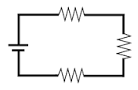

What voltage is needed to cause a 50A current flow through a 10Ω resistor?
15V
500V
500 kV
0.2V

