
 Worksheets
AQA DT
Total questions: 20
Worksheet time: 25mins
A designer has created a security system for use in a home. The system is intended to alert the homeowner to an intruder. What is the input in this system?
Alarm sound
Automatic message sent to mobile phone
Flashing light
Motion sensor

When a person sits on this stool, what is the main force on the stool leg?
Compression
Shear
Tension
Torsion
Which of the following metals should not be used outdoors without a protective coating of a different material?
Aluminium alloy
Copper
Low carbon steel
Zinc
Which one of the following is a production method based on providing stock as it is needed?
Computer Aided Manufacture
Flexible Manufacturing
Integrated Manufacture
Just in Time Manufacturing
Which one of the following statements is true?
Balsa is a natural material used in model making
Medium Density Fibreboard is a man-made material commonly used for outdoor furniture
Silk is a man-made material used in the textiles industry
Urea formaldehyde is a natural material used to manufacture electrical sockets
What is the definition of a smart material?
A material that can hold data
A material that can withstand excessive force
A material that reacts to changes in the environment
A material that shrinks when heated
Designers often create products that they know will have a limited life span. What is this called?
Design for disassembly
Design for maintenance
Planning for manufacture
Planned obsolescence
Which of the following is a thermosetting polymer?
Acrylic (PMMA)
High Density Polythene (HDPE)
Polyester resin (PR)
Polypropylene (PP)
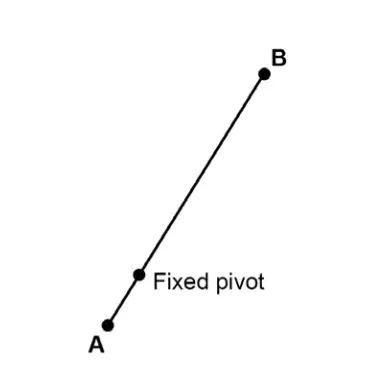
The diagram below shows the movement of a lever which is part of a toy. The distance from point A to the pivot is 10mm. The distance from point B to the pivot is 40mm. If point A moves 10mm to the right, how far would point B move to the left?
10mm
20mm
40mm
50mm
Which one of the following is a softwood?
Beech
Mahogany
Oak
Spruce
State two properties of natural fibres that make them suitable for clothing.
(a)
Daniel and Elsie are working on a project about packaging materials. State two reasons why corrugated cardboard is used as packaging for cooked pizzas: _____ and _____
(a)
Some people are opposed to the use of renewable energy sources because (a) .
The amount of renewable energy generated in 2015 was 83.3 Terawatt hours (TWh). The ratio of solar power to other forms of renewable energy was 1:10. What amount of energy was attributed to solar power? Give your answer to 1 decimal point.
8.3 TWh
7.6 TWh
7.5 TWh
8.0 TWh
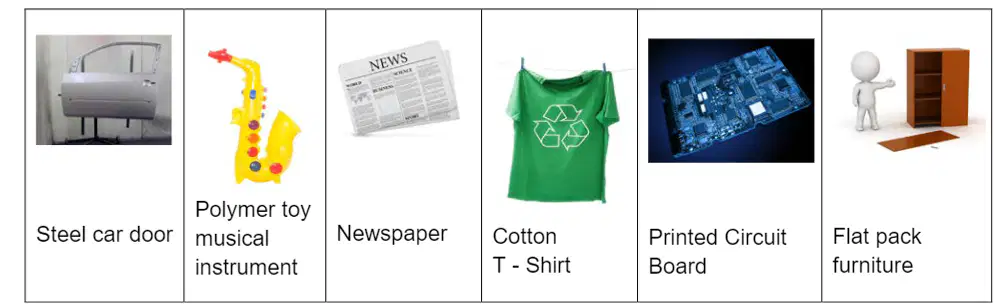
Choose one of the products in the table. Name one of the primary sources/origins it is made from.
(a)
Which of the following are ways that materials and/or products are strengthened or reinforced?
Using composite materials
Applying heat treatment
Painting the surface
Using adhesives
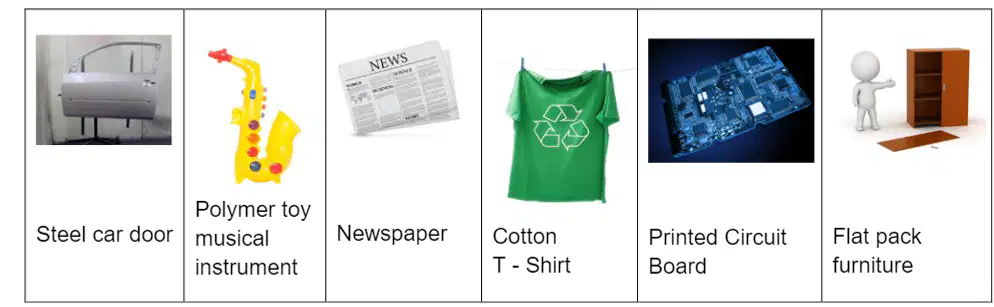
Choose one product or component and describe two features that make it suitable for mass production.
(a)
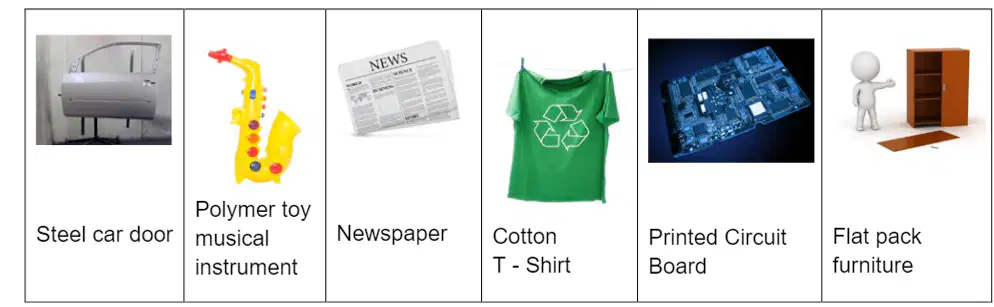
Name one industrial process used in the manufacture of the product or component.
(a)
Circle one of the following and give two reasons why its characteristics or physical properties are suitable for its intended use.
Silk – for use in a men’s tie
Pine – for a bedroom wardrobe
Foam core board – for a display board
Polypropylene – for a school stacking chair
Brass – for a trumpet
Designers sometimes choose materials according to their impact on society and the environment. Examples include the use of fair trade cotton, recycled components and biodegradable packaging. The use of such materials might be seen as:
An ethical choice
A cost-saving measure
A marketing strategy
A regulatory requirement

