
 Worksheets
final review 1
Total questions: 104
Worksheet time: 1hrs 17mins
What shape is the path of a projectile?
hyperbola
circle
parabola
triangle
What is the acceleration due to gravity?
(a)

What launch angle would have the same range as a projectile launched at 20°?
90
70
60
80
What is the path of a projectile called?
(a)
Is projectile motion one dimensional?
yes it's one dimensional
no it's two dimensional
no it's three dimensional
Which direction, horizontal or vertical has acceleration?
horizontal
vertical
Which direction, horizontal or vertical has constant speed?
horizontal
vertical
Two identical balls roll off the edge of a table. One leaves the table traveling twice the speed of the other. Which ball hits the floor first? Explain why.
Draw vector arrows representing the vx and vy velocity components during the course of the motion. The length of the arrows should represent the magnitude of the velocity components.

Draw vector arrows representing the vx and vy velocity components during the course of the motion.


At what point is vy= 0 m/s?
A
B
C
D
None of these points
At what point is vx= 0 m/s?
A
B
C
D
None of these points


What is the horizontal acceleration of a projectile?
The distance and direction an object moves from a starting position is the object's ____________.
displacement
position
distance
speed
If you travel 1.5 km north from your house at noon, and at 6pm you travel 5 km south, what is your displacement?
6.5 km north
6.5 km south
3.5 km north
3.5 km south
In the morning you leave home and walk 0.5km to a friend's house. At 11:30 am you return home, then travel by car to the mall, which is 10 km away, and arrive at 11:45 am. What is the total distance traveled?
2.8 km/h
10 km
10.5 km
11 km
You go to the mall 10 km away and take 15 minutes to get there. What is your speed?
0.67 km/min
2.8 km/h
0.67 km/h
2.8 km/min
average speed is found by ______________.
displacement/total time
total distance/total time
displacement * total time
total distance * total time
Kendra is walking home and her house is 200 m away. It takes her 20 seconds to get home. What was her speed?
400 m/s
200 m/s
25 m/s
10 m/s
Abby is driving at a speed of 30 km/hr over a distance of 600 km. How long will it take her to go 600 km?
300 hr
20 hr
15 hr
90 hr
Aaron is driving 70 km/hr for 3 hours. What distance did he cover?
25 km
210 km
70 km
1.5 km
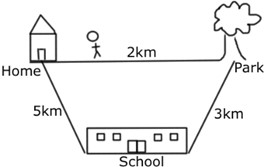
Jerry walked from home to school, then from the school to the park. What is his total distance?
2 km
5 km
8 km
10 km
Jerry walked from home to school, then from the school to the park. What is his total displacement?
2 km
5 km
8 km
10 km
Remember Newton's Laws? Which Law is the Action-Reaction Pairs?
First
Second
Third
Let's say that in our example of the 10 kg weight suspended by a rope, that, instead of being fixed to a wooden beam, the rope is actually being used to pull the weight upwards at an acceleration of 1 m/s2.
If it returns to its shape after being deformed, it's called what?
(a)
A spring is 0.38m long. When it is pulled by a force of 2.0 N, it stretches to 0.42 m. What is the spring constant? Assume the spring behaves elastically.

Are these two situations the same?
Yes, same magnitude of force
No, different type of force
Not enough information
Label the forces acting in this picture.
applied force
tension
normal
gravity

push or pull that causes an object to move, stop, or change direction
force
unit used to measure force
Newton
something returning to its original shape after being squeezed or stretched
elastic
force transmitted through a rope , string, cable, or wire when it is pulled tight by forces acting from opposite ends
tension
push or pull exerted by a magnet
magnetism
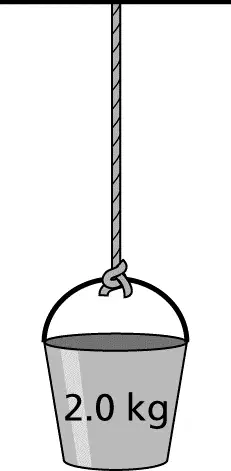
The figure shows a bucket hanging motionless from a rope. Assume that the rope has no mass. What is the net force on the bucket?
0 N
2.0 N
9.8 N
2.0 ×101N
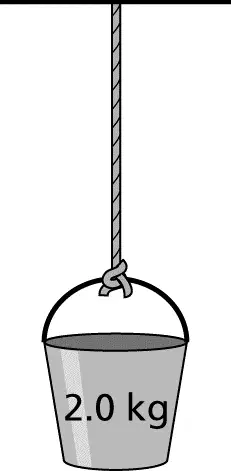
What is the tension on the rope?
9.8 N
10 N
14.2 N
19.6 N
The amount of sliding friction depends on which things?
acceleration
type of surface
weight of the moving object
velocity
Which of the following is NOT used to reduce friction?
wheels
sandpaper
bumpy rocks
bacon grease
Which of the following is NOT considered a "fluid"
air
jeans
water
carpet
Which of the following best describes two surfaces that are in contact with each other but are not in motion?
kinetic friction
static friction
Which of the following is involved in a glider going through the air
fluid friction
static friction
rolling friction
sliding friction
A car driving is an example of what type of friction
fluid friction
static friction
rolling friction
sliding friction
What is static friction?
the friction between two objects that are not moving
friction between a rolling object and the surface that it is rolling on
the friction between two objects that are rubbing against each other
friction of something going through any type of liquid or air
What is rolling friction?
the friction between two objects that are not moving
friction between a rolling object and the surface that it is rolling on
the friction between two objects that are rubbing against each other
friction of something going through any type of liquid or air
What is fluid friction?
the friction between two objects that are not moving
friction between a rolling object and the surface that it is rolling on
the friction between two objects that are rubbing against each other
friction of something going through any type of liquid or air
What is sliding friction?
the friction between two objects that are not moving
friction between a rolling object and the surface that it is rolling on
the friction between two objects that are rubbing against each other
friction of something going through any type of liquid or air
On which surface would a toy car travel the furthest when pushed?
ice
carpet
snow
sand
Rough surfaces have ___ compared to smoother surfaces.
greater friction
less friction
the same level of friction
no friction
The two factors that determine the amount of friction between two objects are...?
force
velocity
color
Which of the following scenarios will have the MOST friction
Smooth object over smooth surface
Smooth object over rough surface
Rough object over smooth surface
Rough object over rough surface
It is difficult to walk on an oily floor because
The force of friction is very high
The force of friction is much less
We don't like to because it messes up our shoes
Something else
If Mars is on average 225,000,000 km from the Earth determine the time (in minutes) it takes a radio signal to travel from Earth to Mars and back.
When the wavelength increases the frequency will
increase
decrease
remain same
none of these
Electromagnetic waves are this type of wave: (a) .
Label the order of the waves
Which of the following electromagnetic waves is given off as heat?
Radio Waves
Infrared Rays
Visible Light
Gamma Rays
Which EM waves are invisible? (more than one correct answer)
x-ray
visible
ultraviolet
infrared
Which wavelengths of the EM spectrum are dangerous to life?
radio, micro and gamma
gamma, infrared, and UV
Infrared, UV and X Rays
UV, X rays and Gamma
Vocabulary check
Modulation
add the signal wave to the carrier wave
Digital signal
Signal that is only on or off
Analog signal
Signal that can vary smoothly
GPS
global positioning system
transceiver
transmits and receives different signals
Why do people see distant events before they hear them?
Light travels faster than sound.
Sound travels faster than light.
Human eyes are more sensitive than human ears.
Human brains can only process events in that order.
How do radio waves work?
A radio works by converting a specific wavelength into vibrations, generating sound from the speakers.
They work by going trough and playing sound
They work by going into the cord and play sound
Radio waves work by converting vibration to speakers
Vocabulary Check
when wave acts like particle
Photon
vibrating electric charges
Electromagnetic Wave
the shortest EM wave
Gamma
Match the following
How much energy is tranferred
Intensity
How we experience intensity
Loudness
High or low (frequency)
Pitch
unit for loudness
decibel (dB)
change in pitch because of motion
Doppler Effect
Match the following
sounds used in a regular pattern
music
difference in sounds of same pitch and loudness
sound quality
hollow chamber to amplify sound
resonator
Match the following
Using reflected soundwaves underwater to detect
Sonar
The study of sound
Acoustics
Natural detection of objects using reflected sound
Echolocation
Sound with frequency > 20,000 Hz
Ultrasound
Which is one way that ultrasound technology may be used?
repairing fractured bones
detecting misplaced electrical equipment
cleaning jewelry
noise canceling headphones
sound wave
longitudinal wave that can only travel through matter
compression
when particles in a wave are packed closely together
rarefaction
when particles in a wave are spread apart
pitch
the perception of how high or low a sound seems
echo
when a sound wave is reflected
Sound Waves
are Longitudinal waves.
are Surface Waves.
are Transverse Waves
move in a circular motion.
High frequency sounds have ______ pitch.
high
low
Which is an example of the doppler effect?
The apparent change in pitch of a police siren as it passes you.
The delay in sound between the lightning and thunder.
The change in pressure in your ears when driving up a mountain.
When you can no longer hear a sound as the pitch increases.
Mechanical Waves
consist of Transverse, Surface and Electromagnetic.
do not require a medium to pass through.
require a medium to pass through.
Sound waves cannot travel through which of these ____.
wood
stone
outer space
air
In which of these types of media will sound travel faster?
solid
liquid
gas
vaccum
Sound travels at 343 m/s in air. If a bat sends out a sound to echolocate to an object 1,029 meters away, how long until it hears the echo?
3 s
6 s
69,000 m
3 m
Which of the following is the term that describes the frequency at which a material tends to vibrate when it is disturbed?
pitch
sound quality
resonance
natural frequency
Vocab pre-check
opaque
no light goes through
transparent
clear
translucent
some light goes through
mirage
illusion image made from refraction
index of refraction
how much the speed is reduced

Which statement best explains what is happening in this picture?
The light is being reflected which makes the spoon appear broken.
The light is being refracted which makes the spoon appear broken.
The light is being absorbed which makes the spoon appear broken.
The light is being transparent which makes the spoon appear broken.
An object’s color is determined by the color of light it ______________.
absorbs
reflects
produces
radiates
When white light shines on Peter’s shirt, the shirt looks blue. Why does the shirt look blue?
It gives off its own blue light.
It absorbs only the blue part of the light.
It absorbs all the white light and turns most of it into blue light.
It reflects the blue part of the light and absorbs most of the rest of the colors of light.
A student places a sheet of black construction paper on her desk. What happens to most of the light that strikes the black construction paper?
The light is bent by the paper.
The light reflects off the paper.
The light is absorbed by the paper.
The light passes through the paper.

When light goes from one medium to another (for example from air to water), it bends.
What is this called?
Reflection
Refraction
Absorption

How can the girl see the letters on the book?
Light hits the book and reflects to her eyes.
Light gets absorbed by the book.
Light refracts when it goes from the air to the book.
All of the above.
Select ALL pictures that show light being refracted.


Why do we feel warm when we stand under the light?
Because light reflects off our clothes.
Because light refracts when it goes from the air to our clothes.
Because light is absorbed by our clothes and turns into heat.
None of the above.
Newton’s prism experiments showed that white sunlight is made up of
the full electromagnetic spectrum.
only blue light.
all the colors of the visible spectrum.
only the longest wavelengths.
Which has the highest frequency?
blue light
green light
yellow light
red light

What type of object is a mirror considered?
opaque
transparent
translucent

The angle of reflection is
90 degrees
55 degrees
45 degrees
135 degrees

