
 Worksheets
Y10 CS EOY_Phy
Total questions: 150
Worksheet time: 3hrs 20mins
Which of the following apparatus is used to measure the volume of liquid?
Stopwatch
Thermometer
Measuring cylinder

what is the area for this surface?
9 cm2
4 cm2
20 cm2
5 cm2

what is the volume of the rock?
10 ml
30 ml
40 ml
70 ml


What is the basic unit of length in the metric system?
gram
meter
Liter
cm3
1. An example of scalar magnitude is _____.
mass
force
acceleration
velocity

8m
A (a) is a quantity that has magnitude but no direction.
A vehicle travels 2345 m in 315 s toward the evening sun. What is its speed?
7.44 m/s
0.13 m/s
738,675 m/s
7.44m
What distance will a car traveling 65 km/hr travel in 180 min?
11,700 m
195 m
21.7 m
2.77 m


A helicopters speed increases from 25 m/s to 60 m/s in 5 seconds. What is the acceleration of this helicopter?
-7 m/ss
7 m/s2
35 m/s2
-35 m/s2
How do you calculate average speed?
total distance / total time
total time / total distance
total distance x total time
total distance x total time
Match the graph to the description:
"The car is traveling at a constant speed."
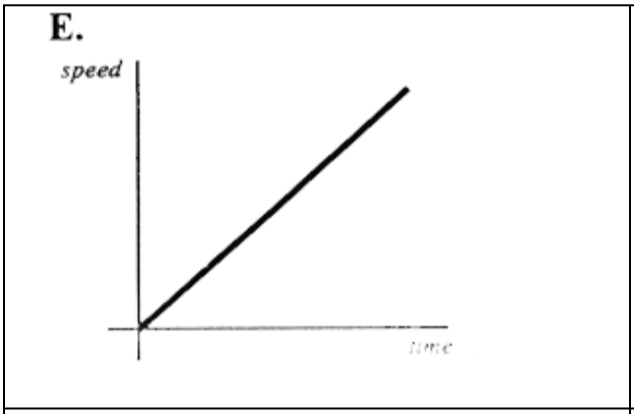
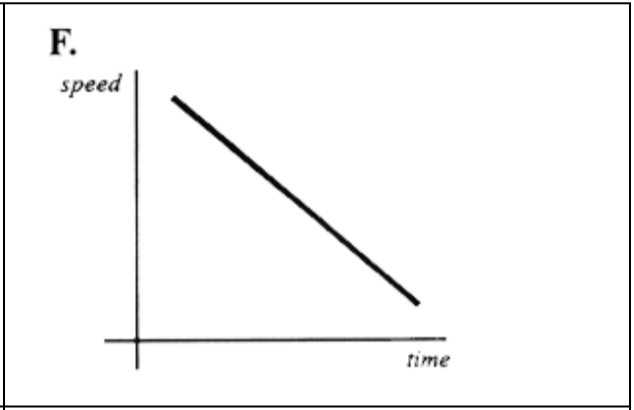
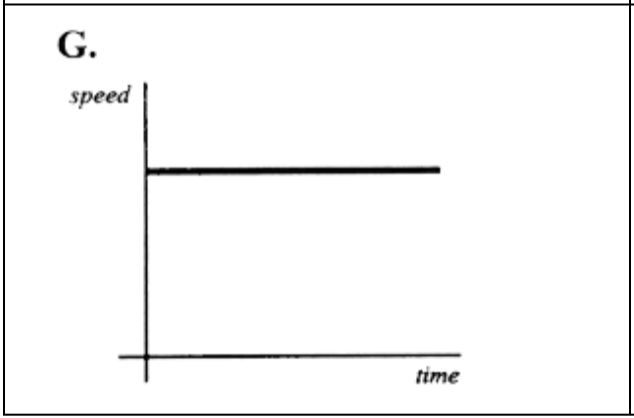
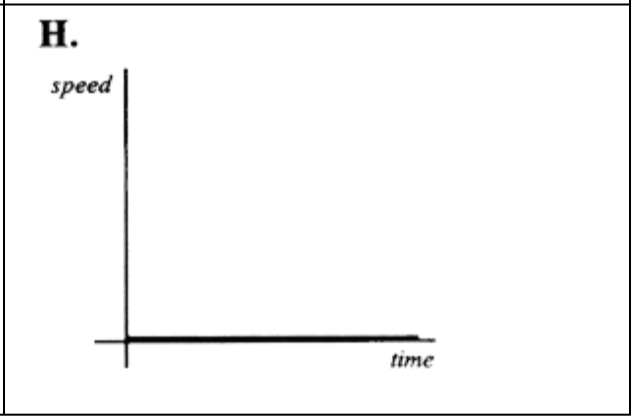
Match the graph to the description:
"The car is accelerating speeding up (positive acceleration)."
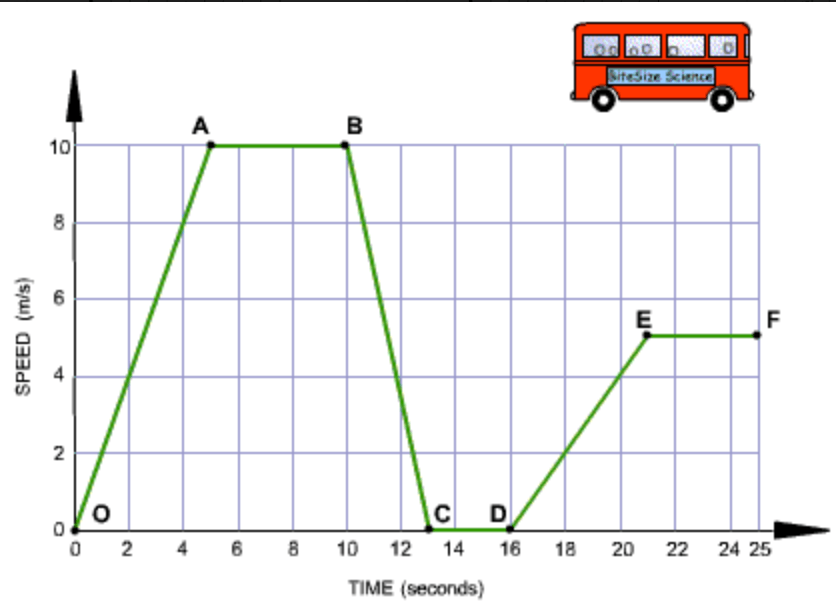
Segment A-B: The bus is moving at a _________________ of 10 m/s for 5 seconds.
accelerating
decelerating
constant speed
at rest
Segment B-C: The bus is _________________. It is slowing down from 10 m/s rest in 3 seconds.
accelerating
decelerating
constant speed
at rest
Segment C-D: The bus is _________________. It has stopped.
accelerating
decelerating
constant speed
at rest
A negative acceleration means that your object is _____.
doing nothing
moving in circles
speeding up
slowing down

Describe the motion in the graph:
Constant Speed (positive slope)
Stopped (at rest)
Acceleration (increasing speed)
Return Home (negative slope)
How do you find the speed from a distance-time graph?
Find the area under the graph
Find the gradient of the line
Read the height of the graph

Which line shows the slower pace?
dashed line
solid line
In which of the following graphs below are both runners moving at the same speed?


How do you find the distance travelled from a speed-time graph?
Find the gradient
Find the area under the graph
Read the height of the graph

How long is the train stopped for in total?
5 minutes
7.5 minutes
10 minutes
2.5 minutes
Weight is an example of which quantity?
acceleration
force
mass
pressure
The mass of an astronaut is 70kg on the Moon. What is the mass of the astronaut on the Earth?
7kg
70kg
80kg
700kg
A student lifts a sack of mass 50 kg through a vertical distance of 2.4 m in 0.80 s.
The gravitational field strength g is 10N/kg.
What is the weight of the sack?
500 kg
500 N
500 N/kg
50 kg
A pumpkin is dropped from a 35 m building. What is its initial velocity, u?
9.8 m/s^2
35 m
0 m/s
9.8 m/s
Free fall is any motion of a body where ____ is the only force acting upon it.
body attraction
tension
gravity
velocity
The acceleration of a freely falling body on Earth is
9.8 m/s.
9.8 m.
9.8 m/s2.
9.8 s.

What causes an object to sink in a water?
if the object's density is less than the water's density.
if the object's density is the same as water's density.
if the object's density is greater than water's density.
if the object's density is zero
What is the formula for Volume?
Mass/Volume
Density x Volume
Mass/Density

What is the formula for density?
d=vm
d=mv
d=m⋅v
d=m+v
If a 10 kilogram object accelerates suddenly at 15 m/s2, how much force was applied to the object?
150 Newtons
15 Newtons
150 kilograms
100 kilograms
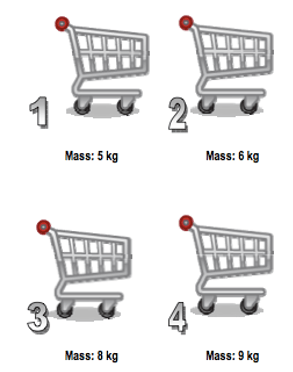


What is the resultant force?
400 N, Up
400 N, Down
800 N, Up
800 N, Down


The head of an arrow represent the __________ of force.
strength
length
direction
If forces on an object are unbalanced, it will _______
make the object to move or change direction.
make it move at same speed.
it will remain still.


What is the resultant/ net force?
30 N left
25 N right
5 N left
55 N right

At point P, _______.
the force applied to the spring is equal to its elongation
Hooke's Law ceases to be valid
the spring is can be stretched but still springs back into shape reversibly
the spring constant increases

When comparing spring A to B,
A has a larger spring constant than B so A is a stiffer spring
B has a larger spring constant than A so A is a stiffer spring
A has a larger spring constant than B so B is a stiffer spring
B has a larger spring constant than A so B is a stiffer spring
the extension of a spring is ___________ to the force applied on the spring.
directly proportional
inversely proportional

Find moment at A
24 kNm
240000 Nm
16 kNm
29000 Nm
Moment (Nm) =
Force (N) x distance (m)
Angular Force (N°) x distance (m)
Work done (J)
Force (N) x distance (s)
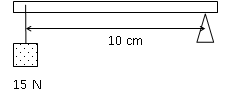
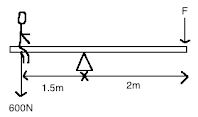
A boy of weight 600N sits on the see-saw as shown at a distance of 1.5m from the pivot. What is the force F required at the other end to balance the see-saw?
450 N
350 N
4.5 N
200 N
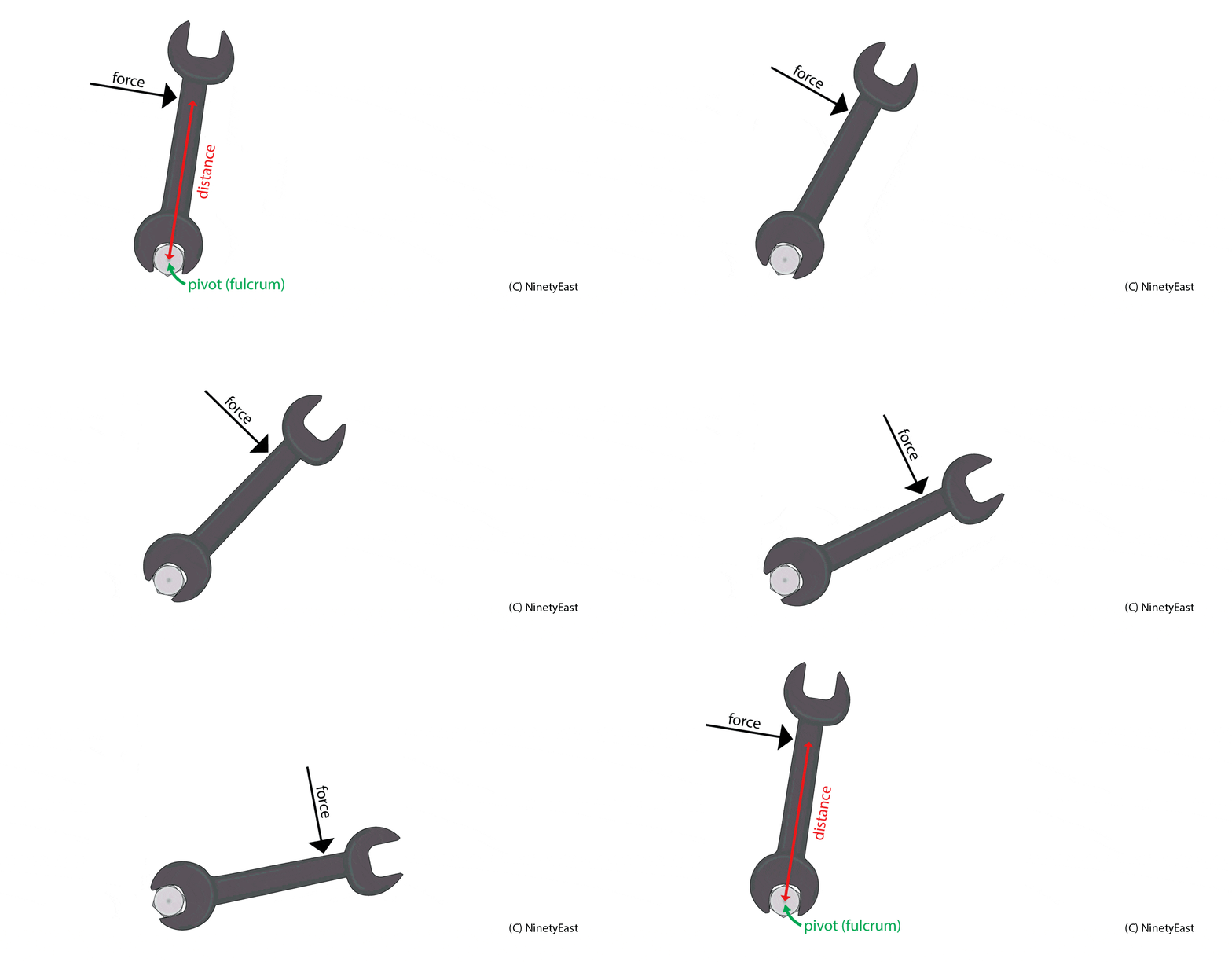
What to we call forces applied to anything that turns?
Minute
Moment
Minimum
Monument
The point through which the whole weight of the body acts is called
Inertial Point
Center of gravity
Centriod
Central point
Center of gravity of an object depends on it's
weight
mass
density
shape

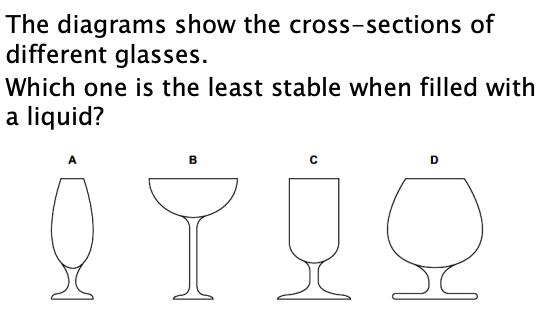
The diagrams show four solid cones. The centre of mass of each cone is marked by a point labelled M.
Which cone is the most stable
A
B
C
D
A
B
C
D

Where does the pendulum have the greatest kinetic energy?
A
B
C
D
E
Where does the pendulum have the greatest potential energy? (pick 2)
A
B
C
D
E
A weight-lifter raises a 2000N weight through a vertical height of 2.0m in 0.80s. What useful power does he develop in doing this?
800 W
700W
4000W
5000W
Two people shove on a wall with 100 N. The wall doesn’t move. How much work is done?
100J
100N
0J
0N
If 40N of force is applied to Rollo Koster's 10 kg cart over a distance of 50 meters, how much work is done?
8000J
8000N
4000J
2000J
There is a 190 kg bell at the top of a tower that is 45 m high. How much GPE does it have?
84000 J
8600 J
820,000 J
What is the correct unit for energy?
meters (m)
kilogram meters per second (kg m/s)
Newtons (N)
Joules (J)

Lilly's cat ran through your yard. The cat has a mass of 5 kg. He is running at a speed of 3 m/s. What is the kinetic energy of the cat as he runs? (KE = 1/2mv2)
8.5 J
45 J
7.5 J
22.5 J

At which position does the child on the swing have the most gravitational potential energy?
W
X
Y
Z
What is the power output of a lightbulb that uses 300 Joules of energy in 60 seconds?
5 Watts
360 Watts
60 Watts
300 Watts

An oven uses 400 J of electricity to produce 300 J of heat. How efficient is it?
133 %
75 %
300 %
.75 %
What is the equation for energy efficiency?
useful outinput × 100
inputuseful output× 100
inputuseful out
input wasteful×100
An oven uses energy to produce heat, light, and sound. If it produces 400 J of heat, 75 J of light, and 50 J of sound, how much input energy did it have?
400 J
500 J
525 J
375 J

Which of the following energy types is not a fossil fuel?
Natural gas
Geothermal
Petroleum
Coal

Which is a negative aspect of the use of petroleum?
It is extracted at a low cost.
It can be easily transported
It produces hazardous substances.
Petroleum is used in many products.

Which is a renewable source of energy?
Uranium
Coal
Waves
Oil

Which non-renewable resource produces the most air pollution?
nuclear energy
wind energy
solar energy
coal

A
B
C
D
Which type of renewable energy uses heat from deep within the earth?
Wind
Solar
Geothermal
Biomass

A cardboard box weighs 30N. If we added weight to the box, what would happen to the pressure?
increase
decrease
stay the same

How has this change affected the force and the pressure exerted by the block on the table?
force=decreased
pressure = decreased
force=decreased
pressure = Unchanged
force=unchanged
pressure = decreased
force=unchanged
pressure = unchanged

Four physics teachers investigate pressure. They wear identical clothes and lie on different beds of nails.
The table gives the weight of each teacher and the total area of contact between the teacher and the nails.
Which teacher experiences the least pressures from the nails?
A
B
C
D

Freezing
Solid to gas
Liquid to solid
Gas to solid

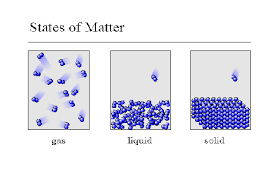
Particles in a ______________________ move quickly and are far apart.
gas
solid
liquid
The slower the particles in a substance move,
the colder it is.
the warmer it is.
the more energy it has.
During boiling, the particles move ______________ and freely to overcome force of attraction.
static
faster
slower

The melting point of the sample is
-60 ºC
-100 ºC
60 ºC
100 ºC

What phase of matter exists in part C of the graph?
Gas
Liquid
Solid
Plasma


The pressure inside the balloon will:
Decrease
Increase
Remain the same
Not enough information to formulate an answer

What happened to the volume between the two steps?
Volume increased
Volume decreased
Volume stayed the same
Pollen grains suspended in water exhibit Brownian motion. How does a particle undergoing Brownian motion move?
In smooth curves
Randomly
Orderly with a pattern
In straight lines with no change of direction

Very small pollen grains are suspended in a beaker of water. A bright light shines from the side. Small, bright dots of light are seen through a microscope. The dots move in rapidly changing, random directions. What are the bright dots?
pollen grains being hit by other pollen grains
pollen grains being hit by water molecules
water molecules being hit by other water molecules
water molecules being hit by pollen grains
Gas pressure is caused by
Gas molecules heating up
Gas molecules reacting with other gas molecules
Gas molecules hitting the walls of a container
Gas molecules hitting other gas molecules
When temperature increases, distance between molecules ______________.
decreases
increases
stays the same
Is the following statement true or false?
An object that expands more when heated, will also contract more when the temperature is reduced
True
False
What effect does Evaporation cause ?
Heating Effect
Magnetic Effect
Cooling Effect
Warming Effect
Which of the following factors thus affect evaporation ?
Increase in Surface Area
Increase in temperature
Increase in Humidity
Decrease in Wind speed
At what temperature does evaporation take place?
Freezing point
Above melting point
Below boiling point
At heating point
Evaporation happens
throughout the liquid
at the surface of a liquid


In a swimming pool, the water near the surface is slightly warmer. The temperature of the water near the top rises because of
Convection
Conduction
Radiation
Too many dogs being in the pool!

A fireman that is at a building that is on fire feels a door and it is hot. Why does his hand feel hot?
Convection
Conduction
Radiation
The Human Torch was on the other side!

In heat transfer, heat always flows from the _______________ object to the _______________ object.
hotter / colder
colder / hotter
hotter / hotter
colder / colder

Which best explains why a hot air balloon floats?
The heated air expands to fill the balloon. The air in the balloon is now lighter than the surrounding air, causing the balloon to rise.
The heated air expands to fill the balloon. The air in the balloon is now heavier than the surrounding air, causing the balloon to rise.
The heated air contracts to fill the balloon. The air in the balloon is now denser than the surrounding air, causing the balloon to rise.
The heated air contracts to fill the balloon. The air in the balloon is now lighter than the surrounding air, causing the balloon to rise.

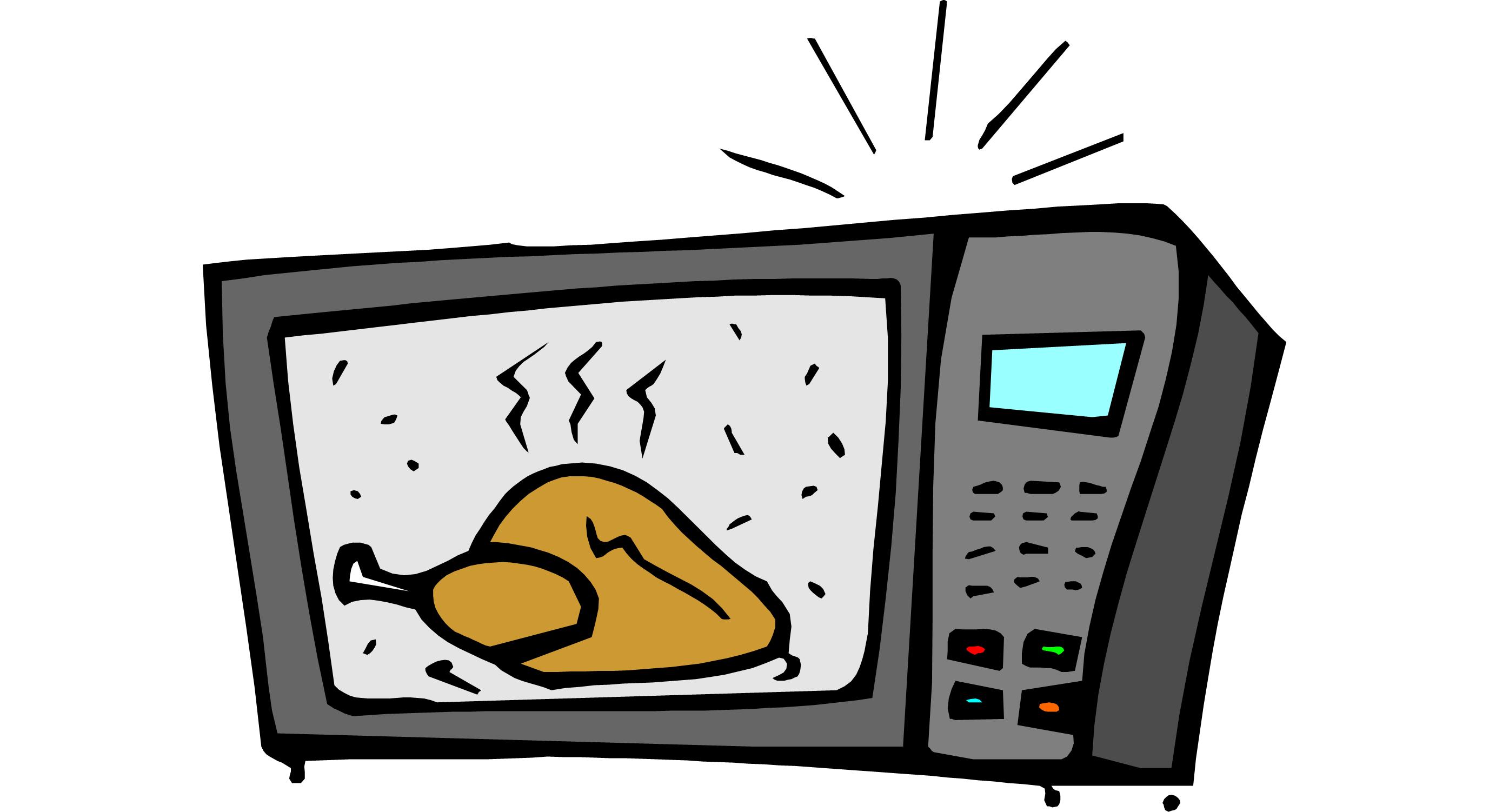
When you use a microwave, what is the main way that heat is transferred?
Convection
Conduction
Radiation
which of the following surfaces is the best emitter of heat?
Matt black
Shiny White
Shiny Silver
Dark Purple
What color is the best at reflecting the heat radiation?
Matte black
Shiny Silver
Black
Red
Heat can transfer through vacuum only by (a)
A wave transfers _____.

Frequency is...
.. the number of waves per second and measured in metres.
the number of waves per second and measured in Volts...
.. the number of waves per second and measured in hertz, Hz.
.. the number of waves per minute and measured in hertz, Hz.
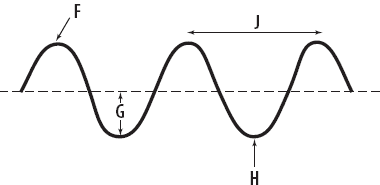
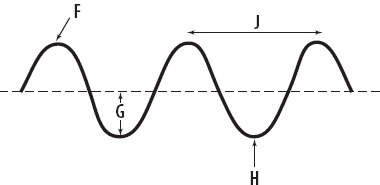
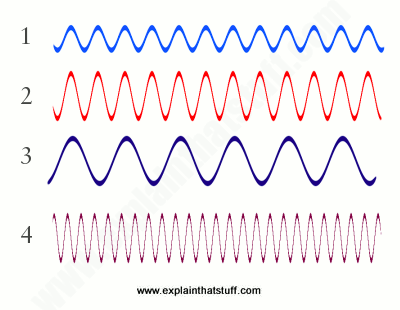
As the frequency of a wave increases, the period _____________.
increases
decreases
stays the same
A wave with a wavelength of 2 cm has a frequency of 3 Hz. What is the wave speed?
1.5 m/s
2 m/s
5 m/s
6 m/s
A wave has a frequency of 4 Hz. What is the period of the wave?
0.25 seconds
0.5 second
1 seconds
4 seconds

What is the approximate wavelength of the wave in the image?
1.5 cm
2 cm
3 cm
9 cm

What happens to the frequency of a wave as it passes through a gap?
Increases
Decreases
No change
None of above

The law of reflection states that
Angle of incidence = Angle of reflection
Angle of incidence = Angle of incidence
Angle of reflection = Angle of translucence
Angle of reflection = Angle of reflection