Wayground logo

Free Printable Worksheets

Font size

S
M
L
XL
Worksheets

science test

Total questions: 155

Worksheet time: 3hrs 8mins

Name
Class
Date
1.

Choose a synonym of "disease"

a)

illness

b)

sickness

c)

protection

d)

vaccination

2.

Choose the one that can make you sick

a)

Bacteria

b)

Virus

c)

Vaccine

d)

Antibiotics

3.

____ is a treatment to produce immunity against a disease

a)

Sickness

b)

Vaccination

c)

Digestion

d)

Invasion

4.

Sneezing, fever, cough, diarrhea, and pain are _____ of an illness.

a)

cells

b)

symptoms

c)

infections

d)

treatments

5.

____ helps the body fight infections and other diseases.

a)

Digestion

b)

Protection

c)

Immune system

6.

Vaccines use very small amount of antigens to help your body's immune system recognize and learn to ________ serious diseases.

a)

play

b)

defend

c)

protect

d)

fight

7.

Antigens are parts of _______ that cause the body’s immune system to go to work.

a)

germs

b)

bacteria

c)

viruses

d)

medicine

8.

Germs are tiny (a)   that can cause infection.

9.

Bacteria, viruses, fungi and protozoa are types of (a)   .

10.

Choose a synonym of "disease"

a)

illness

b)

sickness

c)

protection

d)

vaccination

11.

Choose the one that can make you sick

a)

Bacteria

b)

Virus

c)

Vaccine

d)

Antibiotics

12.

____ is a treatment to produce immunity against a disease

a)

Sickness

b)

Vaccination

c)

Digestion

d)

Invasion

13.

Sneezing, fever, cough, diarrhea, and pain are _____ of an illness.

a)

cells

b)

symptoms

c)

infections

d)

treatments

14.

____ helps the body fight infections and other diseases.

a)

Digestion

b)

Protection

c)

Immune system

15.

Vaccines use very small amount of antigens to help your body's immune system recognize and learn to ________ serious diseases.

a)

play

b)

defend

c)

protect

d)

fight

16.

Antigens are parts of _______ that cause the body’s immune system to go to work.

a)

germs

b)

bacteria

c)

viruses

d)

medicine

17.

Germs are tiny (a)   that can cause infection.

18.

Bacteria, viruses, fungi and protozoa are types of (a)   .

19.

Which of the following is a marine habitat?

a)

Tropical Rainforest

b)

Tropical Coral Reef

c)

Field

20.

What does an adaptation do?

a)

Make animals extinct (die)

b)

Help living things die

c)

Help living things survive in their habitat

21.

How do adaptations help animals?

a)

to hide from predators or other animals

b)

to hunt for food

c)

to survive in their habitats

d)

All of these are correct

22.

An animal's color or pattern that helps it blend or hide into its surroundings is called as:

a)

Environment

b)

Camouflage

c)

Habitat

23.

The main function of a bird's beak is to:

a)

fly

b)

get food

c)

breath

24.

All sharks have fins. This characteristic helps the animal...

a)

To find water

b)

To move and swim

c)

To breathe in oxygen in water

25.
What helps fish swim in water?
a)
fins
b)
bones
c)
lungs
d)
scales
26.
What adaptation helps a frog live in a wet environment?
a)
smooth, wet skin
b)
good eyesight
c)
light color
d)
dry, rough skin
27.

What characteristics helps lions catch and eat their prey?

a)

Sharp claws and teeth with strong jaw

b)

Thick fur

c)

Long tail

28.

How does an elephant use its trunk to survive?

a)

To protect its self from predators or other animals

b)

To pick up food, and soak up water

c)

To breathe in oxygen

d)

All of the above

29.

What characteristic helps this animal eat from the top of trees?

a)

Its spots on its body

b)

Its ears

c)

Its mouth

d)

Its long neck

30.

What do animals need to survive?

a)

air

b)

water

c)

food

d)

shelter

e)

all of the above

31.
Where does this animal live?
a)
Beach
b)
Cave
c)
House
d)
Tree
32.

An animal with webbed feet probably lives in the _________.

a)

Tropical Rainforest

b)

Tropical Coral Reef

c)

Pond or Lake

d)

Field

33.

A bear's thick fur will ___________.

a)

help it to move

b)

scare away other animals

c)

keep its body warm in cold environment

34.

What does a beaver use to chop down trees?

a)

Its sharp teeth

b)

Its tail

c)

Its thick hairs or fur

35.

In your own words, define Habitat.

4 lines
36.

In your own words, define Adaptation.

4 lines
37.
A place where plants and animals live and grow naturally is called a ______________.
a)
shelter
b)
tree
c)
habitat
d)
organism
38.

What is the habitat shown in the picture?

a)

jungle

b)

desert

c)

arctic

d)

ocean

39.

What can we find in this habitat?

a)

polar bear

b)

tiger

c)

camel

d)

crocodile

40.

Where can we find this animal?

a)
b)
c)
41.

What is the habitat shown in the picture?

a)

ocean

b)

desert

c)

mountains

d)

jungle

42.

What animals do we find in this habitat?

Choose TWO.

a)
b)
c)
d)
43.

You find _______ in the jungle.

a)

coral

b)

trees

c)

polar bear

d)

shark

44.

Where do we find this animal?

a)
b)
c)
45.

Name the habitat.

a)

polar region

b)

ocean

c)

jungle

d)

desert

46.
What is true about habitats?
a)
they must be warm during the year for plants to survive
b)
they all have different kinds and amounts of soil, water, sunlight, and living things. 
47.
Where does this animal live?
a)
grassland
b)
jungle
c)
ocean
d)
arctic
48.
Habitat means . . .
a)
what an animal eats
b)
what an animal drinks
c)
baby animals
d)
where an animal lives
49.
Which habitat is very dry, has very little plant life, and is too hot to support many animals?
a)
Stream
b)
Forest
c)
Desert
d)
Polar Region
50.
What kind of environment is shown in the picture?
a)
swamp
b)
grassland
c)
forest
d)
desert
51.

A habitat is a specific place that an animal lives.

a)

True

b)

False

52.
All habitats are the same 
a)
True 
b)
False 
53.
Which plant grows in a desert and can store water in its stems?
a)
Cactus
b)
Kelp
c)
Grass
d)
Water lily 
54.
Any animal can live in any habitat. 
a)
True 
b)
False 
55.

This is a ........

a)

forest

b)

mountain

56.

Do you like to learn more about habitat with Teacher Raimi?

a)

Yes

b)

No

57.

What is a food chain?

a)

The flow of energy from one thing to another

b)

The way animals eat each other

c)

The way the sun makes everything

d)

How the plants grow

58.
What is a producer? 
a)
Organism that creates their own food.
b)
Organism that eat other organisms for energy
c)
Organism that eat other dead organisms
59.
What is a consumer? 
a)
Organism that creates their own food.
b)
Organism that eat other organisms for energy
c)
Organism that eat other dead organisms
60.
An animal that eats other animals is a....
a)
carnivore
b)
omnivore
c)
herbivore
d)
decomposer
61.
What animal is on the top of the food chain? 
*Remember Humans are on the top of all food chains because we do not get hunted. 
a)
Grass
b)
Grasshopper
c)
Mouse
d)
Owl
62.
What do Herbivores eat? 
a)
Plants ONLY 
b)
Animals ONLY
c)
Plants AND Animals
63.

What do plants need to make their own food?

a)

Sun, Water, and Animals

b)

Sun, Coke, and Soil

c)

Sun, Water, and Soil

d)

Nothing at all

64.

An example of a predator:

a)

shark

b)

mouse

c)

rabbit

65.

An example of prey:

a)

lion

b)

mouse

c)

shark

66.
Where does the energy start in this food chain?
a)
Plant
b)
Sun
c)
Deer
d)
Wolf
67.

What is a decomposer?

a)
b)
c)
d)
68.
What are animals called in a food chain?
a)
Producers
b)
Consumers
c)
Decomposers
d)
Plants
69.
What are plants called in a food chain?
a)
Producers
b)
Consumers
c)
Decomposers
d)
Scavengers
70.
What is the role of a producer?
a)
Use sunlight to make food
b)
Gain energy from eating other organisms
c)
Keep other species from overpopulating
d)
Breaking down dead stuff 
71.
Which of these organisms would receive energy from the snake?
a)
Plant
b)
Rabbit
c)
Mouse
d)
Hawk
72.
Which type of consumer eats meat and plants?
a)
Herbivores
b)
Carnivores
c)
Omnivores
d)
Plants
73.
True/False
Food webs show you everything an animal eats. Food chains show you one thing.
a)
True
b)
False
74.
Which of these is true about this food web?
a)
The Owl gets its energy from the producer.
b)
The Lion gets its energy only from a wild cat.
c)
The Kite gets its energy from the goat.
d)
The Mouse is most likely to die, several ways.
75.

What is a food chain?

a)

The flow of energy from one thing to another

b)

The way animals eat each other

c)

The way the sun makes everything

d)

How the plants grow

76.
What is a producer? 
a)
Organism that creates their own food.
b)
Organism that eat other organisms for energy
c)
Organism that eat other dead organisms
77.
What is a consumer? 
a)
Organism that creates their own food.
b)
Organism that eat other organisms for energy
c)
Organism that eat other dead organisms
78.
An animal that eats other animals is a....
a)
carnivore
b)
omnivore
c)
herbivore
d)
decomposer
79.
What animal is on the top of the food chain? 
*Remember Humans are on the top of all food chains because we do not get hunted. 
a)
Grass
b)
Grasshopper
c)
Mouse
d)
Owl
80.
What do Herbivores eat? 
a)
Plants ONLY 
b)
Animals ONLY
c)
Plants AND Animals
81.

What do plants need to make their own food?

a)

Sun, Water, and Animals

b)

Sun, Coke, and Soil

c)

Sun, Water, and Soil

d)

Nothing at all

82.

An example of a predator:

a)

shark

b)

mouse

c)

rabbit

83.

An example of prey:

a)

lion

b)

mouse

c)

shark

84.
Where does the energy start in this food chain?
a)
Plant
b)
Sun
c)
Deer
d)
Wolf
85.

What is a decomposer?

a)
b)
c)
d)
86.
What are animals called in a food chain?
a)
Producers
b)
Consumers
c)
Decomposers
d)
Plants
87.
What are plants called in a food chain?
a)
Producers
b)
Consumers
c)
Decomposers
d)
Scavengers
88.
What is the role of a producer?
a)
Use sunlight to make food
b)
Gain energy from eating other organisms
c)
Keep other species from overpopulating
d)
Breaking down dead stuff 
89.
Which of these organisms would receive energy from the snake?
a)
Plant
b)
Rabbit
c)
Mouse
d)
Hawk
90.
Which type of consumer eats meat and plants?
a)
Herbivores
b)
Carnivores
c)
Omnivores
d)
Plants
91.
True/False
Food webs show you everything an animal eats. Food chains show you one thing.
a)
True
b)
False
92.
Which of these is true about this food web?
a)
The Owl gets its energy from the producer.
b)
The Lion gets its energy only from a wild cat.
c)
The Kite gets its energy from the goat.
d)
The Mouse is most likely to die, several ways.
93.
What is an electrical circuit?
a)
lets you turn the energy on and off
b)
a closed path where where electricity flows
c)
stop electricity from flowing through
94.
What is a battery?
a)
switch
b)
power source
c)
insulator
95.
A complete circuit has .......
a)
a motor in it
b)
a switch in it
c)
two bulbs in it
d)
no breaks in it
96.
A student began building a circuit to light a bulb.  What else does the student need to produce light?
a)
a battery that has energy
b)
a wire that is insulated
c)
a switch that is open
d)
another bulb of the same size
97.
This circuit has a battery, buzzer, and switch.
When the switch is closed the buzzer will sound because -
a)
the switch gives energy to the battery
b)
the buzzer is made of special plastic
c)
the wires are cooled by the surrounding air
d)
electricity can flow in a complete path
98.
What kind of circuit is this?
a)
Series
b)
Consecutive
c)
Parallel
d)
Training
99.
Which of the following can work as an energy source?
a)
Battery
b)
Light bulb
c)
Wire
d)
All of them
100.
Batteries convert what type of energy into electricity?
a)
Chemical energy
b)
Mechanical energy
c)
Both
d)
Kinetic energy
101.
Which bulbs will light?
a)
1 and 2
b)
2 and 3
c)
3 and 4
d)
4 and 2
102.
Lightbulbs use electricity to make light. What else do lightbulbs often give off?
a)
Food energy
b)
Heat Energy
c)
Solar Energy
d)
Wind Energy
103.
Is the following photo of an open circuit or closed circuit? 
a)
A closed circuit which allows electricity to flow
b)
An open circuit which does not allow electricity to flow
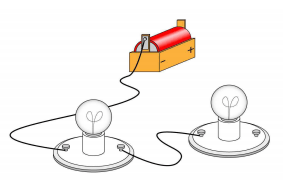
104.
Why won’t the light bulb in the circuit pictured to the right light up?
a)
The wires from the second light bulb are not connected to the battery
b)
The wires are not connected between the light bulbs 
c)
The wires are not connected to both sides of the first light bulb
d)
The wires are too long to complete the circuit 
105.

What is one example of a load?

a)

Battery

b)

Light bulb

c)

Wire

d)

Eraser

106.

The flow of electricity is called...

a)

circuit

b)

load

c)

electrical current

d)

power source

107.

The path an electrical current follows is called

a)

circuit

b)

load

c)

power source

d)

switch

108.

The ruler is an example of ___________ state.

a)

Solid

b)

Liquid

c)

Gas

109.

Read and label the definition below:

a)

Solid

b)

Liquid

c)

Gas

110.

Read and label the definition below:

a)

Solid

b)

Liquid

c)

Gas

111.

Read and label the definition below:

a)

Solid

b)

Liquid

c)

Gas

112.

It's an example of 'gas state'

a)
b)
c)
113.

The milk is an example of __________ state.

a)

Solid

b)

Liquid

c)

Gas

114.

Look at the picture and label the state of matter.

a)

Solid

b)

Liquid

c)

Gas

115.

Look at the picture and label the state of matter

a)

Solid

b)

Liquid

c)

Gas

116.

Look at the picture and label the state of matter

a)

Solid

b)

Liquid

c)

Gas

117.

Name the states of matter

(a)  

118.

Read and label the definition below:

a)

Solid

b)

Liquid

c)

Gas

d)

Matter

119.

The ice is an example of ___________state.

a)

Solid

b)

Liquid

c)

Gas

120.

This is a material with a fixed shape. It does not flow________

a)

liquid

b)

solid

c)

gas

121.

What word is used to describe a liquid changing into a gas?

a)

evaporate

b)

condensate

c)

melt

122.

Matter can be found in different stages:

a)

Liquids only

b)

soids and liquids only

c)

Solids, liquids and gases.

123.

What is the name of the gas that is all around us but we cannot see it?

(a)  

124.

When a solid such as a chocolate is heated it changes to a_____

a)

liquid

b)

gas

c)

solid

125.

Melting is the _______of freezing.

a)

none of these answers

b)

same

c)

reverse

126.

This is gold in which form?

a)

solid

b)

liquid

c)

gas

127.

This image shows water in which state/states?

a)

solid

b)

liquid

c)

gas

d)

none of these options

128.

What process is taking place here?

a)

freezing

b)

melting

c)

cooling

129.

Gold melts at________

a)

very high temperatures

b)

very low temperature

c)

Gold cannot melt

130.

(a)   is the reverse of melting.

131.

True or Fase: The three stages of matter can be found in our bodies

a)

True

b)

False

c)

None of the above

132.

Name 1 example of a solid, liquid and gas found in our bodies.

(a)  

133.

What type of changes the appearance change but the substance is the same.

a)

Physical

b)

Chemical

134.

Identify the following process: We light a matchstick.

a)

Physical change

b)

Chemical change

135.

Identify the following process: The food and the air react.

a)

Physical change

b)

Chemical change

136.

The initial substances before occurring the chemical reaction are called...

a)

Reactants

b)

Products

137.

The new substances after occurring the chemical reaction are called...

a)

Reactants

b)

Products

138.

What is the speed of this chemical reaction (rusting)

a)

SLOW

b)

FAST

139.
What is the speed of this chemical reaction
a)
SLOW
b)
FAST
140.
What is this ?
a)
a chemical reaction
b)
a mathematical equation
c)
a chemical equation
141.
What is this ?
a)
a chemical reaction
b)
a mathematical equation
c)
a chemical equation
142.

A process in which one or more substances change into others different substances.

a)

a chemical reaction

b)

a mathematical equation

c)

a chemical equation

143.
Identify the following environmental pollution
a)
extraction of raw material through mining
b)
agricultural activities using fertilisers and pesticides
c)
use of plastics for dometic and industrial purposes
d)
disposal of industrial chemical residues
144.
Identify the following environmental pollution
a)
extraction of raw material through mining
b)
agricultural activities using fertilisers and pesticides
c)
use of plastics for dometic and industrial purposes
d)
disposal of industrial chemical residues
145.

The mass conservation law says

a)

During a chemical reaction, atoms are destroyed. The number of atoms don't remains constant throughout the reaction.

b)

During a chemical reaction, atoms are created. The number of atoms remains constant throughout the reaction.

c)

During a chemical reaction, atoms are neither created nor destroyed. The number of atoms remains constant throughout the reaction.

146.
What are the states of matter?
a)
solid, liquid, and juice
b)
solid and liquid
c)
solid and gas
d)
solid, liquid, and gas
147.
Which form of matter has a definite shape like this picture?
a)
liquid
b)
solid
c)
gas
d)
clay
148.
Which form of matter take the shape of a container like this juice?
a)
liquid
b)
solid
c)
glass
d)
gas
149.
Which form of matter fills the space like it has in the balloon?
a)
liquid
b)
string
c)
solid
d)
gas
150.
What is happening when my ice cream changes from a solid to a liquid?
a)
freezing
b)
melting
c)
burning
d)
evaporation
151.
What is happening when my water bottle in the freezer goes from a liquid state to a solid state?
a)
melting
b)
evaporating
c)
freezing
d)
cutting
152.
What happens when my glass of water is sitting in the sun and disappears into a gas?
a)
evaporation
b)
burning
c)
melting
d)
freezing
153.
My glass of ice water is sitting in the sun and has droplets of water on the outside of the glass. What is happening?
a)
condensation
b)
evaporation
c)
melting
d)
freezing
154.
Which form of matter does not take the shape of its container?
a)
liquid
b)
gas
c)
solid
d)
air
155.
How many states of matter have we learned about?
a)
4
b)
1
c)
3
d)
2