
 Worksheets
Short Term Decision making
Total questions: 23
Worksheet time: 15mins
Costs that a business must incur to perform an activity at a given level, but that it can avoid if the business reduces or discontinues the activity.
Incremental costs
Avoidable costs
Opportunity costs
Sunk costs
Cost increases resulting from a higher volume of activity or from the performance of an additional activity
Incremental costs
Avoidable costs
Opportunity costs
Sunk costs
The profits that a business forgoes by following a particular course of action
Incremental costs
Avoidable costs
Opportunity costs
Sunk costs
Money that has already been spent and cannot be recovered. It is a cost that occurred in the past.
Incremental costs
Avoidable costs
Opportunity costs
Sunk costs
Costs that will change as a result of a decision, that is will differ among the alternatives.
Irrelevant costs
Avoidable costs
Opportunity costs
Revevant costs
Future costs that a business will incur for activities that are NOT necessary to carry out the decision
Irrelevant costs
Avoidable costs
Opportunity costs
Revevant costs
Wages paid for factory labour used in producing a product?
Fixed cost
Variable cost
Opportunity cost
Sunk cost
Raw materials used in making a product
Fixed
Variable
Sunk
Irrelevant
Dara makes bracelets and sells them in her shop. Which is a fixed expense for Dara’s business?
the cost of the beads
the cost of the string
the cost of advertising
rent for her shop
If Sam's Sandwiches use 25c of material for each sandwich, what will be their variable costs for 10 sandwiches
10 x 0.25 = $2.50
2.5 x 10 = $25
25 x 10 = $250
0.25/10 = 2.5c

OPPORTUNITY cost.
SUNK cost.

Your business rents a building on Main Street in Dewsbury. Every month you pay exactly $750 to rent the building. This is an example of a...
OPPORTUNITY cost.
SUNK cost.

OPPORTUNITY cost.
SUNK cost.
Rent, administrative costs, employee salary are examples of ...
Variable costs
Fixed costs
Costs
Prices
Span has 10 workers. Each worker is paid $5,000.00 every month. Workers wages/salary is an example of a ___.
Fixed Cost
Variable Cost
Incremental Cost
Opportunity Cost
Chris has 3 trucks. It costs her $1 for fuel for each kilometer (km) a truck covers. In May the trucks covered a total of 12 000 km and in June the trucks covered a total of 18 000 km. This is an example of a ___.
Fixed Cost
Variable Cost
Which of the following would be an example of a fixed cost on a farm?
Mortgage on the land
Cost of seed
Fuel to operate machinery
Fertilizer
An example of a variable cost would be:
Depreciation of factory machinery
Shop rent
Sales staff commission
Factory manager’s salary
Which costs would NOT be relevant when decising to accept or reject a special order for a product
Avoidable costs
Direct materials
Direct labour
Variable overhead
One of the costs of particular interest when deciding whether to drop a product is...
Avoidable costs
Fixed costs
Irrelevant costs
All of these are of particular interest
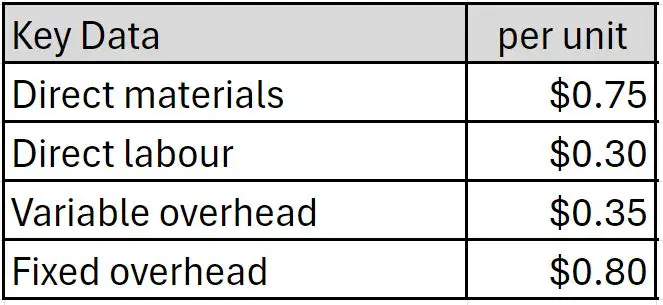
The manager wants to know if we should buy or make a widget. Which of the costs sshown is NOT relevant in the decision?
Direct materials
Direct labour
Variable overhead
Fixed overhead
The manager wants to know if we should buy or make a widget. We can buy the widgets for $1.80 each. Should we make or buy?
Make it for $1.40 each which is cheaper than buying
Buy for $1.80 which is cheaper than making for $2.20 each
Make - we can make for $1.05 each which is cheaper than buying
Buy for $2.20 which is cheaper than making for $1.80 each
The manager wants to know if we should buy or make a widget. We can buy the widgets for $1.80 each. If we make, we will have to hire a machine for $500 per year. We need 1,000 widgets. Should we make or buy them?
Buy for $1,800 total cost which is cheaper than making for $1,900
Buy for $1,800 total cost which is cheaper than making for $2,200
Make - we can make for $2,200 total cost which is cheaper than buying
Buy for $2,200 total cost which is cheaper than making for $1,400

