
 Worksheets
Regents Review II
Total questions: 28
Worksheet time: 14mins

What was the main reason for implementing the system described in this passage?
to welcome outsiders
to promote cultural exchange
to allow social mobility
to establish power and authority

Which historical turning point was directly influenced by the events described in this document?
Germany unified and industrialized, becoming a dominant world power by World War I.
Europeans lost profitable colonies in the Americas and sought new imperial holdings.
Japan shifted from a period of isolation to a more modernized state.
British Parliament began to pass legislation to address concerns over working conditions.

Which historical writing most influenced the circumstances described in this document?
John Locke’s Two Treatises of Government
Olympe de Gouges’ Declaration of the Rights of Woman
Karl Marx’s Communist Manifesto
Adam Smith’s Wealth of Nations

The passage was written to justify
the export of Irish grain
the importation of foreign food through English ports
Irish protests against British trade policies
the Great Famine

Which problem is identified in this passage?
the low prices of agricultural products
the exporting of much-needed food
the waste caused by grain overproduction
the opening of ports to foreign merchants

Which British policy is most closely associated with the situation described in this document?
neutrality
collective security
imperialism
isolationism

Which event influenced the writing of this poem?
World War I
the Russian Revolution
World War II
the Korean War

Siegfried Sassoon’s primary purpose for writing this poem is to
promote nationalism and encourage soldiers to volunteer
show the horrors of the fighting and the cruelty of the war
encourage the development of more technologically advanced weapons
protect the environment from destruction by human actions
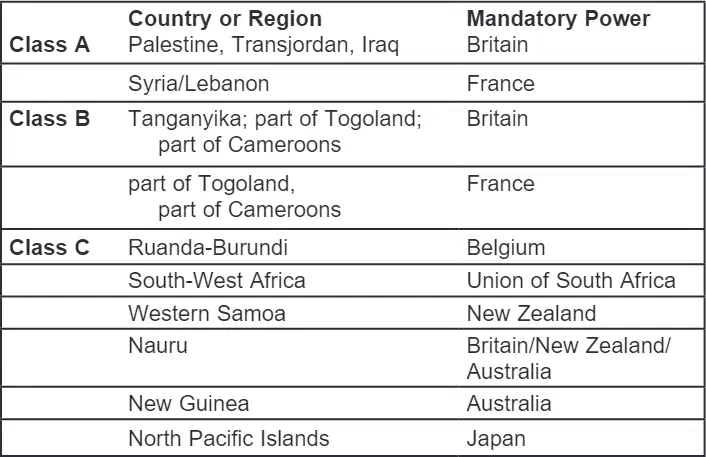
Why did Britain and France have power over many of the mandates identified in this chart?
They had strong cultural ties to these areas.
They defeated Germany, giving them a strong claim to its colonies.
There were large populations of British and French citizens living in these territories.
Their experience in decolonization made them the best choices.
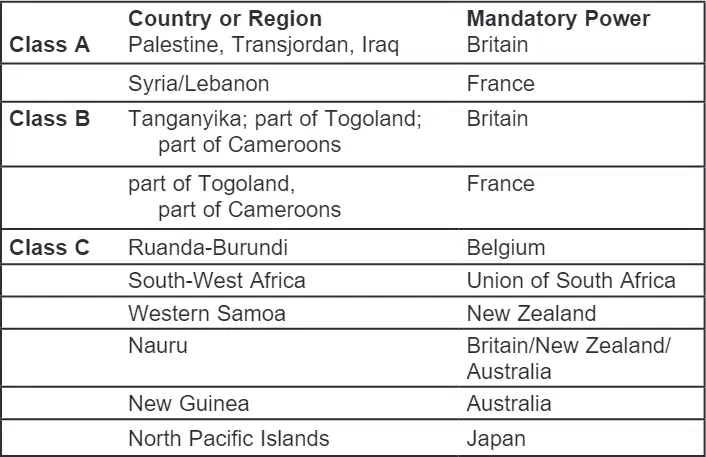
What was a consequence of the situation shown in this chart?
Nationalist movements developed in areas under European control.
Britain and France were bankrupted by the high cost of governing these mandates.
More mandates were created as nations struggled to govern themselves after World War II.
Germany regained substantial power in sub-Saharan Africa.

Based on these documents, Secretary McNamara believed U.S. involvement in this region would prevent
rebellions against colonial rule
genocides and human rights abuses
the spread of communism
civil wars in recently liberated nations

The conflict referred to in the documents is most closely associated with
the Chinese Civil War
the Cold War
the Cultural Revolution
global terrorism

The author interprets Kenyatta’s discussion of the Kenya African Union flag as a call for
a new monotheistic religious movement
a peaceful transfer of political power to Africans
removal of restriction on political speech
violent resistance against colonial authority

Which event led most directly to the situation described in this document?
the French Revolution
the Berlin Conference
the Treaty of Versailles
the Truman Doctrine

Base your answer to the question on the cartoon below and on your knowledge of social studies. Which statement best describes the point of view of this cartoonist?
Nuclear arms treaties have been highly effective.
The arms race was limited to nuclear missiles.
The threat of armed revolution was not taken seriously.
Disarmament talks had not been effective.

Based on this cartoon, what is being “fed” to the Chinese people?
Democratic philosophy
Communist ideology
Capitalist doctrine
Mercantilist principles

This cartoon suggests that the Chinese people and their government
wanted to continue Mao’s economic programs
saw the need to increase agricultural imports
disagreed on whether to adopt democratic reforms
had no interest in the principles of the Enlightenment

This photo demonstrates a clash between
traditional cultural values and secularization
localized trade networks and globalization
economic inequality and socialism
ethnic diversity and cultural homogenization

Which event most directly contributed to the action shown in this photo?
Iran’s decision to become a member of OPEC
passage of the Universal Declaration of Human Rights
founding of the Mothers of the Plaza de Mayo
the Ayatollah Khomeini’s rise to power

What is a correct inference based on the data presented in this chart?
Global migration trends reveal people increasingly moving to urban centers and living in overcrowded environments.
European imperialism has left many African nations with inadequate health care, a lack of education, and poverty.
Post-independence movements led some African nations to experience ethnic conflict, genocide, and an increase in refugee populations.
Modern societies continue to negatively impact the environment by polluting air and water in addition to depleting natural resources.

This chart would be most useful to a person or group advocating for
policies to slow climate change
free trade laws
collective security agreements
health and education funding

What is the primary focus of these documents?
the need for cultural exchanges in Europe
the value of immigration to German regions
the role of American culture in globalization
the importance of the Cold War in history

Which claim about globalization is supported by these documents?
It minimizes trade
It reshapes cultures
It discourages creativity
It restricts freedom

Which conclusion about China can best be drawn from this passage?
It uses a communist economy based on Maoist principles.
It rejects capitalism as an economic system but welcomes democratic ideals.
It wants to completely isolate itself from contact with the rest of the world.
It wants the economic benefits of capitalism without free speech and democracy.

Which claim is best supported by the evidence in this passage?
Sisowath Doung Chanto questioned his father’s patriotism.
The Khmer Rouge only arrested artists and authors.
Millions of Cambodians were executed during the civil war.
Many Cambodians resisted arrest by fleeing the country.

The actions described in this passage are most closely associated with which leader?
Ho Chi Minh
Pol Pot
Deng Xiaoping
Sun Yat Sen

According to this author, what is the underlying reason for the exploitation of child labor?
increasing health costs
extreme poverty
government interventions
technological developments

Which statement best describes the difference between child labor laws and enforcement as described in this passage?
Most countries have no laws to protect children from dangerous labor situations.
Most employers are always punished for breaking child labor laws.
Unless people take action, little will change regarding child labor abuses.
Child labor laws are changing to ensure children are earning equal pay for equal work.

