

wayground logo

Free Printable Worksheets

Font size

S
M
L
XL
Worksheets

Chem B Final Exam Review

Total questions: 72

Worksheet time: 4hrs 7mins

Name
Class
Date
1.

How many particles are found in a mole?

a)

6.022 x 10236.022\ x\ 10^{23}  

b)

6.022 x 10236.022\ x\ 1023  

c)

6022 x 10236022\ x\ 10^{23}  

d)

6022 x 10236022\ x\ 1023  

2.

What are the units used for Molar Mass

a)

grams

b)

mols

c)

g/mol

d)

mol/g

3.

How many grams are in 3 mol of carbon?

a)

6 grams

b)

12 grams

c)

18 grams

d)

36 grams

4.

What is the correct equation to calculate the number of moles in 3.13 x 1026 molecules of H2O2?

a)
b)
c)
d)
5.
How many molecules of sugar (C6H12O6) are in a mole?
a)
24 molecules
b)
180 molecules
c)
180 g
d)
6.02 x 10²³ molecules
6.

Convert 4.5x1024 atoms to moles

a)

0.747 particles

b)

0.747 mol

c)

2.71x1047 mol

d)

2.71x1047 particles

7.

A sample of AlCl3 contains a total of 4.515 x 1027 atoms. What must be the mass of this sample?

a)

2.500 x 10⁵ g

b)

1.000 x 10⁻⁶ g

c)

18.75 g

d)

1.01 x 10⁶ g

8.
Which of the following dimensional analysis setups will correctly convert 27.76g of Li to atoms of Li?
a)
A
b)
B
c)
C
d)
D
9.

How many atoms of carbon are in 6.00 g of carbon?

a)

1.20x1024 atoms C

b)

6.02x10²³ atoms C

c)

3.01x10²³ atoms C

d)

1.50x10²³ atoms C

10.

Find the percent composition of CaCl2?

a)

Ca: 36.11%; Cl: 63.88%

b)

Ca: 53.12%; Cl: 100%

c)

Ca: 36.11%; Cl: 83.56%

d)

Ca: 46.11%; Cl: 63.88%

11.
What is the percent by mass of chlorine in NaCl?
a)
39%
b)
61%
c)
35%
d)
65%
12.
A formula with the lowest whole # ratio of elements in a compound is called
a)
Molecular Formula
b)
Chemical Formula
c)
Empirical Formula 
d)
Distance Formula
13.

What is the empirical formula for C4H6?

a)

CH

b)

CH3

c)

C2H3

d)

C4H6

14.

You are given the following percentages: 40.05% S and 59.95% O. Find the empirical formula for these elements.

a)

SO

b)

SO2

c)

SO3

d)

SO4

15.

A compound consists of 72.2% magnesium and 27.8% nitrogen by mass. What is the empirical formula?

a)

Mg4N3

b)

MgN2

c)

Mg3N2

d)

MgN

16.
What is the molecular formula for a compound with the empirical formula: K2SOand a molecular mass of 696g.
a)
K2SO
b)
K8SO16
c)
K8S4O
d)
K8S4O16 
17.
A chemical formula that shows the actual # and kinds of atoms present in one molecule of a compound is called_________
a)
ionic formula
b)
covalent formula
c)
empirical formula
d)
molecular formula
18.
Na2CO3 · 10H2O is known as sodium sulfate ______
a)
Hydroxide
b)
Hydrate
c)
Decahydrate
d)
None of the above
19.

A 4.175 gram sample of a certain hydrate of copper (II) sulfate, CuSO4•xH2O, is heated until all the water is driven off. The resulting anhydrous compound weighs 3.120 grams. What is the formula of the hydrate?

a)

CuSO4•H2O

b)

CuSO4•3H2O

c)

CuSO4•6H2O

d)

CuSO4•4H2O

20.

Match the following

a)

The number of atoms in a compound.

1.

MOLECULAR FORMULA definition

b)

The simplest reduced ratio of elements in a compound.

2.

EMPIRICAL FORMULA defintion

c)

N2O4N_2O_4

3.

MOLECULAR FORMULA example

d)

NO2NO_2

4.

EMPIRICAL FORMULA example

21.
Mole ratios are obtained from the
a)
balanced chemical equation
b)
periodic table
c)
molar mass
22.

What coefficients are needed to balance the following chemical equation?

__Zn + __HCl → __ZnCl2 + __H2

a)

1,1,1,1

b)

1,2,1,1

c)

2,1,2,2

d)

2,1,2,1

23.
What can be determined from a balanced chemical equation?
a)
Mole ratio of any two substances in the reaction
b)
Energy released in the reaction.
c)
Electron configuration of all elements in the reaction. 
d)
Mechanism involved in the reaction. 
24.
3 Mg + 1 Fe2O3 → 3 MgO + 2 Fe
What is the Ratio of moles of Mg to moles Fe?
a)
3mol Mg / 2 mol Fe
b)
2 mol Mg/ 3 mol Fe
c)
1 mol Fe/ 2 mol Fe
d)
3 mol MgO / 2 mol Fe
25.

Where are the numbers for a mole ratio found?

a)

They are part of the chemical formulas for the reactants / products.

b)

They are given in the problem.

c)

They are found on the periodic table for those elements.

d)

They are found as coefficients in the reaction's balanced chemical equation.

26.
Which of the following represent a mole ratio between silver nitrate and copper(II) nitrate in the following reaction:
2AgNO3 + Cu --> Cu(NO3)2 + 2Ag
a)
2 mol AgNO3 / 2 mol Ag
b)
2 mol Ag / 2 mol AgNO3 
c)
2 mol AgNO3 / 2 mol Cu(NO3)2
d)
2 mol AgNO3 / 1 mol Cu(NO3)2
27.

2 C2H6 + 7 O2 → 4 CO2 + 6 H2O

Ethane (C2H6) combusts in the above reaction. What is the mole ratio of ethane to oxygen gas?

a)
b)
c)
d)
28.

2 C2H6 + 7 O2 → 4 CO2 + 6 H2O

If 16 moles of carbon dioxide are formed by this reaction, how many moles of water were also produced?

a)

4 mol H2O

b)

6 mol H2O

c)

24 mol H2O

d)

96 mol H2O

e)

384 mol H2O

29.

2 C2H6 + 7 O2 → 4 CO2 + 6 H2O

How many moles of ethane (C2H6) are required to produce 13.5 moles of water from the above reaction?

a)

4.5 mol C2H6

b)

27 mol C2H6

c)

40.5 mol C2H6

d)

81 mol C2H6

e)

162 mol C2H6

30.
Where do you look to calculate the molar mass?
a)
avogadros number
b)
periodic table 
31.
What is the molar mass of NaOH?
a)
368 g/mole 
b)
40 g/mole
c)
57 g/mole
d)
23 g/mole
32.
What is the mole ratio of H2O to H3PO4 in the following chemical equation?   P4O10 + 6 H2O --> 4 H3PO
a)
6:4
b)
4:6
c)
1:3
d)
3:1
33.

1 CH4 + 2 O2 → 1 CO2 + 2 H2O

How many moles of carbon dioxide (CO2) are produced from the combustion of 110.0 g of CH4 (molar mass = 16 g)?

a)

13.7 mol

b)

2.75 mol

c)

6.85 mol

d)

6.11 mol

34.

How many grams of magnesium chloride are produced if 4.67 moles of HCl react?

Mg + 2 HCl --> MgCl2 + H2

a)

222 g MgCl2

b)

4.67 g MgCl2

c)

94 g MgCl2

35.
B2H6 + 3O2 -->2 HBO2 + 2 H2O
 What mass of O2 will be needed to burn 36.1 g of B2H6?
a)
13.8 g O2
b)
3.86 mol of O2
c)
124 g O2
36.
Using the following equation:
4NH3(g) + 5O2(g) --> 4NO(g) + 6H2O(l)
How many grams of oxygen gas are needed to react with 56.8 grams of ammonia?
a)
45.08 g O2
b)
133.33 g O2
c)
260.77 g O2
d)
75.92 g O2
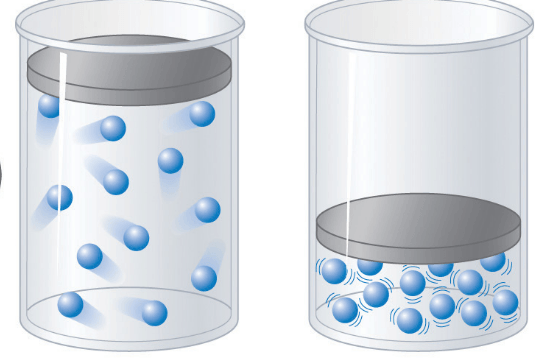
37.

Which container will have a lower pressure?

a)

left

b)

right

c)

they both have the same pressure

38.
Dalton's Law states...
a)
that at a constant temperature the volume of a confined ideal gas varies inversely with its pressure.
b)
that the total pressure exerted by the mixture of non-reactive gases is equal to the sum of the partial pressures of individual gases
c)
how gases tend to expand when heated
d)
that the density of an ideal gas at constant pressure varies inversely with the absolute temperature of the gas.
39.

Which equation represents Dalton's Law?

a)

E = mc2

b)

PV = nRT

c)

P1 / T1 = P2 / T2

d)

Ptotal = P1 + P2 + P3

40.
Three gases, Ar, N2 and H2 are mixed in a 500L container. Ar has a pressure of 255 torr, N2 has a pressure of 228torr and H2 has pressure of 752torr. What is the total pressure in the container?
a)
483torr
b)
270torr
c)
1235torr
41.

A container holds a mixture of two different gases. The oxygen in a container exerts 80 mmHg of pressure on the inside of the container. The total pressure inside the container is 120 mmHg. What is the pressure of the other gas in the container?

a)

200 mmHg

b)

80 mmHg

c)

40 mmHg

d)

120 mmHg

42.
A mixture of hydrogen, nitrogen, and water vapor has a total pressure of 864 mmHg. The partial pressure of hydrogen is 220 mmHg and that of nitrogen is 410 mmHg. What is the partial pressure of water vapor?
a)
234 mmHg
b)
1.37 mmHg
c)
2.64 mmHg
d)
1, 494 mmHg
43.
Tom Brady enjoys balloon animals from the carnival. He just received a balloon giraffe that has an initial temperature of 39.0°C and a volume of 1.28 L. If Gronkowski plays a trick on Tom, and puts his balloon giraffe into the freezer, what would be the new volume of the balloon if the temperature drops down to 8.0°C?
(Don’t forget about what must be done to temperatures!)
a)
1.42 L
b)
6.85 x 10⁴ L
c)
3.78 L
d)
1.15 L
44.

Label the phase change diagram

45.

During melting, the temperature ​ (a)   .

Choose from the below words
stays the same
increases
decreases
46.

During condensation, the heat energy ​ (a)   .

Choose from the below words
decreases
increases
stays the same
47.

As the heat energy and temperature of a substance INCREASES, the particles of a substance ​ (a)   .

Choose from the below words
speed up
slow down
48.

When a substance changes from a liquid to a solid, the temperature ​ (a)   .

Choose from the below words
stays the same
increases
decreases
49.

When a substance changes from a LIQUID to a GAS, the heat energy ​ (a)   .

Choose from the below words
increases
decreases
stays the same
50.

Delta H is negative indicates

a)

reaction is exothermic

b)

reaction is endothermic

c)

reaction is spontaneous

d)

reaction is not spontaneous

51.

Delta S is negative indicates

a)

enthalpy increases

b)

enthalpy decreases

c)

entropy decreases

d)

entropy increases

52.

Delta G is negative indicates

a)

reaction is exothermic

b)

reaction is endothermic

c)

reaction is spontaneous

d)

reaction is not spontaneous

53.

A phase change from solid --> liquid

a)

shows a decrease in entropy

b)

shows an increase in entropy

c)

is exothermic

d)

is endothermic

54.

A phase change from gas --> liquid

a)

shows a decrease in entropy

b)

shows an increase in entropy

c)

is exothermic

d)

is endothermic

55.

The reaction 2 H2(g)+O2(g) 2 H2O(g)2\ H_{2\left(g\right)}+O_{2\left(g\right)}\rightarrow\ 2\ H_2O_{\left(g\right)}  shows 

a)

no change in entropy

b)

an increase in entropy

c)

a decrease in entropy

56.

According to Hess' law, if you reverse a reaction

a)

the sign of delta H must flip

b)

you do not change the delta H sign

c)

you must multiply the delta H value by 2

d)

you must divide the value of delta H by 2

57.

What does Gibbs Free Energy tell us?

a)

How much energy is given off by a reaction.

b)

The tendency of a reaction to become "random"

c)

How spontaneous a reaction is.

58.

1. Given the following information, calculate ΔG0 for the reaction below at 250C: (K = 0C + 273)

SnCl4(l) + 2 H20(l) → SnO2(S) + 4HCl(g),

ΔH0=+133.0 kJ and ΔS0 =+401.5 J/K

a)

-252.6 kJ

b)

-13.4 kJ

c)

13.4 kJ

d)

252.6 kJ

59.

Which potential energy diagram represents the reactions A + B → C + energy?

a)

b)

c)

d)

Diagram D

60.

Which potential energy diagram represents an exothermic reaction?

a)

b)

c)

d)

61.

Which statement correctly describes this reaction?

a)

It is endothermic and energy is absorbed.

b)

It is endothermic and energy is released.

c)

It is exothermic and energy is absorbed.

d)

It is exothermic and energy is released.

62.
What is the first thing you must do to solve a stoichiometry problem?
a)
Write a Balanced Equation
b)
Panic
c)
Write an Unbalanced Equation
d)
Ask for help
63.
What is a Limiting Reagent?
a)
speeds up a reaction
b)
what you run out of first
c)
what you have left over
d)
slows down a reaction
64.
What is a Excess Reagent?
a)
amount you end with
b)
what you run out of first
c)
what you have left over
d)
what you start with
65.
Use the equation 2 Al + 3 Cl2 ---> 2 AlCl3.  If 2 moles of aluminum and 2 moles of chlorine are reacted, identify the limiting reactant.
a)
AlCl3
b)
Cl2
c)
Al
d)
Gary Busey
66.
Carbon and Oxygen combine to form CO2. If 10g of Carbon combines with Oxygen to produce 20g of CO2 and 10g of Oxygen combines with Carbon to produce 15g of CO2, How many grams of CO2 are produced from 10g of Carbon and 10g of Oxygen?
a)
20g of CO2
b)
15g of CO2
c)
17.5g of CO2
d)
25g of CO2
67.
When does a chemical reaction stop?
a)
When the lab is finished
b)
When the excess reactant is used up
c)
When the limiting reactant is used up
d)
Chemical reactions never stop
68.
Cl2 + 2KBr → Br2 + 2KCl
How many grams of potassium chloride (KCl) can be produced from 356 g of potassium bromide (KBr)?
a)
749 g
b)
223 g
c)
479 g
d)
814 g
69.
B2H6 + 3O2 -->2 HBO2 + 2 H2O
 What mass of O2 will be needed to burn 36.1 g of B2H6?
a)
13.8 g O2
b)
3.86 mol of O2
c)
125.2 g O2
70.
Identify the limiting reagent when 6.00 g HCl combines with 5.00 g Mg to form MgCl2.
 
Mg +  2HCl --> MgCl2  +  H2   
 
a)
Mg
b)
H2
c)
MgCl2
d)
HCl
71.
6CO2 + 6H2O --> C6H12O6 + 6O2 
What is the total number of moles of water needed to make 2.5 moles of C6H12O6?
a)
2.5
b)
6
c)
12
d)
15
72.

Identify the Empirical Formula for:

C4H6

a)

CH

b)

CH3

c)

C2H3

d)

C4H6
