wayground logo

Free Printable Worksheets

Font size

S
M
L
XL
Worksheets

G8 L12.6-12.8

Total questions: 228

Worksheet time: 10hrs 57mins

Name
Class
Date
1.
Sarah plays softball over the summer.  If there are 10 players on the team, how many ways can the coach make a batting order that includes all players?
a)
1
b)
3628800
c)
100
d)
1814400
2.
There are 125 juniors at the high school. How many ways can they elect a president, vice president,and secretary?
a)
1906500
b)
317750
c)
375
d)
1953125
3.
Determine the number of 4-letter arrangements that can be made using the word RHOMBUS.
a)
5040
b)
35
c)
28
d)
840
4.
Ashlyn needs to bring a dessert to her dinner party. If the bakery has eight pies to choose from, how many ways can Ashlyn choose three?
a)
336
b)
56
c)
24
d)
100
5.
In the orchestra, there are eight violinists in the front row. How many different ways can they be seated?
a)
40320
b)
1
c)
64
d)
8
6.
Erik gets to choose from five cake flavors, seven icing flavors, and three topping flavors. If he can only choose one of each flavor,  how many cakes are possible?
a)
35
b)
573
c)
21
d)
105
7.
There are 14 candy bars for sale. How many ways can Andy choose five of them?
a)
240240
b)
2002
c)
87178291200
d)
70
8.
There are 12 kinds of Girl Scout cookies for sale. How many ways can Rachel choose three different kinds to buy?
a)
220
b)
36
c)
1320
d)
100
9.
The Nebraska license plate has 6 characters, each one filled with a number (0-9) or a letter. How many license plates are possible?
a)
36
b)
2176782336
c)
60
d)
1402410240
10.
A restaurant offers four appetizers, nine entrees,and three desserts. How many different ways can Angela choose a three course meal?
a)
36
b)
100
c)
108
d)
27
11.
Justin took a quiz with five multiple choice (A-D) and five true/false questions. How many different ways can he answer the questions?
a)
1024
b)
32
c)
32768
d)
25
12.
If Lucas owns 11 hoodies,how many ways can he choose four to bring on vacation?
a)
44
b)
7920
c)
330
d)
121
13.
There are 18 people running in a cross country race. How many possible ways are there to place the runners in first, second, and third?
a)
324
b)
4896
c)
816
d)
54
14.
Rob is one of seven children in his family. How many ways can his parents choose four siblings to do chores?
a)
35
b)
28
c)
840
d)
10
15.
Jane needs to make a four-letter password. If the first letter has to be a vowel, how many possibilities are there to choose from?
a)
456976
b)
104
c)
160
d)
87880
16.
What is the value of 5!
a)
25
b)
15
c)
120
d)
720
17.
How many ways ways can you arrange the letters in the word math?
a)
15
b)
4
c)
24
18.
At summer camp, the campers pick two activities for the first day of camp.  They can choose from among hiking, canoeing, rock climbing, and bird watching.  How many different combinations of activities are there?
a)
6
b)
12
c)
2
d)
8
19.
At the middle school, a student takes 4 core classes a day.  There are 6 different core classes offered.  How many different combinations of classes are there?
a)
24
b)
15
c)
720
d)
360
20.
The class is drawing maps of the 7 continents to display in the school lobby.  The main wall in the lobby has room for 3 maps.  How many combinations of maps are possible for that location?
a)
5,040
b)
35
c)
210
d)
6
21.
Kimberly has seven colors of lanyards.  She uses three different colors to make a key chain.  How many different combinations can she choose?
a)
210
b)
5.040
c)
6
d)
35
22.
What is the value of 8!
a)
40320
b)
36
c)
362880
d)
5040
23.
A restaurant offers four sizes of pizza, two types of crust, and eight toppings. How many possibles combinations of pizza with one topping are there?
a)
64
b)
14
c)
4
d)
112
24.
How many 5-digits numbers can be formed using ten digits (0-9) if no repetition is allowed?
a)
30240
b)
252
c)
120
d)
3628800
25.

7P2

a)

0

b)

7

c)

42

d)

210

26.
12C3
a)
0
b)
1
c)
220
d)
1140
27.
12P4
a)
24
b)
132
c)
1320
d)
11880
28.
Which of the following is an example of combination?
a)
Form a passcode with 4 digits
b)
Students line up in a queue to assembly
c)
Choose 4 students in a class committee
d)
Choose the chairperson, secretary and treasurer in a club
29.
Permutation, combination, or neither?
A team of 8 basketball players need to choose a co-captain and captain.
a)
combination
b)
permutation
c)
neither
30.
Permutation, combination, or neither?
There are 45 applicants for three Computer Programmer job positions.
a)
combination
b)
permutation
c)
neither
31.
Permutation, combination, or neither?
The batting order for seven players on a 12 person team.
a)
combination
b)
permutation
c)
neither
32.
Rylan’s basketball team has 11 players. How many ways can his coach choose five starting players?
a)
462
b)
55440
c)
55
d)
1000
33.
Probability is ...
a)
the chance that some event will occur.
b)
a game that involves coins.
c)
a guarantee.
34.

Simple probability can be defined as...

a)

# Favourable outcomes / # Total Outcomes

b)

# Favourable Outcomes / # Unfavourable Outcomes

c)

# Favourable Outcomes + # Unfavourable Outcomes

d)

# Total Outcomes - # Unfavourable Outcomes

35.
An impossible event has a probability of _____?
a)
1
b)
0
c)
1/2
d)
100
36.

Simple odds can be calculated using the formula.

a)

# Favourable Outcomes / # Total Outcomes

b)

# Favourable Outcomes + Unfavourable Outcomes

c)

# Total Outcomes - # Unfavourable Outcomes

d)

# Favourable Outcome / # Unfavourable Outcomes

37.

To calculate the compound probability for a series of events you...

a)

Multiple the individual probabilities

b)

Divide the individual probabilities

c)

Add the individual probabilities

d)

Subtract the individual probabilities.

38.
The theoretical probability of rolling an even number on a dice.
a)
3/6
b)
1/2
c)
1/6
d)
5/6
39.
The chance of rain today is 70%. What is the chance it does not rain?
a)
70%
b)
30%
c)
100%
d)
50%
40.
The letters that form the word MATHEMATICS are placed in a bowl. What are the odds against choosing an “A”? 
a)
9:2
b)
2:9
c)
9:11
d)
11:9
41.

A tree diagram is useful in determining the __________of a probability experiment.

a)

result

b)

possible outcomes

c)

event

d)

none of the above

42.
The odds of an event happening are 3:8. What are the odds it does not happen?
a)
8:3
b)
3:11
c)
11:3
d)
8:11
43.
Clara picks a marble at random, puts it back, and then picks another marble at random.
a)
Dependent
b)
Independent
44.
A bag contains some red-colored and some blue-colored marbles. First a red-colored marble is drawn and then, without replacing the first marble, a blue-colored marble is drawn. Are the two events dependent or independent?
a)
Independent
b)
Dependent
45.
A bag contains 9 green marbles, 5 yellow marbles and 6 red marbles.  You choose one marble.   What is the probability of selecting a green or red marble?  Do you add or multiply probabilities?
a)
Add
b)
Multiply
46.

A coin is tossed and a number cube is rolled. Find the probability, P(heads and 7).

a)

1/14

b)

1/2

c)

0

d)

1/7

47.
You pick a marble from this bag.
What is the probability you will choose either a black or white marble?
a)
3/5
b)
9/100
c)
1/10
d)
2/5
48.
A spinner is spun and the results are shown in the chart. 
Which of the following statements is true about the probability of spinning a blue?
a)
The experimental probability and theoretical probability are equal.
b)
The experimental probability is less than the theoretical probability.
c)
The experimental probability is greater than the theoretical probability.
d)
The experimental probability cannot be determined from the data.
49.
A bag contains 5 blue marbles, 4 red marbles, and 3 orange marbles. Mrs. Cox picks one without looking, replaces it and picks another one. What is the probability that she picks two that are not orange? 
a)
9/16
b)
3/4
c)
9/144
d)
5/16
50.
Which of the following describes experimental probability?
a)
Perform a situation and count the number of possibilities
b)
Use trials to count the number of desired outcomes
c)
Perform an experiment to determine the probability of an event
d)
Use a formula to determine the expected probability of an event
51.
Which of the following describes theoretical probability?
a)
Perform a situation and count the number of possibilities
b)
Use trials to count the number of desired outcomes
c)
Perform an experiment to determine the probability of an event
d)
Use a formula to determine the expected probability of an event
52.
A spinner has 5 sections of equal size labeled P, Q, R, S, and T. The arrow of this spinner is spun 15 times and landed 4 times on the section labeled Q.
Which statement best describes the experimental probability and theoretical probability of the arrow landing on the section labeled Q? 
a)
The experimental probability is 4/15, and the theoretical probability is 1/5.
b)
The experimental probability is 1/5, and the theoretical probability is 1/5.
c)
The experimental probability is 4/15, and the theoretical probability is 4/15.
d)
The experimental probability is 1/5, and the theoretical probability is 4/15.
53.
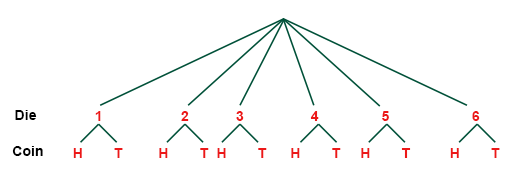
The tree diagram shows the outcomes of rolling a die and flipping a coin.  
How many total outcomes are there?  
a)
6
b)
12
c)
24
d)
36
54.

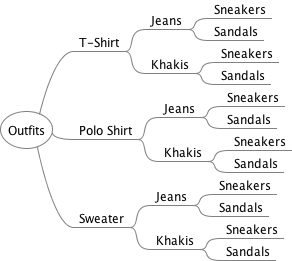
You have a 3 tops, 2 pants and 2 shoes. How many total outfit options are represented?

a)

12 outfits

b)

22 outfits

c)

3 outfits

d)

7 outfits

55.

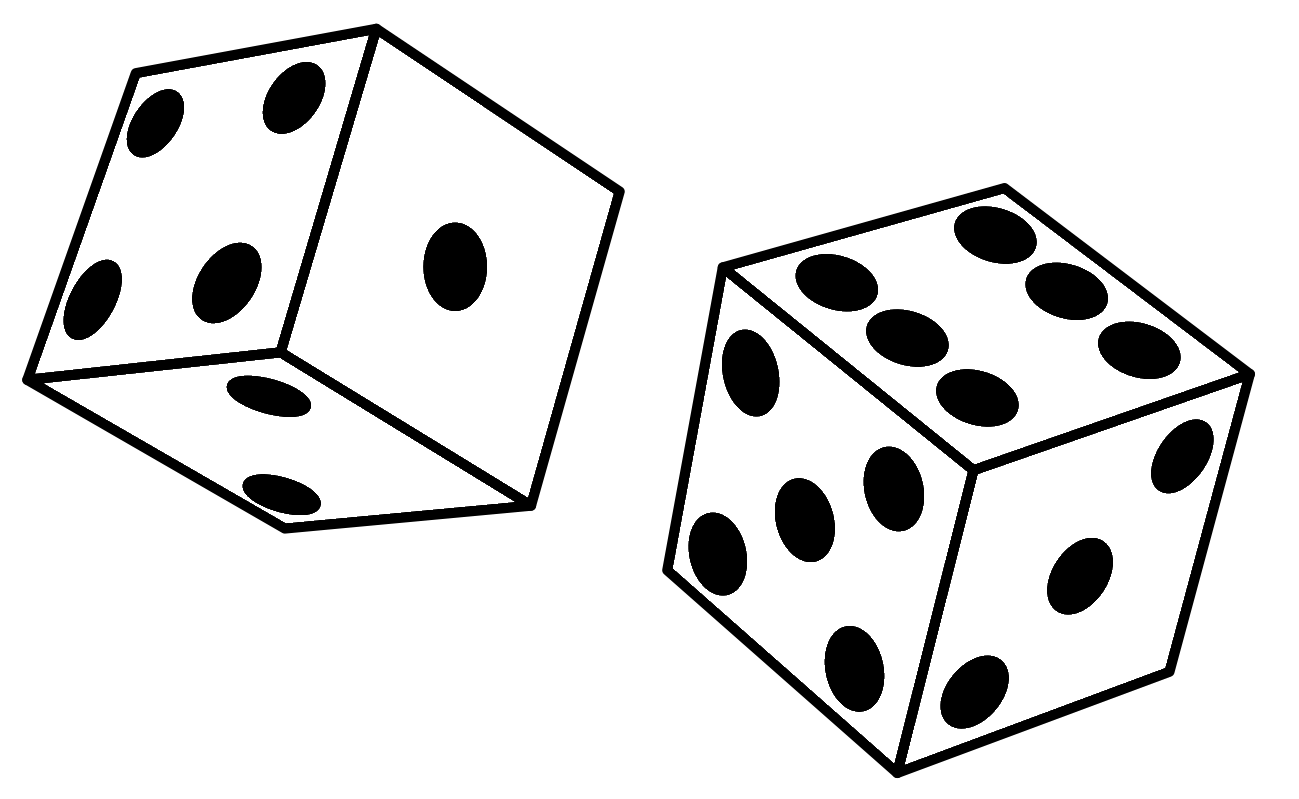
Two dice are rolled. What is the probability that the sum is 9?

a)

1/4

b)

1/9

c)

5/12

d)

7/12

e)

1/12

56.

P(King)?

a)

4/52

b)

2/52

c)

3/13

d)

4/13

57.

P(a red 8)?

a)

3/26

b)

2/52

c)

1/13

d)

4/13

58.
There are 5 red roses, 3 yellow roses, and 8 white roses in a tray. If Stephanie picked 2 roses one after the other without replacing, then what is the probability of picking a white rose first and a red rose next?
a)
1/6
b)
5/6
c)
1/3
d)
2/3
59.
There are 6 red marbles, 5 green marbles, and 4 yellow marbles in a bag. If Joe picks 2 marbles one after the other without replacement, then what is the probability that both are red in color?
a)
2/5
b)
1/21
c)
4/25
d)
1/7
60.
A fruit basket contains
9 apples, 3 bananas, 7 oranges, 5 pears, and 1 grapefruit. Kyle randomly chooses a fruit, does not replace it, then chooses another. What is the probably that he chose two pears? 
a)
9/49
b)
4/125
c)
1/10
d)
1/30
61.

Find the probability of drawing a red from a standard deck of 52 cards, replacing it, then drawing a spade ♠

a)

1/13

b)

1/8

c)

1/4

d)

1/6

62.

Find the probability of drawing a diamond ♦ from a standard deck of 52 cards, replacing it, then drawing a club♣

a)

1/16

b)

1/8

c)

1/4

d)

1/2

63.

Using a standard deck of cards with no jokers, what is the probability of pulling any Jack, then any Ace? (no replacement)

a)

1/169

b)

4/663

c)

1/221

d)

3/676

64.

Using a standard deck of cards with no jokers, what is the probability of getting two of a kind?(No replacement)

a)

1/221

b)

1/169

c)

1/17

d)

3/676

65.

Using a standard deck of cards with no jokers, what is the probability of getting three Queens? (No replacement)

a)

1/5525

b)

1/425

c)

3/17,576

d)

1/2,197

66.

Imagine you've just walked into a casino, and won a significant amount of money in a short period of time. What would be your wisest choice at this point?

a)

Keep gambling. You're on a lucky streak!

b)

Take your money and leave.

c)

Play blackjack because it has the best odds.

d)

Bet all of your winnings on one roll at the roulette table.

67.

A digital lock uses a 4 letter combination. If each position on the lock has 26 variations, and no letters are allowed to be repeated, how many possible combinations are there available?

a)

104

b)

256

c)

456,976

d)

358,800

68.

Suppose you're on a game show, and you're given the choice of three doors: Behind one door is a car; behind the others, goats. You pick a door, say No. 1, and the host, who knows what's behind the doors, opens another door, say No. 3, which has a goat. He then says to you, "Do you want to pick door No. 2?" What should you do and why?

a)

Stay. The probability of winning is 1/3 no matter which door you chose.

b)

Switch. The probability of winning increases to 2/3

c)

Switch. The probability of winning is 100%.

d)

Stay. The probability of winning is already 2/3.

69.
In a deck of 52 playing cards what are the odds in favor of drawing a 2, 3, 4, or 5 of diamonds at random?
a)
1:12
b)
12:1
c)
1:13
d)
13:1
70.
If all the letters in the alphabet were placed in a bowl, what are the odds against pulling out an “A”, “H”, “R” or “X”? 
a)
2:11
b)
11:2
c)
2:13
d)
13:2
71.
What are the odds in favor of randomly selecting a dime from a dish containing 11 pennies, 6 nickels, 5 dimes, and 3 quarters? 
a)
4:1
b)
1:4
c)
1:5
d)
5:1
72.
The probability that a team wins the district championship is 20%. What are the odds in favor of the team winning?
a)
1:4
b)
4:1
c)
1:5
d)
5:1
73.
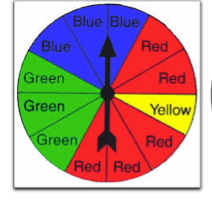
What is the probability of spinning green?
a)
0
b)
1/4
c)
1/2
d)
3/4
74.

The letters that form the word ALGEBRA are placed in a bowl. What is the probability of choosing a letter other than “A”?

a)

2/7

b)

5/49

c)

5/7

d)

10/49

75.
Find the probability of drawing a 10 from a standard deck of 52 cards.
a)
1 out of 52
b)
13 out of 52
c)
26 out of 52
d)
4 out of 52
76.
A bag contains 30 pieces of candy. There are 15 grape, 7 cherry, 3 lemon, 5 strawberry. What is the probability of drawing a lemon?
a)
3
b)
1/10
c)
3/10
d)
30%
77.
In a deck of 52 playing cards what are the odds in favor of drawing a 2,3,4,5 that is also a diamond? 
a)
1:12
b)
12:1
c)
1:13
d)
13:1
78.
The theoretical probability of rolling an even number on a dice.
a)
3/6
b)
1/2
c)
1/6
d)
5/6
79.
You roll a pair of dice. What are the odds in favor of rolling a sum of 12? 
a)
1:36
b)
1:35
c)
1:18
d)
1:12
80.

The letters that form the word MATHEMATICS are placed in a bowl. What are the odds AGAINST choosing an “A”? 

a)
9:2
b)
2:9
c)
9:11
d)
11:9
81.
A number cube is rolled twice. What is the probability of getting a 6 on the first roll, then a number less than 5 on the second roll? 
a)
2/3
b)
5/36
c)
1/9
d)
1/36
82.

You are dealt 5 cards from a standard deck of playing cards. What is the probability you are dealt a flush?


**A flush is all 5 cards of the same suit (order does not matter).

a)

1/1287

b)

1/2598960

c)

1287/2598960

d)

5/52

83.
What is probability?
a)
A number between zero and one
b)
The chance or the likelihood of an event happening
c)
The favorable outcomes divided by all the possible outcomes.
d)
All of the choices are true.
84.
What is the probability of picking a red marble from the bag?
a)
4/10
b)
1/10
c)
3/10
85.
What is the probability of picking a purple marble from the bag?
a)
3/10
b)
1/10
c)
0
d)
1
86.

The probability of getting bonus points is 5:8. Find the odds in favor of getting bonus points.

a)

5/3

b)

5/13

c)

3/5

d)

8/13

87.

The odds against a customer ordering dessert are 20:3. What is the probability of a customer ordering dessert?

a)

3/20

b)

20/23

c)

3/23

d)

20/3

88.

Out of 10 balloons, two are small, five are medium, and three are large. Find the odds against a large balloons.

a)

3:7

b)

3:10

c)

7:10

d)

7:3

89.

Out of 10 balloons, two are small, five are medium, and three are large. Find the odds in favor of a small balloon.

a)

2:8

b)

8:10

c)

2:10

d)

8:2

90.

Suppose one card is drawn at random from a standard deck. What is the probability that the card drawn is a club?

a)

1/4

b)

1/3

c)

4/1

d)

3/1

91.
An impossible event has a probability of _____?
a)
1
b)
0
c)
1/2
d)
100
92.

The odds in favor of receiving a gift are 5:16. Find the probability of Henry receiving a gift.

a)

16/5

b)

5/21

c)

None of these

d)

5/16

93.
A spinner has 8 equal sections numbered 1 to 8. What is the probability of the spinner stopping on a number that is a multiple of 3 or is greater than 5?
a)
1/7
b)
1/12
c)
5/8
d)
1/2
94.
What is the probability of the arrow stopping on “J” or “A” on one spin?
a)
5/6
b)
1/36
c)
1/3
d)
1/6
95.
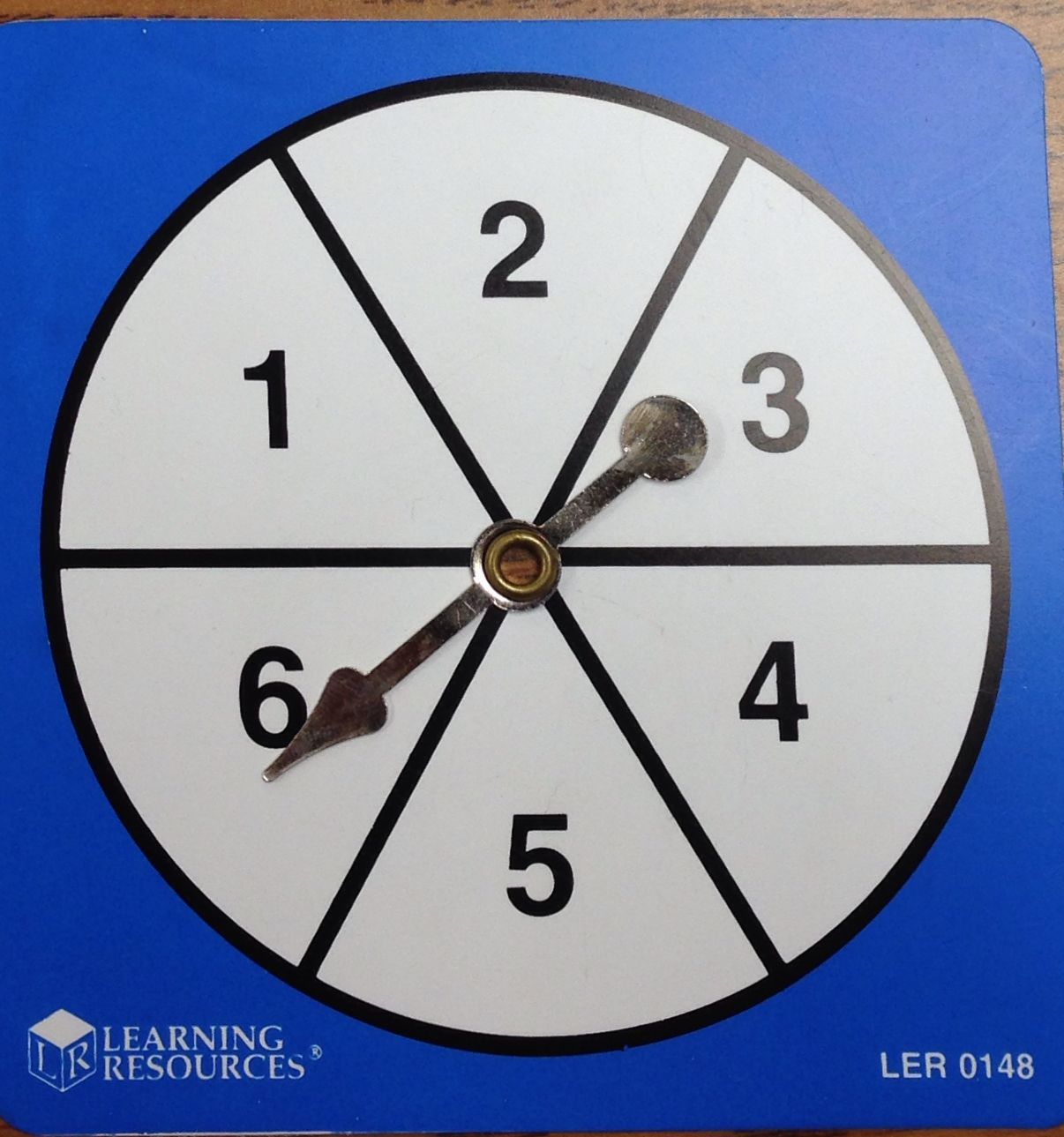
What is the probability of the arrow stopping on an odd number or a number greater than 2?
a)
5/6
b)
1/36
c)
1/6
d)
Elephant
96.
What is the probability of passing this class, if you do all your work?
a)
25%
b)
60%
c)
83%
d)
100%
97.
The chance of rain today is 70%. What is the chance it does not rain?
a)
70%
b)
30%
c)
100%
d)
50%
98.
How do you write 0.02 as a percent?
a)
20%
b)
200%
c)
2%
d)
.02%
99.
What is the probability of selecting an orange candy?
a)
0%
b)
25%
c)
50%
d)
100%
100.
The odds of an event happening are 3:8. What are the odds it does not happen?
a)
8:3
b)
3:11
c)
11:3
d)
8:11
101.
When a coin is flipped, what is the probability of heads?
a)
1
b)
1/2
c)
1/4
d)
1/100
102.

The probability of the box having a toy is 6/13. What are the odds against the box having a toy?

a)

7:13

b)

6:7

c)

7:6

d)

13:6

103.

A bag contains 13 red skittles, 18 purple skittles, 12 orange skittles, and 5 yellow skittles. What are the ODDS in FAVOUR of drawing a red skittle?

a)

13:35

b)

35:13

c)

13/48

d)

35/48

104.

A bag contains 13 red skittles, 18 purple skittles, 12 orange skittles, and 5 yellow skittles. What are the ODDS AGAINST drawing a yellow skittle?

a)

43:5

b)

5:43

c)

43/48

d)

5/48

105.

What are the ODDS in FAVOUR of rolling doubles on a pair of six sided dice?

a)

1:5

b)

30:6

c)

6/36

d)

5/6

106.

A standard deck of cards has 52 cards. What are the odds of choosing the 7 of spades?

a)

51:1

b)

1:51

c)

1:52

d)

52:1

107.

A bag holds 10 coloured marbles,. Of the marbles, 6 are red, 3 are blue, and 1 is green. What are the odds of selecting a red marble?

a)

4:6

b)

10:4

c)

6:4

d)

4:10

108.

A bag holds 10 coloured marbles,. Of the marbles, 6 are red, 3 are blue, and 1 is green. What are the odds of NOT selecting a blue marble?

a)

10:7

b)

7:10

c)

3:7

d)

7:3

109.
P(1 and A)
a)
1/16
b)
1/10
c)
4/16
d)
1/4
110.
P(odd and A)
a)
1/4
b)
1/2
c)
2/5
d)
1/8
111.
P(not chow mein)
a)
7/8
b)
1/8
c)
2/7
d)
5/6
112.
a)
7/24
b)
1/2
c)
1/24
d)
1/12
113.
a)
1/2
b)
1/8
c)
1/3
d)
1/12
114.
A coin is tossed and then the spinner is spun. Determine the probability that you get Heads and Red.
a)
1/6
b)
1/10
c)
0
d)
1/12
115.
P(4)*P(Tails)=
You flip a coin and roll a die. What is the probability that you flip a tails and roll a 4?
a)
3/15
b)
1/12
c)
2/3
d)
Susan
116.
Classify each pair of events as dependent or independent. 
Roll a number cube. Then toss a coin.
a)
Independent
b)
Dependent
117.
Suppose you have five books in your book bag. Three are novels, one is a biography, and one is a poetry book. Today you grab one book out of your bag without looking, and return it later. Tomorrow you do the same thing. What is the probability that you grab a novel both days?
a)
3/5
b)
6/10
c)
6/25
d)
9/25
118.
If you draw one card from a standard deck, what is the probability of drawing a 5 or a diamond?
a)
2/52
b)
4/52
c)
16/52
d)
26/52
119.
If you draw one card from a standard deck, what is the probability of drawing a spade or a red card?  Are the events inclusive or mutually exclusive?
a)
Inclusive
b)
Mutually exclusive
120.
If you roll one die, what is the probability of getting an odd number or a 4?  Are the events inclusive or mutually exclusive?
a)
Inclusive
b)
Mutually exclusive
c)
1/2
d)
1/6
121.
If you roll one die, what is the probability of getting an odd number or a 4?
a)
2/3
b)
1/3
c)
1/2
d)
1/6
122.
If you roll one die, what is the probability of getting an even number or a multiple of 3?   Are the events inclusive or mutually exclusive?
a)
Inclusive
b)
Mutually exclusive
c)
1/2
d)
1/6
123.
If you roll one die, what is the probability of getting an even number or a multiple of 3?
a)
1/3
b)
2/3
c)
1/2
d)
1/6
124.
How many face cards in a standard deck of cards?
a)
3
b)
12
c)
13
d)
52
125.
A bag contains 9 green marbles, 5 yellow marbles and 6 red marbles.  You choose one marble.   What is the probability of selecting a green or red marble?  Do you add or multiply probabilities?
a)
Add
b)
Multiply
126.
In how many ways can 3 different vases be arranged on a tray?
 
a)
3
b)
9
c)
6
d)
12
127.
How many outfits are possible with 5 pairs of jeans, 8 t-shirts, and 2 pairs of shoes?
a)
15
b)
40
c)
80
d)
10
128.
How many 5-digit (numerical) passwords are possible for the school email system if the first digit cannot be 0?
a)
11,424,400
b)
10,967,424
c)
9000
d)
90,000
129.
There are 6 roads from Ponder to Justin, 2 roads from Justin to Halslet, and 3 roads from Haslet to Saginaw.  How many possible routes are there from Ponder to Saginaw using only these roads and no backtracking? 
a)
12
b)
11
c)
18
d)
36
130.
Homecoming has 7 candidates for King. How many ways can a King and a First Runner-up be chosen to form the Festival Court?
a)
23
b)
840
c)
42
d)
3,628,800
131.
A team of 17 volleyball players needs to choose three players to refill the water cooler.  How many different ways can the players be chosen?  
a)
3360
b)
560
c)
4080
d)
680
132.
Picking a team of three people out of a group of 10.
a)
Permutation
b)
Combination
c)
Neither
133.
Choosing 3 toppings for your sundae out of a list of 15.
a)
Permutation
b)
Combination
c)
Neither
134.
Picking a President, Vice-President, and Secretary from a group of 12.
a)
Permutation
b)
Combination
c)
Neither
135.
How many ways can a president, vice president, and treasurer be elected from a group of 40 students?
a)
120
b)
59,280
c)
9,880
d)
2,354
136.
Ambry must submit 4 paintings as part of her
application to art school. If she has 25 to choose from, how many ways can she pick 4?
a)
12,650
b)
303,600
c)
100
d)
254
137.
20C18
a)
0
b)
1
c)
190
d)
1140
138.
12P4
a)
24
b)
132
c)
1320
d)
11880
139.
Permutation, combination or neither:
Rob and Mary are planning trips to 9 countries this year.  There are 13 countries they would like to visit.  They are deciding which countries to skip.
a)
combination
b)
permutation
c)
neither
140.
Permutation, combination or neither:
The batting order for seven players on a 12 person team.
a)
combination
b)
permutation
c)
neither
141.
Permutation, combination, or neither:
There are 45 applicants for three Computer Programmer positions.
a)
combination
b)
permutation
c)
neither
142.
How many Outcomes?
Choosing from 3 sizes of bottled water and from distilled, filtered, or spring water.
a)
6
b)
9
c)
2
d)
12
143.
Which of the following is an example of combination?
a)
Form a passcode with 4 digits
b)
Students line up in a queue to assembly
c)
Choose 4 students in a class committee
d)
Choose the chairperson, secretary and treasurer in a club
144.

The diagram shows the sports played by 80 students.


If a student is picked at random, what is the probability that they play football only?

a)

66/80

b)

4/80

c)

18/80

d)

49/80

145.

The diagram shows the sports played by 80 students.


If a student is picked at random, what is the probability that they play football?

a)

66/80

b)

4/80

c)

18/80

d)

49/80

146.

The diagram shows the sports played by 80 students.


If a student is picked at random, what is the probability that they play Hockey and Rugby but not Football?

a)

36/80

b)

5/80

c)

41/80

d)

44/80

147.

The diagram shows the sports played by 80 students.


If a student is picked at random, what is the probability that they play any of the three sports?

a)

79/80

b)

1/80

c)

74/80

d)

6/80

148.

The diagram shows the sports played by 80 students.


If a student is picked at random, what is the probability that they don't play any of the three sports?

a)

79/80

b)

1/80

c)

74/80

d)

6/80

149.

The diagram shows the sports played by 80 students.


If a student is picked at random, what is the probability that they play Rugby or Hockey?

a)

75/80

b)

8/80

c)

13/80

d)

44/80

150.

The diagram shows the sports played by 80 students.


If a student is picked at random, what is the probability that they play Rugby or Hockey but not Football?

a)

75/80

b)

8/80

c)

13/80

d)

44/80

151.

The diagram shows the sports played by 80 students.


If a student is picked at random, what is the probability that they don't play Rugby?

a)

24/80

b)

77/80

c)

23/80

d)

17/80

152.

There are 20 sweets in a bag. A sweet is picked at random from the bag. The probability that this sweet is not a chocolate is 0.6.


How many chocolates are in the box?

a)

0.4

b)

4

c)

8

d)

12

153.
a)

5700\frac{5}{700}

b)

695700\frac{695}{700}

c)

699700\frac{699}{700}

d)

1700\frac{1}{700}

154.
a)

0.25

b)

0.3

c)

0.75

d)

0.35

155.

There are only Pink, Yellow, Green and Blue counters in a bag. The table shows the probability of picking each colour.


What is the probability of picking a Yellow counter?

a)

0.8

b)

0.2

c)

0.7

d)

0.3

156.
The chance that an event will happen.  A ratio of chance/all chances.
a)
odds
b)
probability
c)
outcomes
d)
tree diagram
157.
The probability based on frequency of outcomes during an experiment
a)
 experimental probability
b)
fundamental counting principle
c)
mutually exclusive event
d)
dependent event
158.
The ratio of the number of ways an event can occur to the number of possible outcomes.
a)
odds
b)
theoretical probability
c)
 outcomes
d)
dependent event
159.
Possible results of an event
a)
outcomes
b)
compound event
c)
simple event
d)
probability
160.
A diagram used to show the total number of possible outcomes in a probability event
a)
mutually exclusive event
b)
outcomes
c)
tree diagram
d)
odds
161.
The outcome of one event does not influence the outcome of the other event
a)
independent event
b)
tree diagram
c)
simple event
d)
odds
162.
2 or more simple events
a)
theoretical probability
b)
outcomes
c)
simple event
d)
compound event
163.

What is an event that will happen or has a probability of 1?

a)

theoretical

b)

probability

c)

mutually exclusive

d)

certain

164.

outcome with the same chance of occurring

a)

mutually exclusive

b)

impossible

c)

equally

d)

independent

165.

a situation involving doing the activity that leads to results or outcomes.

a)

complement

b)

outcome

c)

dependent

d)

experimental

166.

an event with a probability of zero

a)

impossible

b)

mutually exclusive

c)

outcome

d)

outcome

167.

Mathematical calculation that an even will happen in theory.

a)

odds

b)

theoretical probability

c)

outcomes

d)

dependent event

168.

A set of all possible outcomes of one or more events. Ex. {1,2,3,4,5,&6}

a)

Independent Events

b)

Outcome

c)

Probability

d)

Sample Space

169.

Probabilities are always between...

a)

0 & 1 or 0% & 100%

b)

0 & 100 or 0% & 1%

c)

1 & 100

d)

2 & 1

170.
The probability of an event is written as P(event).
a)
False
b)
True
171.

The chance of flipping a tail on a normal coin is equally as likely as flipping a head.

a)

True

b)

False

172.

Identify the following scenario as experimental or theoretical:


Samantha flips a coin 10 times and the result is heads 7 times. She concludes that the probability of getting heads must be 7/10

a)

Experimental

b)

Theoretical

173.

the outcome of the first event affects the outcome of the second event

a)

equally

b)

independent

c)

dependent

d)

certain

174.
-information being collected
a)
data
b)
variability
c)
tally
d)
graph
175.
-describes how spread out the data is
a)
variability
b)
interval
c)
frequency
d)
mean
176.
-most frequently occurring number in a data set
a)
mean
b)
median
c)
mode
d)
range
177.
-center number of a data set
a)
mean
b)
median
c)
mode
d)
range
178.
-difference between the largest and smallest value of a data set
a)
mean
b)
median
c)
mode
d)
range
179.
-graph that summarizes data into 5 measures
a)
stem and leaf plot
b)
dot plot
c)
histogram
d)
box plot
180.
-graph used to convey information about center and variability
a)
stem and leaf plot
b)
dot plot
c)
histogram
d)
box plot
181.
-graph that uses dots to show frequency
a)
stem and leaf plot
b)
dot plot
c)
histogram
d)
box plot
182.

The number of times the value appears in a data set.

a)

Frequency

b)

Joint Relative Frequency

c)

Marginal Relative Frequency

d)

Conditional Relative Frequency

183.

What is the definition of "population"?

a)

Part of a population and should be representative of the whole population.

b)

The whole of a group being studied.

c)

the practice or science of collecting and analyzing numerical data in large quantities,

d)

not representative of the population

184.

What is a "sample"?

a)

Part of a population and should be representative of the whole population

b)

The whole of a group being studied

c)

the practice or science of collecting and analyzing numerical data in large quantities

d)

not representative of the population

185.
-describes middle 50% of data
a)
lower quartile range
b)
mean absolute deviation
c)
interquartile range
d)
deviation from the mean
186.
To find the _________ you add up all the numbers and then divide by how many numbers you have.
a)
Mean
b)
Median
c)
Mode
d)
Range
187.

Average

a)

Mean

b)

Median

c)

Mode

d)

Range

188.

The largest number in a data set

a)

Minimum

b)

Difference

c)

Sum

d)

Maximum

189.

Middle number in a data set

a)

Median

b)

Outlier

c)

Boxplot

d)

Mode

190.

Compares data using medians

a)

Dot Plot

b)

Box Plot

c)

Range

d)

Histogram

191.

Smallest number in a data set

a)

Maximum

b)

Range

c)

Median

d)

Minimum

192.
What is the term for the median of the upper half of the data?
a)
Upper Quartile
b)
Lower Quartile
c)
Median
d)
Minimum
193.
True or False
The interquartile range is the difference between the upper quartile (Q3) and the lower quartile (Q1).
a)
True
b)
False
194.

Which of the following best describes the process of finding the interquartile range for a set of data?

a)

Add the biggest and smallest numbers.

b)

Place the numbers in order from least to greatest and find the middle.

c)

Find the difference between the maximum and the minimum.

d)

Subtract Q1 from Q3.

195.

In a deck of 52 cards, what is the probability of drawing a heart?

a)

1/4

b)

1/3

c)

1/5

d)

1/2

196.

If you have a 1 in 5 chance of winning a prize, what is the probability of not winning?

a)

3/5

b)

4/5

c)

2/5

d)

1/5

197.

A coin is tossed 18 times. It lands on heads 12 times. What is the experimental probability of the coin landing on tails? reduce the fraction!

a)
b)
c)
198.

The bar graph shows the results of rolling a number cube __________times

a)

6

b)

50

c)

100

d)

12

199.

The bar graph shows the results of spinning the spinner 200 times. What is the experimental probability of landing on a 3?

a)
b)
c)
d)
200.

The bar graph shows the results of spinning the spinner 200 times. What is the theoretical probability of landing on a 4 ?

a)
b)
c)
d)
201.

Neil tossed a 6-sided die 90 times. The results of his tosses are recorded in the table below: Which number has the experimental probability of 13/90?

a)

1

b)

2

c)

3

d)

4

e)

5

202.

The arrow is spun 15 times and landed 4 times on the section labeled Q. Which statement is true?

a)
b)
c)
d)
203.

The table shows the results of 50 rolls of a number cube. According to the data in the table, what was the experimental probability of rolling a 1?

a)
b)
c)
d)
204.

What is the probability of spinning red?

a)
b)
c)
d)
205.

Shannon has a bag of jelly beans. She removed one jelly bean, recording the color, and then replaced it. She repeated the process 44 times and record her results in the table. What is the experimental probability of her selecting a red jelly bean?

a)

11/44

b)

9/22

c)

1/4

d)

1/3

206.
Bruce flipped a penny 5 times. It landed on heads 2 times and tails 3 times. If he flips the coin a 6th time, what statement is true?
a)
It is more likely to be heads
b)
It is equally likely to be heads or tails
c)
It is more likely to be tails
d)
It is not likely to be tails
207.
The spinner is spun once. Find the P(H)
a)
1/8
b)
1/2
c)
1/12
d)
1/10
208.
The spinner is spun once. Find P(B or E)
a)
1/4
b)
1/5
c)
1/8
d)
1/10
209.
P(Not K)
a)
7/10
b)
0
c)
9/10
d)
1
210.
P(Not M)
a)
1
b)
0
c)
1/2
d)
1/10
211.
What do we call Theoretical Probability?
a)
What Actually Happens
b)
What Should Happen
212.
What do we call Experimental Probability?
a)
What Actually Happens
b)
What Should Happen
213.
What is the experimental probability of green?
a)
22/103
b)
11/50
c)
11/51
d)
22/105
214.
 Josh is rolling dice in a probability experiment. If Josh wants the experimental probability to be as close as possible to the theoretical probability, which plan should he use?
a)
Roll 4 times
b)
Roll 40 times
c)
Roll 75 times
d)
Roll 140 times
215.
Cassie rolls a fair number cube with 6 faces labeled 1 through 6. She rolls the number cube 600 times. Which result is most likely?
a)
Cassie will roll a 1 about 100 times
b)
Cassie will roll a 1 exactly 100 times
c)
Cassie will roll an even number about 400 times
d)
Cassie will roll an even number exactly 400 times
216.
A nickel is tossed 840 times and heads came up 400 times. What is the experimental probability of tossing tails?
a)
10/21
b)
5/11
c)
11/21
d)
3/5
217.

In a bag of marbles there are 42 red, 74 blue, 66 green and 118 yellow marbles. These 300 marbles are mixed up. What is the probability of getting the most unlikely marble choice?

a)

10%

b)

12%

c)

16%

d)

14%

218.

What is the probability of spinning an even number?

a)

30%

b)

33%

c)

50%

d)

67%

219.

If you choose from the following M & M colors, what is the probability that you choose blue? **Remember to simplify**

5 green

6 yellow

8 blue

7 brown

a)

8/18

b)

4/13

c)

8/25

d)

1/3

220.

What is the experimental probability of the coin landing on heads?

a)

1324\frac{13}{24}

b)

12\frac{1}{2}

c)

1124\frac{11}{24}

d)

712\frac{7}{12}

221.

What is the Theoretical Probability of NOT landing on red?

a)
25%
b)
50%
c)
65%
d)
66.7%
222.

Which table shows an experimental probability of landing on tails that is closest to the theoretical probability of landing on tails?

a)
b)
c)
d)
223.
a)
b)
c)
d)
224.

A standard 6-sided die is tossed 90 times. The results are recorded in the table. What number had an experimental probability that matched its theoretical probability?

a)

1

b)

2

c)

3

d)

4

e)

5

225.

The spinner has 4 sections of equal size labeled T, V, W, and X. The arrow of this spinner was spun 10 times and landed 6 times on the section labeled T.

Which statement best describes the experimental probability and theoretical probability of the arrow landing on the section labeled T?

a)

The experimental probability is 1/4, and the theoretical probability is 3/5.

b)

The experimental probability is 3/5, and the theoretical probability is 1/4.

c)

The experimental probability is 3/5, and the theoretical probability is 3/5.

d)

The experimental probability is 1/4, and the theoretical probability is 1/4.

226.

If the spinner was spun 50 times and landed on 11 fifteen times, which statement is true?

a)

The experimental probability of landing on 11 is 1/8 while the theoretical probability of landing on 11 is 3/10

b)

The theoretical probability of landing on 11 is 12.5% while the experimental probability of landing on 11 is 30%

c)

The experimental probability of landing on 11 is less than the theoretical probability of landing on 11

d)

The theoretical probability of landing on 11 is equal to the experimental probability of landing on 11

227.

Joe is spinning a spinner with four equal sections labeled red, blue, green and yellow. If he wants the experimental probability of spinning green to be similar to the theoretical probability of spinning green, what must happen?

a)

He should spin the spinner a large number of trials

b)

He should make more outcomes.

c)

He only needs to spin the spinner a small number of trials

d)

He should take away some of the outcomes

228.

Lisa is rolling a six-sided number cube. If she wants the experimental probabilities to be as close as possible to the theoretical probabilities, how many times should she roll the number cube?

a)

100 times

b)

10,000 times

c)

10,000,000 times

d)

100,000 times