
 Worksheets
IELTS 11 Semester 2 Exam
Total questions: 60
Worksheet time: 1hrs 10mins
Following Henri Becquerel’s discovery in 1896 of a new phenomenon, which Marie later called ‘radioactivity’, Marie Curie decided to find out if the radioactivity discovered in uranium was to be found in other elements. She discovered that this was true for thorium.
When uranium was discovered to be radioactive, Marie Curie found that the element called (a) had the same property.
Turning her attention to minerals, she found her interest drawn to pitchblende, a mineral whose radioactivity, superior to that of pure uranium, could be explained only by the presence in the ore of small quantities of an unknown substance of very high activity. Pierre Curie joined her in the work that she had undertaken to resolve this problem, and that led to the discovery of the new elements, polonium and radium.
Marie and Pierre Curie’s research into the radioactivity of the mineral known as (a) led to the discovery of two new elements.
In 1911 she was awarded the Nobel Prize for Chemistry for the isolation of a pure form of radium.
In 1911, Marie Curie received recognition for her work on the element (a) .
During World War I, Marie Curie, with the help of her daughter Irène, devoted herself to the development of the use of X-radiography, including the mobile units which came to be known as ‘Little Curies’, used for the treatment of wounded soldiers.
Marie and Irène Curie developed X-radiography which was used as a medical technique for (a) .
One of Marie Curie’s outstanding achievements was to have understood the need to accumulate intense radioactive sources, not only to treat illness but also to maintain an abundant supply for research.
Marie Curie saw the importance of collecting radioactive material both for research and for cases of (a) .
The existence in Paris at the Radium Institute of a stock of 1.5 grams of radium made a decisive contribution to the success of the experiments undertaken in the years around 1930. This work prepared the way for the discovery of the neutron by Sir James Chadwick and, above all, for the discovery in 1934 by Irène and Frédéric Joliot-Curie of artificial radioactivity.
The radioactive material stocked in Paris contributed to the discoveries in the 1930s of the (a) and of what was known as artificial radioactivity.
What is the main idea of this paragraph?
World-renowned astrophysicist Stephen Hawking believes that once spaceships can exceed the speed of light, humans could feasibly travel millions of years into the future in order to repopulate earth in the event of a forthcoming apocalypse. This is because as the spaceships accelerate into the future, time would slow down around them (Hawking concedes that bygone eras are off limits - this would violate the fundamental rule that cause comes before effect).
Human time travel is theoretically possible, but is unlikely to ever actually occur.
Human time travel might be possible, but only moving backward in time.
Human time travel might be possible, but only moving forward in time.
What is the main idea of this paragraph?
Procrastination, a kind of chronic time-wasting, has long been dismissed as an innocuous human foible. Researchers are now beginning a more sober examination of this practice, however, and there may be good reason for doing so: twenty per cent of Americans now admit to suffering from procrastination, a fifteen per cent jump from 1970.
Procrastination has never been considered a serious problem.
Procrastination has, until recently, not been recognised as a serious problem.
Procrastination has always been recognised as a serious problem.
Does the following statement agree with the information given in the text? Mary Somerville was a greater mathematician than Augustus de Moran.
Although it was unusual for young women of her era to pursue mathematics as a discipline, and Ada did not enjoy the privilege of formal education, her position in society allowed her access to some of the greatest minds of her day. Among these tutors was Mary Somerville, a noted mathematician and astronomer, whose legacy is continued in the naming of women’s colleges around the world. Another tutor, logician Augustus De Morgan, informed Anne that her daughter had the potential to become ‘an original mathematical investigator, perhaps of first-rate eminence’.
True
False
Not Given
Does the following statement agree with the views of the writer? Davis’ trumpet teacher wanted him to play with vibrato.
Whereas most trumpeters of the era favoured the use of vibrato (a wobbly quiver in pitch inflected in the instrument’s tone), Davis was taught to play with a long, straight tone, a preference his instructor reportedly drilled into the young trumpeter with a rap on the knuckles every time Davis began using vibrato.
Yes
No
Not Given
Does the following statement agree with the views of the writer? Playing in jazz clubs in New York was the best way to become famous.
Much of his early training took place in the form of jam sessions and performances in the clubs of 52nd Street, where he played alongside both up-and-coming and established members of the jazz pantheon such as Coleman Hawkins, Eddie ‘Lockjaw’ Davis, and Thelonious Monk.
Yes
No
Not Given
Does the following statement agree with the views of the writer? According to Davis, studying at Julliard helped him to improve his musical abilities.
His enrolment in the prestigious Julliard School of Music was short-lived, [but] Davis did later acknowledge that this time at the school was invaluable in terms of developing his trumpet-playing technique and giving him a solid grounding in music theory.
Yes
No
Not Given
The IELTS listening test contains 40 questions for general and academic assessment.
true
false
I do not know.
Answer requirement indicates how many words IELTS test takers should write down.
true
false
I do not know
Which one is NOT an academic topic?
a discussion between students and a tutor/ lecturer about a research
a lecture
report of the study
travel information
What type of task is NOT in IELTS listening test?
multiple-choice
note completion
matching
yes/ no/ not given
Which skill is NOT used when listening to an IELTS test?
writing a summary
identifying keywords
paraphrasing
note-taking
Which is NOT the role of keywords?
locating your answers when listening to the test
thinking of synonyms and antonyms
checking spelling mistakes
identifying parts of speech of your answers
Which one is NOT used for doing paraphrase?
synonyms and antonyms
translating
shortlisting
explaining
What should test takers focus on to identify correct answers in IELTS listening test?
keywords
parts of speech and numbers
singular, plural and uncountable nouns
all of them
What should test takers focus on when listening to a map?
getting familiar with the map
locating the entrance
following direction during the talk
all of them
True or False
You can play the recording several times in the Listening test.
True
False
True or False
The Listening section consists of 50 questions.
True
False
How many parts are in the Listening Comprehension section?
(a)
You need to be aware of spelling and grammar in the Listening section.
True
False
What is the main purpose of listening comprehension?
To improve speaking skills
To understand spoken language
To write better essays
To memorize vocabulary
Which of the following is NOT a strategy for effective listening?
Taking notes
Asking questions
Ignoring the speaker
Paraphrasing
Which of the following is an example of a listening barrier?
Active listening
Background noise
Taking notes
Asking questions
What is the purpose of listening for gist?
To understand the main idea
To identify specific details
To analyze the speaker's tone
To take notes
What is the purpose of listening for inference?
To understand the main idea
To identify specific details
To analyze the speaker's tone
To make educated guesses
What is the purpose of listening for supporting details?
To understand the main idea
To identify specific words or numbers
To analyze the speaker's tone
To find evidence or examples

Which is the "best" introductory statement for the data shown?
The graph shows traffic growth in the Netherlands between 1960 and 2010.
The graph indicates the changes in traffic in the Netherlands from 1960 to 2010.
The graph indicates the changes in the number of vehicles on the road in the Netherlands from 1960 to 2010.

Approximately how many adults play basketball?
80
25
10
How many boys enjoy swimming?
about 40
about 60
about 170
Which sport is enjoyed by the same number of adults as girls?
basketball
tennis
football
Which group seems to participate in the most sport overall?
adults
boys
girls
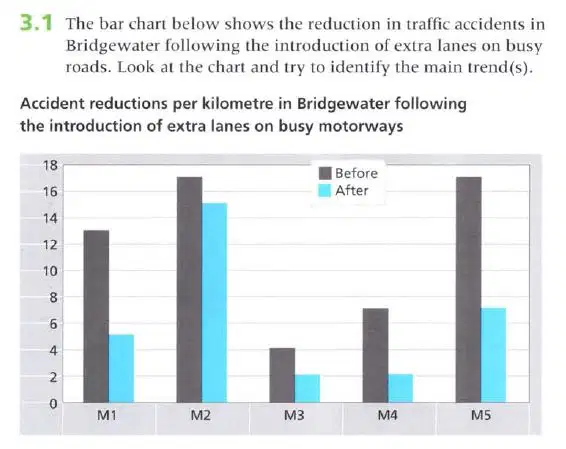
Which of the following sentence is an accurate overview sentence of the bar chart?
(you must summarize the main trend(s)).
There were mixed results following the introduction of the new traffic system in Bridgewater.
On some roads the extra lanes were more popular than on others.
The roads with the largest amount of traffic are the M1 and M5.
In every case, adding an extra lane on the main roads had a positive effect on traffic accidents.
All cities should incorporate this system on the main roads.
Which word could be used to replace the underlined word?
There was a sharp decrease in the sales between 2007 and 2010.
reduction
drop
rise
stay
Which word could be used to replace the underlined word?
The figure fell steadily over the next 10 years.
reduction
dropped
rise
stayed
Which word could be used to replace the underlined word?
It is predicted that the numbers will begin to increase from 2025.
reduction
drop
rise
stay
Which word could be used to replace the underlined word?
It is predicted that the numbers will remain the same for the next ten years.
reduction
drop
rise
stay

Which main export will be the most popular in the future?
Meat Products
Dairy Products
International tourism
all-in package
a holiday when you pay by yourself
a holiday where you purchase the travel and accommodation together
a holiday where you travel to a lot of places
a holiday where you go with your friends
breathtaking view
a cheap holiday
full of pollution place
fresh air place
an extremely beautiful view
guided tour
somewhere a long way away
a holiday where you purchase the travel and accommodation together
travel with someone you loved
an organized group shown around a place of interest by an expert
holiday of a lifetime
a special holiday that you are unlikely to repeat
a place where lots of people go for a holiday
somewhere a long way away
where you go for a holiday
out of season
an extended weekend holiday including Friday or Monday
outside of the main holiday period
where you wait for your flight to be called
crowds of tourists
tourist trap
a place where lots of people go for a holiday
to take a holiday to escape a busy or stressful lifestyle
a holiday where you purchase the travel and accommodation together
somewhere where too many tourists go
Paramount
Unsettling
Supreme
Disguised
Heavy
Invasive
Flaw
Service
Interfering
Abetting
Native
Foreign
Local
New
Groundbreaking
Catastrophic
Auspicious
Meticulous
Constientious
Disastrous
Arid
Humid
Wet
Very dry
Moist
How many parts are in the IELTS speaking exam?
1
2
3
4
How many examiners give the speaking test?
only 1
2
it depends
What is the duration of the Speaking section in the IELTS test?
Less than 15 minutes
Around 30 minutes
About 1 hour
More than 2 hours
Which Speaking Test criterion assesses the ability to express ideas clearly and coherently?
Fluency and Coherence
Lexical Resource
Grammatical Range and Accuracy
Pronunciation
What does Lexical Resource evaluate in the Speaking module?
Grammar usage
Pronunciation skills
Vocabulary range and usage
Speech continuity and rate
What does the Pronunciation criterion assess in the Speaking module?
Accent and dialect
Grammar accuracy
Speech continuity
Intonation and stress
Which Speaking Test criterion refers to the accurate and appropriate use of grammatical forms and structures?
Fluency and Coherence
Lexical Resource
Grammatical Range and Accuracy
Pronunciation

