
 Worksheets
Unit 8 Test - Reform Movements & Causes of the Civil War
Total questions: 22
Worksheet time: 11mins
Name
Class
Date
1.
3. Which reform movement is most closely associated with William Lloyd Garrison, Frederick Douglass, and Harriet Beecher Stowe?
a)
abolitionist
b)
labor
c)
Populist
d)
Progressive
2.
4. What did the Elizabeth Cady Stanton & Lucrietta Mott write in the Declaration of Sentiments from the Seneca Falls Convention of 1848?
a)
that the abolition of slavery was necessary
b)
that all men and women are created equal
c)
that California should be admitted as a free state
d)
that the sale of alcoholic beverages should be illegal
3.

5. According to this passage, those who adopted this pledge believed that
a)
religion had no place in national politics
b)
Congress should repeal Prohibition
c)
alcohol consumption was damaging to society
d)
only the government can solve social problems
4.

6. Which historical event would be most likely supported by Horace Mann and the quote below?
a)
The opening of private schools to benefit the children of rich planters.
b)
Prevenitng black children from attending public schools.
c)
The hiring of uneducated women to teach.
d)
The creation of common schools that admitted students of varying economic status.
5.
7. The publication of Uncle Tom’s Cabin, written by Harriet Beecher Stowe, contributed to the start of the Civil War by
a)
exposing the dangers of cotton manufacturing
b)
increasing the awarness of the issues of slavery
c)
pressuring the president to support temperance
d)
convincing Congress to ban women's right to vote
6.
8. What did the Missouri Compromise (1820), the Compromise of 1850, and the Kansas-Nebraska Act (1854) attempt to do?
a)
end fighting between midwestern farmers and Native American Indians
b)
encourage manufacturing in the West
c)
increase the number of people who voted in presidential elections
d)
settle disputes over the spread of slavery to the western territories
7.
9. How did “Bleeding Kansas,” effect the United States?
a)
ended conflict over slavery in the territories
b)
eased tensions between the North and the South
c)
contributed to the formation of the Whig Party
d)
made sectional compromise more difficult
8.
10. Which statement about the Missouri Compromise (1820) is most accurate?
a)
Slavery was banned west of the Mississippi River.
b)
Unorganized territories would be governed by the United States and Great Britain.
c)
The balance between free and slave states was maintained.
9.
11. In the 1850s, why did many runaway enslaved people go to Canada?
a)
They feared being drafted into the Northern army.
b)
The Fugitive Slave Law kept them at risk in the United States
c)
More factory jobs were available in Canada.
d)
Northern abolitionists refused to help fugitive slaves.
10.
12. In the 1850s, the phrase “Bleeding Kansas” was used to describe clashes between
a)
proslavery and antislavery groups
b)
Spanish landowners and new American settlers
c)
Chinese and Irish railroad workers
d)
Native American Indians and white settlers
11.
13. Which is a primary source of information about the nature of slavery in the United States?
a)
a television program showing life on a Southern plantation
b)
a copy of the Supreme Court's ruling in Brown v. Board of Education
c)
the autobiography of Frederick Douglass
d)
a history of slavery written by a 20th-century historian
12.
14. Elizabeth Cady Stanton and Lucretia Mott were best noted for their struggle to
a)
prohibit the manufacture and sale of alcohol
b)
abolish slavery
c)
secure the right of women to vote
d)
expose government corruption
13.
15. The Underground Railroad which helped enslaved people escape to freedom, would be classified under what movement?
a)
Temperance movement
b)
Abolition Movement
c)
Women's Rights Movement
d)
Suffrage movement
14.
16. The primary goal of the American Temperance Society was to?
a)
ban the spread of slavery to new territories
b)
decrease the consumption of alcohol
c)
gain the release of mentally ill people from prisons
d)
create a self-sufficient utopian society
15.
17. Who became known for her efforts to improve conditions and treatment of the mentally ill?
a)
Harriet Tubman
b)
Lucretia Mott
c)
Susan B. Anthony
d)
Dorothea Dix
16.
18. The Compromise of 1850 had an addition known as the Fugitive Slave Law. What did the Fugitive Slave Law do?
a)
The underground railroad was ended
b)
Slaves that ran-away would be jailed
c)
Made it illegal for slaveholders to recapture their slaves
d)
Made it easier for slaveholders to find and reclaim runaway slaves
17.
19. What were reformers wanting to change within the prison system in the 1800s?
a)
more outdoor time for death row inmates
b)
horrible living conditions, lack of proper nutrition, and abuse of the inmates
c)
stricter punishments for criminals
d)
giving prisoners access to books and newspapers
18.
20. Discrimination, lack of public funding, & teachers lack of training, were all problems this movement tried to address?
a)
Abolition
b)
Temperance
c)
Prison
d)
Education
19.
21. Which event was the immediate cause of the secession of several Southern states from the Union in 1860?
a)
the Dred Scott decision, which declared that all prior compromises on the extension of slavery into the territories were unconstitutional
b)
the Missouri Compromise, which kept an even balance between the number of free and slave states
c)
the raid on the Federal arsenal at Harper's Ferry, which was led by the militant abolitionist John Brown
d)
the election of President Abraham Lincoln, who opposed the spread of slavery into the territories
20.
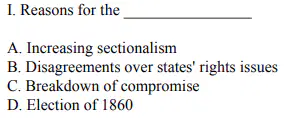
22. Which phrase best completes the title for the partialoutline shown below?
a)
Start of the Revolutionary War
b)
Adoption of the Bill of Rights
c)
Failure of the Whiskey Rebellion
d)
Secession of Southern States from the Union
21.
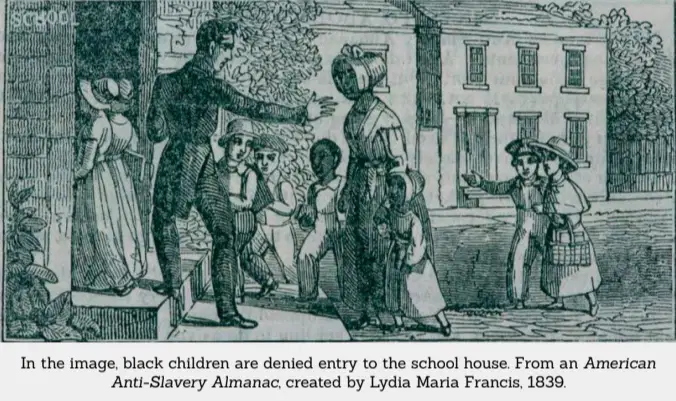
23. Based on the image below and your knowledge, what problems in education still exsisted after refroms were implemented.
a)
Teachers were not trained in education and had little schooling themselves
b)
African Americans were denied access to and education
c)
Schools were not provided with curriculum resources
d)
In northern states schools became publicly funded
22.
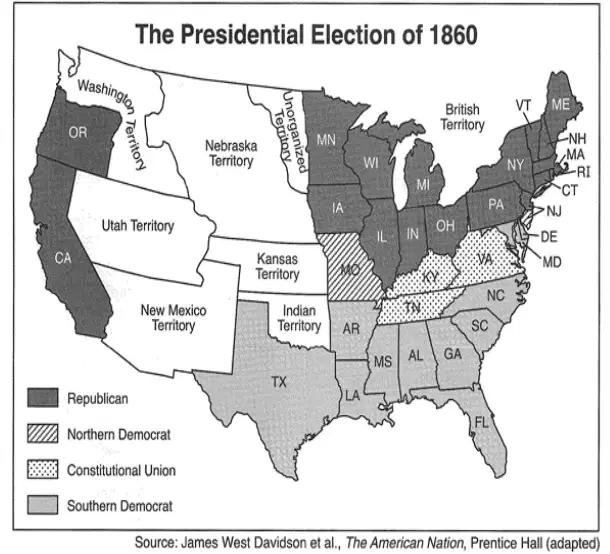
24. Base your answer to question 25 on the map below.
The election results shown on this map most clearly reflect the influence of
a)
nationalist motives
b)
sectional differences
c)
political stability
d)
ethnic conflict
100 %

