
NEW
Font size
 Worksheets
Biology AHL Topic 8 Metabolism, photosynthesis and respiration
Total questions: 20
Worksheet time: 23mins
Which of the following is the correct equation for aerobic cellular respiration?
6CO2 + 6H2O ⟶ C6H12O6 + 6O2 + ATP
6O2 + C6H12O6 ⟶ 6H2O + 6CO2 + ATP
C6H12O6 + 6H2O ⟶ 6CO2 + 6O2 + ATP
6O2 + 6H2O ⟶ C6H12O6 + 6CO2 + ATP
What stage of cellular respiration produces the most number of ATP?
Glycolysis
Krebs cycle
Electron transfer chain
anaerobic respiration
What is true of NAD in cellular respiration?
NAD carries the oxygen needed to break down the glucose molecules into the cell.
NAD is used to directly break apart the glucose molecules.
NAD carries and transfers electrons and H+ ions.
NAD carries excess carbon dioxide out of the cell.
Several molecules are produced as a result of glycolysis.
What is the net production of ATP, pyruvate, and NADH when one molecule of glucose undergoes glycolysis?
2 ATP, 2 NADH, and 2 pyruvate
4 ATP, 1 NADH, 2 pyruvate
4 ATP, 2 NADH, and 4 pyruvate
2 ATP, 1 NADH, and 1 pyruvate
In what part of the cell does glycolysis take place?
Cytoplasm
Mitochondria
Chloroplast
Nucleus
The electron transport chain (ETC) is one part in oxidative phosphorylation, which is the last step in cellular respiration.
Which of the following is true of the ETC?
The movement of H+ ions across the inner membrane of the mitochondria drives the transfer of electrons down the ETC.
The movement of electrons down the ETC drives the formation of a H+ gradient.
The movement of H+ ions through ATP synthase drives the transfer of electrons down the ETC.
The movement of electrons down the ETC drives the movement of ADP and phosphate through ATP synthase.
In what part of the cell does the electron transport chain take place?
Cytosol
Matrix of the mitochondria
Cristae of mitochondria
Outer membrane of mitochondria
Chemiosmosis is a part of oxidative phosphorylation, the final step in cellular respiration.
Which of the following is true regarding chemiosmosis?
The energy from a proton gradient is used to make ATP
Chemiosmosis regenerates electron carriers like NADH and FADH2
ATP synthesis creates a proton gradient that causes electron flow through an electron transport chain (ETC).
A temperature gradient drives ATP synthesis.

What is being released at "A" in the diagram?
Oxygen
Glucose
Water
Carbon Dioxide
What is the reactant at "B" in the diagram?
Oxygen
Glucose
Water
Carbon Dioxide
In which stage of aerobic respiration does complete oxidation of glucose occurs?
Glycolysis
Link reaction
Krebs cycle
Oxidative phosphorylation
During chemiosmosis that occurs in chloroplast, proton is pumped from
Thylakoid space into stroma
Stroma into thylakoid space
Stroma into intermembrane space
Matrix into intermembrane space
When oxygen is released as a result of photosynthesis, it is a direct by-product of
reducing NADP+
splitting water molecules
chemiosmosis
splitting carbon dioxide molecules
Which of the following statements best represents the relationships between the light reactions and the Calvin cycle?
The light reactions provide ATP and NADPH to the Calvin cycle, and the Calvin cycle returns ADP, Pi, and NADP+ to the light reactions.
The light reactions provide ATP and NADPH to the carbon fixation step of the Calvin cycle, and the Calvin cycle provides water and electrons to the light reactions.
The light reactions supply the Calvin cycle with CO2 to produce sugars, and the Calvin cycle supplies the light reactions with sugars to produce ATP.
The light reactions provide the Calvin cycle with oxygen for carbon fixation, and the Calvin cycle provides the light reactions with sugars to produce ATP.
Non-competitive inhibition involves a molecule binding to a ______ site.
Active
Allosteric
Accompanying
Applied
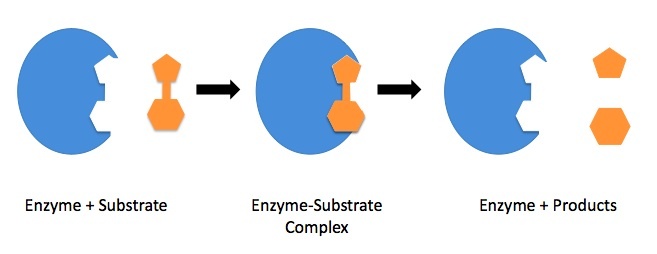
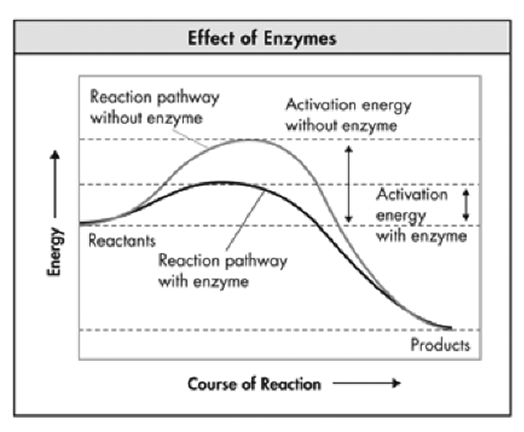

Which explains the shape of the graph?
active sites malfunction as more substrates are added
active sites denature as more substrates are added
active sites become full as more substrates are added
active sites collide less as more substrates are added

