
Font size
 Worksheets
Central Heating Systems Quiz
Total questions: 84
Worksheet time: 1hrs 24mins
What is the maximum heat output covered by the unit for central heating systems?
20kW
30kW
40kW
50kW
What is the diameter of the pipework covered by the unit for central heating systems?
Up to 16mm
Up to 24mm
Up to 32mm
Up to 40mm
What do modern central heating systems use to provide the best possible heating?
Traditional boilers
Energy saving appliances and boilers
Manual controls
Basic components
What percentage of heat from a radiator is convected heat?
20%
50%
80%
100%
At what temperature does the radiator operate in the diagram?
18°C
21°C
24°C
70°C
What happens to the hot air in a radiator heating system?
It descends
It rises
It stays at the same level
It cools down immediately
What is the temperature of the cooler air as it descends in the diagram?
18°C
21°C
24°C
70°C
What is the primary purpose of central heating in dwellings?
To provide heat and warmth
To create a thermally comfortable environment
To reduce energy consumption
To improve air quality
What is the ideal humidity range for humans to feel comfortable?
20-30%
30-40%
40-60%
60-80%
What happens if the humidity level is below 40%?
The atmosphere becomes damp and clammy
The eyes and throat become dry
The body sweats excessively
The body craves water
What is the percentage of oxygen in the air that humans breathe in?
10%
20%
30%
40%
How many air changes per hour are required for a lounge?
1
2
3
4
What is the average temperature difference between men and women for comfort?
Women prefer temperatures 1°C higher than men
Women prefer temperatures 2°C higher than men
Women prefer temperatures 3°C higher than men
Women prefer temperatures 4°C higher than men
What is the optimum air velocity for human comfort in a building?
0.1 to 0.2 m/s
0.2 to 0.25 m/s
0.3 to 0.4 m/s
0.5 to 0.6 m/s
What is the optimum temperature for human comfort in the winter?
18°C
20°C
22°C
24°C

What effect does opening a window have on air velocity?
Varies Velocity by +0.5m/s
Varies Velocity by +1.0m/s
Varies Velocity by +2.0m/s
Varies Velocity by -0.5m/s
What is the recommended temperature range for nursing homes and hospitals?
18 - 20°C
20 - 22°C
22 - 24°C
24 - 26°C
What is the definition of full central heating?
The simultaneous heating of all spaces in a dwelling so as to maintain specified temperatures based upon calculated heat losses.
The simultaneous heating of some of the spaces in a dwelling so as to maintain specified temperatures based upon calculated heat losses.
The simultaneous heating of all or some of the spaces in a dwelling to temperatures below those specified based upon calculated heat losses.
The use of a single circuit of pipework that runs from the boiler and back to the boiler, connecting each radiator in turn.
Which type of heating system is often called part house central heating?
Full central heating
Background heating
Selective heating
Two pipe systems
Why is background heating no longer acceptable under Building Regulations Document L1a?
Because it is too expensive
Because of efficiency and environmental issues
Because it heats all spaces in a dwelling
Because it uses a single circuit of pipework
What is a characteristic of one pipe systems?
They use a single circuit of pipework that runs from the boiler and back to the boiler, connecting each radiator in turn.
They are extremely rare for domestic properties.
They are designed to best practice conditions as recommended in the Domestic Heating Compliance Guide.
They are used to reduce the risk of condensation in certain rooms.
When were two pipe systems developed?
Early 1960s
Early 1970s
Early 1980s
Early 1990s
What are the two circuits used in two pipe systems?
Flow circuit and return circuit
Supply circuit and exhaust circuit
Heating circuit and cooling circuit
Main circuit and secondary circuit
What is one advantage of two pipe systems over one pipe circuits?
They are cheaper to install
They reduce the heating time of the building
They require less maintenance
They use less water
What is the primary function of the boiler management control in a central heating system?
To regulate the temperature of the hot water cylinder
To control the outdoor sensor
To manage the operation of the boilers
To control the zone valves
Which component in the central heating system is responsible for managing the temperature based on external conditions?
Boiler management control
Zone controller
Outdoor sensor
Pressurising unit
What is the role of the expansion vessel in a central heating system?
To manage the operation of the boilers
To control the zone valves
To accommodate the expansion of water as it heats up
To regulate the temperature of the hot water cylinder
Which component is used to separate the primary circuit from the secondary circuits in a central heating system?
Boiler Shunt pumps
Low loss header
Zone valves
Pressurising unit
What is the function of the zone valves in a central heating system?
To manage the operation of the boilers
To control the flow of water to different zones
To regulate the temperature of the hot water cylinder
To accommodate the expansion of water as it heats up
Which of the following phrases refers to a heating system that operates at temperatures below 100°C because it includes an open vent pipe?
Sealed heating
Gravity
Low pressure heating
Microbore
What is the function of an open vent in a heating system?
To prevent heating systems from exceeding 100°C and assist with accommodating the expansion of water due to the water being heated.
To create an airgap between the heating system and the water main.
To use very small pipework to the radiators.
To allow multiple pipe connections in one.
Which heating system does not contain a vent pipe or feed and expansion system and is filled with water from the mains cold water supply?
Low pressure heating
Sealed heating
Gravity
Manifold
What method of heating water uses conduction and involves water expanding and losing density when heated, then flowing upwards to the heat exchanger?
Microbore
Manifold
Gravity
Sealed heating
Which system of heating uses very small pipework to the radiators, typically sizes of 8mm and 10mm pipework?
Low pressure heating
Gravity
Sealed heating
Microbore
What is the purpose of a manifold in a heating system?
To prevent heating systems from exceeding 100°C.
To allow multiple pipe connections in one.
To create an airgap between the heating system and the water main.
To use conduction for heating water.
What is the purpose of a feed and expansion cistern in a low-pressure heating system?
To store hot water for immediate use
To allow water to expand when heated and to fill the system with water
To provide a backup water supply in case of a system failure
To filter impurities from the water before it enters the system
What should be done with the filling loop after the filling, venting, and pressurization tasks are completed?
It should be left in place for future use
It should be removed
It should be cleaned and stored
It should be connected to the hot water supply
Which of the following is NOT a method by which heat is transferred into the building using wet central heating systems?
Conduction
Convection
Radiation
Evaporation
Which of the following is a characteristic of a one pipe low pressure system?
Fully pumped, 3 port valve (mid position/diverting) (Y/W plans)
Pumped heating with gravity hot water (semi-gravity)
Fully pumped, 2 x two port valves (S plan)
Microbore systems
Which type of heating system uses modern installation techniques, materials, and controls to make better use of the energy they generate?
One pipe low pressure systems
Two pipe low pressure systems
Fully pumped low pressure systems
Modern wet systems
What type of system uses a continuous loop of pipework that travels to and from the boiler?
Two pipe high pressure systems
One pipe low pressure systems
Combination boiler systems
Underfloor heating systems
What was a significant development in the late 1950s that improved the heat-up time of gravity systems?
Introduction of underfloor heating
Development of the central heating circulating pump
Use of larger pipework
Installation of combination boilers
What is the typical size of pipework used in the improved gravity systems with the central heating circulating pump?
15mm and 18mm
20mm and 25mm
28mm and 22mm
30mm and 35mm
In domestic dwellings, what was the main system used for heating?
Two pipe high pressure system
Underfloor heating system
Pumped heating with gravity hot water (semi-gravity) system
Combination boiler system
In a pumped heating with gravity hot water (semi-gravity) system, where is the circulating pump installed?
On the supply part of the pipework loop
On the return part of the pipework loop
At the boiler
At the hot water storage cylinder
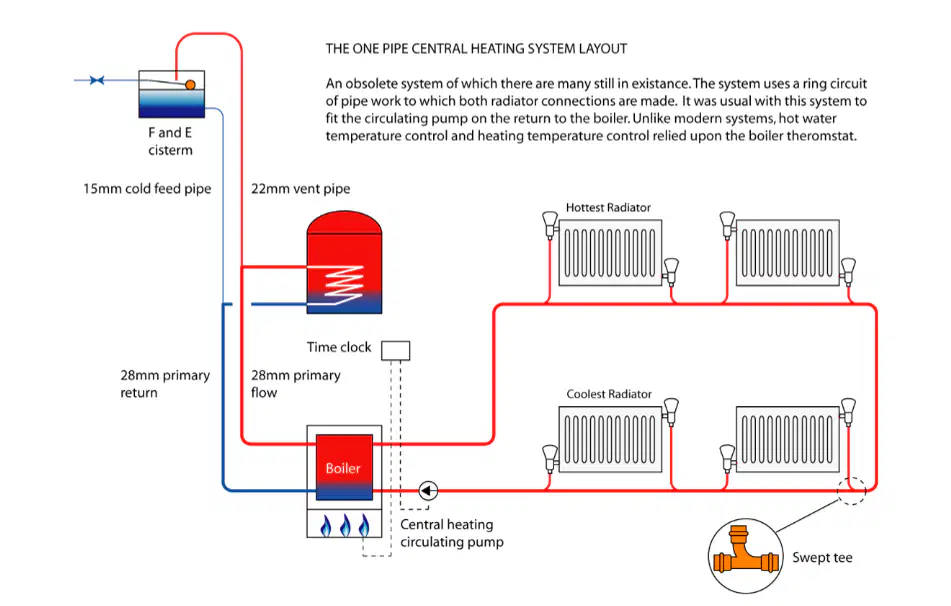
How are the radiators usually connected in a one pipe central heating system?
Via straight tees
Via swept tees
Via elbow joints
Via compression fittings
What is the main reason for connecting the flow pipe to the top connection on the radiator in a gravity circulation system?
To increase the water pressure
To reduce the resistance to flow
To improve the aesthetic appearance
To decrease the water temperature
What is a detrimental feature of the gravity circulation system mentioned in the text?
The water in the system heats up too quickly
Each successive radiator is fed with cooler water
The system requires a lot of maintenance
The radiators are too small
What is the net effect of the cooler water mixing with the pipework loop in a gravity circulation system?
The radiators heat up more quickly
The radiators become larger in proportion to the heat output
The water temperature remains constant
The system becomes more energy efficient
What is the main benefit of the two pipe low pressure (semi gravity) system?
It reduces the overall cost of the system
It ensures that each radiator has its own circuit to and from the boiler
It increases the water pressure in the system
It makes the system easier to install
What is the main disadvantage of the two pipe system mentioned in the text?
It requires more maintenance
It lacks secondary hot water circulation
It is more expensive to install
It heats up more slowly
What is the primary improvement of the two pipe central heating system layout over the one pipe system?
It uses a larger boiler.
It has a thermostat on the primary flow.
It includes a room thermostat controlling the pump.
It eliminates the need for a programmer.
In the two pipe central heating system layout, what controls the heating temperature?
The boiler thermostat.
The room thermostat.
The programmer.
The radiator valves.
What is the function of the 22mm vent pipe in the two pipe central heating system layout?
To control the room temperature.
To provide a cold feed.
To allow air to escape from the system.
To connect the radiators.
In the pumped heating with gravity hot water system, what is the minimum circulatory pressure required?
0.5m
1m
1.5m
2m
What type of boiler is used in the heat sink radiator system?
Electric boiler
Gas boiler
Solid fuel boiler
Oil boiler
What is a major challenge when using solid fuel appliances compared to gas or oil?
They are more expensive to install.
They are less efficient in heating water.
They are difficult to control for heat output.
They require more frequent maintenance.
What is the purpose of a heat leak radiator in a solid fuel system?
To increase the efficiency of the system.
To allow excess heat to disperse to the surrounding atmosphere.
To reduce the noise produced by the system.
To prevent the system from overheating.
Which type of thermostat is installed on the gravity flow set to 45°C in a solid fuel system?
Room thermostat
Pipe thermostat
Cylinder thermostat
Heat sink thermostat
What is the function of the second pipe thermostat set to 90°C in a solid fuel system?
To control the room temperature.
To prevent the system from freezing.
To automatically energise the pump if the temperature exceeds 90°C.
To monitor the water level in the system.
What is the main difference between the Honeywell C Plan system and the previous system?
The C Plan system uses a different type of fuel.
The C Plan system includes a two-port motorised zone valve on the primary flow into the cylinder.
The C Plan system is more expensive to install.
The C Plan system does not require a heat leak radiator.
What is the main reason for eliminating gravity circulation in domestic heating systems?
It is very wasteful in terms of heat energy and fuel.
It is too complex to maintain.
It requires too many components.
It is not compatible with modern thermostats.
Which of the following systems uses a three-port motorised mid-position valve?
The Honeywell Y Plan
The Honeywell W Plan
The Honeywell S Plan
The Honeywell Z Plan
What type of valve does the Honeywell W Plan use?
Three-port motorised mid-position valve
Three-port motorised diverter valve
Two-port motorised zone valve
Four-port motorised diverter valve
Which system uses two, two-port motorised zone valves?
The Honeywell Y Plan
The Honeywell W Plan
The Honeywell S Plan
The Honeywell Z Plan
What is one of the benefits of fully pumped systems mentioned in the text?
Greater choice of system design
Lower installation costs
Reduced need for maintenance
Increased energy consumption
What is the function of the valve in the heating system when hot water only is required?
It closes off the heating port (Port A)
It closes off the hot water port (Port B)
It allows water to flow around both heating and hot water circuits
It shuts down the system completely
What controls the individual room temperatures in the system?
Cylinder thermostat
Room thermostat
Thermostatic radiator valves (TRVs)
System by-pass
What is the purpose of the system by-pass in the heating system?
To allow water circulation through the boiler to keep it below its high energy cut-out temperature
To control the room temperature
To shut down the system completely
To allow water to flow around both heating and hot water circuits
What happens when both hot water and heating are satisfied in the system?
The system will shut down completely
The valve swings to close off the heating port
The valve swings to close off the hot water port
The system by-pass is activated
What is the approximate high energy cut-out temperature for the boiler?
75°C
85°C
95°C
100°C
What does the S Plan system use to independently control both the heating and hot water circuits?
One three-port motorised zone valve
Two two-port motorised zone valves
One two-port motorised zone valve
Two three-port motorised zone valves
What operates the heating zone valve in the S Plan system?
Cylinder thermostat
Room thermostat
Programmer
System by-pass
What is the purpose of the system by-pass in the S Plan system?
To control the hot water temperature
To maintain the system temperature below the high energy cut-out temperature
To control the room temperature
To operate the heating zone valve
What development in the late 1990s made feed and expansion cisterns obsolete in domestic heating systems?
Introduction of the expansion vessel
Use of two-port motorised zone valves
Installation of system by-pass
Use of room thermostats
What is a sealed heating system?
A system that contains an open vent pipe and is open to the atmosphere.
A system that does not contain an open vent pipe and is sealed off from the atmosphere.
A system that uses a Feed and Expansion cistern to fill the system.
A system that does not require a pressure/expansion relief valve.
What is the purpose of the temporary filling loop in a sealed heating system?
To permanently connect the water main and the heating system.
To fill the system directly from the mains cold water supply.
To provide a permanent air gap between the water main and the heating system.
To replace the expansion vessel in the system.
Which of the following is NOT a benefit of heating water at around 1 bar pressure in a sealed heating system?
Air infiltration through the open vent pipe is eliminated.
Higher water pressure means better flow rate through the system.
Higher temperatures can be used if required.
More pipework is required.
What classification is given to water contained in a central heating system according to the Water Supply (water fittings) Regulations 1999?
Fluid category 1
Fluid category 2
Fluid category 3
Fluid category 4
What is the main difference between the S Plan sealed system layout and its low-pressure version?
The presence of a Feed and Expansion cistern.
The absence of a temporary filling loop.
The absence of a Feed and Expansion cistern, cold feed, and open vent pipes.
The use of a permanent filling loop.
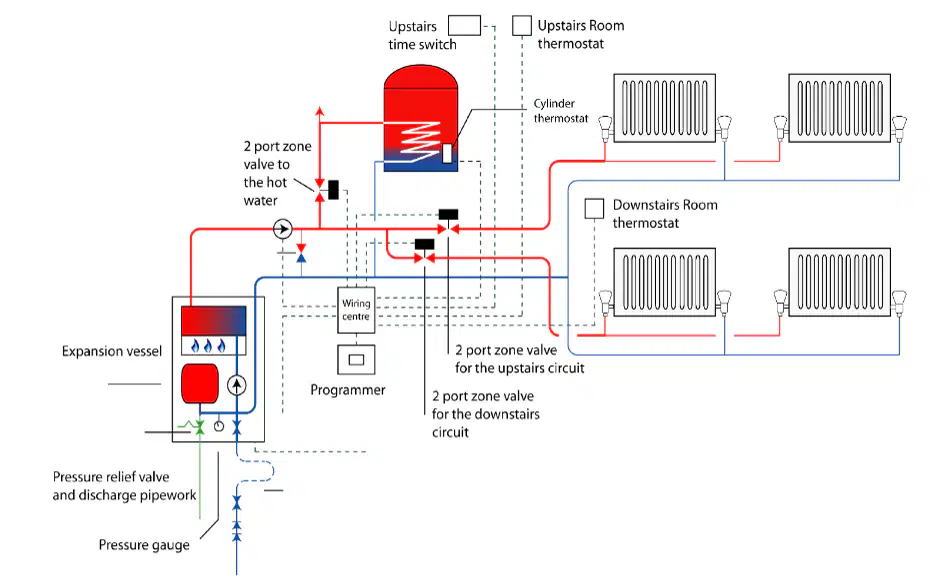
What type of heating system layout is shown in the first diagram?
Gravity-fed system
Combination boiler system
Fully pumped system
Electric heating system
How many port motorized zone valves are used in the Honeywell 'S' Plan Sealed System?
One
Two
Three
Four
What controls the flow of water to the upstairs and downstairs heating circuits in the Honeywell 'S' Plan Sealed System?
Room thermostat
Cylinder thermostat
Port motorized zone valves
Programmer
What is the purpose of the Building Regulations Approved Document L1 mentioned in the text?
To ensure all dwellings have a single heating zone
To mandate the use of electric heating systems
To zone dwellings between living space and sleeping space for individual time and temperature control
To require the use of combination boilers in all dwellings

