
 Worksheets
Earth/Sun Systems & Seasons
Total questions: 41
Worksheet time: 3hrs 33mins
They revolve around the Sun.
Inner Planets
Outer Planets
Both
They are terrestrial and have rocky surfaces.
Inner Planets
Outer Planets
Both
They are relatively close to each other.
Inner Planets
Outer Planets
Both
They are larger in size.
Inner Planets
Outer Planets
Both
They have gravity.
Inner Planets
Outer Planets
Both
They are smaller in size.
Inner Planets
Outer Planets
Both
They have a gaseous surface.
Inner Planets
Outer Planets
Both
They are all very cold.
Inner Planets
Outer Planets
Both
They are further apart from each other.
Inner Planets
Outer Planets
Both

The sun is in the middle of our solar system.
true
false

The Earth sits straight up and down (NO TILT).
true
false
What is the invisible line between the North Pole and South Pole?
rotation
orbit
axis
gravity
The spinning movement on it axis is called __________.
summer
Earth's rotation
seasons

The Earth's rotation is what gives us day and night everyday, all year.
true
false
At the same time that the Earth spins on its axis it also orbits or revolves around the Sun. This movement is called its _____________.
rotation
axis
revolution
The Earth is rotating on its axis, creating day and night, at the same time it's revolving all the way around the Sun.
True
False
If the Earth was NOT tilted we would have sunlight all the time.
true
false
One full orbit all the way around the Sun is one revolution and it takes the Earth _______ days to complete a revolution.
42
18
398
365
Day and night on the Earth are caused by -
the orbit of the Moon around the Earth
the rotation of the Sun on it axis
the orbit of the Earth around the Sun
the rotation of the Earth on its axis
Which of the following occurs on a daily basis?
The Earth rotates once on its axis
The Earth revolves once around the Sun
The Moon rotates once on its axis
The moon revolves once around the Sun

A student observed the Sun throughout the day over the neighbor’s house. The change the student observed is caused by -
orbit of Earth around the Sun
rotation of Earth on its axis
orbit of the Sun through space
reflection of the Sun off the Moon

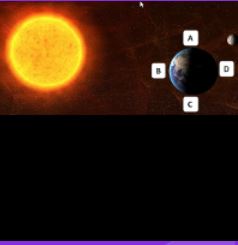
The diagram here illustrates Earth rotating as well as the Sun’s light illuminating Earth. According to the diagram above, which point on Earth is about to experience sunset?
A
B
C
D
Which of the following takes about one day?
One rotation of the Earth on its axis
One revolution of the Moon around Earth
One orbit of the Earth around the Sun
One rotation of the clouds across the sky
The Sun appears to move across the sky because -
the Sun orbits around Earth
Earth rotates on its axis
the Moon revolves around Earth
the Sun gets smaller in the evening
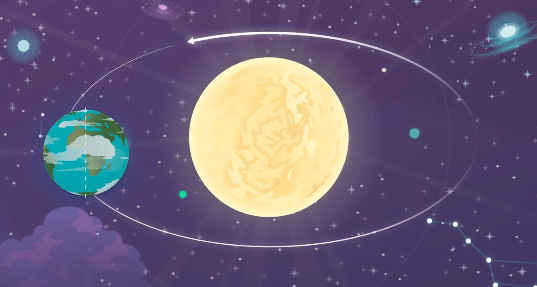


The image shows Earth's __?__.
Revolution
Rotation
Orbit
About how long does Earth's rotation take?
24 hours
30 days
365.25 days
About how long does one complete revolution of Earths around the Sun take?
24 hours
30 days
365.25 days
Why does Earth have seasons?
Earth revolves around the Sun
Earth is tilted on its axis of rotation
Both A & B

Path A shows the path of the sun during which season?
Summer
Autumn
Winter
Spring
Path B shows the path of the sun during which seasons? (THERE ARE 2 ANSWERS!!!!!!!)
Summer
Autumn
Winter
Spring
What word means to make a complete spin on an axis?
Orbit
Double Mint
Rotation
Root words
What is the name of the star at the center of the solar system that supplies heat and light to earth?
Sun
Earth
Mars
Thanks
The Coriolis Effect is caused by what?
The wind blowing
Earth's gravity pulling things down
The rotation of the Earth
The pull of the Moon
The Coriolis effect causes ___________.
the Earth to rotate on its axis
earthquakes
global winds to move in a curved path instead of a straight line
the Earth to revolve around the sun

Which motion is pictured below?
rotation
revolution
orbit
ellipse

