wayground logo

Free Printable Worksheets

Font size

S
M
L
XL
Worksheets

Honors English 9B Final Exam '23-'24

Total questions: 58

Worksheet time: 58mins
Name
Class
Date
1.
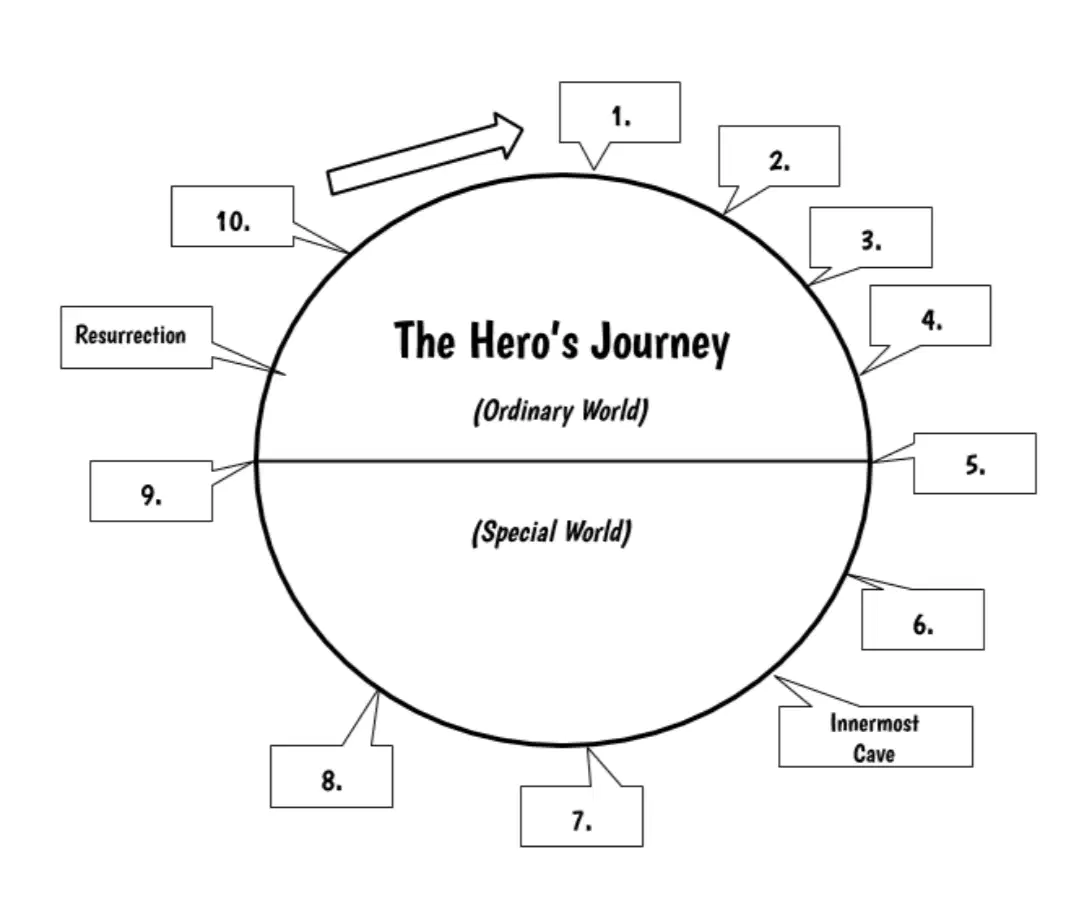
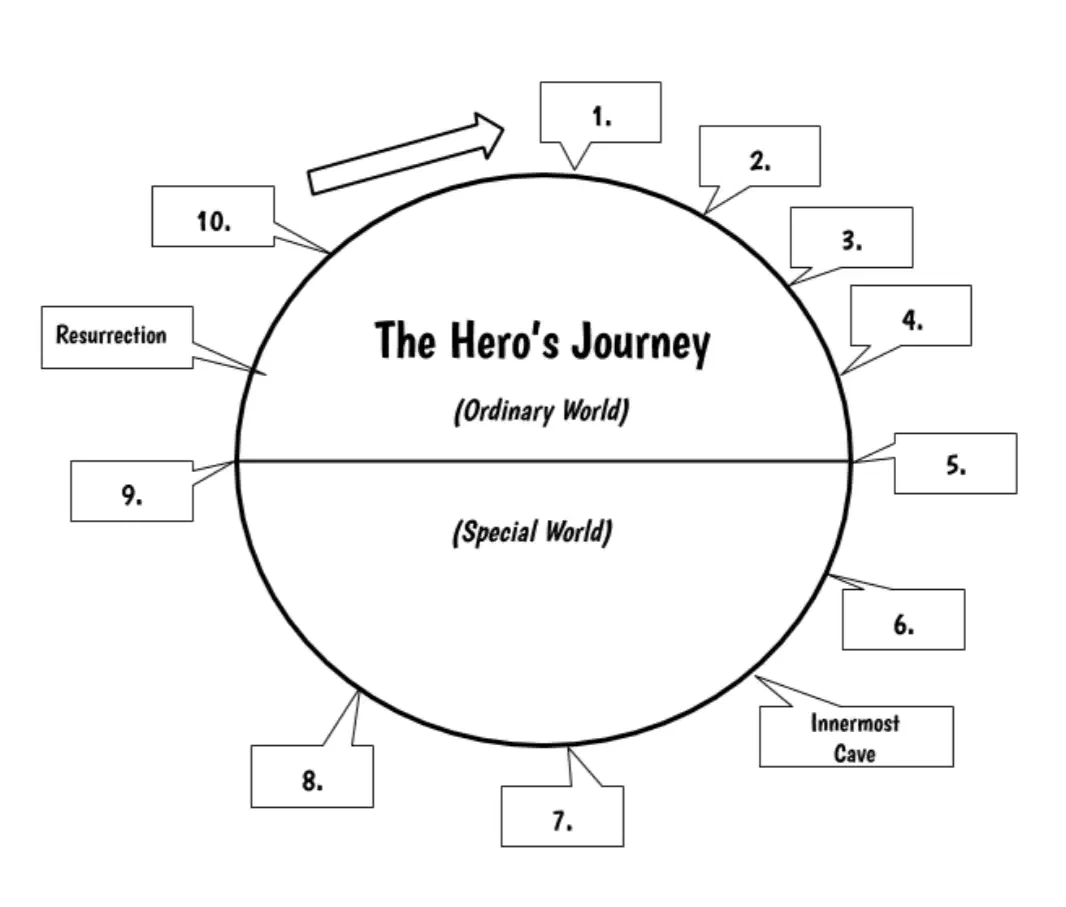
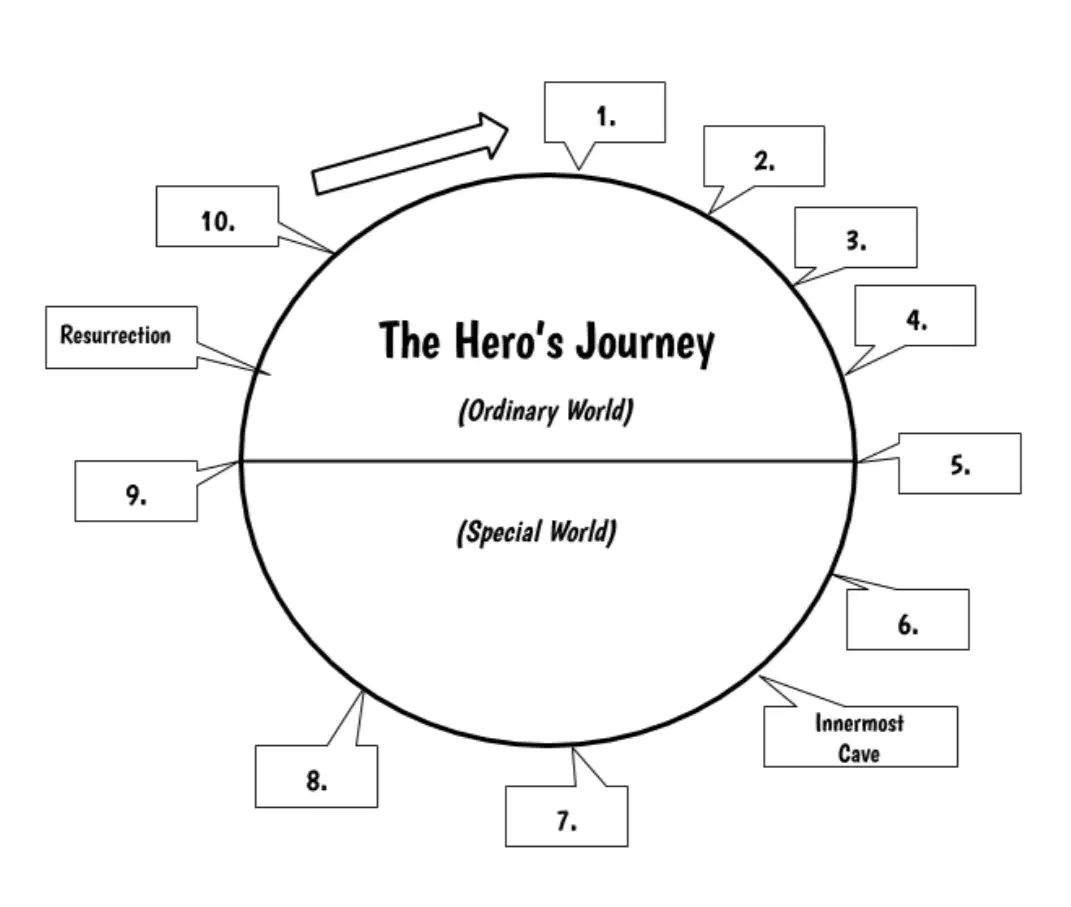
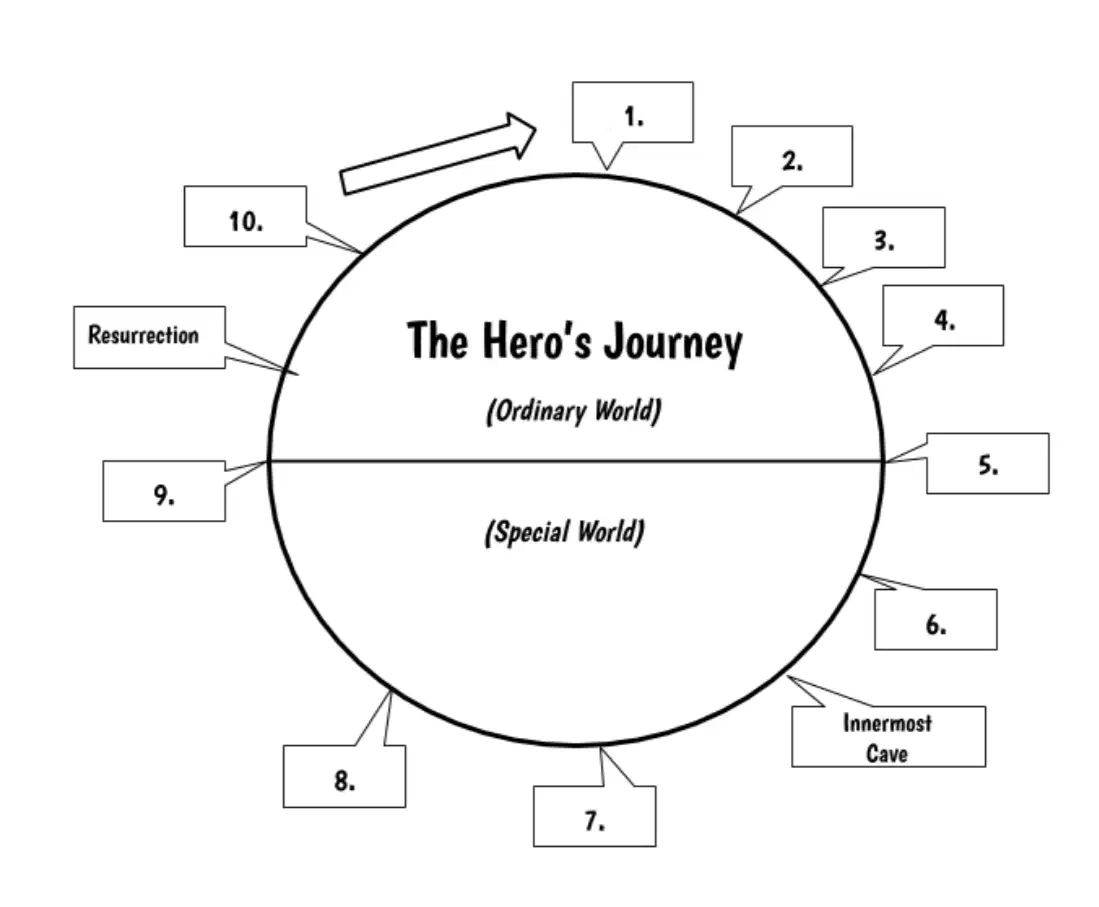
1. According to the hero's journey diagram above, which of the following should be in box #1?
a)
The Call to Adventure
b)
The Reward
c)
The Road Back
d)
The Ordeal
e)
The Ordinary World
2.
2. The second step of the hero's journey is:
a)
Refusal of the Call
b)
The Reward
c)
The Call to Adventure
d)
Crossing the Threshold
e)
The Ordinary World
3.
3. The third step of the hero's journey is:
a)
Refusal of the Call
b)
The Reward
c)
The Call to Adventure
d)
Crossing the Threshold
e)
The Ordinary World
4.
4. The fourth step of the hero's journey is:
a)
Tests, Allies & Enemies
b)
The Ordeal
c)
The Call to Adventure
d)
Crossing the Threshold
e)
Meeting the Mentor
5.
5. The fifth step of the hero's journey is:
a)
Tests, Allies & Enemies
b)
The Ordeal
c)
The Call to Adventure
d)
Crossing the Threshold
e)
Meeting the Mentor
6.
6. The sixth step of the hero's journey is:
a)
Tests, Allies & Enemies
b)
The Ordeal
c)
The Call to Adventure
d)
Crossing the Threshold
e)
Meeting the Mentor
7.
7. The step of the hero's journey that belongs at #7 in the image is:
a)
Tests, Allies & Enemies
b)
The Ordeal
c)
The Call to Adventure
d)
The Innermost Cave
e)
Meeting the Mentor
8.
8. The step of the hero's journey where #8 appears in the image is:
a)
The Reward
b)
The Ordeal
c)
The Call to Adventure
d)
Crossing the Threshold
e)
Meeting the Mentor
9.
9. The step of the hero's journey where #9 appears in the image is:
a)
The Reward
b)
The Ordeal
c)
The Call to Adventure
d)
The Road Back
e)
Meeting the Mentor
10.
10. The step of the hero's journey where #10 appears in the image is:
a)
Return with the Elixir
b)
The Ordeal
c)
The Call to Adventure
d)
The Road Back
e)
Meeting the Mentor
11.
11. Which of the following is Christopher's greatest gift?
a)
His gift for metaphors
b)
His gift for investigating mysteries
c)
His gift for mathematics
d)
His gift of artistic abilities
12.
12. What is the inciting incident that sets the plot of the novel in motion?
a)
Christopher's mother's death
b)
The murder of the neighbor's dog, Wellington
c)
Christopher's diagnois
d)
Christopher finding letters from his mother
13.
13. What does Christopher believe about his mother? ​
a)
That she killed Wellington
b)
That she died of a heart attack
c)
That she had an affair with the neighbor
d)
That she moved to London without him
14.
14. What does Christopher remember most about his neighbor, Mrs. Shears?
a)
That she baked delicious chocolate chip cookies.
b)
That she always had the best Christmas decorations in the neighborhood.
c)
That she cooked him and his father meals and played Scrabble with him.
d)
That she was always very cruel.
15.
15. Who is Christopher's primary suspect in the murder of the dog?
a)
His father
b)
Siobhan
c)
His mother
d)
Mr. Shears
16.
16. Who is Siobhan and what purpose does she serve in Christopher's life?
a)
She looks after him while his father is at work
b)
She mentors him and helps him learn about emotions and academic life
c)
She is the next door neighbor who helps him solve the mystery of Wellington's death
d)
She is his math tutor
17.
17. ​ What advantages and disadvantages does Christopher's condition cause for him?
a)
He is an excellent cook but struggles with reading
b)
He excels in math, but struggles with social interactions and emotions
c)
Excellent social skills, but he struggles academically
d)
He is able to communicate with animals, but struggles to communicate with adults
18.
18. Which of the following is the most prominent feature of Christopher's thinking?
a)
A tendency to mistrust strangers
b)
An "either/or" way of thinking
c)
An inability to understand adult relationships
d)
A strong desire for social acceptance at all costs
19.
19. What characteristics best describe Christopher's mother?
a)
Independent, selfless, dreamy
b)
Dreamy, loving, independent
c)
Determined, ironic, detached
d)
Sentimental, loving, depressed
20.
20. Which character in Christopher's life doesn't articulate his emotions well?
a)
Mrs. Shears
b)
Roger Shears
c)
His father
d)
Reverend Peters
21.
21. What is unique about the formatting of the chapter numbers throughout the novel, and why is this a feature of the book?
a)
The chapters are only odd numbers because those are the numbers Christopher likes best.
b)
The chapters are all multiples of three because three is Christopher's favorite number.
c)
The chapters are all prime numbers because those are the numbers Christopher likes best.
d)
The chapters are all even numbers because Christopher hates odd numbers.
22.
22. What shocking thing does Christopher learn about his father?
a)
He killed Wellington
b)
He lost his job
c)
He had an affair with Mrs. Shears
d)
He is not Christopher's biological father
23.
23. How does Christopher change over the course of the novel?
a)
He does not change and stays the same throughout the novel.
b)
He realizes he can achieve his goals.
c)
He discovers that he is extraordinarily brave
d)
He learns that he has incredible deductive reasoning powers
24.
24. Since Christopher does not like physical touch, how do his parents express their affection for him?
a)
Hugging him close anyway
b)
Verbally mouthing, "I love you"
c)
Giving him candy
d)
Spreading their fingers apart like a fan
25.
25. What does the following quote demonstrate about Christopher?: “I think I would make a very good astronaut. To be a good astronaut you have to be intelligent and I’m intelligent. You also have to understand how machines work and I’m good at understanding how machines work. You also have to be someone who would like being on their own in a tiny space-craft thousands and thousands of miles away…”
a)
He desires a way to use his mathematical skills and intelligence
b)
He desires a way to be fulfilled without being around lots of people
c)
He knows he could thrive in a situation that did not require social interactions
d)
All of the above
26.
26. After learning about his mother's affair with Mr. Shears, the next chapter opens the following quote from Christopher. What does this quote demonstrate about Christopher and his feelings?: "Mr. Jeavons said that I liked maths because it was safe. He said I liked maths because it meant solving problems, and these problems were difficult and interesting but there was always a straightforward answer at the end. And what he meant was that maths wasn’t like life because in life there are no straightforward answers at the end.”
a)
Christopher is struggling to make sense of the world as it is not as orderly as a math problem with a clear solution.
b)
Christopher is a math genius and he knows that he can solve any problem in life by treating it like an equation.
c)
Christopher is ready to solve the problem of his parents' relationship and help his father understand how to fix it.
d)
Christopher is easily able to understand people because they can be treated like a math problem to be solved.
27.
27. Just before finding the letters from his mother, Christopher says, " “And this shows that sometimes people want to be stupid and they do not want to know the truth. And it shows that something called Occam’s razor is true. And Occam’s razor is not a razor that men shave with but a Law, and it says…No more things should be presumed to exist than are absolutely necessary.” How is this quote ironic, given Christopher's thoughts after finding the letters?
a)
This is ironic because Christopher's mother explains Occam's razor in one of her letters
b)
This is ironic because the letters are a hoax, but Christopher believes them anyway
c)
This is ironic because Christopher abandons all logic and comes up with wild theories to explain the existence of the letters.
d)
This is ironic because Christopher believes in many supernatural and unexplainable things like God, fairies, and ghosts
28.
28. What is significant about Christopher's behavior throughout the novel?
a)
He becomes increasingly afraid of people
b)
He becomes increasingly outgoing and social
c)
He becomes increasingly bold and in control of his life
d)
He becomes increasingly withdrawn and depressed
29.
29. What is Christopher's favorite dream?
a)
He dreams he is a famous astronaut and when he returns to Earth everyone has died
b)
He dreams that everyone in the world dies of a virus and the only survivors are people who don't understand facial expressions
c)
He dreams that his mother is alive and they are able to have a picnic that avoids yellow and brown foods
d)
He dreams that his father wins the lottery and the winnings are a prime number
30.
30. Which of the following demonstrates The Ordeal in the Curious Incident of the Dog in the Night-time?
a)
When Christopher finds Wellington dead.
b)
When Christopher finds his mother's letters.
c)
When Christopher has to settle into life with his mother in London.
d)
When Christopher finds out his father killed Wellington.
31.
31. Which of the following demonstrates Return with the Elixir in the novel?
a)
Christopher taking the train to London.
b)
Christopher spending the night in the shed.
c)
Christopher investigating Wellington's murder.
d)
Christopher gaining confidence and believing he can do anything.
32.
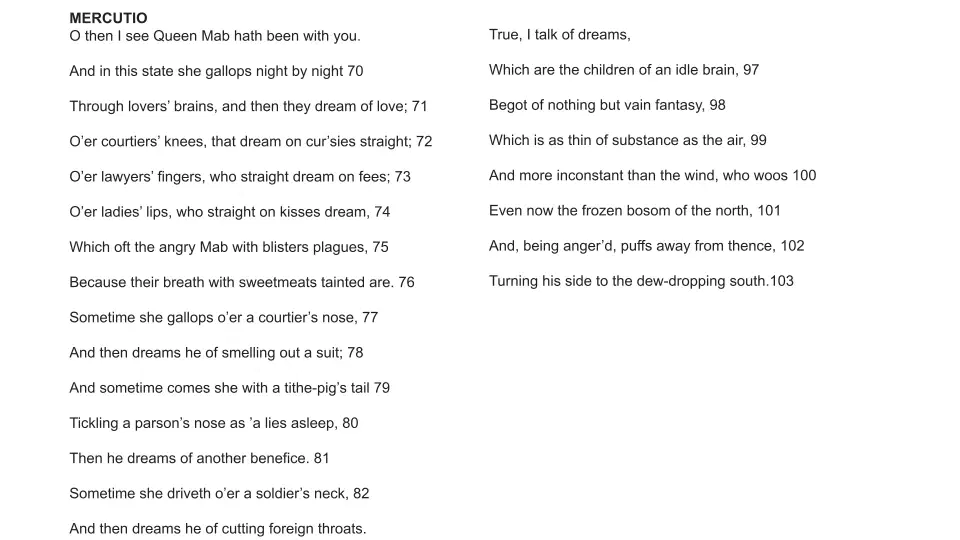
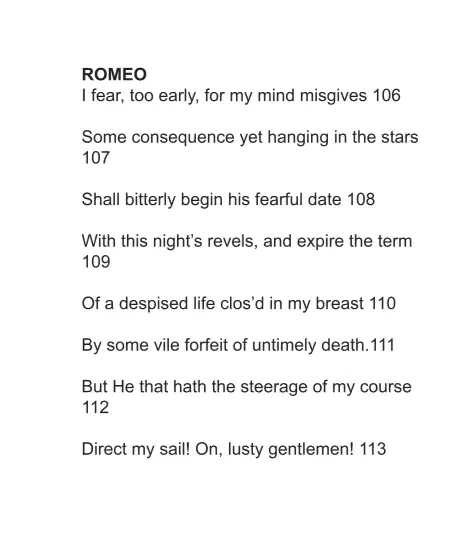
32. Through his speech, Mercutio is characterized in what way?
a)
As a prankster
b)
As a romantic
c)
As a cynic
d)
As an insensitive jerk
33.
33. What tone does the passage take on at the end?
a)
Hopeful
b)
Worried
c)
Dreary
d)
Cautious
34.

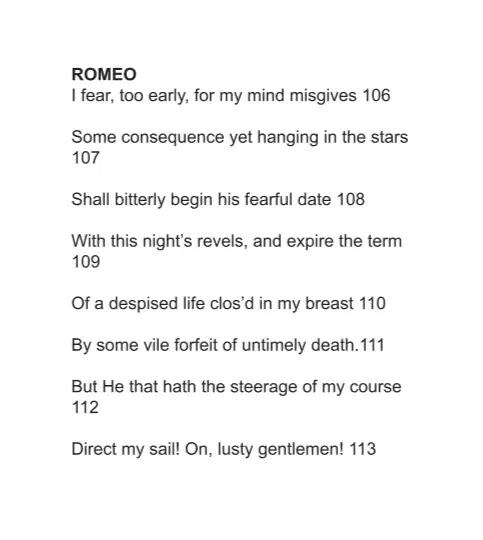
34. How does the Queen Mab passage highlight key differences between Mercutio and Romeo?
a)
Romeo's idealism vs. Mercutio's realism
b)
Romeo's stupidity vs. Mercutio's intelligence
c)
Romeo's passion vs. Mercutio's indifference
d)
Romeo's innocence vs. Mercutio's vanity
35.
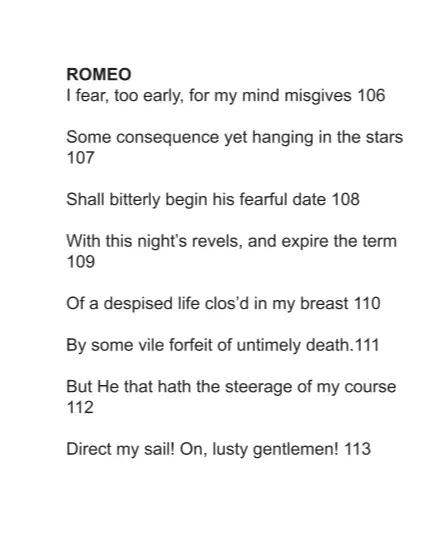
35. What event is foreshadowed in the passage?
a)
a. A revival of the feud
b)
b. The ending of an old love
c)
c. Romeo's death
d)
d. A long journey
36.
36. Which of the following lines best demonstrates the theme of "the existence of fate"?
a)
a. Line 108
b)
b. Line 107
c)
c. Line 109
d)
d. Line 110
37.
37. This speech occurs right before what event?
a)
a. The fight between Mercutio and Tybalt
b)
b. The Capulet ball
c)
c. Juliet is promised to Paris
d)
d. Romeo is banished
38.

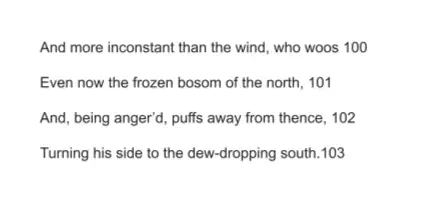
38. What literary device does Mercutio use to describe wind in lines 100 - 103?
a)
a. Personification
b)
b. Metaphor
c)
c. Soliloquy
d)
d. Simile
39.
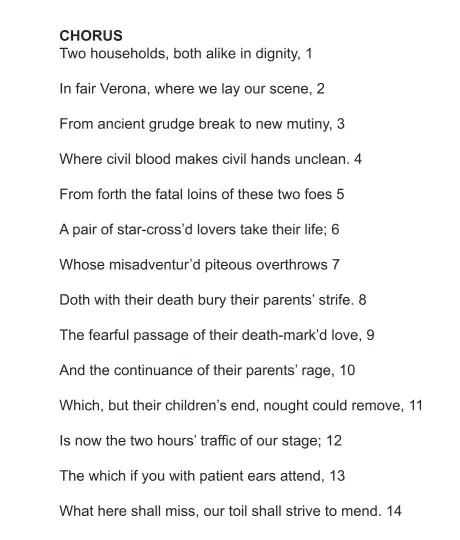
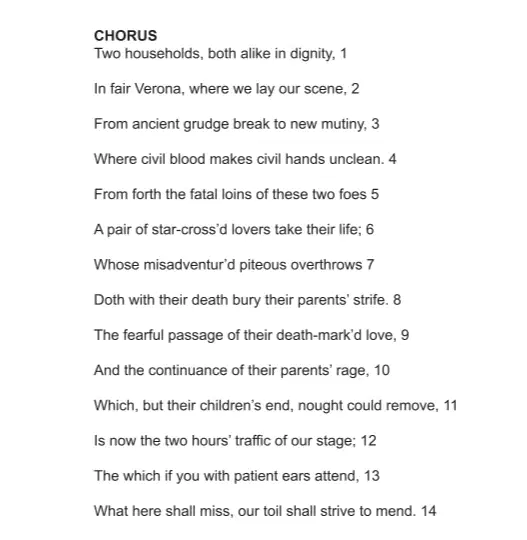
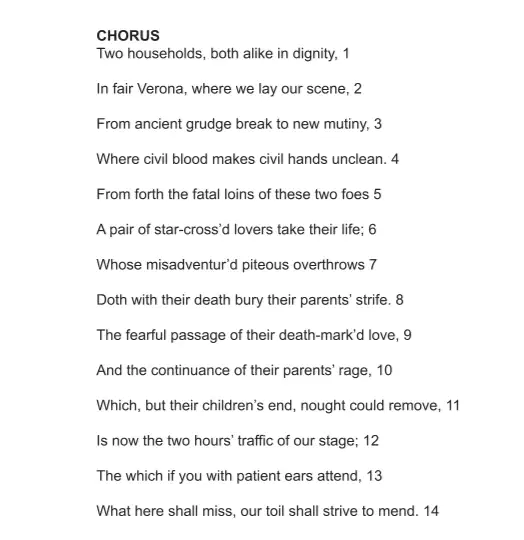
39. What is NOT the purpose of the prologue?
a)
a. To introduce the characters
b)
b. To set the scene
c)
c. To give background information
d)
d. To let the audience know what will happen
40.
40. Which information do we NOT learn about the "two households" in the prologue?
a)
a. They are of the same social class
b)
b. They are in a never-ending feud
c)
c. They produce children who are doomed
d)
d. They are lifelong friends
41.
41. Which best describes the overall theme of the prologue?
a)
a. The power of love
b)
b. The existence of fate
c)
c. The violence of rebellion
d)
d. The corruption of society
42.
42. Which description does NOT reveal the doomed nature of the two lovers?
a)
a. star-cross'd
b)
b. death-marked
c)
c. misadventur'd
d)
d. civil
43.

43. Which two lines describe the outcome of the feud?
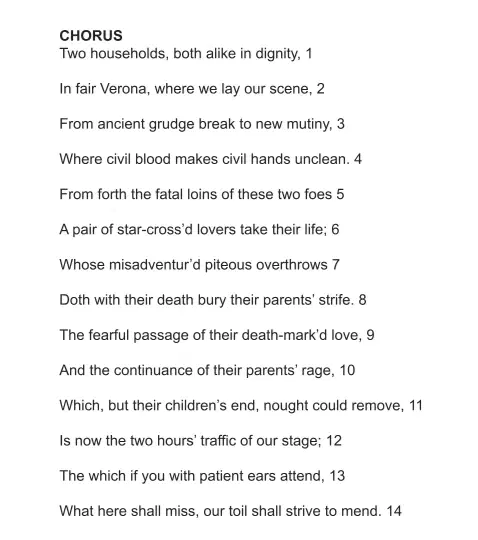
a)
a. 3 & 4
b)
b. 4 & 5
c)
c. 8 & 11
d)
d. 10 & 11
44.
44. Which event is foreshadowed in the prologue?
a)
a. The death of Mercutio
b)
b. The death of Tybalt
c)
c. The suicides of Romeo and Juliet
d)
d. The banishment of Romeo
45.
45. The prologue is in the form of a...
a)
a. stanza
b)
b. essay
c)
c. sonnet
d)
d. exposition
46.
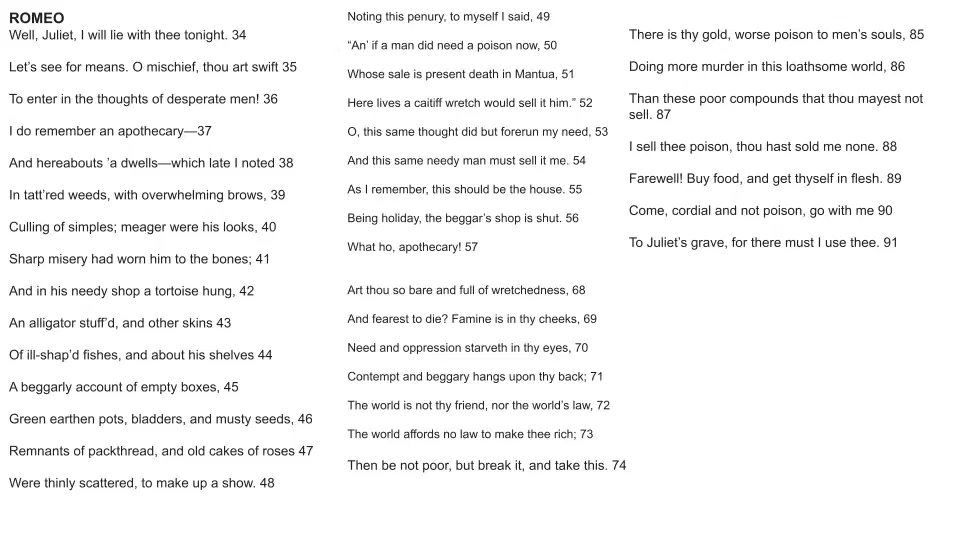
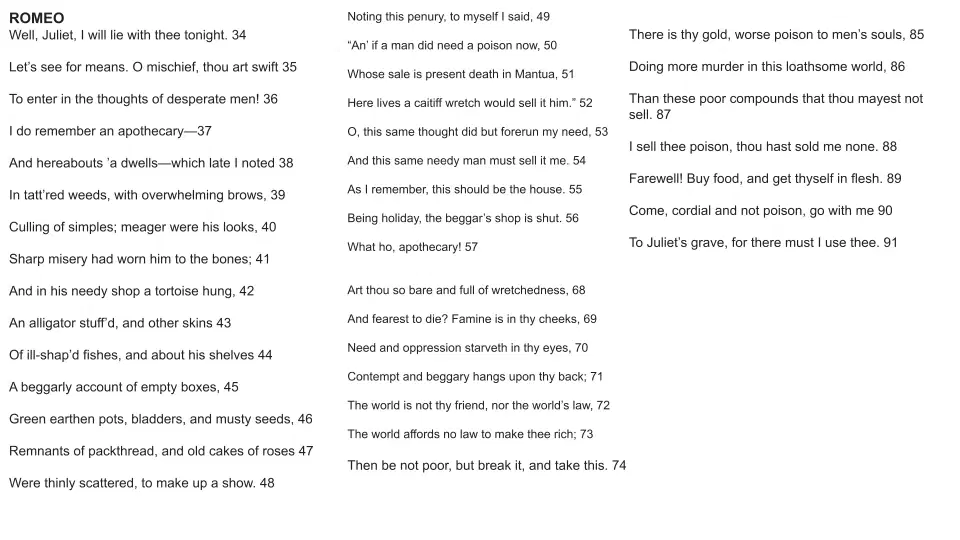
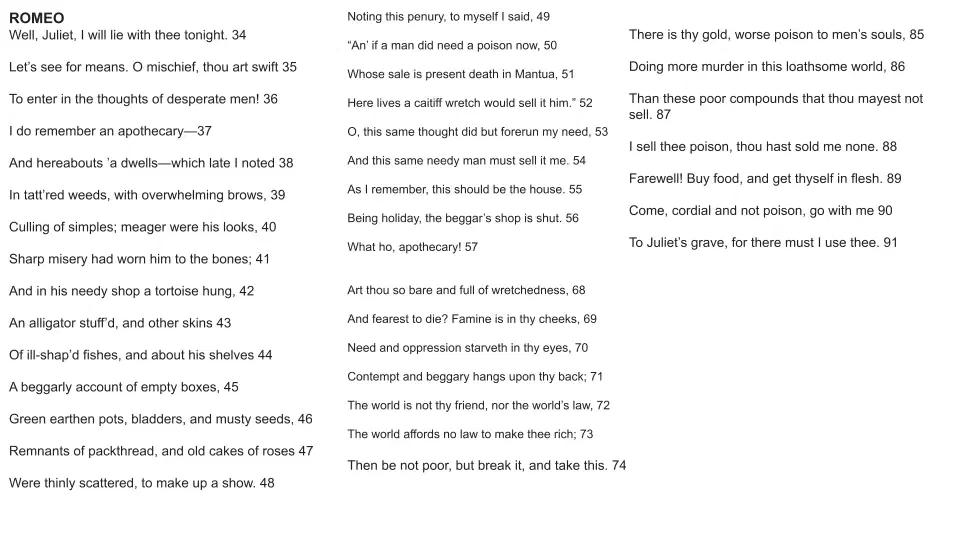
46. What does Romeo mean when he says, "O mischief, thou art swift to enter in the thoughts of desperate men" in lines 35 - 36?
a)
a. How slowly things have changed for him
b)
b. People who are desperate tend to negatively influence others who normally wouldn't listen to them
c)
c. Bad things can happen rather quickly and cause people to respond in ways they normally wouldn't
d)
d. He should not follow through with his original plan of committing suicide
47.
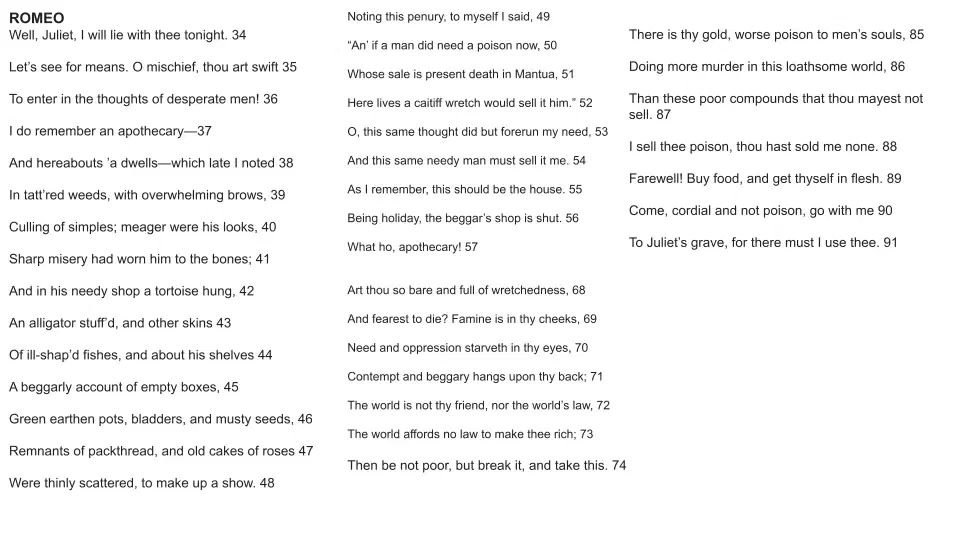
47. Why would Shakespeare write this section, lines 34 - 57, of the play as a soliloquy?
a)
a. Romeo would need to reveal his intentions, and by stating these thoughts aloud only to himself, he keeps other people from preventing him from acting.
b)
b. Romeo needs to show how conflicted he is by Juliet's sudden death that he cannot help but to speak out immediately as opposed to waiting for counsel from Friar Laurence.
c)
c. Romeo would not want Balthasar, his servant, to know he would visit some place with such a bad reputation as an Apothecary's house, so he must wait for Balthasar to leave.
d)
d. Romeo is seen as a romantic and this soliloquy proves just how romantic he is.
48.
48. What is purpose of having Romeo's describe the Apothecary's house?
a)
a. To show that the Apothecary is an outcast.
b)
b. To explain Romeo's reasons for needing to buy poison.
c)
c. To detail how poor the man (the apothecary) is.
d)
d. To define the social hierarchy (ranking) existing in the play.
49.
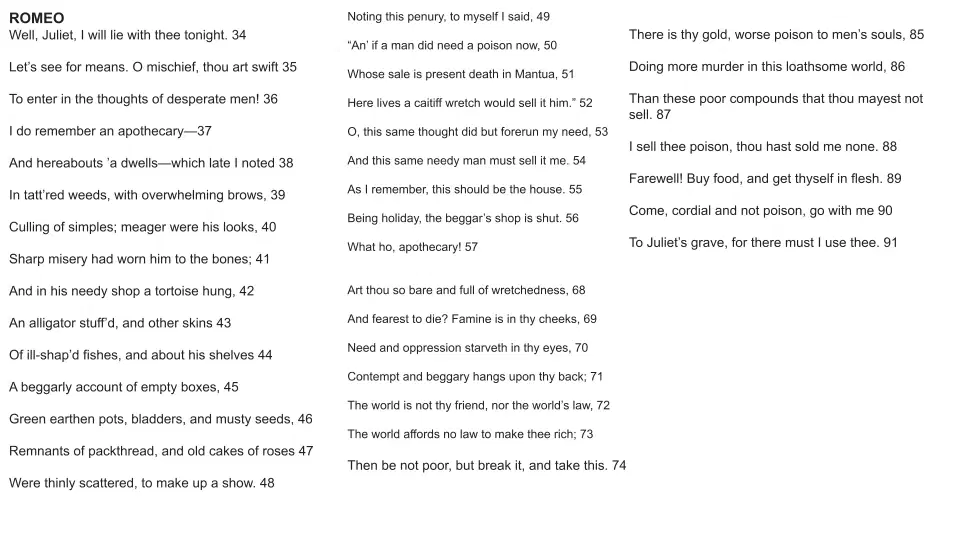
49. What is Romeo attempting to do in lines 68 - 74?
a)
a. Highlight the man's poverty.
b)
b. Talk the apothecary into selling him poison.
c)
c. Explain how cruel the world is.
d)
d. Beg for the apothercary's forgiveness for putting him in an awkward situation.
50.
50. What seems to be Romeo's tone based on lines 88 - 90?
a)
a. He is upset and can barely talk anymore.
b)
b. He is confused and thinks that the poison is wine.
c)
c. He is optimistic that everything will end well for him.
d)
d. He is resigned to his fate to die beside Juliet.
51.
51. What is the main ideas Romeo is trying to convey to the apothecary in lines 68 - 74?
a)
a. Life can keep you down unless you accept a helping hand when it is offered.
b)
b. Life is too short to sit idly by. You must make the most out of it.
c)
c. Each character treats his “creation” with kindness before being punished.
d)
d. Both characters accept their fate with a sense of satisfaction.
52.
52. What type of irony does Romeo's decision to kill himself represent?
a)
a. verbal
b)
b. dramatic
c)
c. situational
d)
d. traumatic
53.

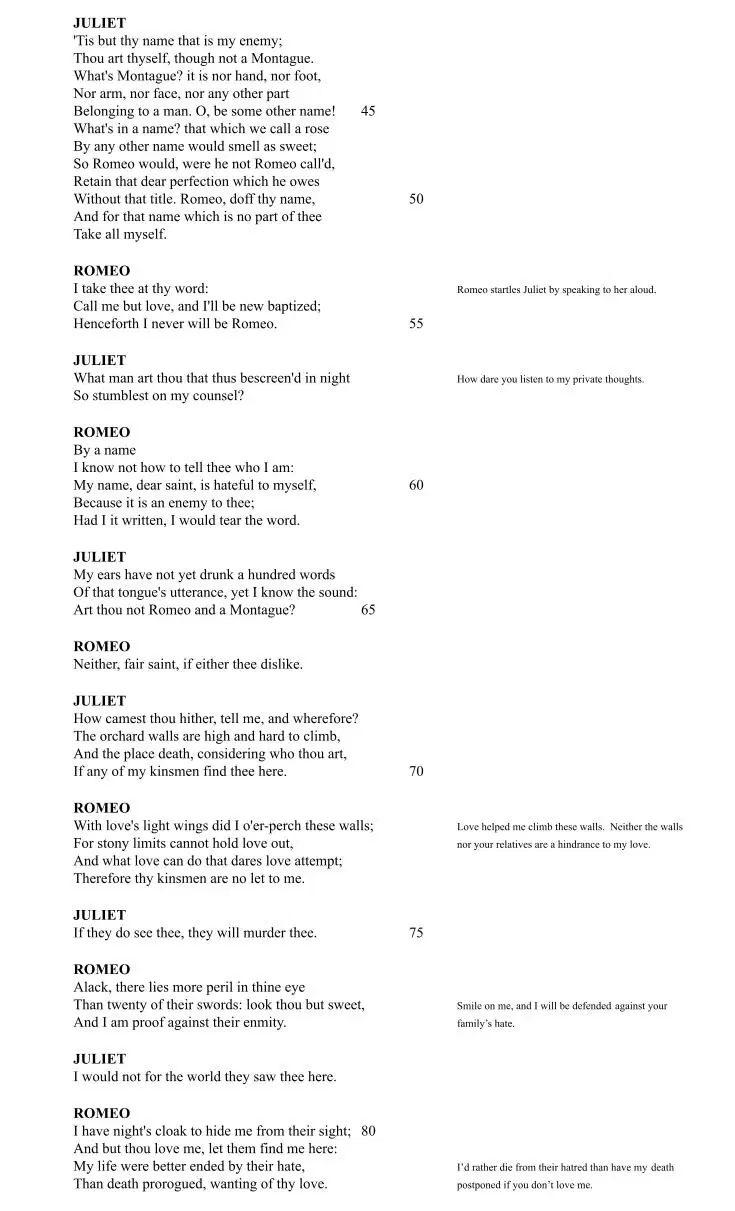
What is the main idea of Juliet's lines (41-52)?
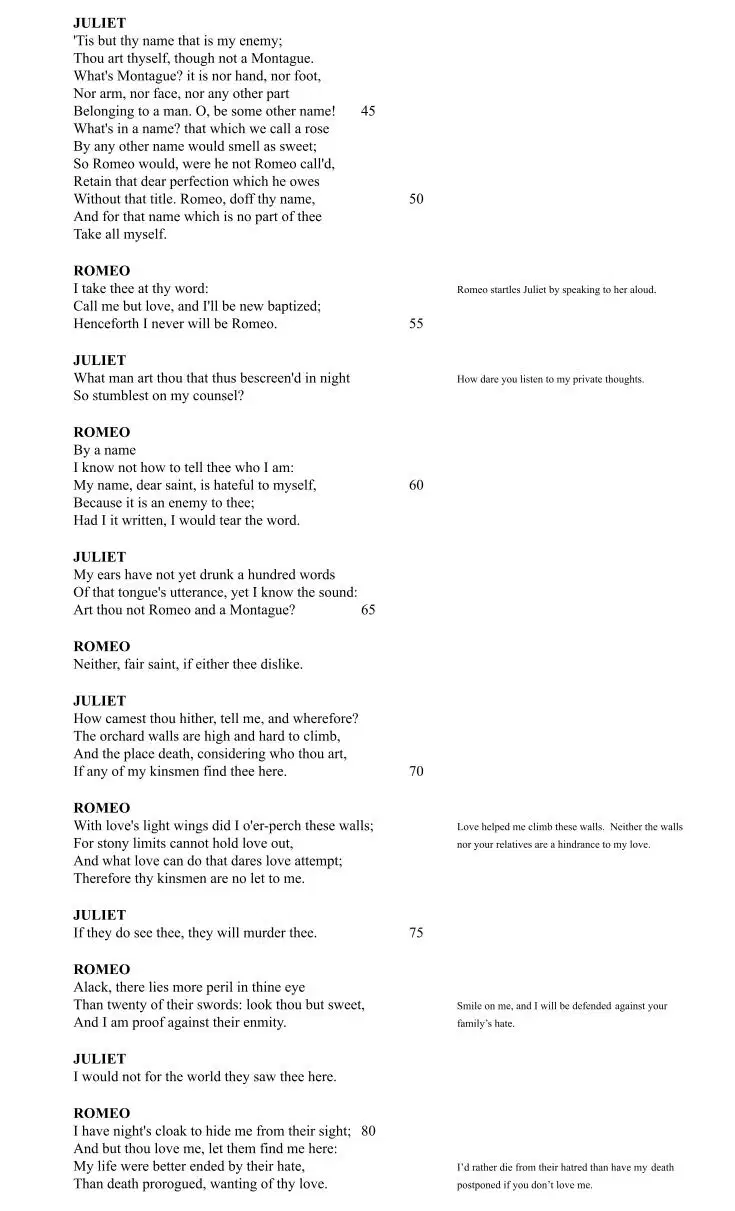
a)
a. Juliet is rationalizing to herself why it is acceptable that she love Romeo.
b)
b. Juliet is attempting to figure out why she loves Romeo.
c)
c. Juliet is deciding which part of Romeo she loves most.
d)
d. Juliet is trying to talk herself out of loving her family’s enemy.
54.

What is Juliet’s tone based on her use of personification in lines 63-65?
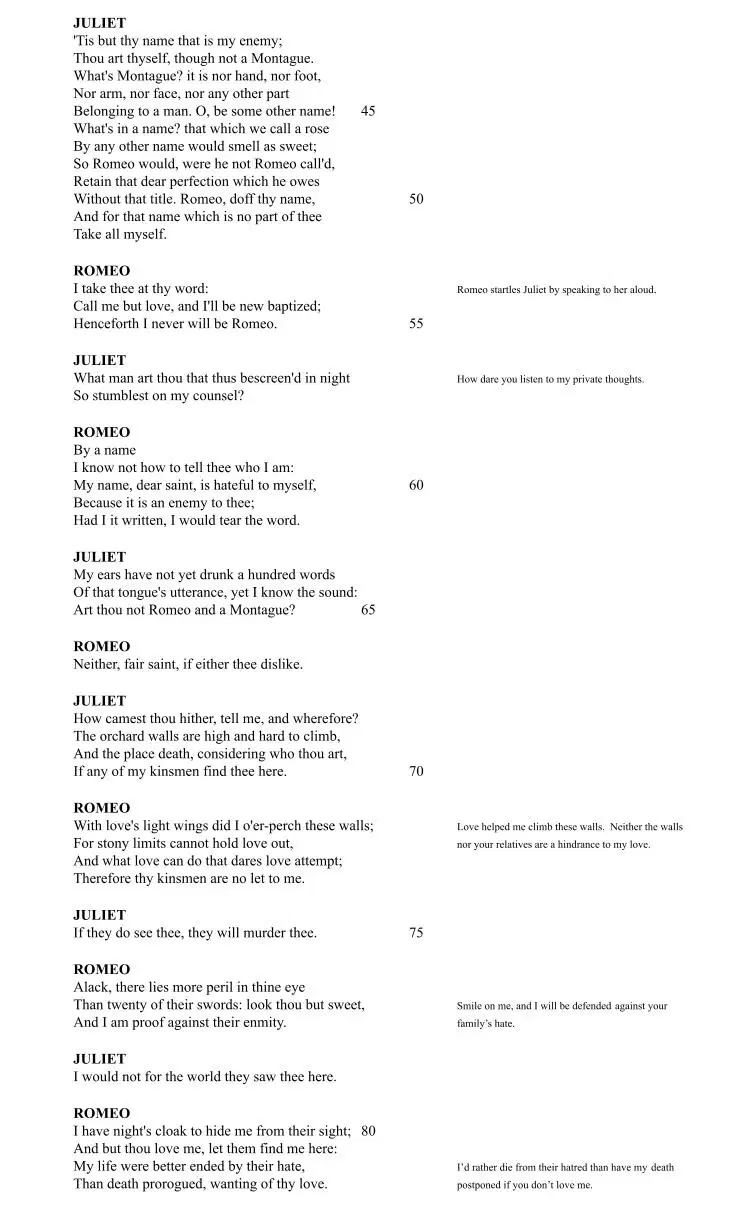
a)
a. Desperate-she needs to hear what Romeo has to say.
b)
b. Craving-she thirsts to hear what Romeo will say to her.
c)
c. Annoyed-his excuses right now fill up her ears with unwanted sound.
d)
d. Confused-she thinks she is drowning because of the conflict she imagines hearing.
55.

. Lines 69-78 serve to show how Romeo and Juliet are foil characters. How is this depicted here?
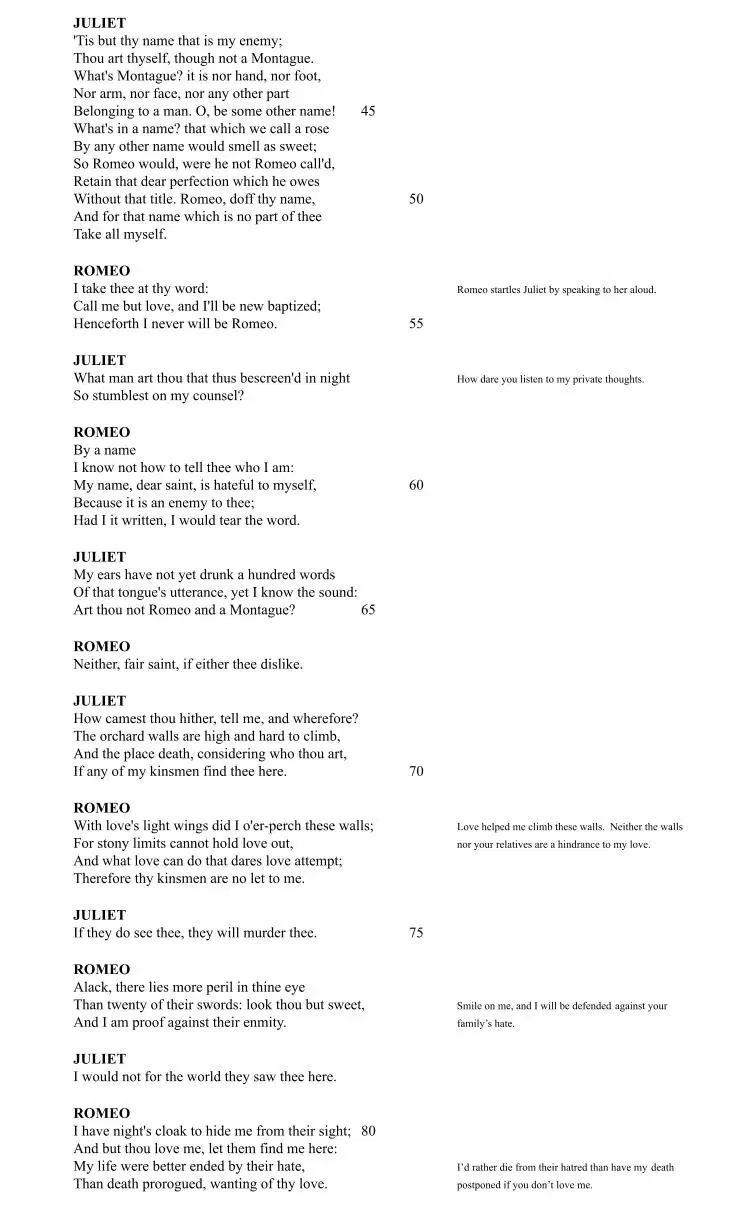
a)
a. Juliet is shown to be very pessimistic about love while Romeo is a complete optimist.
b)
b. Romeo fails to think about loving a Capulet but Juliet does consider the ramifications.
c)
c. Juliet considers the danger of Romeo’s presence but Romeo fails to think seriously about this danger.
d)
d. Romeo uses humor to diffuse the tension in this scene where Juliet adds anxiety to their interaction.
56.

What does Romeo mean through the use of personification in lines 80-83?
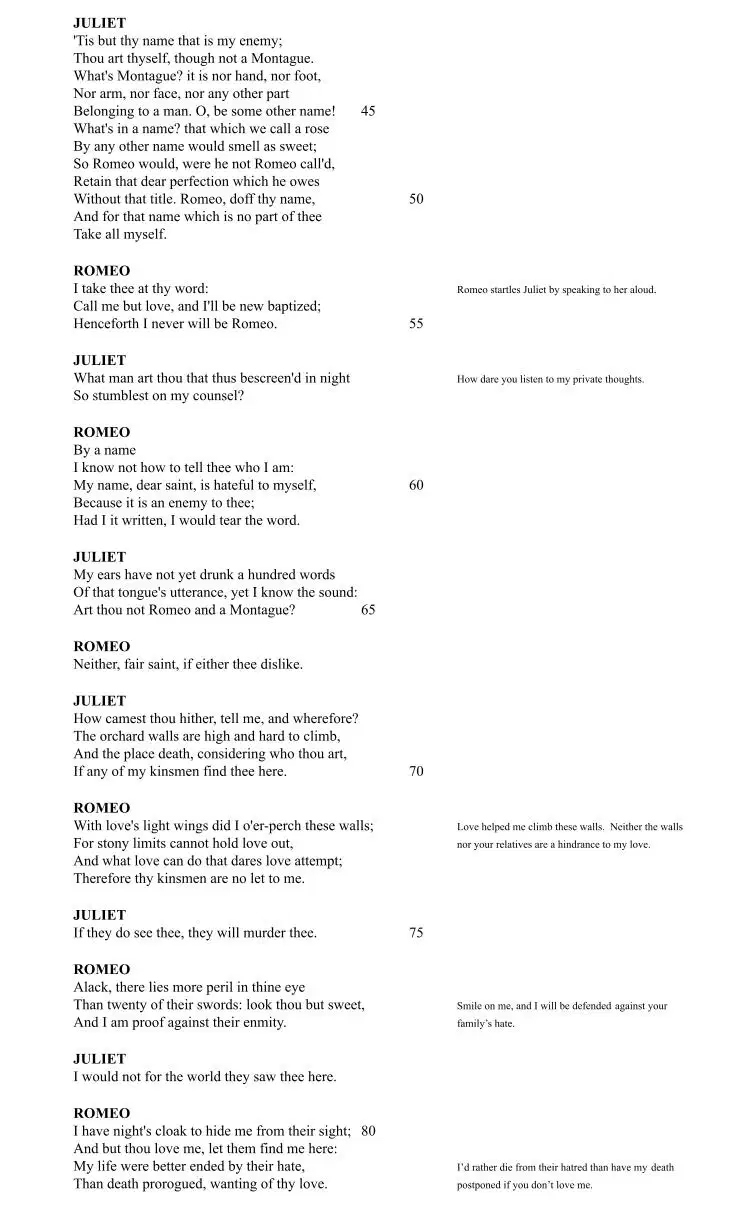
a)
a. Romeo would gladly die at the Capulet’s hands then to die slowly wanting Juliet’s love.
b)
b. Because it is dark, the Capulet’s will not be able to see Romeo.
c)
c. Because of the feud, Romeo doesn’t believe the Capulet’s will be able to see (understand) his love for Juliet.
d)
d. The Capulets’ hatred of the Montagues prevents Romeo and Juliet from being together.
57.

Twice Romeo refers to Juliet as “dear Saint.” For what purpose does he do this?

a)
a. He is complimenting her on her purity and holiness.
b)
b. He is comparing her to a holy person to show his knowledge of her religion.
c)
c. He is informing Juliet of his religious beliefs in the hopes it will win her over.
d)
d. He is trying to impress her with his knowledge of religion.
58.

A student, writing a short answer response, wants to quote a portion of this scene in his answer. Which of the following correctly shows the punctuation and ​ citation?

a)
a. Romeo demonstrates to Juliet that he is willing to do whatever he can to impress her, especially when he claims “And what love can do that dares love attempt; Therefore thy kinsmen are no let to me. (II.ii.73-74).”
b)
b. Romeo demonstrates to Juliet that he is willing to do whatever he can to impress her, especially when he claims, “And what love can do that dares love attempt; Therefore thy kinsmen are no let to me.” (II.ii.73-74).
c)
c. Romeo demonstrates to Juliet that he is willing to do whatever he can to impress her, especially when he claims, “And what love can do that dares love attempt; Therefore thy kinsmen are no let to me” (II.ii.73-74).
d)
d. Romeo demonstrates to Juliet that he is willing to do whatever he can to impress her, especially when he claims “And what love can do that dares love attempt; Therefore thy kinsmen are no let to me.” (II.ii.73 - 74).