
 Worksheets
Y9 PHYSICS REVISION
Total questions: 195
Worksheet time: 10hrs 42mins
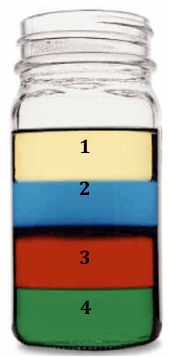


What is the formula for Volume?
Mass/Volume
Density x Volume
Mass/Density
What is the formula for Mass?
Mass/Volume
Density x Volume
Mass/Density

What is mass?
The amount of space an object takes up
The amount of matter in a given space
The amount of matter in an object
What is volume?
The amount of space an object takes up
The amount of matter in a given space
The amount of matter in an object
What is density?
The amount of space an object takes up
The amount of matter in a given space
The amount of matter in an object
Lisa has a bottle of water. How can she increase the thermal energy of the water?
She can pour the water into a larger bottle.
She can increase the temperature of the water.
She can place the bottle of water in the refrigerator.
She can divide the water between tow identical containers.

How does the thermal energy of the liquid in the larger beaker compare to the thermal energy of the liquid in the smaller beaker?
The liquid in the larger beaker has less thermal energy than the liquid in the smaller beaker.
The liquid in the larger beaker has more thermal energy than the liquid in the smaller beaker.
The liquid in the larger beaker has the same amount of thermal energy as the liquid in the smaller beaker.
The exact volume of the liquid in each beaker must be known to compare the thermal energy of the liquids.
Which description defines heat?
total thermal energy of an object or substance
change in the temperature of a substance in degrees Celsius
energy transferred between objects at different temperatures
average kinetic energy of the particles that make up a substance
How does heat affect the thermal energy of an object that is colder than the air that surrounds it?
Heat decreases the thermal energy of an object as energy moves to the air.
Heat causes the thermal energy of the object to increase as energy moves from the warmer air to the colder object.
Heat has no effect on thermal energy, but it increases the potential energy of an object.
Heat is not related to thermal energy, so it cannot affect the thermal energy of an object.

Kito puts his spoon into a helping of fresh, hot, mashed potatoes as shown in the picture. Which process takes place when the objects come together?
The temperature of the spoon increases, but its thermal energy does not change.
Energy in the form of heat is transferred by conduction from the warmer mashed potatoes to the cooler spoon.
The thermal energy of both the mashed potates and the spoon increase as the energy in the form of heat is transferred between them.
The average temperature of the spoon does not change.
As energy in the form of heat is added to an ice cube, it begins to melt. What causes melting.
Heat causes the molecules to expanded and forces them apart.
Heat removes thermal energy from the ice cube and causes it to become liquid water.
Adding energy causes the bonds between the hydrogen and oxygen in the ice cube to break.
The transfer of thermal energy to the ice cube causes its molecules to move faster.

Ashton warms a pure, solid substance. He graphs the changes in temperature as shown in the figure below. What is happening as he warms the substance?
molecules move more slowly
molecules move more rapidly
speed of the molecules in not changing
molecules speed up than slow down
Which example illustrate the transfer of energy through RADIATION?
feeling warmth when you sit in a sunny place.
feeling warm air while standing in front of the blower from a heating system.
feeling the warmth of the bricks around a fireplace by touching them with your hand.
feeling warmth on the soles of your feet when you walk along the beach on a sunny day.
Which of these processes is the result of the motion of particles in a gas or liquid?
conduction
convection
insulation
radiation
Emily has a cup of hot cocoa on the counter to cool off so she can drink it safely. She watches the steam rise from the hot cocoa. Which type of thermal energy transfer is occurring as the steam rises into the surrounding air?
conduction
convection
radiation
transformation
A fireplace warming the air in the room is and example of this type of heat transfer?
conduction
convection
radiation
transformation
A toaster warms a bagel for breakfast. What type of thermal energy transfer is occuring?
conduction
convection
radiation
transformation
Mrs. Plata likes to collect river rocks on her daily walk. She picked up a rock and placed it in her pocket. If the rock is 10 degrees Celsius and Mrs. Plata is 31 degrees Celsius, which of the following BEST describes the transfer of energy?
Thermal energy will flow from Mrs. Plata to the rock.
Thermal energy will flow from the rock to Mrs. Plata.
Thermal energy will flow from Mrs. Plata into the air.
Thermal energy will flow into the air and to the rock.
When cold water is added slowly to warm water they will slowly blend over time evenly through the entire liquid. Which BEST explains the reason the heat moves throught the liquid?
The densities of the liquids are similar.
Cold liquids rise and hot liquids sink causing mixing.
Molecules creates chemical bonds the help spread energy.
Heat always moves from higer temperatures to lower temperatures.
How does removing heat change the particles in a closed system?
Particles move apart
Particles slow down and break apart
Particles move faster and potentially change phases
Particles move slower and potentially change phases
At room temperature water is a liquid. How could the water be changed to a solid?
add heat
remove heat
decrease density
increase density

Using the picture. What was the change in the system?
air was added to the system
heat was added to the system
water was added to the system
particles were added to the system
David is warming chocolate on the stove. How is the motion of the particles different after the temperature is increased?
they move faster
they move slower
the move less freely
they vibrate close together
On a hot day the lake water warms and the temperature increases. How does the movement of the particles change?
move slower and farther apart
move slower and closer together
move faster and farther apart
move faster and closer together
An ice cube is placed in a glass of water. Which of the following best explains the heat transfer?
The thermal energy is moving from the ice cube into the water causing the temperature of the water to increase.
The thermal energy is moving from the ice cube into the water causing the temperature of the water to decrease.
The thermal energy is moving from the water to the ice cube causing the temperature of the water to increase.
The thermal energy is moving from the water to the ice cube causing the temperature of the water to decrease.
Stretched bow and arrow?
Running?
Thermal energy being transferred from a hot mug of cocoa to the table it is sitting on is an example of __________.
convection
conduction
radiation
chemistry
Which best explains how this roasting marshmallows happens?
Heat from the fire is conducted to the marshmallow.
Heat from the fire is radiated to the marshmallow.
The coolness of the marshmallow is conducted to the fire.
The coolness of the marshmallow is radiated to the fire.
Which best describes heat transfer by radiation?
A slice of bacon frying in a pan.
A pot on a stove boiling water.
Cooking a hotdog in a microwave.
A hot air balloon.
Which of the following best describes CONVECTION?
When heat is transferred through waves.
When heat is transferred through objects that are touching.
The movement of gas or liquid in which warmer parts move up and the colder parts moves down.

Warm air rises and the cool air sinks demonstrates this type of heat transfer.
Conduction
Convection
Radiation

Walking on hot sand with your bare feet shows this type of heat transfer.
conduction
convection
radiation

Ironing a shirt is an example of:
condensation
evaporation
conduction
convection

You and your friends are gathered around a campfire to keep warm. How is heat being transferred to you?
conduction
convection
radiation

This is the transfer of thermal energy through "space".
conduction
radiation
convection
spaceship

What kind of heat transfer is occurring when the sun warms the sand?
Conduction
Convection
Radiation
All of them


a convective flow of energy is set up inside the iron bar.
energy is conducted from atom to atom along the length of the iron bar.


Which type of heat transfer is happening inside the hot air balloon?
convection
conduction
radiation
hot air balloon
What effect does Evaporation cause ?
Heating Effect
Magnetic Effect
Cooling Effect
Warming Effect
What happens when Acetone is poured on your palm ?
The particles gain energy from acetone and evaporate
The particles gain energy from the surroundings and evaporate
The particles gain energy from the palm and evaporate
The particles gain energy from the Palm or Surroundings and evaporate
Sam kept some water out side in the sun next day he saw nothing in the glass what happen to the water?
It disappeared
It evaporated
Magic
Evaporation is the change of state from ___________ to __________
liquid to gas
solid to liquid
gas to liquid
Evaporation takes place at any temperature
True
False
Evaporation happens
throughout the liquid
at the surface of a liquid
What happens when a liquid perfume is sprayed on your palm ?
The liquid gain heat from the sanitizer and evaporate
The liquid gain heat from the surroundings and evaporate
The liquid gain heat from the palm and evaporate
The liquid gain heat from the palm or surroundings and evaporate
Evaporation is a process where _____________________
liquid changes to gas
throughout whole water
on surface of water
at any temperature
at boiling point
During evaporation, water molecules on the surface of water ___________________ from surroundings to move faster and then escapes into the air
gain energy
lose energy
share energy
produce energy
At what temperature does evaporation take place?
Freezing point
Above melting point
Below boiling point
At heating point
What effect does Evaporation cause ?
Heating Effect
Magnetic Effect
Cooling Effect
Warming Effect
Which of the following sound wave produces the highest pitch of sound?


Choose the correct statements. (2 answers)
P - The loudness increases
Q - The pitch decreases
R - The loudness decreases
S - The pitch increases
The ____________ of sound is the number of sound vibrations generated in a second.
amplitude
frequency
reflection
absorption
The __________ of a sound is the sharpness of a sound.
loudness
echo
pitch
vibration

Diagram shows 3 types of sound waves generated from speaker. Which of the following statements is true?
P has a higher pitch than Q
Q has a higher pitch than R
R has the highest pitch
P, Q and R have the same pitch
What will happen when the sound of siren of the ambulance comes closer to the observer?
the pitch of sound increases
the loudness of the sound increases
The loudness of the sound decreases
The pitch of the sound decreases
If a musician plays a soft note, what is the characteristic that has been changed?
Loudness
Pitch of sound

Which waveform has the lowest frequency?
(a)
(b)
(c)
(d)
(e)
Choose true statements about the difference in the characteristics of the vibration of the voice box of men and women. (2 answers)
The voice box of women produces sound with higher frequency compared to the voice box of men.
The voice box of women produces sound with lower frequency compared to the voice box of men.
women's voice has a higher pitch
women's voice has a lower pitch

If the distance represented by the letter A (the amplitude) were increased, how would it change the sound?
The sound would be higher.
The sound would be softer.
The sound would be lower.
The sound would be louder.

What is changed in the second picture?
Someone is talking louder in picture 2
Someone is talking softer in picture 2
Someone is talking lower pitch in picture 2
Someone is talking higher pitch in picture 2

What is changed in the second picture?
Someone is talking louder in picture 2
Someone is talking softer in picture 2
Someone is talking lower pitch in picture 2
Someone is talking higher pitch in picture 2
Frequency is measured in the unit of
Ampere (A)
Hertz (Hz)
Mole (mol)
Meter (m)

What best describes the doppler effect?
An apparent change in frequency of a wave due to the relative motion between a wave source and an observer
An apparent change in the amplitude of a wave due to the relative motion between a wave source and an observer.
Which of the following determines the pitch of a sound wave?
Frequency
Amplitude
Reflection
Absorption
Light travels... (select 2 answers)
Around corners
In straight lines
Faster in glass than in air
Faster than sound

The picture shows 4 sound waves on an oscilloscope. Which has the highest pitch?
A
B
C
D
The picture shows 4 sound waves on an oscilloscope. What can you say about A?
It is a very low pitched sound
It is a very high pitched sound
It is a very quiet sound
It is a very loud sound
The picture shows 4 sound waves on an oscilloscope. Which 2 have the smallest amplitude?
A
B
C
D
Which statement is true of sound waves. Select 2 answers.
They are made by objects vibrating
They are detected because they make our ear drum vibrate
They are transverse waves
They travel faster in air than in water.
What is the height of a wave called?
Peak
Wavelength
Amplitude
Frequency
Sound waves are caused by the (a) of particles
The distance between 2 crests or troughs
wavelength
amplitude
frequency
wave speed
All waves can be reflected
true
false

The speed of sound is about...
30 m/s
300 m/s
30 000 m/s
300 00 0m/s

A
B

A
B
Human can hear Ultrasound?
YES
NO
Select the correct answer: Ultrasound are...
sounds that only dolphins can produce
sounds that have a frequency above 20 000Hz
sounds that only superheroes can hear
sounds that are below 20 000Hz
From the words below, which one is linked with the Pitch of the sound
Amplitude
Loudness
Frequency
speed
Frequency is measured in
m/s
m
Hz
Decibel

What are nebulae?
groups of exploding stars
clouds of gas and dust in space
a collection of stars
groups of stars forming a pattern

Stars, like our Sun, form from nebulae. How long ago did our Sun form?
4.6 million years ago
46 million years ago
4.6 billion years ago
46 billion years ago

A cloud of gas that has been excited by light from a nearby star is called ___
a reflection nebula
an emission nebula
a lit nebula
a glowing nebula
The evidence is in ______________________, where coastlines and mountain ranges appear to fit together like a puzzle all over the world
Continental drift
Plate Tectonics
The Rock Cycle
Divergent boundaries
Other evidence include __________________ that plate tectonics does occurr in the crust of the Earth.
Rock formation, weather, fossils
Mountain formation, fossils, climate
Land features, fossils, climate
Valleys, Ocean trenches, climate
A theory explaining the structure of the earth's crust is called _________________
Pangea
Plate Tectonics
The Rock Cycle
Sea-floor spreading
The outermost layer of rock on Earth, especially the part of the earth above the mantle is called ________________
Crust
Rock Cycle
Plate tectonics
Subduction zones
The region of the earth's interior between the crust and the core is called the ________________.
Crust
Mantle
Both the crust and the mantle
Both the mantle and the core
Which scientist proposed the theory of continental drift?
Alfred Wagner
Harry Hess
Alfred Wegner
Victor
What was the name of the supercontinent proposed by Alfred Wegner?
Pangea
Gondwana
Laurasia
Rodinia
What evidence supported Wegner's continental drift theory?
Fossils of similar plants and animals were found on different continents.
The age and type of rock layers coincided on different continents.
Both answers are correct
None of the above
What did Harry Hess propose in the 1950s?
Theory of continental drift
Theory of plate tectonics
Theory of seafloor expansion
Evolution theory
What process drives the movement of tectonic plates?
Convection currents in the mantle
Traction forces in the lithosphere
The interaction of the continents
Movements of the oceans
What is the approximate speed at which tectonic plates move?
1 centimeter per year
1 meter per year
1 kilometer per year
10 kilometers per year
Where is seismic activity greatest?
At the convergent edges of the plates
At the divergent edges of the plates
At the transforming edges of the plates
In all the previous options
What happens in subduction zones?
Two continental plates collide and uplift, forming mountains.
A dense oceanic plate sinks beneath a continental plate.
Two plates slide horizontally past one another
None of the above is correct
Which is the reason why the theory of plate tectonics is considered the unifying theory of geology?
It explains the formation of mountains, volcanoes, and earthquakes.
It unites different areas of study within geology.
It is widely accepted by the scientific community.
All of the above options are correct
What process drives the formation of volcanoes in subduction zones?
Melting of magma in the mantle
Cooling and solidification of lava
Collision of tectonic plates
Friction between plates
What is the name of the chain of volcanoes located in the subduction zone of the Pacific Ocean?
Volcanoes of Fire
Circle of fire
Chain of Fire
Ring of fire
What geological phenomenon occurs in the convergence zones between continental plates?
Formation of volcanoes
Formation of mountains
Formation of submarine valleys
Formation of alluvial plains.
What is the main evidence supporting the theory of plate tectonics?
The presence of similar fossils in different continents
The existence of plate boundaries and zones of seismic and volcanic activity
The observation of the drift of the continents
The analysis of the age and type of rocks in the oceans.
What is the temperature of the Earth's core?
Impossible to determine
Cooler than Earth's surface
As hot as the temperature of the Earth's surface
As hot as the surface of the Sun
What type of current helps drive the movement of tectonic plates?
Convection currents
Ocean currents
Air currents
Seismic currents
Which geologic process leads to the creation of mountain ranges?
Flow of magma at divergent boundaries
Movement of tectonic plates along transform boundaries
Collision of tectonic plates at convergent boundaries
Rupture of tectonic plates at rift boundaries
What term is used to describe the constant renewal of the Earth's crust through tectonic plate movements?
Continental drift
Rock cycle
Plate tectonics
Subduction

The circuit shown contains three ammeters X, Y and Z.
Which ammeter has the largest reading?
X
Y
Z
They all have the same reading.

The diagram shows two resistors connected in a circuit.
What could be the combined resistance of this arrangement of resistors?
4.0Ω
6.0Ω
9.0Ω
18Ω
A student uses the circuit shown to determine the resistance of the two identical resistors.
The voltmeter reading is 2.2V and the ammeter reading is 0.25A.
What is the resistance of each resistor?
0.275Ω
0.55Ω
4.4Ω
8.8Ω

The diagram shows a circuit containing three ammeters P, Q and R.
Which statement about the readings on the ammeters is correct?
The reading on P is equal to the reading on Q.
The reading on P is equal to the reading on R.
The reading on Q is greater than the reading on P.
The reading on Q is greater than the reading on R.

Identical resistors are connected together to form arrangements X, Y and Z.
What is the correct order of the resistances of the arrangements from the largest to the smallest?
X → Y → Z
Y → X → Z
Z → X → Y
Z → Y → X

A circuit contains a cell of electromotive force (e.m.f.) 2.0V, three resistors, three ammeters and two voltmeters. One ammeter is labelled P and one voltmeter is labelled Q.
The readings on the other two ammeters and on the other voltmeter are shown.
What is the reading on ammeter P and what is the reading on voltmeter Q?
P : 1.5 A
Q : 1.5 V
P : 1.5 A
Q : 2.5 V
P : 2.5 A
Q : 1.5 V
P : 2.5 A
Q : 2.5 V
Resistors of resistance 1.0Ω, 2.0Ω and 3.0Ω are connected in parallel across the terminals of a cell.
Which statement is correct?
The currents in the resistors are equal.
The sum of the currents in the three resistors is equal to the current in the cell.
The sum of the potential differences (p.d.’s) across the resistors is equal to the electromotive force (e.m.f.) of the cell.
The potential difference across the 3.0Ω resistor is greater than the potential difference across the other two resistors.

The diagram shows a circuit including a lamp, an electric bell and three switches S1, S2 and S3. The lamp and bell are not faulty.
The bell is ringing but the lamp is not lit. Which switches are closed?
S1 only
S1 and S2 only
S1 and S3 only
S1, S2 and S3

A 12V battery is connected to a combination of 2.0Ω resistors as shown.
What is the current in the battery?
1.5A
2.0A
4.0A
6.0A

A potential difference of 3 V is applied to a network of resistors. the ammeter reads 0.5A.
What is the current flowing through the 6 Ω resistor?
0.5 A
0.167 A
0.333 A
1.0 A

an unknown value of potential difference is applied to a network of resistors.
the ammeter shows reading of 2A.
what is the value for potential difference across the cell?
42 V
24 V
16.5 V
5.33 V

Calculate the effective resistance of the resistors.
40 Ω
0.25 Ω
3.2 Ω
1.6 Ω

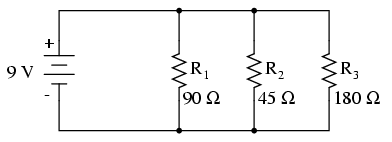
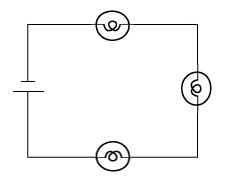

What is the definition of electrical current?
The opposition to the flow of electrons
The rate of flow of charge
The work done on each coulomb of charge
Electrons moving around
When more light bulbs are added they all remain bright.


When a resistor in a series circuit is replaced by another resistor with an increased resistance value, the total circuit current will __________.
stay the same
decrease
increase
double in value
If a bulb is disconnected in a parallel circuit _________
No bulbs will light up
The other bulb will still light up
Each bulb will only light up if there is a high enough voltage
You will get electrocuted
A light Bulb can be found in a circuit diagram by looking for which symbol?


What electrical charge to electrons carry?
Positive
Negative
Neutral

What voltage is needed to cause a 50A current flow through a 10Ω resistor?
15V
500V
500 kV
0.2V

What type of circuit is shown in the picture?
Series circuit
Parallel circuit
Open circuit
A student uses a length of wire as a resistor. He makes a second resistor from the same material.
To be certain of making a second resistor of higher resistance, he should use a piece of wire that is:
longer and thicker.
longer and thinner.
shorter and thicker.
shorter and thinner.

The table describes four different resistance wires.
They are all made from the same metal.
Which wire has the smallest resistance?
A
B
C
D

The circuit shown contains a battery, a 6.0 Ω resistor and two meters X and Y.
One meter records current and one meter records potential difference.
meter X : 2.0 A
meter Y : 12.0 V
meter X : 2.0 V
meter Y : 1.0 A
meter X : 12.0 A
meter Y : 2.0 V
meter X : 12.0 V
meter Y : 2.0 A

most brightly: W
least brightly: Y
most brightly: W
least brightly: Z
most brightly: X
least brightly: Y
most brightly: X
least brightly: Y

The diagram shows a circuit with a 3.0Ω and a 2.0 Ω resistor connected in parallel.
The switch is open, and the ammeter reads 2.0 A.
The switch is now closed and the ammeter reads the total current in both resistors.
What is the ammeter reading with the switch closed?
1.2 A
3.0 A
4.0 A
5.0 A
Which equation can be used to calculate the resistance R of a resistor?
V = I / R
I = V x R
R = V x I
V = I x R

The diagrams show four current-voltage graphs.
Which two graphs show the characteristics of an ohmic resistor and of a filament lamp?
ohmic resistor : W
filament lamp : Y
ohmic resistor : X
filament lamp : Y
ohmic resistor : W
filament lamp : Z
ohmic resistor : X
filament lamp : Z
The resistance of a wire depends on its length l and on its cross-sectional area A.
The resistance is:
directly proportional to l and directly proportional to A.
directly proportional to l and inversely proportional to A.
inversely proportional to l and directly proportional to A.
inversely proportional to l and inversely proportional to A.

Which symbols are used for the units of current and of resistance?
A
B
C
D
There is a current of 2.0A in a resistor for 30 s.
The potential difference (p.d.) across the resistor is 12V.
How much energy is transferred in the resistor?
1.25 J
5.0 J
180 J
720 J
There is a current of 3.0A in a resistor for time t. During time t, a charge of 120C flows through the resistor.
What is time t ?
0.025 minutes
0.025 s
40 minutes
40 s
A metal wire of length 1000 mm and cross-sectional area 0.20mm2 has a resistance of 8.0Ω.
What is the resistance of a wire of the same metal of length 500 mm and cross-sectional area of 0.40 mm2?
2.0 Ω
8.0 Ω
16 Ω
32 Ω
Which two changes to a metal wire both increase resistance?
decreasing its length and increasing its temperature
increasing its length and decreasing its temperature
decreasing its thickness and increasing its temperature
increasing its thickness and decreasing its temperature
The resistance of a component in a circuit is found using an ammeter and a voltmeter.
How are the ammeter and the voltmeter connected?
the voltmeter and ammeter in parallel with the component
the voltmeter and ammeter in series with the component
the voltmeter in parallel with the component and the ammeter in series with the component
the voltmeter in series with the component and the ammeter in parallel with the component
Which quantity is equivalent to 1.0V?
1.0 J /C
1.0 kJ /C
1.0 J / s
1.0 kJ / s

