
 Worksheets
Chemistry Exam Prep 10K1 Weds June 12th
Total questions: 153
Worksheet time: 2hrs 9mins


Isotopes are atoms of the same element with a
different number of protons.
different number of electrons
similar number of gluons.
different number of neutrons.
Which scientist discovered the electrons?
Dalton
Thomson
Atristotle
Bohr
Bohr discovered that electrons are located in
the nucleus
inside protons
electron cloud
circular orbits around the nucleus
The smallest particle of an element that still represents that element.
Nucleus
electron
proton
atom
What is the neutral particle found in the nucleus called?
proton
neutron
electron
quark
All matter is made of
energy
atoms
electrons
compounds
Matter always has mass.
true
false
In Dalton's Atomic Theory, all elements consist of __________ that cannot be divided.
Atoms
Parts
Molecules
Hydrogen
Who was the Greek philosopher who called the smallest particle of matter an "atom"?
Democritus
Aristotle
J.J Thompson
Einstein
Which of the following is/are conclusions based on Rutherford’s gold foil experiment?
Atom is mostly empty space
The nucleus is positively charged
The atom has a small dense nucleus
All answers are correct

Who is the scientist who proposed the "solar system" model of an atom where the electrons orbit around the nucleus?
Democritus
Niels Bohr
Ernest Rutherford
Chadwick
The majority of an atom's mass exists where?
In the nucleus
In the electron cloud
In the space between the nucleus and the electrons
In the neutrons
What did James Chadwick discover?
neutrons
electrons
the atomic theory
protons

J.J. Thomson provided evidence that an atom...
is the smallest particle of matter
contains negatively charged particles
has an overall negative charge
has an overall positive charge
Match the following
From his Gold Foil Experiment, he concluded that the atom is mostly empty space with a tiny, positively charged, dense center he called the nucleus.
Ernest Rutherford
Concluded the atom had negatively charged particles that he named electrons. Proposed the Plum-Pudding Model of the atom.
J. J. Thomson
Proposed a model of the atom in which electrons travel around the nucleus in orbits.
Niels Bohr
Match the following
Proposed that all matter is made up of tiny indivisible particles called atoms.
Democritus
In 1803, proposed the atomic theory of matter.
John Dalton
Describes mathematically the wave properties of electrons.
Quantum Theory
Which of the following points was included in Dalton's atomic theory, but later found to be not true?
All matter is composed of atoms.
Atoms of a given element are identical.
Atoms of different elements combine to form compounds.
In chemical reactions, atoms are separated, rearranged, or combined.
How does the current Quantum Model differ from the Bohr Model?
The Quantum Model show a dense, solid atom, and Bohr's model shows an empty space atom.
In Bohr's model, the electrons are in the nucleus, and in the Quantum Model electrons are outside the nucleus.
The Quantum Model agrees with Bohr's model, except that the orbits are further apart.
The Quantum Model has an electron cloud, and Bohr's model shows electrons in orbits around the nucleus.
Match the following images to the correct atomic model name.

Billiard Ball Model

Quantum Mechanical Model

Bohr Model

Plum Pudding Model

Rutherford Model

What scientist is best known for his "Plum Pudding" model of the atom?
J.J. Tomson
Ernest Rutherford
John Dalton
Democritus

Whose model of the atom is represented in the image?
Thomson
Bohr
Dalton
Rutherford
Who developed the Periodic Table of Elements?
Dmitri Mendeleev
Dmitri Mendeleev and Scientists
Dmitri Mendeleev and Julius Lothar Meyer
Dmitri Mendeleev, Julius Lothar Meyer and other Scientists
3 elements that were discovered in 1871
Gallium
Galiium and Germanium
Gallium, Germanium and Scandium
Gallium, Germanium, Scandium and Hydrogen
Elements discovered in 1890
Metals
Nonmetals
Metalloids
Noble Gases
2 rows beneath the main periodic table
Lanthanide
Lanthanide and Actinide
Lanthanide and Hydrogen
Actinide and Hydrogen
What is the periodic law?
Elements have numbers
Elements have specific names
Elements are organized based on families
Elements are organized based on atomic masses
Book Mendeleev wrote in 1867
Principals in Chemistry
Principles in Chemistry
Principles of Chemistry
Organic Chemistry
Why was Mendeleev's students struggling in his Science Class?
It was boring
It was too much info
There's no fun activities
There's no system to organize elements
Number of known elements in the 1800's
10
20
30
63
As of 2012, how many elements are there?
100
110
115
118
98% of the Universe is made of
H and N
H and C
H and O
H and He
What would be the product at the negative electrode in the electrolysis of Sodium Chloride solution
Sodium
Chlorine
Hydrogen
Oxygen
What would be the product at the positive electrode in the electrolysis of Sodium Chloride solution
Sodium
Chlorine
Hydrogen
Oxygen
What would be the product at the negative electrode in the electrolysis of molten Sodium Chloride
Sodium
Chlorine
Hydrogen
Oxygen
What would be the product at the positive electrode in the electrolysis of molten Sodium Chloride
Sodium
Chlorine
Hydrogen
Oxygen
What would be the product at the negative electrode in the electrolysis of Silver Nitrate solution
Silver
Nitrogen
Hydrogen
Oxygen
What would be the product at the positive electrode in the electrolysis of Silver Nitrate solution
Silver
Nitrogen
Hydrogen
Oxygen
What is the name given to the negative electrode
(a)
What name is given to the positive electrode
(a)
What is the third product produced in the electrolysis of Silver Nitrate solution
Silver Nitrate
Water
Nitric Acid
Silver Hydroxide
What is the product at the negative electrode in the electrolysis of Copper Iodide solution
Copper
Iodine
Hydrogen
Oxygen
What is the product at the positive electrode in the electrolysis of Copper Iodide solution
Copper
Iodine
Hydrogen
Oxygen
What is the third product produced in the electrolysis of Copper Iodide solution
Copper Iodide
Copper Hydroxide
Water
Hydrogen Iodide
What particles carry the electrical charge through the electrodes
Electrons
Ions
Atoms
Molecules
What particles carry the electrical charge through the electrolyte
Electrons
Ions
Atoms
Molecules
What would you observe at the negative electrode in the electrolysis of Sodium Chloride solution
Bubbles of gas that burn with a squeaky pop
Bubbles of gas that relight a glowing splint
Bubbles of gas that bleach damp litmus paper
Solid deposits in the electrode
What would you observe at the positive electrode in the electrolysis of Sodium Chloride solution
Bubbles of gas that burn with a squeaky pop
Bubbles of gas that relight a glowing splint
Bubbles of gas that bleach damp litmus paper
Solid deposits in the electrode
What would you observe at the positive electrode in the electrolysis of Copper Sulphate solution
Bubbles of gas that burn with a squeaky pop
Bubbles of gas that relight a glowing splint
Bubbles of gas that bleach damp litmus paper
Solid deposits in the electrode
What would you observe at the negative electrode in the electrolysis of Copper Sulphate solution
Bubbles of gas that burn with a squeaky pop
Bubbles of gas that relight a glowing splint
Bubbles of gas that bleach damp litmus paper
Solid deposits in the electrode
During electrolysis, the negatively charged ions (anions) are attracted to the ________.
anode
cathode
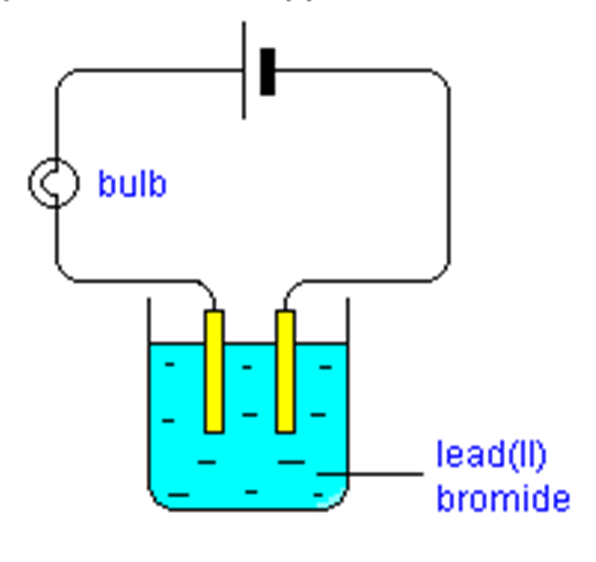
The diagram shows the electrolysis of lead(II) bromide using inert electrodes. Why does the bulb only light up when the lead(II) bromide is melted?
Bromine atoms in lead(II) bromide are converted to ions when it is melted
Electrons flow through the lead(II) bromide when it is melted
The ions in lead(II) bromide are mobile in the molten state.
There are no ions in solid lead(II) bromide
Anions get discharged by ________ electrons at the ___________
gaining, cathode
losing, anode
gaining, anode
losing, cathode
Positive ions (cations) move towards the cathode (-) where they will discharge by....
Breaking apart
Losing electrons
Clumping together.
Gaining electrons
What ions are present in molten aluminium oxide?
Al3+, O2-, H+, OH-
Al3+, O2-
Al3+, OH-
___________ electrode is an inert electrode.
Copper
Iron
Carbon
Zinc


If the fork is to be electroplated with silver metal, what electrolyte should be used?
Molten silver chloride
Aqueous silver nitrate
Sodium chloride solution
Copper(II) sulphate solution
What is the half-equation for the discharge of hydroxide ions?
2O2- --> O2 + 4e-
OH- --> OH + e
4OH- --> 2H2O + O2 + 4e-
2H2O + O2 + 4e- --> 4OH-
In electrolytic cell that uses aqueous copper(II) sulfate as electrolyte and copper plates as electrodes, what is the product at the anode?
Oxygen gas and water
Copper metal
Copper(II) ions
Hydrogen gas
What is the equation to show what happens to Cl- ions at the anode.
Cl2 + 2e- --> 2Cl-
Electroplating is an industrial process where objects are coated by a thin layer of a nonreactive metal by electrolysis. What should be used as the cathode in this process?
Graphite electrode
The electroplating metal
The object to be electroplated
Magnesium ribbon

The picture shows electrolysis of copper(II) sulfate solution using graphite electrodes. Besides formation of a brown solid on the cathode, what other observations can be made?
The mass of graphite anode decreases.
The blue colour solution becomes paler.
Bubbles of gas form at the anode.
The blue colour solution becomes darker.

The diagram shows the electrolysis of concentrated hydrochloric acid and concentrated aqueous sodium chloride using carbon electrodes.
At which electrode(s) is hydrogen produced?
electrode 1 only
electrodes 1 and 3
electrode 2 only
electrodes 2 and 4

Electricity is passed separately through concentrated hydrochloric acid, concentrated aqueous sodium chloride and dilute sulfuric acid.
In which rows are the electrolysis products correctly named?
1, 2 and 3
1 and 2 only
1 and 3 only
2 and 3 only
This question is about a simple cell made up of zinc and copper electrodes and sulfuric acid. The following is true.
Copper ionises and becomes smaller.
Zinc is the positive terminal.
Effervescence will be seen at both electrodes.

What are the electrode products when molten silver iodide is electrolysed between inert electrodes?
A
B
C
D
In an electrolysis experiment, the same amount of charge deposited 6g of titanium and 16g of copper. The charge on teh copper ion was 2+. What was the charge on the titanium ion?
(a)
Match the following products to their respective electrolytes and electrodes.
dilute NaCl
(+ electrode)
colourless gas (oxygen)
dilute NaCl
(- electrode)
colourless gas (hydrogen)
Conc.NaCl
(+ electrode)
yellowish green gas
(chlorine)
Conc.NaCl
(- electrode)
colourless gas (hydrogen)
What happens to the concentration of sodium chloride during electrolysis using dilute NaCl as electrolyte and inert electrodes?
(a)

Three different compounds are electrolysed.
Which one gives a yellow green gas at the anode?
1
2
3
In the electrolysis of molten sodium chloride, the products are molten sodium and chlorine gas. What is the volume of chlorine gas obtained at room temperature and pressure if the mass of molten sodium obtained is 230g?
60dm3
120dm3
240dm3
480dm3
Covalent bonds are formed between...
two or more metal atoms
two or more non-metal atoms
a metal and a non-metal atom
Covalent bonds are formed when electrons are transferred between atoms.
True
False
Atoms can only share electrons in the (a) shell.
Fluorine is a diatomic molecule. Fluorine is in Group 7. How many electrons are shared in this covalent bond?
(a)
Oxygen is a diatomic molecule. Oxygen is in Group 6. How many electrons are shared in this covalent bond?
(a)

The structure of ammonia is shown in the diagram. What is the formula for ammonia?
NH3
HN3
N3H
HN3
What are the disadvantages of using displayed formulae, like the one shown?
The 3D structure of the molecule is not shown.
They can show how atoms are bonded in large molecules.
They do not show which atom each electron comes from.
They can be used to find the structural formula of the molecule.
Select the properties of simple covalent substances.
Low melting and boiling points.
High melting and boiling points.
Do not conduct electricity.
Good conductors of electricity.
Why do simple covalent substances not conduct electricity?
They have low melting points.
They have low boiling points.
There are no delocalised electrons or free ions to carry the charge.
The molecules are too large.
Covalent structures have low melting and boiling points because it does not take much energy to break the _____ intermolecular forces.
weak
strong
Which of these statements about nanoparticles is correct?
They have large volume to surface area ratios
They have large surface area to volume ratios
They have small surface area to volume ratios
To calculate the surface area of a cube, which formula is used?
Length x width x height
Length x width x 6

The surface area of this cube would be calculated as:
3 x 3 x 6 = (a) Inches2.

Calculate the surface area of this cube (sides: 5cm).
Answer = (a) cm2.
To calculate the volume of a cube, which formula is used?
Length x width x height
Length x width x 6
The volume of this cube would be calculated as:
3 x 3 x 3 = (a) Inches3.
Calculate the volume of this cube (sides: 5cm).
Answer = (a) cm3.
The surface area to volume ratio of this cube is therefore 54:27. What is the simplest version of this ratio?
54:27
2:1
5:2
3:1
Select all the uses of nanoparticles below.
Catalysts
Suncreams
Cosmetics
Sock deodorizers
Which is a concern over the use of nanoparticles in suncreams?
Zinc Oxide nanoparticles block UV light from reaching the skin.
Zinc Oxide nanoparticles are invisible.
They could pass through the skin into the body and have harmful effects.
When the solids Ba(OH)2 and NH4SCN are mixed, a solution is produced and the temperature drops. Which statement about the energetics of this reaction is correct?
The reaction is endothermic and ΔH is negative
The reaction is endothermic and ΔH is positive
The reaction is exothermic and ΔH is negative
The reaction is exothermic and ΔH is positive
The following equation shows the formation of magnesium oxide from magnesium metal. Which statement is correct for this reaction?
2Mg(s) + O2(g) → 2MgO(s) ΔH = -1204 kJ
1204 kJ of energy are released for every mole of magnesium reacted
602 kJ of energy are absorbed for every mole of magnesium oxide formed
602 kJ of energy are released for every mole of oxygen reacted
1204 kJ of energy are released for every two moles of magnesium oxide formed
For the reaction 2H2(g) + O2(g) → 2H2O(g) the bond enthalpies (in kJ/mol) are
H-H = x, O=O = y, O-H = z
Which calculation will give the value, in kJ/mol, of ΔH for the reaction?
2x + y - 2z
4z - 2x - y
2x + y - 4z
2z - 2x - y

Using the table of average bond energies below the image, the ΔH for the reaction in kJ is.....
+ 160 kJ
-63 kJ
- 160 kJ
-217 kJ
Does breaking bonds require energy, release energy, or not involve energy at all?
requires energy to break
releases energy when broken
No energy involved
What kind of energy change happens in the photosynthesis reaction in plant leaves?
Endothermic
Exothermic
No change
Is this equation endo- or exo-thermic?
PCl3 (s) + Cl2 (g) --> PCl5 (s) + energy
endothermic
exothermic
Is this equation endo- or exo-thermic?
2KNO3 (s) + energy --> 2KNO2 (s) + O2
endothermic
exothermic
How can we figure out if an overall reaction is endo- or exo-thermic? It is the difference between _______ and __________.
hot and cold temperatures
energy to break and energy to form bonds.
time to form a bond versus time to break a bond
Ionic bonds are formed between...
Non - metals
A metal and a non-metal
Metals
Which of the below is an ionic compounds?
Ni
MgCl2
H2O
CH4
How is an ionic bond formed?
Sharing of electrons
Delocalised electrons
Transfer of electrons
An example of an ionic compound is Sodium Chloride, which is made from Na+ and Cl- ions. Why do these ions form an ionic bond?
They have like charges
They are from the same group
They are from the same period
They have opposite charges
Lead Chloride is an ionic compound, made up from Pb2+ ions and Cl- ions. Which is the correct formula for this compound?
PbCl3
PbCl
PbCl4
PbCl2
Which of the following is true for ionic bonding & ionic compounds? (3 correct statements)
They must be made of ions with like charges.
The negative ion must be written first.
Compounds must have an overall charge of zero.
They are made of metals and nonmetals.
The positive ion must be written first.

Which properties are all characteristics of ionic compounds?
solids with high melting and boiling points
soft solids which are highly malleable
when solid, the ions are held in place so the compounds cannot conduct electricity
conduct electricity when dissolved or molten
What properties does an ionic compound have?
A low boiling point and it conducts electricity when dissolved in water
A high melting point and it conducts electricity when molten or dissolved
A high boiling point and it conducts electricity when solid

Why do ionic compounds NOT conduct electricity when they are in their solid state?
Their ions are free to move.
Their ions are held in fixed positions.
Their electrons are free to move
Their electrons are held in a fixed state
Ionic compounds conduct electricity when dissolved in water. Which statement below best explains the property?
Ions are free to move.
Electrons are free to move.
Bonds are strong.
There are weak intermolecular forces of attraction.

Why do ionic compounds have high melting and boiling points?
Their ions are free to move.
Their ions are held in fixed positions.
They have many strong bonds which require a large amount of heat energy to overcome these strong bonds.
They have weak bonds which require a little amount of heat energy to overcome these weak bonds.
Which three of the following are features of ionic compounds? (click 3 boxes)
They have bonds between metals and non-metals.
They have bonds between two non-metals.
They form simple molecular structures.
They form giant ionic lattices.
They involve the transfer of electrons.
Be and F can combine to form BeF2, an ionic compound. Select ALL the true statements.
Each Be atom loses two electrons from the outer shell.
Each F atom gains two electrons from Be.
The force holding the ionic compound together is electrostatic attraction.
Each F ion has a charge of -1

Select all the true statements:
Each outer shell electron in Cl is represented by a cross.
In Na, the total charge is -2.
Na+ and Cl- are held together by electrostatic attraction.
Na+ has a full outer shell of electrons.
A single crystal of table salt (Sodium Chloride) is one giant ionic lattice, the Na+ and Cl- ions are held together in a (a) lattice.
Match the following to form true statements:
When solid, ionic compounds
cannot conduct electricity
When melted ionic compounds
can conduct electricity
Ionic compounds have
high melting and high boiling points
There are many strong bonds
between ions in an ionic compound.
Elements in group 1 of the periodic table form ions
with a charge of 1+
Sodium Oxide is Na2O. Meaning there are 2 Na present for every O in the ionic compound. As the Oxygen ion has a charge of -2, what charge does each Sodium ion have?
-1
-2
+2
+1

This is an image of the giant ionic lattice representing Sodium Chloride, what is represented by the +?
Cl ion
Cl atom
Na atom
Na ion
What is the correct formula for aluminium oxide? Aluminium is in group 3 and oxygen is in group 6.
Al₂O₃
AlO
AlO₄
Al₂O
Al₃O₂

