
NEW
Font size
 Worksheets
P1 Energy Quiz
Total questions: 30
Worksheet time: 17mins
Which type of energy is stored in the nucleus of an atom?
Kinetic energy
Gravitational potential energy
Nuclear energy
Elastic potential energy
How is energy transferred by heating?
From an object with higher temperature to one with lower temperature.
From an object with lower temperature to one with higher temperature.
By moving an object.
By compressing an object.
What is the formula for calculating gravitational potential energy?
E_p = mgh
E_p = 1/2 mv^2
E_p = kx^2
E_p = Fd
What is the unit of power?
Joule (J)
Watt (W)
Newton (N)
Meter (m)
What is the definition of efficiency in energy transfer?
The total input energy divided by the useful output energy.
The useful output energy divided by the total input energy.
The total energy stored in an object.
The energy lost due to friction.
Which of the following is a way to reduce energy wasted due to air resistance or drag in water?
Lubrication
Streamlining
Insulation
Heating
What type of energy is transferred when a force moves or changes the shape of an object?
Thermal energy
Electrical energy
Mechanical work
Chemical energy
Name five energy stores.
Kinetic, gravitational potential, elastic potential, thermal, chemical
Kinetic, electrical, magnetic, nuclear, sound
Gravitational potential, magnetic, sound, light, thermal
Elastic potential, nuclear, sound, light, chemical
Name the four ways in which energy can be transferred.
Heating, waves, electric current, mechanically (by forces)
Heating, sound, light, magnetically
Waves, sound, light, magnetically
Electric current, sound, light, magnetically
What is a system?
An object or group of objects
A single object
A group of forces
A type of energy
What is a closed system?
A system where no energy can be transferred to or from the surroundings
A system where energy can be transferred to the surroundings
A system where energy is always increasing
A system where energy is always decreasing
What is work done?
Energy transferred when a force moves an object
Energy stored in an object
Energy lost due to friction
Energy gained from heat
What is the unit for energy?
Joules (J)
Watts (W)
Newtons (N)
Volts (V)
What is one joule of work?
The work done when a force of 1 N causes an object to move 1 m in the direction of the force
The work done when a force of 1 N causes an object to move 1 cm in the direction of the force
The work done when a force of 1 N causes an object to move 1 km in the direction of the force
The work done when a force of 1 N causes an object to move 1 mm in the direction of the force
Describe the energy transfer when a moving car slows down.
Energy is transferred mechanically from the kinetic store of the car to the thermal store of its brakes
Energy is transferred electrically from the battery to the kinetic store of the car
Energy is transferred thermally from the engine to the surroundings
Energy is transferred chemically from the fuel to the kinetic store of the car
Describe the energy transfer when an electric kettle is used to heat water.
The electric current in a kettle transfers energy to the heating element’s thermal store
The electric current in a kettle transfers energy to the kinetic store of the water
The electric current in a kettle transfers energy to the chemical store of the water
The electric current in a kettle transfers energy to the sound store of the water
Describe the energy transfer when a ball is fired using an elastic band.
Energy is transferred mechanically from the elastic store of the elastic band to the kinetic store of the band
Energy is transferred electrically from the battery to the kinetic store of the ball
Energy is transferred thermally from the elastic band to the surroundings
Energy is transferred chemically from the elastic band to the kinetic store of the ball
Describe the energy transfer when a battery powered toy car is used.
Energy is transferred electrically from the chemical store of the battery to the kinetic store of the toy car
Energy is transferred mechanically from the chemical store of the battery to the kinetic store of the toy car
Energy is transferred thermally from the chemical store of the battery to the kinetic store of the toy car
Energy is transferred chemically from the chemical store of the battery to the kinetic store of the toy car
Describe the energy transfer when a falling apple hits the ground.
Energy is transferred from the kinetic store of the apple and dissipated to the thermal store of the surroundings
Energy is transferred from the kinetic store of the apple to the chemical store of the surroundings
Energy is transferred from the kinetic store of the apple to the sound store of the surroundings
Energy is transferred from the kinetic store of the apple to the light store of the surroundings
Name the unit that represents one joule transferred per second.
Watt (W)
Joule (J)
Newton (N)
Volt (V)
A motor is 30% efficient. What does that mean?
30% of the energy is usefully transferred and 70% is dissipated
70% of the energy is usefully transferred and 30% is dissipated
30% of the energy is lost and 70% is transferred
70% of the energy is lost and 30% is transferred
Which of the following is an example of kinetic energy?
A moving car
A compressed spring
A charged battery
A hot cup of coffee
What happens to the energy in a system when work is done against friction?
It is converted into thermal energy
It is stored as potential energy
It is converted into electrical energy
It is stored as chemical energy
If a car has a mass of 1000 kg and is moving at a speed of 20 m/s, what is its kinetic energy?
200,000 J
400,000 J
100,000 J
50,000 J

The formula for calculating the gravitational potential energy in an object is shown above. Which object will have the largest value for its GPE
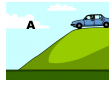
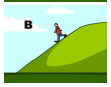
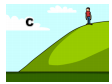
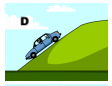
To convert grams into kilograms...
multiply the grams by 100
divide the grams by 100
multiply the grams by 1000
divide the grams by 1000
What is the main reason energy is wasted in machines with moving parts?
Friction between the parts
Electrical resistance
Magnetic fields
Sound waves
Which energy store increases when an object is lifted higher above the ground?
Gravitational potential energy
Chemical energy
Kinetic energy
Thermal energy

