
 Worksheets
Is it Ecologically Sustainable Development?
Total questions: 23
Worksheet time: 20mins
A recent land management project in Queensland saw agricultural land holders attend a series of workshops aimed at educating cattle farmers on new methods of environmentally sustainable grazing.
Farmers in the region have begun implementing changes to their land such as planting hundreds of large trees to act as shade for their cattle; improving the processes of rotating their cattle more regularly; and changing their current fences to wild-life friendly fencing, which will positively impact native marsupial species numbers.
The changes made by landowners positively impacts which of the Earth's spheres?
the lithosphere, due to the improved carbon sequestration that the hundreds of new trees will provide
the hydrosphere, due to the new habitat provided to native species by the hundreds of new trees
the atmosphere, due to the improvement of soil quality that will occur from the regular cattle rotation
the biosphere, due to the new wild-life friendly fences causing less harm to local marsupial species
This project considers intergenerational equity because
future generations will benefit from the improved land care practices, and the current generation will benefit from reduced soil degradation
future generations will benefit from the increased number of native marsupials, while the current generation will be negatively impacted from loss of available farming jobs
future generations will be negatively impacted due to the increase in number of trees, while the current generation will benefit from reduced soil degradation
future generations will be negatively impacted due to the increase in number of trees, while the current generation will be negatively impacted from loss of available farming jobs
Which of the following government organisations will benefit from this project?
local media outlets
indigenous community representatives
local environmental care groups
local council's Department of Environment and Land planning
Use the following information to answer Questions 4 to 6.
A construction and development company has purchased a 150 km2 parcel of native grassland that borders on a section of a national park and is also close to the local town. This section of land has been identified as being in a growth corridor for the region. There are old, disused school buildings on the parcel of land. The construction and development company has plans to convert the old school buildings and school grounds into 150 townhouses and a 400 dwelling housing estate. There are also plans to create a greenspace to be used as a recreational area, which includes open grassland, playgrounds, recreation reserves and a man-made lake and river system.
Question 4
The process that the development company can use to determine if this development project is worthwhile, that can take into account the overall positive and negative aspects on environmental, social, and economic factors is best described as:
a life cycle analysis
an environmental impact assessment
a cost-benefit analysis
an environmental risk analysis
As part of the planning approval of the project, the process that is undertaken that outlines the environmental effects of the development project, and provides alternative actions, can be best described as
a life cycle analysis
an environmental impact assessment
a cost-benefit analysis
an environmental risk analysis
This development project aims to address which of the following challenges to sustainability?
food
population
water
climate change
Use the following information to answer Questions 7 to 9.
An unpaved path currently exists along a 110km stretch of the south-west coast of Victoria. This path is state owned land and managed by Parks Victoria. It is used for recreation activities such as hiking, mountain bike riding and whale watching. Multi day hikes are encouraged, with hikers carrying food, water and sleeping equipment. There is currently no cost for the recreational use of the path, however, overnight hikers must pay to use campgrounds (also state owned and managed by Parks Victoria).
A proposal has been put forward by a tourism operator to build small, privately owned sleeping cabins in 5 of the campgrounds.
The operator predicts that this will increase the number of hikers each year from 20,000 to 40,000. The operator’s proposal also states the creation of local construction and hospitality jobs as a benefit of this project.
What is the predicted % increase in number of hikers, as per the tourism operator’s proposal?
50
60
100
200
An increase in numbers of hikers on the trail will negatively impact the
lithosphere because of trampling of small plants and atmosphere because of increased plastic pollution ending up in the ocean
atmosphere because of trampling of small plants and hydrosphere because of increased plastic pollution ending up in the ocean
biosphere because of trampling of small plants and hydrosphere because of increased plastic pollution ending up in the ocean
biosphere because of trampling of small plants and lithosphere because of increased plastic pollution ending up in the ocean
The operator of the project states that this project will meet the sustainability principle of efficiency of resource use. Which of the following would not help in meeting this principle?
asking hikers to pay an additional tourist tax as part of their fee for using the cabins
using previously cleared land as the site for the sleeping cabins
using sustainability harvested plantation timber as the building material for the sleeping cabins
setting a solar system onto the roof of all sleeping cabins for the generation of electricity
Environmental Protection
(a)
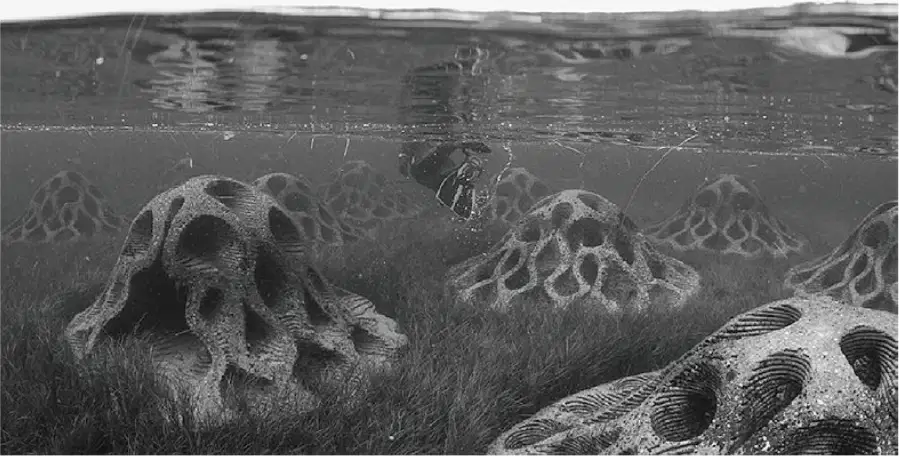
As part of the City of Greater Geelong’s Climate Change Response Plan, an artificial reef was installed in Clifton Springs. The reef is composed of 46 Erosion Mitigation Units (EMUs), which are made of a concrete mixture that includes recycled shells. Examples of these EMUs are shown in the photograph below. Each unit is designed to provide habitats for fish and marine invertebrates, as well as protection against coastal erosio
The City of Greater Geelong stands to benefit from the artificial reef because the reef may attract tourists looking to snorkel in the waters of Clifton Springs. This is an example of
a sociocultural value system
an ecocentric dimension of sustainable development
an anthropocentric value system
a circular economy project plan
Which one of the following best describes the project’s application of intragenerational equity?
Future generations will need to replace the EMUs as they erode over time.
The current generation will benefit from a decrease in seafood prices, while future generations will benefit from a decrease in coastal erosion.
The current generation will benefit from the ability to snorkel with increased marine diversity in the region.
Future generations will see a reduction in greenhouse gas emissions due to the use of recycled products in the EMUs.
Which one of the following statements is the most true regarding the long-term management of the artificial reef?
Stakeholders should be regularly consulted to establish their ongoing support for the project.
Ongoing biodiversity surveys should be undertaken to monitor ecosystem health.
Long-term management of the reef is unnecessary, as the EMUs will become native habitats over time.
The long-term economic benefits of the project outweigh the ecological benefits.
A developer has purchased land in Melbourne’s west with plans to build a housing estate. The land has several small patches of remnant grassland. A recent survey has found two individual Plum Swamp Wallaby-grass (Amphibromus pithogastrus) plants.
This tufted grass was once found in grasslands across Victoria and NSW. It is now presumed extinct in NSW and is confined to 7 small patches in Victoria, with an estimated 20 individual plants remaining. Some of the sites containing the remaining plants have been zoned for industrial or residential development. Some sites lay on private land in rural zones while a mere 2 sites have been marked as protected grassland reserve by the Victorian Government.
The developer has decided to maintain the remnant patch of grassland and consider its health as part of the planning for the housing estate in the area as a way of helping in conservation efforts. This decision is based on
anthropocentric values
ecocentric values
a mutualistic relationship
the protection of an exotic species

The management plan for this species considers the fact that the remaining populations of the Plum Swamp Wallaby-grass are all very small and isolated from one another. This consideration is likely noted as being a threat to the
ecosystem diversity
species diversity
genetic diversity
abiotic diversity

If this species was to be listed on the IUCN Red List of Threatened Species, what would be the most appropriate category for its listing?
critically endangered
endangered
extinct in the wild
threatened
Based on the information above. Which of the following is not a likely threat to the individual plants remaining on private land?
habitat modification
livestock grazing
competition from exotic grass species
overexploitation
A local government is planning a widening project along a main country road. Initial investigations of the area recorded patches of fragmented remnant vegetation mixed in among dairy farms along a creek system. A number of threatened species are thought to use the remnant habitat but additional fieldwork is required to collect more data and to confirm this.
When evaluating the issues related to developing the road, planners are considering three options:
• Option 1 – Do not proceed with widening the road.
• Option 2 – Use the existing path of the road but widen it to allow for traffic growth.
• Option 3 – Construct a new road path away from the remnant vegetation and through the dairy farms but at three times the cost of Option 2.
A decision to accept Option 1 would be mainly based on
the user pays principle
the precautionary principle
intragenerational equity issues
economic sustainability concerns
A decision to accept Option 3 would be mainly based on
economic efficiency
stakeholder communication
sustainable development concerns
conservation of biodiversity and ecological integrity
World H- Convention
(a)

A mining company is planning to develop a large-scale coal mine near the Australian coast. The planned mine site is adjacent to a wetland that provides a major habitat for nationally and internationally threatened waterbirds. The project could have potentially negative impacts on these threatened bird species, the water resources of the region and a protected Commonwealth marine reserve located off the coastline. Before the project can proceed, approval is required under the
Which of the following is a primary goal of sustainable development?
Maximizing short-term economic gains
Ensuring long-term environmental health
Increasing population growth
Promoting industrialization
What is a key benefit of implementing wildlife-friendly fencing in agricultural areas?
Increased crop yield
Reduced soil erosion
Enhanced biodiversity
Lower water usage
Flora and Fauna BLANK ACT
(a)
Which of the following best describes the concept of intergenerational equity?
Ensuring that current generations have more resources than future generations
Balancing resource use between current and future generations
Focusing solely on the needs of the current generation
Prioritizing economic growth over environmental sustainability

