
 Worksheets
BIOLOGY F4 REVISION CHAPTER 1-6
Total questions: 200
Worksheet time: 3hrs 20mins
Which of the following is TRUE about the function of fume chamber?
To clean the eyes if chemical splash occurs
To protect against toxic fumes
Provide a close space to study about pathogens
Clean the body if chemical splash occurs
Which of the following materials CANNOT be thrown into the laboratory sink?
Chemical substances with pH value of 5-9
Radioactive substances
Low concentrated solutions
Distilled water
How liquid medium such as blood is managed according to the correct Standard Operating Procedure?
Wrapped in a biohazard plastic bag
Thrown in the sink
Decontaminated using autoclave before thrown
Thrown in the drain
Which of the following is TRUE about biological drawing?
Use pen to draw
Shaded artistically
Lines drawn continuously
Drawing must not be labelled
What is the correct steps after forming a hypothesis?
Controlling variables
Identifying problems
Collecting data
Planning and carrying out a scientific investigation
What is meant by making a hypothesis?
Giving a statement whereby its validity has not been proven yet
Forming an experiment plan to study the scientific problem
Forming a rational conclusion that can be obtained from the experiment
Using an experimental technique that is suitable in solving the problem

What are P, Q and R?
nucleus, RER, vesicle
Vesicle, Golgi A.,Nucleus
Mitochondrion, RER, Chromosome
Mitochondrion, SER, Chromosome
Which organelle produces proteins?
Vacoule
Ribosome
Mitochondrion
Nucleus
What are P, Q and R?
nucleus, RER, vesicle
Vesicle, Golgi A.,Nucleus
Mitochondrion, RER, Chromosome
Mitochondrion, SER, Chromosome
Which organelle produces proteins?
Vacoule
Ribosome
Mitochondrion
Nucleus
Which structure is permeable to all fluids, rigid and not elastic?
Vacoule
Cell wall
Golgi apparatus
Plasma membrane
Which organelle is found abundantly in muscle tissues?
Mitochondrion
Ribosome
Nucleus
RER
Which organelle is involved in the formation of spindle fibre?
Nucleus
Ribosome
Mitochondrion
Centriole

What are P and Q?
Golgi app. & Mitochondrion
Golgi app.& Nucleus
Ribosome & Nucleus
Ribosome & Mitochondrion

Which structure controls the movement of substances into and out of the cell?
A
B
C
D

What is P that can be found on this Amoeba?
Vacoule
Pseudopodium
Plasma membrane
Nucleus

Which is an example of X?


Which is representing X?


What is the effect to the cell if there is no SER?
no energy product
no synthesis of lipid
no synthesis of protein
no modification of protein
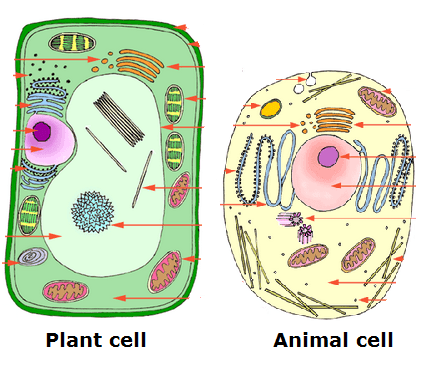
What distinguishes a plant cell from an animal cell? (How do you tell them apart) Hint: There's 3 ways (Check all 3)
Central Vacuole
Mitochondria
Cell Wall
Ribosomes
Chloroplasts
Which structure in Amoeba sp. is involved in osmoregulation?
Pseudopodium
Lysosome
Nucleus
Contractile vacoule

A large central vacuole is found in a _____ cell.
animal
plant

What is the function of a chloroplast?
makes proteins for animal cells
allows materials in and out of the cell
provides structure and support
absorbs sunlight for photosynthesis


Identify cholesterol molecule
structure a
structure b
structure h
structure i
Plasma membranes are selectively permeable. This means
anything can pass in and out
the membrane regulates the passage of the material in and out of the cell
glucose cannot enter the cell
cholesterol cannot enter
Which of the following substances would have the most trouble crossing the membrane by diffusing through the bilayer?
water
oxygen
carbon dioxide
a sodium ion
The cholesterol associated with membranes
is attached to proteins and extends into the environment surrounding the cell
helps stabilize the membrane at body temperature
is an abnormality resulting from a diet high in cholesterol
both a and c
The fluid mosaic model describes a membrane consisting of
a phospholipid bilayer with embedded proteins
2 layers of phospholipids with proteins in between
individual proteins and phospholipids that can drift
both a and c
What kinds of molecules pass through a cell membrane most easily?
ionic
small and hydrophobic
large polar
large and hydrophobic

Which structure is the hydrophilic polar head of the phospholipid molecule?
F
D
C
A1

The majority of the plasma membrane is composed of ______.
phospholipids
proteins
carbohydrates
cholesterol
The movement of atoms, ions, or molecules from an area of high concentration to an area of low concentration.
osmosis
active transport
diffusion
facilitation

When animal cells are placed in a __________ solution they begin to swell.
Hypertonic
Isotonic
Hypotonic
Concentrated

What keeps this plant cell from bursting?
the cell wall
the vacuole
the membrane
the nucleus


Which one represent passive transport in living things?
transport of sucrose from a leaf to a phloem
tissue
gaseous exchange between an alveolus and
a blood capillary through simple diffusion
absorption of mineral ions by a plant root hair
cell
eabsorption of glucose through the renal
tubule in the kidney
Hypertonic solution is a solution that has______________.
a high solutes concentration and high water potential.
a high solutes concentration and low water potential.
a low solutes concentration and high water potential.
a low solutes concentration and low water potential.
Hypotonic solution is __________________.
a solution high solutes concentration and high water potential.
a solution low solutes concentration and low water potential.
a solution low solutes concentration and high water potential.
a solution high solutes concentration and low water potential.
The absorption of amino acid across small intestine in human body through small projections called villi occurs via __________________.
osmosis
simple diffusion
facilitated diffusion
endocytosis


N-Hypertonic
N-Hypotonic
N-Isotonic
N-isotonic


Y-Plasmolysis
Y-Crenation
Y-Haemolysis
Y-Crenation

Diagram 5 shows the structure of plasma membrane.
What is X?
Phospholipid
Cholesterol
Carrier protein
Glycoprotein

Diagram 10 shows a plant cell in a particular solution.
The plant cell experiences
plasmolysis
deplasmolysis
haemolysis
crenation

Diagram 9 shows an organism.
What is the process carried out by the organism as shown in Diagram 9?
Facilitated transportation
Active transport
Facilitated difussion
Diffusion
Which of the following is NOT the element for a carbohydrate?
Nitrogen
Carbon
Hydrogen
Oxygen
What is the monomer for a protein?
Nucleotide
Galactose
Fatty acid
Amino acid
The proses involved adding water molecules to a polymer. Name the process
Condensation
Evaporation
Hydrolysis
Osmosis
How many types of amino acid?
20
30
40
50
Iodine is used to test the presence of?
Cellulose
Glucose
Glycogen
Starch
What is the original color of benedict solution?
Brick red precipitate
Blue
Purple
Mauve
A nucleotide consists of?
Phosphate group, hexose sugar and amino acid
Phosphate group, pentose sugar and nitrogenous base
Phosphate group, pentose sugar and fatty acid
Phosphorus, nitrogen and carbon
Which of the following is true about saturated fat
Has one more double bond in a chain
Solid at room temperature
Liquid at room temperature

Rajah 1 menunjukkan satu eksperimen untuk mengkaji pergerakan bahan merentasi tiub visking.
Diagram 1 shows an experiment to investigate the movement of substances across a visking tube.
Apakah process yang berlaku dalam eksperimen tersebut?
What is the process that takes place in this experiment?
Resapan
Diffusion
Pengangkutan berbantu
Facilitated transportation
Pengangkutan aktif
Active transport
Osmosis
Osmosis

Rajah 2 menunjukkan pergerakan molekul-molekul merentasi membran plasma melalui satu proses.
Diagram 2 shows the movement of molecules across the plasma membrane through a process.
Process tersebut ialah
The process is
pengangkutan berbantu
facilitated transportation
resapan berbantu
facilitated difussion
osmosis
osmosis
pengangkutan aktif
active transport
Manakah antara faktor-faktor berikut mempengaruhi pergerakaan bahan merentasi membran plasma?
Which of the following factors affect the movement of molecules across the plasma membrane ?
Berat molekul / Molecule weight/
Saiz molekul / Molecule size
Kekutuban molekul / Polarity of molecule
Bentuk molekul / Molecule shape
Ionic charge/Cas ion

Manakah antara molekul berikut dapat merentasi P?
Which of the following molecules can pass through P?
Amino acid/Asid amino
Water/Air
Glycogen/Glikogen
Starch/Kanji

Rajah 1 menunjukkan suatu sel tumbuhan dalam air suling.
Diagram 1 shows a plant cell in distilled water.
Apakah proses P?
What is process P?
Osmosis
Osmosis
Pengangkutan berbantu
Facilitated transportation
Resapan berbantu
Facilitated difussion
Pengangkutan aktif
Active transport
Sejenis pergerakan molekul-molekul merentasi membran plasma diterangkan dalam maklumat yang berikut:
A type of movement of molecules across the plasma membrane is described in the following information:
Molekul-molekul dan ion-ion bergerak melawan kecerunan kepekatan dan memerlukan tenaga
Molecules and ions move against the concentration gradient and require energy
Pergerakan tersebut dikenali sebagai
The movement known as
pengangkutan berbantu
facilitated transportation
resapan berbantu
facilitated difussion
osmosis
osmosis
pengangkutan aktif
active transport
Apakah proses di mana molekul bergerak dari satu kawasan yang berkepekatan tinggi ke satu kawasan yang berkepekatan rendah?
Osmosis
Pengangkutan aktif
Pengangkutan pasif
Resapan ringkas

Rajah 9 menunjukkan sejenis organisma.
Diagram 9 shows an organism
Apakah process yang dijalankan oleh organisma tersebut seperti yang ditunjukkan dalam Rajah 9?
What is the process carried out by the organism as shown in Diagram 9?
Resapan
Diffusion
Pengangkutan berbantu
Facilitated transportation
Pengangkutan aktif
Active transport
Resapan berbantu
Facilitated difussion
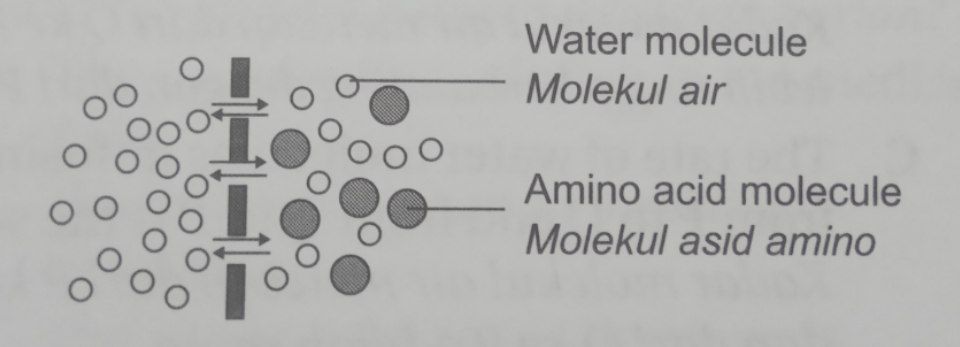
Rajah menunjukkan pergerakan molekul melalui membran telap memilih.
Antara berikut, yang manakah betul tentang pergerakan molekul yang ditunjukkan dalam rajah di atas?
Memerlukan tenaga dalam bentuk ATP
Berlaku secara osmosis
Berlaku dengan bantuan protein liang
Berlaku menentang kecerunan kepekatan
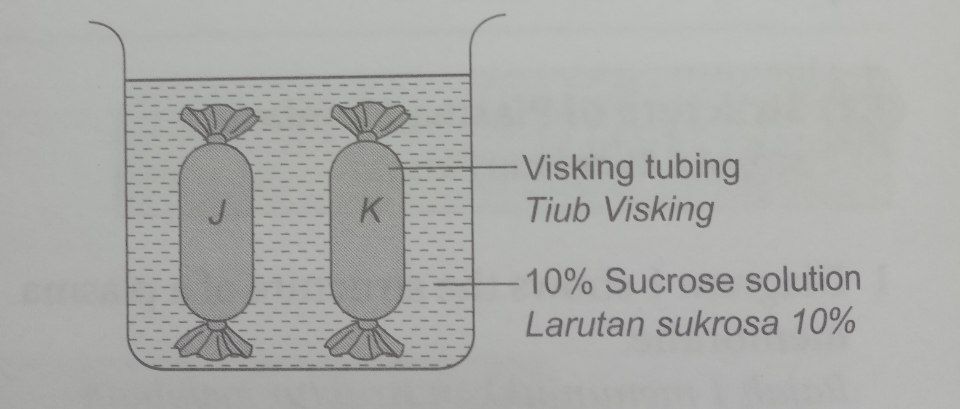
Rajah menunjukkan dua tiub Visking berlabel J dan K. Tiub Visking J mengandungi larutan sukrosa 5% dan tiub Visking K mengandungi larutan sukrosa 20%.
Antara yang berikut, yang manakah menerangkan keadaan tiub Visking J dan K selepas direndam di dalam larutan sukrosa 10% selama 30 minit ?
J - Flasid
K - Flasid
J - Flasid
K - Segah
J - Segah
K - Segah
J - Segah
K - Flasid

The diagram shows the mechanism of an enzyme.
What is X?
Enzyme
Product
Substrate
Enzyme-substrate complex

The diagram shows the action of an enzyme on a substrate.
Which of the following is represented by P?
Product
Substrate
Enzyme-substrate complex
Stable intermediate substance

Diagram shows a molecule of an enzyme.
Which of the followings show the substrate for this enzyme?


A housewife accidentally cut her finger and her blood stained her shirt.
Her husband bought a box of washing powder with enzyme.
Which of the followings is the most suitable enzyme and water temperature to remove the blood stain?
Lipase, 37oC water
Protease, 37oC water
Amylase, 37oC water
Protease, 18oC water

Diagram shows the effect of substrate concentration on the rate of enzyme reaction.
What causes the rate of reaction at point X to Y?
Free active sites
Maximum rate of reaction
Limited enzyme concentration
Decrease in pH of the substrate
A daughter need to prepare a meat dish in less than an hour after come back from work.
Which of the followings is the best step to treat the meat before cooking?
Marinate with lipase
Marinate with rennin
Marinate with protease
Marinate with amylase

Diagram below shows an enzyme reaction.
Which of the followings represent X, Y and Z?
X:enzyme, Y:product, Z:substrate
X:product, Y:enzyme, Z:substrate
X:substrate, Y:enzyme, Z:product
X:substrate, Y:product, Z:enzyme

The equation shows the hydrolysis of sucrose.
What is represented by P, Q and R?
P:sucrase, Q:glucose, R:glucose
P:amylase, Q:maltose, R:glucose
P:sucrase, Q:fructose, R:glucose
P:sucrase, Q:galactose, R:glucose

Diagram shows the experiment to study the effect of pH on the reaction of an enzyme.
Which test tubes remain cloudy after 60 minutes?
P and Q
R and S
Q and S
P and R

Diagram shows a petri dish with agar jelly containing starch.
Four holes were cut in the jelly and each hole was treated differently.
After 30 minutes, iodine solution was poured over the jelly.
Which holes, A, B, C or D would be surrounded by the largest yellowish brown region?
A
B
C
D
Which is the most effective washing for a t-shirt with grease stain?
Detergent containing lipase with 37oC water
Detergent containing protease with 37oC water
Detergent containing amylase with 37oC water
Detergent containing pectinase with 37oC water
What is the product from the catalysis of cellulose by cellulase?
glucose
galactose
amino acid
glucose and galactose

Diagram shows the action of enzyme to form a disaccharide.
What is S and T?
S:galactose, T:maltose
S:glucose, T:sucrose
S:galactose, T:sucrose
S:glucose, T:maltose
Lipase solution was added to milk. After 30 minutes the pH of the milk decreases.
What is the substrate and product in this reaction?
Substrate:fat, Product:amino acid
Substrate:protein, Product:amino acid
Substrate:fat, Product:fatty acid
Substrate:protein, Product:fatty acid

Based the diagram, what are the two correct characteristics of lactase?
structure of enzyme is unchanged
has active site for specific reaction
needs co-factor to function
reversible reaction
What is the criteria of the active site of enzymes that ensure them to function at narrow pH?
different charge between active site and substrate
same charge of active site and substrate
enzyme denatures during extreme pH change
all enzyme function at the same range of pH
When does the replication of chromosomes occur in a cell cycle?
G1 phase
G2 phase
S phase
M phase
In which stage, does the division of cytoplasm start?
Prophase
Metaphase
Anaphase
Telophase

Prophase
Metaphase
Anaphase
Telophase

A
B
C
D
Which of the following statements is correct?
Chromatids separate during anaphase I.
Crossing over occurs during mitosis.
Homologous chromosomes pair up during prophase I.
In meiosis, the cell only divides once.

I and II
II and III
III and IV
I and IV

A
B
C
D

I and II
II and III
III and IV
I and IV

Prophase I
Telophase I
Prophase II
Telophase II

R only
S only
P and Q only
R and S only
Which of the following is responsible for producing two identical daughter cells during mitosis?
The two sister chromatids are joined together at the centromere
The chromosomes shorten and thicken during prophase
Each chromatid from one chromosome moves to the opposite poles
The chromosomes line up at the equator of the cell

2
4
8
16

A
B
C
D

I and II
II and III
III and IV
I and IV
The diploid chromosomal number of a cat is 38. If one of the homologous chromosome pairs does not separate during meiosis I, how many chromosomes can be found in the gametes?
18
19
37
38

I and II
II and III
III and IV
I and IV

I and II
II and III
III and IV
I and IV

I and II
II and III
III and IV
I and IV

Produces clones with the same resistance to pests or diseases
Produces clones with the same characteristics
Produces clones in large numbers that are identical to the parent
Produces clones with the different characteristics

I and II
II and III
III and IV
I and IV




The elements that can be found in carbohydrates are
Carbon, hydrogen, oxygen
Carbon, nitrogen, oxygen
Carbon, hydrogen, oxygen, nitrogen
Carbon, hydrogen, oxygen, sulphur
The simplest sugars are also known as
monosaccharides
disaccharides
polycharides
Lactose is made of
two fructose molecules
two glucose molecules
one glucose molecule and one fructose molecule
one glucose molecule and one galactose molecule
Maltose is made from
two fructose molecules
two glucose molecules
one glucose molecule and one fructose molecule
one glucose molecule and one galactose molecule
What is the main component of the cell wall of plant cells?
lignin
cellulose
pectin
chitin
Excess carbohydrates is stored in the animal cells as
starch
glycogen
fats
glucose

What is the name of the carbohydrate?
glucose
glycogen
starch
cellulose

What is the name of this carbohydrate?
glucose
glycogen
starch
cellulose

What are processes P and Q?
P - oxidation
Q - reduction
P - reduction
Q - oxidation
P - condensation
Q - hydrolysis
P - hydrolysis
Q - condensation

The equation above shows the digestion of cellulose.
What are M and P?
M - Hydrolysis
P - fructose
M - Hydrolysis
P - glucose
M - condensation
P - fructose
M - condensation
P - glucose
Which of the following is a non-reducing sugar?
Sucrose
fructose
glucose
maltose

_______________ is found in milk.
maltose
galactose
fructose
sucrose
X is a process which involves the removal of a water molecule when a bond is formed between two monomers.
What is X?
condensation
hydrolysis

What type of carbohydrates can be found in above?
glucose
fructose
lactose
sucrose
When a solution of sugar is heated with Benedict's solution, a reducing sugar will cause the formation of a brick-red precipitate.
TRUE
FALSE


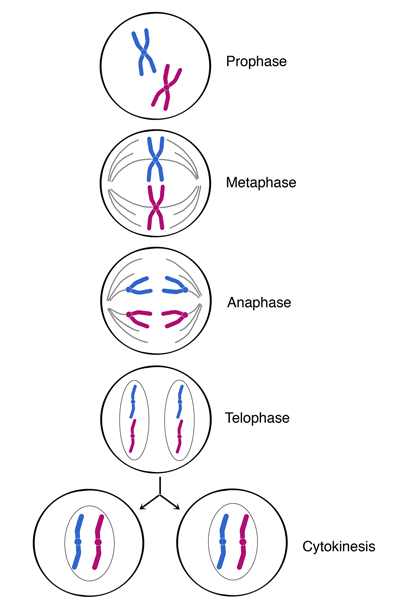
Which occurs during cytokinesis?
binary fission
cytoplasm divides
DNA duplicates
spindle apparatus forms
Results in a condition called cancer
Normal cycle
abnormal cycle
The cell grows during this stage.
anaphase
interphase
metaphase
prophase
telophase
Which of the following cells is in Telophase?


What phase is this cell in?
Anaphase
Cytokinesis
Interphase
Prophase

