

wayground logo

Free Printable Worksheets

Font size

S
M
L
XL
Worksheets

Summer Learning Academy "A Drop of Water" Assessment

Total questions: 20

Worksheet time: 10mins

Name
Class
Date
1.
Which word means the OPPOSITE of gritty?
a)
bland
b)
rough
c)
smooth
d)
wrinkled
2.
Which word means almost the SAME as typical?
a)
different
b)
messy
c)
odd
d)
usual
3.
What does the word mingle mean?
a)
to divide
b)
to mix together
c)
to make bigger
d)
to keep separated
4.
What does the word cling mean?
a)
to separate things
b)
to glue things together
c)
to stick to something closely
d)
to stay away from everything
5.
Which word means almost the SAME as humid?
a)
cold
b)
dry
c)
moist
d)
slippery
6.
What does the word magnified mean?
a)
caused objects to appear larger
b)
made objects look smaller
c)
showed objects as they are
d)
made objects shrink
7.
Which of the following professionals would MOST likely use a microscope?
a)
lawyer
b)
nurse
c)
scientist
d)
waiter
8.
What does the word dissolves mean?
a)
dries out
b)
separates two things
c)
rinses with warm water
d)
becomes part of a liquid
9.
According to the selection, evaporation is DIFFERENT from condensation because
a)
condensation only occurs in clouds.
b)
you can see condensation, but not evaporation.
c)
You can see evaporation, but not condensation
d)
you can only see condensation occur occasionally.
10.
What causes the water droplets in clouds to form?
a)
evaporation of water
b)
the clinging together of molecules
c)
the clinging together of raindrops
d)
water molecules accumulate on surfaces
11.
What is the MAIN idea of the section "Endless Variety"?
a)
Snowflakes form in the same way, but produce many designs.
b)
Snowflakes form in different ways, and produce many designs.
c)
Snowflakes from in different ways, and produce one design.
d)
Snowflakes always look the same.
12.
What do you see when light passes into water?
a)
nothing
b)
the color red
c)
the color violet
d)
all the colors of the rainbow
13.
What happens AFTER massive clouds form in the water cycle?
a)
Water falls from the sky as rain.
b)
Water vapor condenses on surfaces.
c)
Water vapor moves invisibly through the air.
d)
Water evaporates from puddles, ponds, plants, trees, and so on.
14.

What is a molecule?

a)
A molecule is a group of cells bonded together.
b)
A molecule is a group of atoms bonded together.
c)
A molecule is a type of animal.
d)
A molecule is a form of energy.
15.

How many times is the snowflake shown in the image magnified from its actual size?

a)

60 times

b)

100 times

c)

50 times

d)

80 times

16.

What happens when a snowflake grows large enough?

a)

It evaporates

b)

It falls to the ground

c)

It rises in the air

d)

It breaks apart

17.

What happens when water vapor condenses on particles in very cold air?

a)

It forms rain

b)

It forms ice crystals

c)

It evaporates

d)

It remains unchanged

18.

What happens to a snowflake when it melts?

a)

It turns into a drop of water

b)

It becomes a crystal again

c)

It evaporates immediately

d)

It turns into a piece of ice

19.

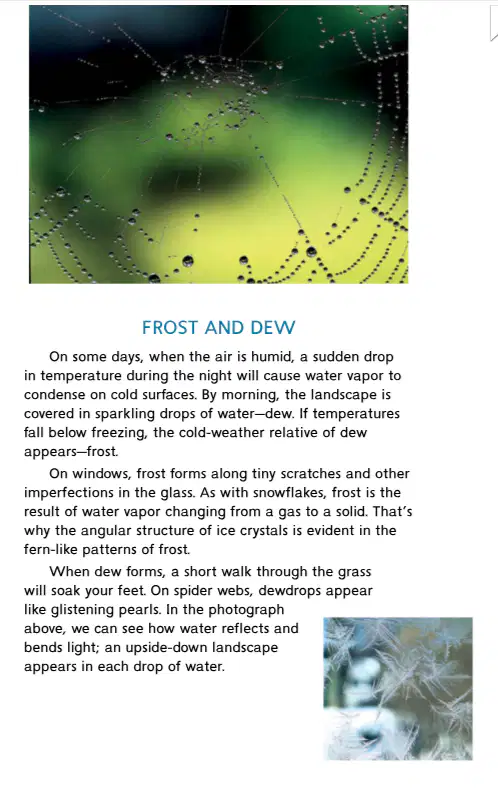
As mentioned in the text, why is the angular structure of ice crystals evident in the fern-like patterns of frost?

a)

Because of the reflection of light

b)

Because of the water soaking the surface

c)

Because frost forms along tiny scratches and other imperfections in the glass

d)

Because of the movement of water vapor
20.

What is frost the result of?

a)

Water vapor changing from a gas to a solid

b)

Water vapor changing from a liquid to a gas

c)

Water vapor changing from a solid to a liquid

d)

Water vapor changing from a gas to a liquid
