Wayground logo

Free Printable Worksheets

Font size

S
M
L
XL
Worksheets

year 8 computer science revision questions

Total questions: 78

Worksheet time: 49mins

Name
Class
Date
1.

Convert this 4-bit binary number to denary

a)

8

b)

5

c)

6

d)

4

2.

Convert this 4-bit binary number to denary

a)

12

b)

13

c)

10

d)

11

3.

Convert this 8-bit binary number to denary

a)

53

b)

58

c)

64

d)

52

4.

Convert this 8-bit binary number to denary

a)

145

b)

130

c)

135

d)

134

5.

Convert 4 into binary

a)

1010

b)

1110

c)

0101

d)

0100

6.

Convert 14 into binary

a)

1010

b)

1110

c)

1111

d)

1011

7.

Convert 15 into binary

a)

1010

b)

1110

c)

1111

d)

1011

8.

Convert 30 into binary

a)

0001 1110

b)

0011 0001

c)

0011 0011

d)

0111 1111

9.

Convert 130 into binary

a)

1000 0010

b)

1001 0001

c)

1001 0110

d)

0111 1111

10.

Convert 195 into binary

a)

1001 0010

b)

1001 0001

c)

1100 0011

d)

0111 1111

11.

What is D in binary

a)

1111

b)

1101

c)

1011

d)

0111

12.

What is 1011 in hex

a)

B

b)

C

c)

D

d)

E

13.

What is A in binary

a)

1111

b)

0101

c)

1010

d)

0110

14.

What is 0111 in hex

a)

E

b)

A

c)

7

d)

3

15.

15 in denary is what in Hex?

a)

A

b)

B

c)

E

d)

F

16.

12 in denary is what in Hex?

a)

A

b)

B

c)

C

d)

D

17.

What is E in denary

a)

10

b)

12

c)

14

d)

16

18.

What is B in denary

a)

10

b)

11

c)

12

d)

13

19.

Denary = ?

Hexadecimal = E

a)

11

b)

12

c)

13

d)

14

e)

15

20.

Denary = (a)  

Hexadecimal = 20

21.

Denary = (a)  

Hexadecimal = 21

22.

Denary = (a)  

Hexadecimal = A1

23.

what is this in hexadecimal

10101110

a)

AB

b)

5D

c)

2F

24.

What will the AND gate's output be?

a)

0

b)

1

25.

What will the AND gate's output be?

a)

0

b)

1

26.

What will the OR gate's output be?

a)

0

b)

1

27.

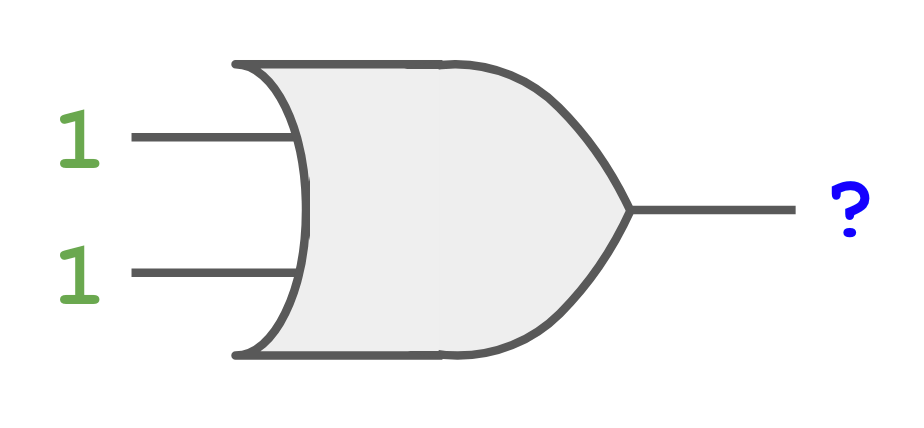
What will the OR gate's output be?

a)

0

b)

1

28.
What is the output of an AND gate if the inputs are 1 and 0?
a)
ON
b)
2
c)
1
d)
0
29.
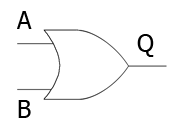
What logic gate is this?
a)
AND
b)
OR 
c)
NOT
d)
TO
30.
What is the output of an OR gate if the inputs are 1 and 0?
a)
0
b)
1
c)
OFF
d)
2
31.
An OR gate has
a)
Two inputs and one output
b)
One input and one output
c)
One input and two outputs
d)
Two inputs and two outputs
32.
A logic state can only be….
a)
On or 1
b)
Off or 1
c)
1 or 0
d)
In and Out
33.
The output of a ________ gate is only 1 when both inputs are 1.
a)
OR
b)
NOT
c)
NAND
d)
AND
34.
What gate is this table for?
a)
AND
b)
OR
c)
NOT
d)
NOR
35.
Which of the following is not a component inside a processor?
a)
Memory
b)
Control Unit
c)
Arithmetic Logic Unit
d)
General Purpose Registers
e)
Text for option 5 (optional)
36.
The control unit does what?
a)
Connects parts of the CPU together.
b)
Performs arithmetic and logical operations on the data.
c)
Stores the outcomes of arithmetic and logic operations.
d)
Controls timing and control signals around the CPU.
37.
What does ALU stand for?
a)
Addition Logic Unit
b)
Arithmetic Logical Unit
c)
Arithmetic Logic Unit
d)
Algebra Logic Unit
38.
The Arithmetic Logic Unit does?
a)
Connects parts of the CPU together.
b)
Performs arithmetic and logical operations on the data.
c)
Stores the outcomes of arithmetic and logic operations.
d)
Controls and coordinates the activities of the CPU.
39.
Which of the following can the Arithmetic Logic Unit not do?
a)
ADD, SUBTRACT, MULTIPLY, DIVIDE
b)
Shift operations
c)
Boolean logic operations
d)
Accepts instructions and decodes it.
40.
The abbreviation (PC) for a CPU stands for?
a)
Personal Computer
b)
Program Counter
c)
Personal Counter
d)
Program Count
41.
The abbreviation (ACC) for a CPU stands for?
a)
Accumulator
b)
Accumulate
c)
Arithmetic Logic Unit
d)
Address
42.
The abbreviation (MAR) for a CPU stands for?
a)
Main Address Register
b)
Memory Address Register
c)
Main Addressing Register
d)
Memory Addressing Register
43.
The abbreviation (MDR) for a CPU stands for?
a)
Main Data Register
b)
Memory Data Register
c)
Main Directional Register
d)
Memory Directional Register
44.
Which of the following is not part of the fetch stage?
a)
Address of next instruction copied from the PC to MAR
b)
The instructions held at that address is copied to the MDR
c)
The contents of the MDR are copied to the CIR
d)
ALU performs calculations on the data.
45.
In which register does the Fetch Decode Execute cycle start in?
a)
Memory Address Register
b)
ALU
c)
Memory Data Register
d)
Program Counter
46.
What gets passed to the MAR?
a)
The instruction
b)
Both the instruction and data
c)
The address to the next instruction or data
d)
The data
47.
What happens to the Program Counter after it has passed its address?
a)
It passes the next address
b)
It decodes the instruction
c)
It increments
d)
It decrement
48.
What is the purpose of the accumulator?
a)
To store intermediate data
b)
To store decoded data
c)
To analyse the data
d)
To pass instructions
49.
What gets stored in the MDR?
a)
The address to the next instruction or data
b)
The program which is loaded from main memory
c)
The data retrieved from the MAR
d)
The instruction from main memory
50.
Where are all data and instructions stored in?
a)
SSD
b)
Memory
c)
Optical Disc
d)
Magnetic Hard Disk
51.
Assembly language has mnemonics.
a)
True
b)
False
52.
Compilers translate high-level language into machine code.
a)
True
b)
False
53.
High and low-level programming languages can be understood by a computer.
a)
False
b)
True
54.
An example of a high-level programming language is:
a)
Python
b)
Assembly
c)
Machine code
d)
Cloud
55.
Machine code uses the binary number system.
a)
True
b)
False
56.
High-level languages need to be compiled into machine code before they can be used by a computer.
a)
True
b)
False
57.
Machine code is easy to understand by a human.
a)
False
b)
True
58.

Which of the following is NOT a translator?

a)

Assembler

b)

Compiler

c)

Interpreter

d)

Executable

59.
LOAD r1,
LOAD r2,
ADD r1,
DIV r1, #2
a)
Machine Code
b)
High Level
c)
Assembly Language
60.
Compilers, assemblers and interpreters are examples of this.
a)
Translator
b)
Run time environment
c)
Editor
d)
Error diagnostics
61.

A translator for high level code that translates code all at once into machine code

a)

Assembler

b)

Compiler

c)

Interpreter

d)

Programmer

62.

A translator for high level code that translate codes as the program is being run.

a)

Compiler

b)

Interpreter

c)

Assembler

d)

Programmer

63.

Converts either a high level language or a low level language into machine code

a)

Translator

b)

High level language

c)

Low level language

d)

Machine code

64.

print("Hello World!") is an example of...

a)

High-level language

b)

Low-level language

c)

Machine Code

65.

What is debugging?

a)

The term popularly used to describe fixing errors in a computer program

b)

The term popularly used to describe no errors in a computer program

c)

The term popularly used to describe locating errors in a computer program

66.
_____ is a way of repeating code
a)
While
b)
Expression
c)
Loop
d)
Lopp 
67.

A list of steps to complete a task

a)

Algorithm

b)

Program

c)

CPU

d)

Hardware

68.

What is a syntax error?

a)

An error that stops the program from running

b)

An error that occurs during runtime

c)

An error in the logic of the program

d)

An error that causes the program to crash

69.

What is a runtime error?

a)

An error that stops the program from running

b)

An error that occurs during runtime

c)

An error in the logic of the program

d)

An error that causes the program to crash

70.

What can cause a runtime error?

a)

Incorrect syntax

b)

Misspelled words

c)

Using the wrong indentation

d)

Referencing non-existent data

71.

John is coding a program for his school project. He notices that his program runs without any syntax errors but does not produce the expected output. What type of error is John likely facing?

a)

An error that stops his program from running

b)

An error that occurs while his program is running

c)

An error in the logic of his program

d)

An error that causes his program to crash

72.

What is an example of a logical error?

a)

Comparing a string to an integer

b)

Forgetting to close a speech mark

c)

Referencing a non-existent data

d)

Switching less-than and greater-than symbols

73.

While debugging a program, Lisa found that the program was crashing unexpectedly. What type of error is Lisa likely encountering?

a)

Syntax error

b)

Runtime error

c)

Logical error

d)

All errors can be found easily

74.

What is software?

a)

The physical parts of a computer

b)

The operating information used by a computer

c)

The memory bank of a computer

d)

The electrical current inside of a computer

75.

Software that controls all of the computers hardware is...

a)

Program Software

b)

Application Software

c)

Instructional Software

d)

System Software

76.

Which of the following is NOT an operating system?

a)

YouTube

b)

Windows

c)

MAC OS

77.

An example of system software is:

a)

Word Processors

b)

Antivirus

c)

Web browsers

78.

MS Word is an example of ____________ software

a)

Presentation software

b)

DBMS software

c)

Spreadsheet software

d)

Word processing software