
 Worksheets
6035 Drainage outcome 2 part 2
Total questions: 43
Worksheet time: 22mins
What is one reason that a trap seal can be lost?
The water level is raised above the bend of the trap.
The water level is lowered to below the bend of the trap.
The trap is cleaned regularly.
The trap is replaced with a new one.
What will happen if the trap seal is lost?
Water will overflow from the trap.
The property will be flooded.
Noxious smell will enter the property.
The trap will become clogged.
What needs to be done to stop the noxious smell from entering the property?
The trap seal needs to be cleaned.
The trap seal needs to be replaced.
The trap seal needs to be reinstated.
The trap seal needs to be removed.
What is a common reason for trap seal loss?
The seal water is evaporating.
The seal water is leaking out.
The trap is too old.
The trap is too small.
What could cause the seal water to leak out in a trap?
The trap being too large.
The rubber seals not being watertight.
The trap being too new.
The trap being too clean.
What is another possible reason for trap seal loss besides the rubber seals not being watertight?
The plastic body of the trap being damaged.
The trap being too old.
The trap being too small.
The trap being too clean.
What is a common reason for trap seal loss in warmer climates and holiday properties?
Freezing
Evaporation
Condensation
Overflow
What happens to the water in the trap seal due to lack of use of the appliance?
It freezes
It condenses
It evaporates
It overflows
How do appliances rely on maintaining the trap seal water?
By regular use
By occasional use
By not using at all
By using only in winter
What is the average UK seal loss per week due to evaporation?
1.5mm
2.5mm
3.5mm
4.5mm
What causes the traps in appliances to bob up and down, leading to trap seal loss?
Water pressure
Wind passing over the top of a soil stack
Temperature changes
Electrical interference
What can assist with the problem of trap seal loss caused by wavering out?
A water pump
A wind cowl
A heating element
An air filter
What causes trap seal loss due to momentum?
A small amount of water being slowly discharged down a trap.
A large amount of water being suddenly discharged down a trap.
A small amount of water being suddenly discharged down a trap.
A large amount of water being slowly discharged down a trap.
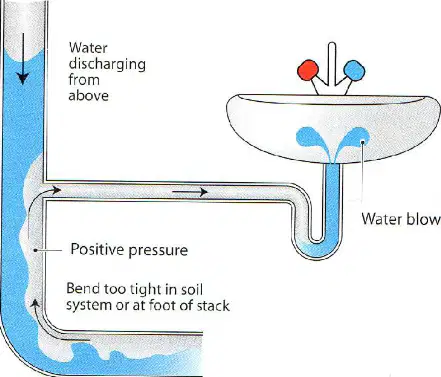
What happens when a WC is discharged from the first floor and the soil stack has a tight radius at the base?
The water flows smoothly down the stack.
The water starts to back up the stack, causing pressure to build.
The water evaporates before reaching the base.
The water gets absorbed by the soil.
What is the consequence of water backing up the stack due to a tight radius at the base?
It causes the lower traps to be pushed out.
It causes the water to flow faster.
It causes the water to evaporate.
It causes the water to be absorbed by the soil.
What generally causes capillary action in S traps?
Long fibres or hairs caught over the top of the weir
High water pressure
Low water temperature
Presence of soap
What does capillary action do in the context of trap seal loss?
It increases the water level in the trap
It draws the trap seal water up and over the weir
It prevents water from entering the trap
It cleans the trap
What is self-siphonage?
When a single appliance discharges and pulls its own trap out
When multiple appliances discharge simultaneously
When water is siphoned from one appliance to another
When the waste pipe is blocked
What is formed when an appliance discharges, leading to self-siphonage?
A plug of water
A vacuum
A blockage
A bubble of air
What is created as the plug of water moves down the waste pipe during self-siphonage?
Negative pressure
Positive pressure
Neutral pressure
Atmospheric pressure
What is a common cause of self-siphonage in basins?
Small waste pipe diameter
Large waste pipe diameter
Blocked waste pipe
High water pressure
What is the easiest way to overcome the problem of self-siphonage?
Using an anti-vac trap
Increasing the waste pipe diameter
Decreasing the waste pipe diameter
Using a stronger discharge pump
Self-siphonage can also occur if the gradient of the waste pipe is:
Too steep
Too shallow
Too narrow
Too wide
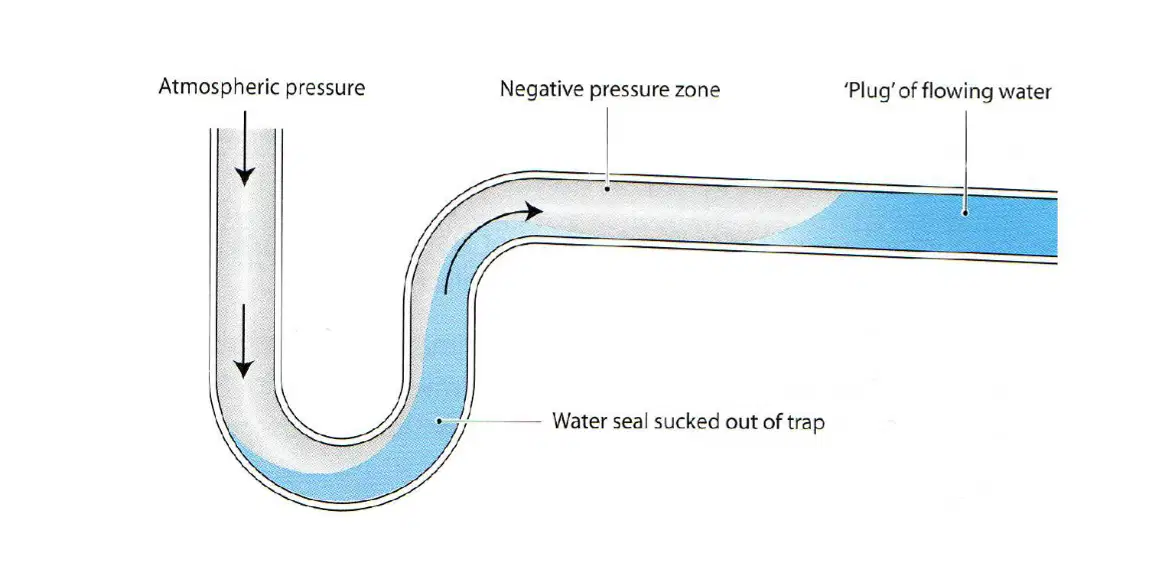
What is the term used to describe the loss of water seal in a plumbing trap due to the movement of water creating a negative pressure zone?
Backflow
Self-siphonage
Air admittance
Water hammer
What is induced siphonage?
It occurs when a single appliance is connected to a discharge branch.
It occurs when several appliances are connected to the same discharge branch and one appliance is discharged, pulling the other appliance’s trap out.
It occurs when water flows back into the appliance.
It occurs when the discharge pipe diameter is less than 50mm.
What happens when a plug of water moves down the waste pipe?
It creates positive pressure, pushing the trap in.
It creates negative pressure, pulling the trap out.
It creates no pressure change.
It creates a vacuum, stopping the water flow.
What should be the branch discharge pipe diameter for multiple appliances to prevent induced siphonage?
25mm
35mm
50mm
75mm
What is the term used to describe the loss of water from a trap due to the movement of water through the plumbing system?
Atmospheric pressure
Induced siphonage
Negative pressure zone
Water flowing from the appliance
Which of the following is NOT a factor involved in induced siphonage?
Atmospheric pressure
Water flowing from the appliance
Negative pressure zone
Positive pressure zone
In the context of trap seal loss, what does the term "negative pressure zone" refer to?
A region where atmospheric pressure is higher
A region where water is pushed into the trap
A region where water is sucked out of the trap
A region where water remains stagnant
What is the term used to describe the loss of water in a trap due to siphonage?
Induced siphonage
Evaporation
Capillary action
Backflow
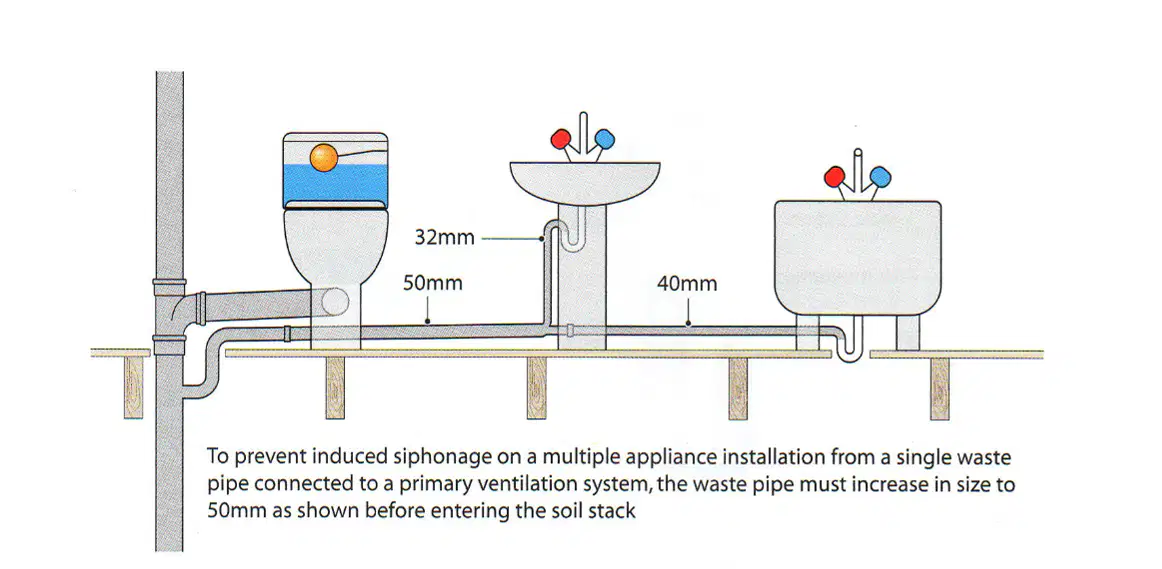
According to the diagram, what is the required size of the waste pipe before entering the soil stack to prevent induced siphonage?
32mm
40mm
50mm
60mm
Which of the following is a common cause of trap seal loss?
Waste pipes are too short
Waste pipe diameter is too large
Incorrect fall
No short radius bend
What can cause trap seal loss due to the waste pipe diameter?
Waste pipe diameter is too large
Waste pipe diameter is too small
Waste pipe diameter is too short
Waste pipe diameter is too long
Which of the following is NOT a common cause of trap seal loss?
Waste pipes are too long
Too many appliances on a discharge branch
Too few changes in direction
Debris or blockages
How would you rectify the cause of trap seal loss due to too many changes in direction?
Increase the number of changes in direction
Decrease the number of changes in direction
Increase the diameter of the waste pipe
Decrease the diameter of the waste pipe
What is the maximum length (in meters) for the waste pipe of a WC (adult)?
1.7
3.0
6.0
3.5
What is the gradient range (in mm/m) for the waste pipe of a basin or bidet?
18-22
18-90
18
20-25
What is the trap seal depth (in mm) for a washing machine or dishwasher?
50
75
100
32
What is the waste size (in mm) for a junior WC?
100
75
40
32
Which appliance has a waste size of 32 mm?
WC
Bath
Basin or bidet
Sink
What is the maximum length (in meters) for the waste pipe of a bath?
1.7
3.0
6.0
4.0
What is the trap seal depth (in mm) for a sink?
50
75
100
32

