
NEW
Font size
 Worksheets
World War I
Total questions: 29
Worksheet time: 15mins
Which factors contributed to the cause of World War I?
Militarism and Arms Race
Nationalism
Economic and Imperial Rivalry
All of the above
Which countries formed the Triple Alliance during World War I?
Germany, Austria-Hungary, Italy
Germany, Russia, France
Britain, France, Russia
Austria-Hungary, Ottoman Empire, Bulgaria
The Triple Alliance during World War I, also known as:
The Axis Powers
The Entente Powers
The Allied Powers
The Central Powers
The countries that formed the Triple Entente during World War I were:
France, Russia, United Kingdom
Germany, Austria-Hungary, Italy
United States, Japan, Britain
Russia, Ottoman Empire, Bulgaria
The outbreak of World War I was primarily triggered by:
The assassination of Archduke Franz Ferdinand of Austria-Hungary
The signing of the Treaty of Versailles
The rise of fascism in Italy
The Russian Revolution
The Schlieffen Plan, developed by Germany during World War I, aimed to:
Establish a defensive line against British forces
Quickly defeat France to avoid a two-front war with France and Russia
Encourage British neutrality in the war
Initiate peace negotiations with Austria-Hungary
The Schlieffen Plan, developed by Germany during World War I, aimed to:
Establish a defensive line against British forces
Quickly defeat France to avoid a two-front war with France and Russia
Encourage British neutrality in the war
Initiate peace negotiations with Austria-Hungary
What does "Western Front War" refer to during World War I?
The conflict between Germany and Russia
The fighting between Italy and Austria-Hungary
The battles between Germany and the Allies in France and Belgium.
The naval warfare between Britain and Germany
Which type of military technology played the largest role in creating the long stalemate on the Western Front?
U-boats
zeppelins
Airplanes
machine guns
What does "Eastern Front War" refer to during World War I?
The conflict between Germany and Russia.
The fighting between Italy and Austria-Hungary.
The battles between Germany and the Allies in France and Belgium.
he naval warfare between Britain and Germany
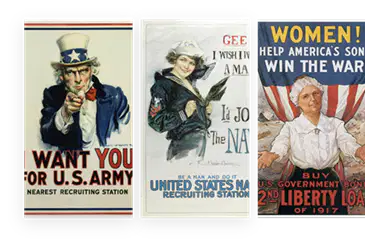
What do the following images primarily represent?
Military tactics
Historical events
Propaganda
Cultural symbols
How did World War I change society?
Factories switched to producing war equipment.
The economy experienced a boom.
Social equality increased.
he education system was reformed.
What were two significant events that led to the U.S. entry into World War I?
The sinking of the Lusitania and the Zimmerman Telegram
The Battle of Verdun and the Treaty of Versailles
The Russian Revolution and the Treaty of Brest-Litovsk
The Treaty of Portsmouth and the assassination of Archduke Franz Ferdinand.
What was the Zimmerman Telegram?
A diplomatic note from the United States to Germany demanding the cessation of unrestricted submarine warfare.
A communication between France and Britain discussing their war strategies
A message from Russia to Germany proposing a ceasefire.
A secret telegram sent by Germany to Mexico in 1917, proposing a military alliance against the United States.
Which event in Germany during World War I indirectly led to Germany's surrender and the end of the war?
The signing of the Treaty of Versailles
The Russian Revolution
The German Revolution
The signing of the Armistice of Compiegne
What happened when the German Emperor, Wilhelm II, was forced to quit?
Germany declared war on the United States
The Weimar Republic was established
The German Empire expanded its territory
The Treaty of Versailles was signed
Which treaty placed blame on Germany, demanded reparations, and limited its military?
Treaty of Brest-Litovsk
Treaty of Trianon
Treaty of Versailles
Treaty of Saint-Germain
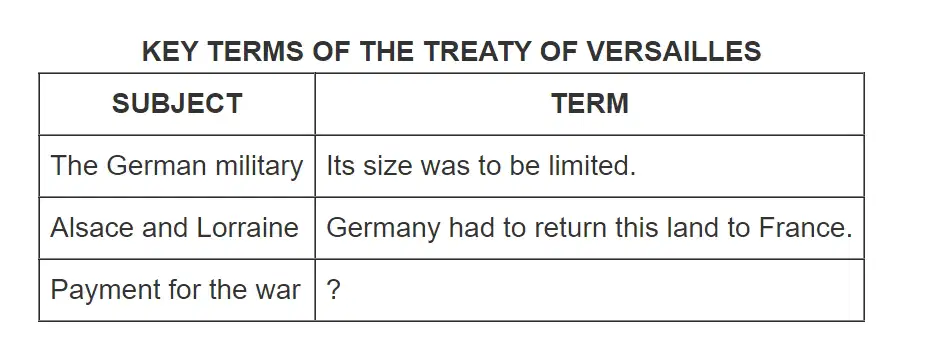
Choose the answer to complete the table listing terms of the Treaty of Versailles
France was forced to pay for the war.
All sides were forced to pay equally
Germany was forced to pay for the war.
No one need to pay for the war
What was a cause of the February Revolution in Russia?
Successes on the Eastern Front
Economic hardship and food shortages
Industrial prosperity
Increased political freedoms
What sparked the February Revolution in Russia?
Successful military campaigns
Industrial growth
Increased political reforms
Protests in Petrograd led by women textile workers due to food shortages and World War I
What were the demands of the protesters during the February Revolution in Russia?
Greater military funding
Economic sanctions
Political reforms and an end to food shortages
Bread, an end to World War I, and the Tsar's abdication
Who established the Provisional Government in Russia during the February Revolution?
The Tsar
The Bolsheviks
Members of the Duma (Russian parliament)
The military
After the February Revolution in Russia, which party became increasingly popular among urban workers and soldiers?
The Mensheviks
The Socialist Revolutionaries
The Bolsheviks
The Constitutional Democrats (Kadets)
Under whose leadership did the Bolshevik Party seek to overthrow the Provisional Government?
Vladimir Lenin
Leon Trotsky
Joseph Stalin
Alexander Kerensky
What did the Bolsheviks promise when they established a Soviet government?
Peace, land, and bread
Military conquest
Cultural reforms
Religious freedom
Which Revolution led to the Russian Civil War (1917-1923)?
February Revolution
October Revolution
December Revolution
January Revolution
Formation of the USSR in 1922 brought together which countries?
Russia
Ukraine
Belarus
All of the above
After Lenin died in 1924, who eventually took over?
Leon Trotsky
Joseph Stalin
Nikita Khrushchev
Mikhail Gorbachev
During the Soviet Union’s Great Purge (1936-1938), under whose leadership did the country's regime kill millions and send many to labor camps to eliminate threats?
Leon Trotsky
Joseph Stalin
Vladimir Lenin
Nikita Khrushchev

