
Font size
 Worksheets
Writing Improvement Test
Total questions: 18
Worksheet time: 1hrs 5mins
ACADEMIC READING: Multiple Choice (More than one Answer).
Clearly, when older people do heavy physical work, their age may affect their productivity. But other skills may increase with age, including many that are crucial for good management, such as an ability to handle people diplomatically, to run a meeting or to spot a problem before it blows up. Peter Hicks, who co-ordinates OECD work on the policy implications of ageing, says that plenty of research suggests older people are paid more because they are worth more.
And the virtues of the young may be exaggerated. ‘The few companies that have kept on older workers find they have good judgement and their productivity is good,’ says Peter Peterson, author of a recent book on the impact of ageing. ‘Besides, their education standards are much better than those of today’s young high-school graduates.’ Companies may say that older workers are not worth training because they are reaching the end of their working lives; in fact, young people tend to switch jobs so frequently that they offer the worst returns on training. The median age for employer-driven training is the late 40s and early 50s, and this training goes mainly to managers.
1) Choose TWO letters, A-G.
The list below gives some of the advantages of employing older workers. Which TWO advantages are mentioned by the writer of the text?
They are less likely to be involved in careless accidents.
They can predict areas that may cause trouble in the future.
They are able to train younger workers.
They can deal with unexpected problems.
They are more skilled in personal relationships.
ACADEMIC READING: Multiple Choice (More than one Answer).
Clearly, when older people do heavy physical work, their age may affect their productivity. But other skills may increase with age, including many that are crucial for good management, such as an ability to handle people diplomatically, to run a meeting or to spot a problem before it blows up. Peter Hicks, who co-ordinates OECD work on the policy implications of ageing, says that plenty of research suggests older people are paid more because they are worth more.
And the virtues of the young may be exaggerated. ‘The few companies that have kept on older workers find they have good judgement and their productivity is good,’ says Peter Peterson, author of a recent book on the impact of ageing. ‘Besides, their education standards are much better than those of today’s young high-school graduates.’ Companies may say that older workers are not worth training because they are reaching the end of their working lives; in fact, young people tend to switch jobs so frequently that they offer the worst returns on training. The median age for employer-driven training is the late 40s and early 50s, and this training goes mainly to managers.
2) Choose TWO letters, A-F.
The list below gives some of the disadvantages of employing younger workers. Which TWO disadvantages are mentioned by the writer of the text?
They are too confident of their own skills.
They may injure themselves.
They do not stay with the same company for very long.
Their training has been too theoretical.
They are not as well educated as older workers.
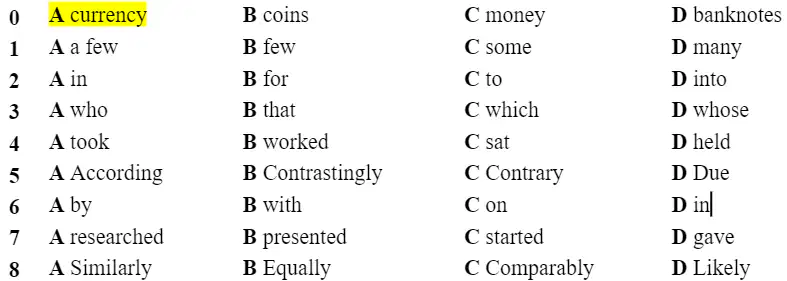
USE OF ENGLISH: Multiple Choice Cloze.
For questions 1-8, read the text below and WRITE which answer (А, В, C or D) best fits each gap.
Example: 0 A Currency
The Dollar Presidents
As most of us know, national 0______ of the US bears portraits of its presidents from various eras. However, 1______ people are aware that some of these historic figures, great as they were, had never been presidents! It is now time for us to go back 2______ the past and find out.
Alexander Hamilton, 3______ face we see on the $10 bill, 4______ a number of important positions. At different periods of US, history he had been a scholar of legal studies, a politician, a statesman, even a military commander. More importantly, he was one of the Founding Fathers of the US. 5______ to popular belief though he was not a president.
Benjamin Franklin, the gentleman adorning one-hundred dollar note, was a man gifted 6______ many different fields. Equally skilled in sciences, politics and social activism, he also 7______ birth to multiple inventions such as bifocals and lightning rod. 8______ to Hamilton, Franklin too was a Founding Father.
USE OF ENGLISH: Key Word Transformation
For questions 1-5, complete the second sentence so that it has a similar meaning to the first sentence, using the word given. DO NOT CHANGE THE WORD GIVEN. You must use between two and five words, including the word given.
1. We went to the same college and that’s why we became good friends. (IF)
I wouldn’t have become good friends with him (a) to the same college.
USE OF ENGLISH: Key Word Transformation
For questions 1-5, complete the second sentence so that it has a similar meaning to the first sentence, using the word given. DO NOT CHANGE THE WORD GIVEN. You must use between two and five words, including the word given.
2. “I can lend you some money if you like” Josh said. (OFFERED)
Josh (a) some money.
USE OF ENGLISH: Key Word Transformation
For questions 1-5, complete the second sentence so that it has a similar meaning to the first sentence, using the word given. DO NOT CHANGE THE WORD GIVEN. You must use between two and five words, including the word given.
3. My shyness makes it difficult for me to meet new people. (PREVENTS)
My shyness (a) new people easily.
USE OF ENGLISH: Key Word Transformation
For questions 1-5, complete the second sentence so that it has a similar meaning to the first sentence, using the word given. DO NOT CHANGE THE WORD GIVEN. You must use between two and five words, including the word given.
4. “Did you see the memo from yesterday?” my boss asked me. (I)
My boss asked (a) the memo from the day before.
USE OF ENGLISH: Key Word Transformation
For questions 1-5, complete the second sentence so that it has a similar meaning to the first sentence, using the word given. DO NOT CHANGE THE WORD GIVEN. You must use between two and five words, including the word given.
5. We all have a lot of respect for our coach. (LOOK)
We all (a) our coach.
USE OF ENGLISH: Word Formation
Read the text about Mahatma Ghandi. Use the words in brackets to form a new word that fits into each gap. There is an example at the beginning (0).
MAHATMA GANDHI - THE GREAT SOUL
Mohandas Karamchand Gandhi, known as "Mahatma" (Great Soul), was 0. LEADER (LEAD) of the Indian nationalist 1. ___________________ (MOVE) against British rule. He is regarded as the father of the Indian nation. Gandhi is well-known for his doctrine of non-violent 2.___________________ (RESIST) and civil 3.___________________ (OBEDIENT) in order to reach political and social progress.
Loved and respected by the whole world as one of the great human rights 4.___________________ (ACTIVE), he did not really match the hero cliché, because he was thin and poor-looking in his simple white robes. But Gandhi proved that fine clothing and status symbols were not important if you wanted to achieve your goals.
After growing up in western India, 13-year-old Mohandas was married to a 14-year-old girl, Kasturbai Makhanji, in an 5.___________________ (ARRANGE) child marriage. This was the tradition that almost all Indian families followed.
After university, he went to London to train as a barrister. In 1893, he accepted a job at an Indian law firm in Durban, South Africa, where he stayed for 20 years. Gandhi was shocked by the 6.___________________ (TREAT) of Indian immigrants there. He joined the struggle for basic rights and was imprisoned several times. In 1906, Gandhi developed his famous philosophy of satyagraha (“devotion to truth”), a new nonviolent way of 7.___________________ (PROTEST).
After his return to India in 1915, he became an influentialfigure in Indian politics. His program of peaceful non-cooperation with the British included boycotts of British goods and institutions, 8.___________________ (LEAD) to the arrests of himself and thousands of co-protesters.
Open the following link to continue with the listening section.
Complete just the first FIVE exercises. Remember to be honest with yourself.
You will have in total 10 minutes to develop this part.
Is it clear?
YES
NO
You will hear people talking in five different situations. For questions 1-5, choose the best answer (A, В or C).
1. You hear two friends talking about attending a motor-racing event. They agree that the best thing about it was…
A the race.
В the facilities.
C the atmosphere.
You will hear people talking in five different situations. For questions 1-5, choose the best answer (A, В or C).
2. You hear a football coach talking about a match. He thinks that the team lost because…
A they lacked concentration.
В they hadn’t practised enough.
C they weren’t very fit.
You will hear people talking in five different situations. For questions 1-5, choose the best answer (A, В or C).
3. You hear two people talking about a computer game. Why does the boy dislike it?
A It’s boring
В It’s expensive
C It’s complicated
You will hear people talking in five different situations. For questions 1-5, choose the best answer (A, В or C).
4. You hear a woman talking about judging a poetry competition. What surprised her?
A how nature was seen in the poems
В how many poems some people wrote
C how humorous the poems were
You will hear people talking in five different situations. For questions 1-5, choose the best answer (A, В or C).
5. You hear a young man talking about travelling alone for the first time. How did his parents react to the idea?
A They were helpful
В They were worried
C They were angry
WRITING SECTION:
Write an Essay using the following prompt. Remember to write between 140 - 190 words. Do not use contractions, idioms, or informal phrasal verbs.
Your teacher has asked you to write your response to the following statement taken from a recent newspaper article:
Is it better to be the oldest or the youngest in a family?
Write about:
1. Parents
2. Role of older sibling
3. ………………(your own idea)
You have 15 minutes to complete this task.
Answer the following questions based on your personal information (around 2min):
1. What is your name?
2. Where are you from?
3. What do you like about living in Quito?
4. Do you normally go out with your family or friends?
5. Can you remember your first English lessons?
Answer the following questions based on your personal information (around 2min):
6. What is the most important thing that you’ve learned at school?
7. Where do you go when you have to study? (Why do you like to study there?)
8. Is there something new you’d really like to learn about? (Why?)

