
 Worksheets
Heat Transfer Basics
Total questions: 20
Worksheet time: 16mins
What is conduction?
Conduction is the transfer of heat through convection
Conduction is the transfer of heat through radiation
Conduction is the transfer of heat through a vacuum
Conduction is the transfer of heat through a material without any movement of the material itself.
Give an example of conduction.
Wooden stick placed in a cold glass of water
Metal spoon placed in a hot cup of coffee
Plastic straw in a lukewarm drink
Rubber band stretched over a pencil
Provide an example of convection.
Boiling water in a pot
Lightning during a storm
Circulation of warm air rising and cool air sinking
A car engine running
Give an example of radiation.
Microwaves from a microwave oven
Ultraviolet light from the sun
X-rays from a medical imaging machine
Infrared radiation from a heater
How does heat transfer occur?
Heat transfer occurs through conduction, convection, and radiation.
Heat transfer occurs through absorption, reflection, and emission.
Heat transfer occurs through evaporation, sublimation, and deposition.
Heat transfer occurs through compression, expansion, and condensation.
What are the three methods of heat transfer?
Reflection, absorption, transmission
Evaporation, sublimation, deposition
Diffusion, osmosis, filtration
Conduction, convection, and radiation
How is heat transferred through conduction?
Direct contact between particles in a material
Heat transferred through reflection
Heat transferred through convection
Heat transferred through radiation
How does radiation differ from conduction and convection?
Radiation only occurs in liquids.
Radiation requires direct contact between objects.
Radiation does not require a medium to transfer heat.
Radiation is slower than conduction and convection.
What are some common applications of heat transfer in everyday life?
Boiling eggs, melting ice, drying hair
Baking, freezing food, lighting candles
Cooking, boiling water, heating rooms, cooling drinks, ironing clothes
Heating cars, cooling laptops, warming blankets
What is the role of insulation in preventing heat loss?
Insulation has no effect on preventing heat loss.
Insulation reduces heat transfer by trapping air pockets.
Insulation absorbs heat and releases it slowly.
Insulation increases heat transfer by conducting heat efficiently.
How does heat transfer impact climate change?
Heat transfer leads to cooling of the Earth's atmosphere
Heat transfer impacts climate change by influencing the distribution of energy in the Earth's atmosphere and oceans, leading to global warming and its associated effects.
Climate change is solely caused by natural factors
Heat transfer has no impact on climate change
Do sea breezes typically happen during the day or night?
Day
Night
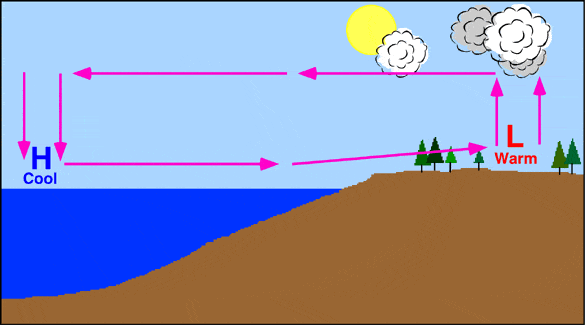

The top floor of your house always seem to have a higher temperature than the 1st floor. What heat transfer method is responsible for this process?
radiation
convection
conduction
condensation
what are the correct precautions to be taken while using a clinical thermometer?
thermometer should be washed before and after use
we should hold the thermometer by the bulb while reading it
we should make sure that it does not hit any hard object because it can break
ensure that before use the mercury level is above 36 degree C.
A clinical thermometer read temperature from____________
35°C to 42°C
10°C to 110°C
42°C to 35°C
Temperature is measured by a device called ____________
Stick
Thermometer
Clinical thermometer
Laboratory thermometer

