
NEW
Font size
 Worksheets
FECsum_Midterm Quiz 1
Total questions: 40
Worksheet time: 40mins
Who is known for experimenting with mechanical resistance and developing Coulomb's Law for electrostatic charges?
Michael Faraday
Alessandro Volta
Luigi Galvani
Charles Coulomb
Which scientist demonstrated that electricity affects magnetism and initiated the study of electromagnetism?
Hans Christian Oersted
James Clerk Maxwell
Andre Ampere
Georg Simon Ohm
Who invented the battery and was very interested in electrical experiments in the late 1700s?
Michael Faraday
Alessandro Volta
William Gilbert
Luigi Galvani
Which scientist discovered X-rays in 1895?
Wilhelm Röntgen
Thomas Alva Edison
Guglielmo Marconi
Nikola Tesla
Who invented the Audion tube, the first triode vacuum tube?
Lee De Forest
Harold Stephen Black
Walter Schottky
Edwin Howard Armstrong
Which scientist developed a theory of quantum surface states of electrons that led to the invention of the junction transistor?
William Bradford Shockley
Walter H. Brattain
Phil Taylor Farnsworth
John Bardeen
Who wrote the 'Treatise on Electricity and Magnetism' in 1873?
Heinrich Rudolph Hertz
Gustav Robert Kirchhoff
James Clerk Maxwell
James Prescott Joule
Which inventor and engineer invented AC generators, distribution systems, and AC induction motors?
John Ambrose Fleming
Guglielmo Marconi
Phil Taylor Farnsworth
Nikola Tesla
Who demonstrated the electromagnetic radiation predicted by Maxwell and was the first to demonstrate the photoelectric effect?
Wilhelm Röntgen
Heinrich Rudolph Hertz
Michael Faraday
Thomas Alva Edison
Which scientist invented regenerative feedback and electronic oscillators, and patented FM radio in 1933?
Philo Taylor Farnsworth
Harold Stephen Black
Walter H. Brattain
Edwin Howard Armstrong
A diode allows the flow of current in only one direction
TRUE
FALSE
The ____________ in the diode contains excess electrons
P-TYPE
N-TYPE
DEPLETION REGION
During forward biasing, the resistance across the diode is __________.
HIGH
LOW
During reverse biasing, the resistance across the diode is __________.
HIGH
LOW
During forward biasing, the cathode of the diode is connected to the _ terminal of the voltage source.
+
-
During reverse biasing, current cannot flow freely through the diode.
TRUE
FALSE
What is the junction between the p-type and n-type regions of a diode called?
Depletion zone
Conduction band
Valence band
Energy gap
The unit for inductance is ___________
Ohm
Henry
Farad
Ampere
Which of the following is not an expression for power?
P=VI
P=I2R
P=V2/R
P=I/R
The resistance of a 100 W, 200 V lamp is
100 ohm
200 ohm
400 ohm
1600 ohm
According to Kirchhoff’s voltage law,
The algebraic sum of all the e.m.f.s in the circuit is zero
Algebraic sum of all the voltage drops in the circuit is zero
Algebraic sum of e.m.f.s plus algebraic sum of voltage drops is equal to zero
All of these
The S.I. unit of power is
Henry
Coulomb
Watt
Watt-hour
Which is the best conductor of electricity?
Iron
Silver
Copper
Carbon
A closed switch has a resistance of
zero
about 50 ohms
about 500 ohms
infinity

Identify this type of bias.
Forward Biased
Reverse Biased
Forward-Reverse Biased
Reverse-Forward Biased

Please indicate whether the diode in each circuit is in forward or reverse bias.
Forward bias
Reverse bias

Please indicate whether the diode in each circuit is in forward or reverse bias.
Forward bias
Reverse bias

Please indicate whether the diode in
each circuit is in forward or reverse bias.
Forward bias
Reverse bias

Please indicate whether the diode in the circuit is in forward or reverse bias.
Forward bias
Reverse bias

Please indicate whether the diode in
each circuit is in forward or reverse bias.
Forward bias
Reverse bias
It is a type of wave-shaping circuit that doesn't alter the waveform's shape.
rectifier
clipper
clamper
bridge circuit
A diode bridge contains how many diodes?
1
2
3
4
It is a type of diode that can be used in the reverse bias condition.
LED
Zener diode
Gunn diode
Silicon diode
What is the most common application of a Zener diode?
amplifier
rectifier
voltage regulator
charger
Which of the following elements are required to construct a basic clipper circuit?
1. Resistor
2. Diode
3. Capacitor
4. Inductor
1, 2, and 3
1, 2, 3, and 4
1 and 2
2, 3, and 4
In which of the following types of clippers is an additional DC component added?
Series Unbiased clipper
Shunt Unbiased clipper
Series biased clipper
Both (a) and (b)
Which of the following is an operation of clippers?
Generates new waves
Acts as a half-wave rectifier
Acts as voltage limiters
All of the above
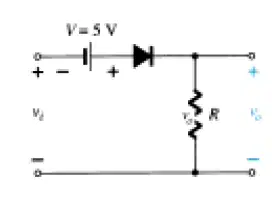
What is the circuit in the given diagram called?
Clipper
Clamper
Half-wave rectifier
Full-wave rectifier
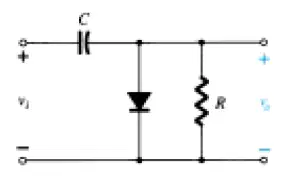
What is the circuit in the given diagram called?
Clipper
Clamper
Half wave rectifier
Full wave rectifier
What type of diode circuit is used to clip off portions of signal voltages above or below certain levels?
clipper or limiter
clamper
voltage regulator
none of the above

