
 Worksheets
YEAR 8 SUMMER MATH REVISION BOOK
Total questions: 83
Worksheet time: 4hrs 9mins

Lauren spins the spinner with 8-equal sized sections one time. Drag the tiles to arrange the events in order from least likely to most likely.
spinning a 4 or 5
spinning a 6
spinning an even number
spinning a number greater than 5
A box contains 4 red pencils, 6 blue pencils, 5 black pencils, and 3 green pencils. The best description of the likelihood of selecting a blue pencil at random from the box is (a) .

Which of the following best describes the likelihood of the spinner landing on a number less than 6?
impossible
unlikely
equally likely
likely
certain

Joseph rolled a number cube 50 times. The table shows the cumulative results of each roll. What is the relative frequency of rolling a 4? Select all that apply.
0.18
509
67.7%
64
18%
During the first several rounds of a golfing league, Anthony made par or better on 32 out of 80 holes. Based on this relative frequency, how many pars or better could he be expected to make on the remaining 160 holes?
54 pars or better
60 pars or better
64 pars or better
70 pars or better

The table shows the number of tickets sold to different kinds of movies at a theater last month. The manager of the theater expects to sell 8,000 movie tickets next month. The theater earn $4.53 profit on each movie ticket. Based on last month's results, how much profit can the theater manager expect to earn from ticket sales to comedy movies next month?
(a)
Suppose a 4 is rolled on a number cube with sides numbered 1, 2, 3, 4, 5, and 6. Which outcomes(s) make up the complement of this event? Select all that apply.
rolling a 2
rolling a 3
rolling a 4
rolling a 5
rolling a 6
Suppose a 4 is rolled on a number cube with sides numbered 1, 2, 3, 4, 5, and 6. The complement of this event would be rolling a 1, 2, 3, 5, or 6. What is the probability of the complement, written as a fraction in simplest form?
(a)

A deli offers the types of bread and sandwiches show in the table. How many possible outcomes are there?
(a)
A box contains red markers, blue markers, and green markers. There are more blue markers than green markers. The probability of randomly selecting a green marker from the box is 51. What is a possible probability that a randomly selected marker from the box is blue?
41
51
61
71
If you toss a coin 10 times and get tails each time, which of the following is true?
The probability of getting a tail on the next toss is more than 21.
The probability of getting a head on the next toss is more than 21.
The probability of getting a head on the next toss is 21.
The probability of getting a tail on the next toss is greater than the probability of getting a head.

A fair spinner with sections 1 through 5 is spun 50 times. The results are shown in the table. Which section's experimental probability (relative frequency) comes closest to it's theoretical probability?
Section 1
Section 2
Section 3
Section 4
Section 5

Papa Johns wants to determine how often it delivers to three different areas of Twinsburg. The table shows the areas from a random sample of 80 deliveries. Based on this data, if the driver makes 200 deliveries, how many will be to the southern area of Twinsburg?
35
55
80
110

Julie created a weighted number generator that produces the integers 0 to 4. She then runs the generator 500 times. The results are shown in the table. If Julie runs the generator a total off 4,000 times, which is the closest to the expected number of times the integer 1 is produced?
385
590
975
1225
For breakfast, the cafeteria offers 3 flavors of PopTarts - Strawberry, Blueberry, and Cherry - but the cafeteria worker picks a random flavor for you. Jayla wants to know the probability of receiving strawberry PopTarts on two consecutive mornings. Which sample space represents this situation?


A coin is flipped three times. What is the probability that the coin will land tails up once and heads up twice, if the order doesn't matter?
(Hint: Draw a tree diagram to help you.)
81
41
43
21
83
Probability ranges from 0 (impossible) to 1 (certain).
true
false

Hannah designs and conducts a computer simulation with 20 trials and uses the data to create the relative frequency bar graph shown. The graph shows the relative frequency of the number of rolls needed in order to roll all of the different numbers on a number cube. According to the results of the simulation, what is the experimental probability that 9 or more rolls are needed to roll all of the different numbers? Express your answer as a percent.
(a)
What is the unit to measure angles?
Kilometers
Centimeter
Meter
Degrees

Which angle is this woman forming through yoga?
Right Angle
Obtuse Angle
Acute Angle

Which angle is it forming in this picture?
Obtuse Angle
Acute Angle
Right Angle
Which geometrical instrument we use to measure angles?
Ruler
Compass
Divider
Protractor
Angle can be defined as the figure formed by two rays meeting at a common end point.
TRUE
FALSE
Obtuse angles are those angles which are less than 90 Degrees.
TRUE
FALSE
Which of these are types of angles?
Acute Angle
Obtuse Angle
Right Angle
Equal angle
What are Bearings in maths?
A bearing is an angle, measured clockwise from the north direction.
A bearing is an angle, measured counter - clockwise from the north direction.
A bearing is an angle, measured clockwise from the east direction.
A bearing is an angle, measured counter - clockwise from the east direction.
Any normal angle
How do you measure a bearing?
Mark North and use a protractor
Mark East and use a protractor
Mark North. Using a pair of compass, make a perpendicular bisector measuring 90 degrees. Make any two random bisectors and the point where they meet is the measure.
Mark East. Using a pair of compass, make a perpendicular bisector measuring 90 degrees. Make any two random bisectors and the point where they meet is the measure.
What is the measure of the angle with a Bearing of 45 degrees?
315 degrees counter - clockwise
45 degrees clockwise
135 degrees clockwise
45 degrees counter - clockwise
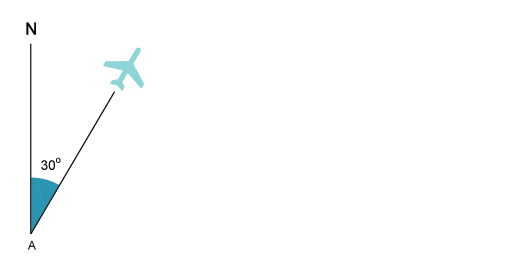
the correct bearing?

Write the bearings of A from O
125
055
035
305

Choose the correct true bearing
75
255
195
075

Choose the correct true bearing
62
062
332
152

what is the true bearing of A from B
50
050
140
320
What is the correct notation of a Bearing measuring Fifty degrees
050 degrees
50 degrees clockwise
50 degrees
5.0 into 10 raised to 1 degrees
050 degrees clockwise
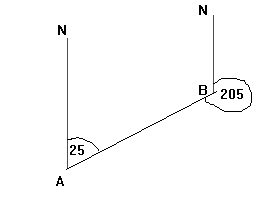

Find the bearing of A from B
250o
110o
290o
070o

Find the bearing of A from B
135o
315o
045o
45o

Find the bearing of A from B
130o
050o
230o
290o

Describe the rule for this sequence
5, 12, 19, 26......
Add five each time
Add seven each time
Subtract seven each time
Add 8 each time
Describe the rule for this sequence
2, 4, 8, 16
add 8 each time
add 4 each time
add 2 each time
Double the previous term
What is the missing term in this sequence
4, ....., 8, 10
5
6
7
8
Fill in the missing term in this sequence
2, 5, ......, 11
5
6
7
8
Find the next term in this sequence
6, 8,12,18.....
20
22
26
24
What is the nth term rule for the following sequence
5, 8, 11, 14.....
3n
3n + 2
3n - 2
5n + 3
What is the nth term rule of this sequence
9, 13, 17, 21....
4n + 5
9n
5n + 4
5n
The nth term of a sequence is 4n + 1.
What are the first 4 terms of the sequence
4, 8, 12, 16
5, 9, 13, 17
5, 6, 7, 8
4, 5, 6, 7
The nth term of a sequence is 3n + 5.
What are the first 4 terms of the sequence
8, 11, 14, 17
8, 13, 18, 23
3, 6, 9, 12
5, 10, 15, 20
The nth term of a sequence is 2n - 1.
What are the first 4 terms of the sequence
2, 4, 6, 8
1, 2, 3, 4
1, 3, 5, 7
2, 5, 7, 9
What is surface area?
The distance around the outside of a two-dimensional figure
The number of square units in a two-dimensional figure
The number of cubic units needed to fill a three-dimensional figure.
The sum of the areas of all surfaces on a three-dimensional figure
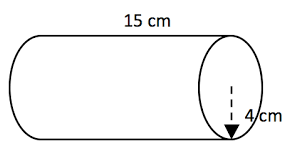
Find the Total Surface area of the cylinder. Round to the nearest tenth.
62.8m
477.3 cm2
235.5 cm3
942.0 cm2
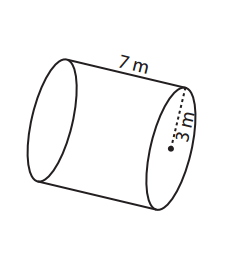
Find the total surface area of the cylinder. Round to the nearest tenth.
60.4 m2
188.4 m2
94.2 m2
881.9 m2
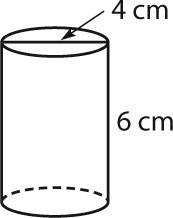
Find the total surface area of the cylinder.
Don't forget to divide the diameter by 2 to get the radius. Round to the nearest tenth.
25.13 square cm
75.40 square cm
50.27 square cm
100.53 square cm
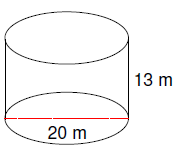
Find the surface area of the figure. Don't forget to divide the diameter by 2 to find the radius. Round to the nearest tenth.
628.3 m2
1445.1 m2
1245 m2
816.8 m2

Find the LATERAL surface area of the cylinder.
471.24 square centimeters
157.08 square centimeters
314.16 square centimeters
296.72 square centimeters
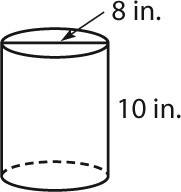
Find the LATERAL surface area of the cylinder. Don't forget to divide the diameter by 2 to get the radius. Round to the nearest hundredth.
100.53 square inches
351.86 square inches
251.33 square inches
50.27 square inches
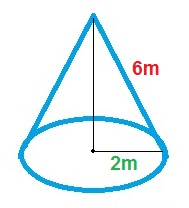
Find the total surface area of the cone. Round to the nearest tenth.
37.7 m²
50.3 m²
75.4 m²
25.1 m²
Find the total surface area of a cone with a radius of 7 inches and a slant height of 11 inches. Round to the nearest tenth.
259.7 in2
241.9 in2
153.9 in2
395.8 in2

Find the total surface area of this figure.
Round to the nearest hundredth.
84.44 sq in
25.25 sq in
104.62 sq in
56.52 sq in
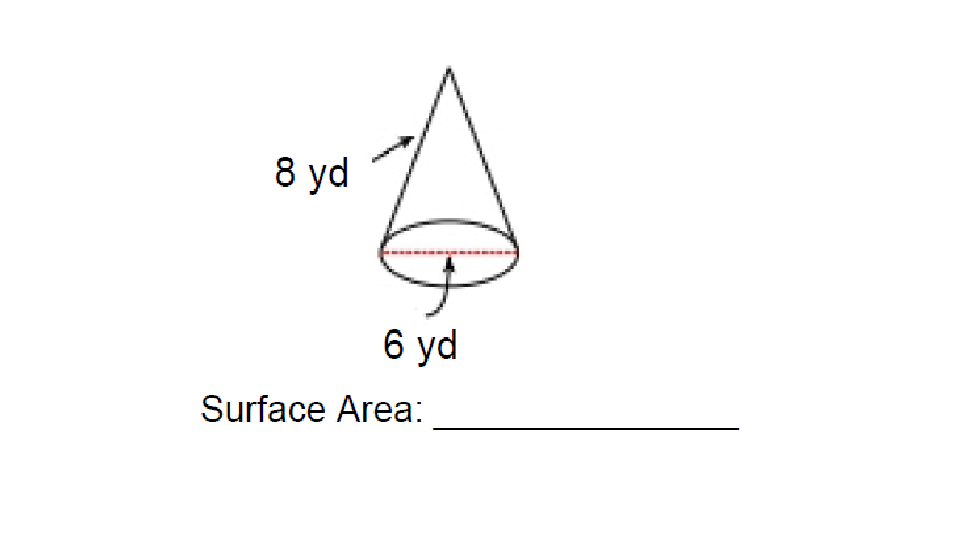
Find the total surface area of the cone. Don't forget to divide the diameter by 2 to find the radius. Round to the nearest tenth.
103.7 yd²
263.9 yd²
75.4 yd²
150.8 yd²
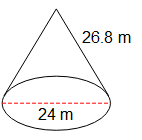
Find the total surface area of the cone. Don't forget to divide the diameter by 2 to find the radius. Round to the nearest tenth.
1158.5 sq. m
1287.2 sq. m
1007.9 sq. m
1462 sq. m

Find the LATERAL surface area of the cone. Round to the nearest tenth.
252.6 sq. cm
217.6 sq. cm
365.7 sq. cm
435.2 sq. cm
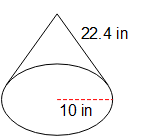
Find the LATERAL surface area of the cone.
1180.7 sq. in
703.7 sq. in
1017.4 sq. in
2597.5 sq. in
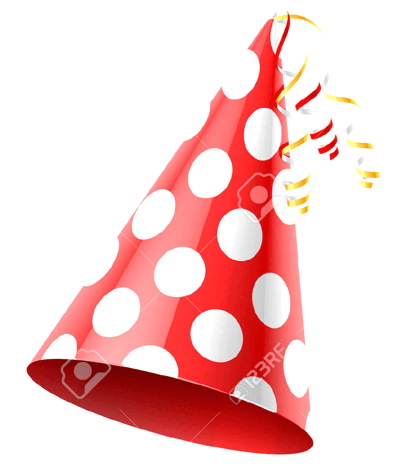
A paper party hat, like the one shown, has a slant height of 6 inches and a radius of 5 inches. How many square inches of cardboard would be needed to create this hat?
94.3 in.2
172.8 in.2
50 in.2
22.5 in.2
The ratio in a right triangle of adjacent to hypotenuse is _____
sine
cosine
tangent
hypotenuse
What is the ratio for Sine?
Hypotenuse/Opposite
Opposite/Hypotenuse
Opposite/Adjacent
Adjacent/Opposite
What is the ratio for Tangent
Opposite/Adjacent
Adjacent/Opposite
Opposite/Hypotenuse
Hypotenuse/Opposite
What is the ratio for Cosine?
Opposite/Hypotenuse
Opposite/Adjacent
Adjacent/Opposite
Adjacent/Hypotenuse
If you are given the two sides that are NOT the hypotenuse, which trig function should you use?
sine
cosine
tangent
cotangent
The length across from the right angle in a triangle is called the ...........
cosine
tangent
hypotenuse
sine
If you are given the length of a hypotenuse and the length of an adjacent side, what trigonometry ratio could you use .
sine
cosine
tangent
trigonometry
The ratio of the length of the side opposite of the angle to the length of the hypotenuse is the _____________
Sine
Cosine
Tangent
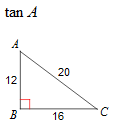
What is the correct ratio set up for finding the tangent of Angle A? Remember: Tangent = opposite/adjacent
20/12
12/20
12/16
16/12
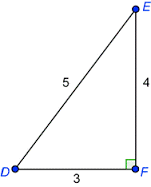
What is the opposite side to <D?
EF
DF
DE
What is the opposite side to <E?
EF
DF
DE
What is the adjacent side to <D?
EF
DF
DE

cos B = ? Remember: Cosine ratio is adjacent/hypotenuse
12/13
12/5
5/13
5/12

What is the green side labelled as using the starred angle as a starting point?
adjacent
opposite
hypotenuse

What is the green side labelled as from the starred angle?
adjacent
opposite
hypotenuse

From ∠C, what side is AB?
Adjacent
Hypotenuse
Opposite

