
 Worksheets
Section 9: Networking (14-20)
Total questions: 32
Worksheet time: 24mins
What are three requirements for Pod networking?
Every Pod should have a routing table
Every POD should have an IP Address.
Every POD should be able to communicate with every other POD on other nodes without NAT.
Every Pod should have a MAC address
Every POD should be able to communicate with every other POD in the same node.
What are three Pod networking solutions for Kubernetes?
OpenVNet
Flannel
Cilium
CoreDNS
VMware NSX
When containers are created, Kubernetes doesn't create network namespaces for them.
True
False
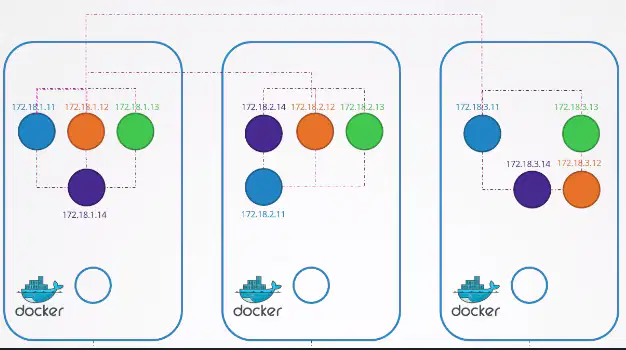
Imagine we have the topology of the attached picture.
In order to enable Pod networking, what components should be configured?
Create a veth for the network namespace and the bridge port
Create a routing table for each node
Create a bridge network on each node
Assign IPs to bridge networks
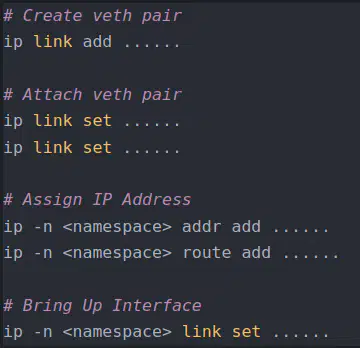
The attached image refers to:
Script to configure Pod networking
Script to configure host networking
Script to configure routing tables on each network namespace
Script to configure routing tables on each node
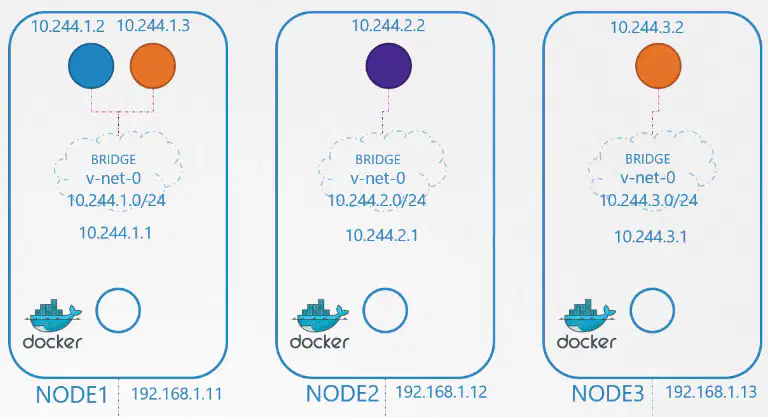
According to the attached image.
Add a route on the NODE1 in order to any Pod in any network namespace within it can reach the Purple Pod (10.244.2.2) on NODE2.
(a)
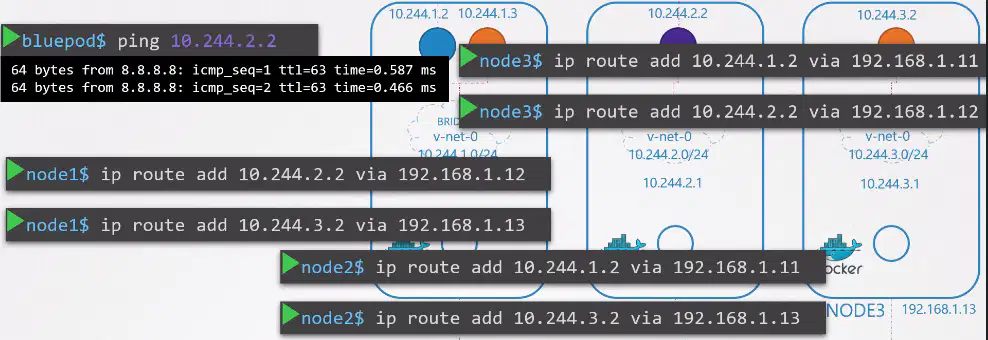
In the attached image is seen how routes are configured on each node to reach other node's Pods.
What's a better solution for route?
Configure a switch on the network
Use a network router
Use VMware NSX
Use any Pod networking solution
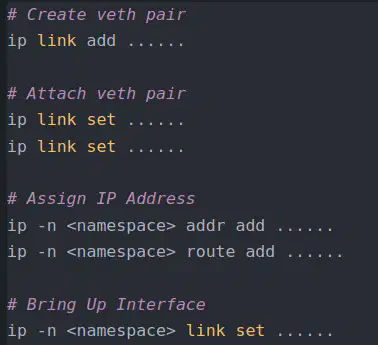
The script of the attached image configures each container in order to allow Pod networking configuration.
What parameters should be added to the script to meet the CNI standards to execute automatically the script every time new containers are created?
CNI)
ADD)
AUTO)
DEL)
DELETE)
The (a) on each node is responsible to create containers.
When a container is created, the container runtime looks at the CNI configuration passed to directory path (a) and identifies our script's name used to automatically configure Pod networking on our containers
The container runtime looks in the CNI bin directory (a) to find our script used to automatically configure Pod networking on our containers.
_____________ defines the responsabilities of container runtime.
Docker
CNI
Kubernetes
API Server
CRI
______________ is responsible for creating containers, network namespaces, identifying and attaching those namespaces to the right network by calling the right network plugin.
Docker
CNI
Kubernetes
API Server
Container Runtime
The CNI plugin is configured in the _______________
etcd server
Kube API Server
Kubelet service
controller-manager
What three options are set in the kubelet service to configure the CNI as the network plugin?
--cni-dir
--network-plugin
--cni-conf-path
--cni-bin-dir
--cni-conf-dir
Type the full command to see the current network plugin configuration in the current running processes:
(a)
What's the full path of the directory containing a file where we can see what's the current CNI plugin configured in the cluster?
Type the absolute path.
(a)
What's the CNI config directory.
Type the absolute path.
(a)
What's the full path where there is a file containing the list of all the supported CNI plugins?
Type the absolute path.
(a)
What is the CNI bin directory?
Type the absolute path.
(a)
What's the absolute path where there's a file that Kubelet looks to find out which plugin needs to be used?
Type the absolute path of the directory where's contained:
(a)
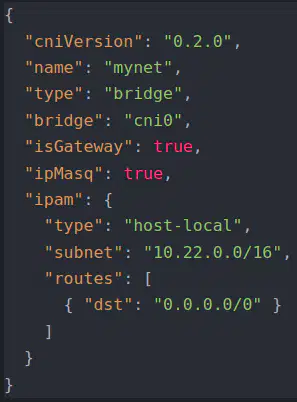
What does the content of the image refer to?
virtual network configuration
CNI main config
CNI plugin configuration
Bridge interface configuration
It's a software-defined networking (SDN) solution for containers that creates a virtual network that connects containers across multiple hosts
CoreDNS
CNI
Weaveworks
VMware NSX
How does Weaveworks do as network solution in order to each node to know about the other nodes, the other Pods in the other nodes, the other namespaces in the other nodes, etc?
It maps the cluster network with its own discovery protocol
It fetches data via SNMP
It deploys agents on each node
It received the information via IMAP
How does the Weaveworks agents do to know the Pods and the IPs on the other nodes?
It maps the cluster network with its own discovery protocol
It fetches data via SNMP
It deploys agents on each node
It received the information via IMAP
It stores a topology of the entire setup
Weave creates its own bridge on the nodes and assign the IP address to each network.
True
False
You cannot have a container attached to the Weave bridge as well as the Docker Bridge created by Docker.
True
False
Without Kubernetes to be configured, Weave and Weave Peers (agents) can be deployed as:
Daemon Sets
Pods
Containers
Services
If Kubernetes is setup already, Weave and Weave Peers (agents) can be deployed as:
Daemons
Pods
Containers
Services
Type the full command to deploy Weave in the cluster.
The source is: https://cloud.weave.works/k8s/net?k8s-version
(a)
Imagine we deployed our cluster with Kubeadm tool and Weave plugin.
Type the full command to list/see the Weave Peers.
(a)
You have the following information to check the logs for weave:
-Pod name: weave-net-5gcmb
-Container name: weave
(a)

