
 Worksheets
Finance Exam 2 Practice (FIN3403)
Total questions: 54
Worksheet time: 9hrs 0mins
How much money do you need to place into a bank account which pays a 6% annual rate in order to have $500 at the end of 7 years?
$332.53
$629.52
$751.82
$463.77
$333.17
How much money would you need to place in an account to have $1,000 10 years from today? Assume the account pays 8.5% and it is compounded monthly. Round to the nearest $1.
$893
$833
$429
$932
$442
Columbia Corporation deposited $2,000 in an account that pays 12% interest annually. If the interest is compounded continuously, how much money will be in the account at the end of 20 years?
$19,293
$22,046
$22,553
$22,704
$22,900
Which of the following provides the greatest annual return?
16% compounded quarterly
15% compounded continuously
15.2% compounded daily
16% compounded annually
If you borrow $25,000 from a local finance company and you are required to pay $4,424.50 per year for 10 years, what is the annual interest rate on the loan?
12%
18.9%
15.9%
13.6%
14.4%
How much do you have to deposit today so that you can withdraw $50,000 a year at the end of years 5 through 9, and $25,000 at the end of year 10? Assume that you can earn an annual rate of 8 percent.
$170,983
$146,591
$146,737
$158,318
$159,243
If you want to have $875 in 36 months, how much money must you put in a savings account today? Assume that the savings account pays 16% and it is compounded quarterly. Round to the nearest $1.
$213
$147
$543
$547
$746
You just purchased a parcel of land for $10,000. If you expect a 12 percent annual rate of return on your investment, how much will you sell the land for in 10 years?
$25,000
$31,058
$31,384
$34,310
$38,720
Amax Inc. deposited $2,000 in a bank account that pays 12% interest annually. How much money will be in the account after 4 years?
$2,525
$2,800
$3,111
$3,100
$3,147
Your grandmother deposited $100 in a savings account for you 25 years ago. The money has been earning an annual rate of 12% interest, compounded quarterly. How much money is now in the account?
$209
$4,165
$1,700
$5,051
$1,922
Suppose you invest $500 in a stock mutual fund at the end of each month. When you retire at the end of your 35-year career, your account is worth $4,000,000. What annual rate of return did you earn over the 35 years?
15.62%
24.13%
6.73%
12.81%
Your bank has agreed to loan you $3,000 if you agree to pay a single "lump sum" of $5,055 in five years. What annual rate of interest will you be paying?
13.2%
15%
11%
16.7%
9.9%
If your opportunity cost is 10%, how much are you willing to pay for an investment promising $750 at the end of years 1 through 4 and $450 at the end of years 5 through 10?
$2,800
$3,716
$3,850
$2,377
$4,337
Suppose you pay $41,625 for an annuity that will pay you $5,000 per year at the end of each of the next 15 years. What annual rate of return will you earn on this investment?
8.46%
9.18%
12%
11%
15.18%
Your firm is investing in a project. Because of the project, the firm will receive cash flows of $10,000 at the end of years 5, 6, 7, 8, 9, and 10. Using a 12% discount rate, what is the present value of this cash flow stream?
$41,114
$26,129
$8,602
$29,264
$23,329
Suppose you decided to place $2,500 in a savings account at First Foremost Savings and Loan. If the account pays 7% compounded continuously, how much money will you have in the account after 15 years?
$9,974
$2,728
$7,144
$6,898
$7,122
Calculate the present value of $1,200 received at the end of each year for 21 years? Use a discount rate of 10%.
$10,378
$162
$8,880
$76,803
$11,416
If you have $1,000 to deposit in a savings account for 1 year, which of the following should you choose?
8.75% compounded continuously
9% compounded quarterly
9.5% compounded annually
Your firm has an unusual investment opportunity that is expected to provide $45,000 two years from now, $25,000 four years from now, and $60,000 six years from now. If your firm's opportunity cost is 14%, what is the present value of these cash flows?
$76,763
$59,226
$49,428
$87,510
$67,336
You have an investment that will provide $1,000 at the end of each of the next 24 months and $1,500 at the end of each of the following 24 months (periods 25 through 48). If your opportunity cost of funds is 10%, how much would you pay for this investment (what is the present value)?
$48,307
$54,177
$32,506
$21,671
$10,353
Artek Corporation deposited $2,000 in a bank account that pays 12% interest annually. If the interest is compounded semiannually, how many compounding periods will it take for the deposit to grow to $6,798?
11
17
19
21
25
At 8% compounded annually, how long will it take $750 to double?
6.5 years
48 months
9 years
8 years
12 years
In 10 years you are planning to buy a mountain chalet. The chalet you want currently costs $100,000 and is expected to increase in value each year at a rate of 2.5 percent. If you can earn 10% annually on your investments, how much must you invest at the end of each of the next 10 years to be able to buy the chalet?
$6,275
$8,032
$5,704
$7,302
$20,833
You have just won a two-part lottery! The first part will pay you $50,000 at the end of each of the next 20 years. The second part will pay you $1,000 at the end of each month over the same 20 year period. Assuming a discount rate of 9%, what is the present value of your winnings?
$456,427
$465,556
$567,572
$474,935
$111,145
You have three choices of retirement plans (listed below). Assuming you can earn 8% interest, which one should you choose?
A) $1 million at the end of 20 years
B) $1,500 at the end of each month for 20 years
C) $23,000 at the end of each year for 20 years
A
B
C
How much money must you pay into an account at the beginning of each of the next 10 years to have $35,000 at the end of the tenth year? Assume that the account pays 12% per year.
$1,781
$1,994
$6,194
$5,531
$3,312
Eternal Life Insurance Company wants to sell you an investment policy that will pay you and your heirs $5,000 at the end of each year forever. The price of the policy is $72,000. Given your expertise with time value from Finance 3403, you are concerned that this price may not be fair. If you can earn 8% annually on your money, what would you consider to be a fair price for the policy?
$9,000
$62,500
$57,600
$72,000
$5,760
Having graduated from UCF with a degree in finance, you can now afford to buy a $120,000 house. Suppose you pay 20% as a down payment and finance the rest for 30 years at 8%. Assuming house payments occur at the end of each month, what will be the amount of your monthly payment?
$881
$64
$847
$2,901
$704
Your neighbor Bill, a liberal arts major who knows little about finance, has financed his college education with his Citibank Visa Card. Upon graduation, Bill’s credit card debt is $12,000. If Bill plans to pay off his debt with equal monthly payments for 5 years, and the annual interest rate on his Visa card is 18%, what will be Bill's monthly payment?
$125
$236
$2,160
$305
$267
Which type of risk cannot be eliminated by diversification?
Firm-Specific Risk
Financial Risk
Default Risk
Market Risk
Foreign Exchange Risk
You want to form a portfolio of stock A and stock B. Stock A has a beta of .85 and stock B has a beta of 1.6. If you invest $6,000 in stock A and $4,000 in stock B, what is the portfolio beta?
1.3
1.47
1.15
1.225
2.45

Given the following information, what is the standard deviation of stock A?
15.7%
15.7%
12%
26.4%
7%
Which of the following has a beta of zero?
The Market
Corporate Bonds
Risk-Free Asset
Diversified Stock Portfolio
All Securities
A stock's beta is a measure of its ________________.
Market Risk
Unsystematic Risk
Firm-Specific Risk
Standard Deviation
Total Risk
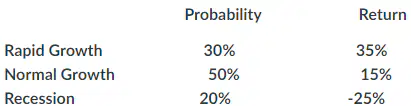
The following are your predictions of 3 possible states of the economy and estimated rates of return for NXS Corporation common stock. Given this information, what is the stock's expected return?
23.0%
22.5%
20.9%
13.0%
25.0%
According to the capital asset pricing model, the appropriate measure for risk is ________________.
Standard Deviation of a Firm's Cash Flows
Alpha
Standard Deviation of Returns
Frim-Specific Risk
Beta
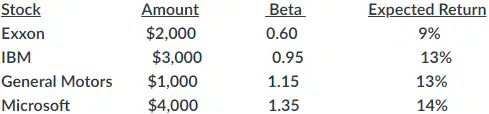
You decide to form a portfolio of the following amounts invested in the following stocks. What is the beta of the portfolio?
1.01
1.06
12.6
51.6
4.05
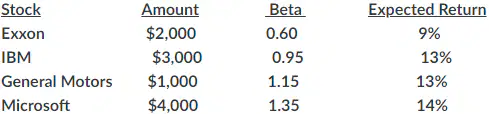
Which of the following statements best describes the stocks in the portfolio? The risk-free rate of interest is 6% and the market return is 13%.
Exxon is underpriced
IBM is underpriced
General Motors is underpriced
Microsoft is underpriced
You are considering buying stock in New England Bankshares Corporation. Which of the following are examples of risk that can be diversified away?
Risk resulting from an impending lawsuit against New England Bankshares.
Risk resulting from an increase in federal budget deficits.
Risk resulting from a strike by New England’s tellers.
Risk resulting from a possible increase in income taxes.
A corporate bond has a 13% coupon rate, pays interest semiannually, and matures in 15 years. The bond's par value is $1,000. If the investors' annual required rate of return is 10%, the intrinsic value of the bond should be:
$1,830
$1,220
$1,156
$2,230
$1,231
The Pennington Corporation issued new bonds 23 years ago. The bonds have a coupon rate of 12%, semi-annual payments, and were sold at their par value of $1,000. The 30-year bonds have 7 years remaining to maturity and the level of interest rates has declined. If the required rate of return for this bond is 10%, what is the intrinsic value of the bond?
$1,693
$1,058
$705
$1,189
$1,099

The following RJR Nabisco bond is listed in a recent issue of The Wall Street Journal:
This $1,000 par value bond has 4 years to maturity and makes semi-annual coupon interest payments. If your required rate of return is 9.5%, what would be the bond’s intrinsic value?
$973
$701
$951
$1,212
$1,310

For the RJR Nabisco bond, if you purchased the bond for the closing price, what is the bond's yield to maturity?
7.78%
15.57%
10.95%
3.82%
7.63%
Six years ago, James Corporation sold a $100 million bond issue to expand its facilities. Each debenture has a $1,000 par value, an original maturity of 20 years (there are now 14 years left to maturity), and an annual coupon rate of 11.5% with semiannual payments. If you require a 14% return, what price would you pay today for a James bond?
$826
$890
$848
$833
$868
You just won the lottery, which promises you $990,000 per year for the next 20 years. You receive the first payment today (hint: annuity due). If your discount rate is 9.75%, what is the present value of your winnings?
$9,654,166
$8,574,272
$9,897,833
$9,706,887
$9,410,263
You just paid $534 for a security that claims it will pay you $1,962 in 11 years. What is your annual rate of return?
(a)
What is the future value of an investment that pays $800 at the beginning of each year for 15 years? Use an annual interest rate of 9.50%.
$27,501
$24,988
$26,238
$24,432
$26,753
What is the present value of $8,002 payable at the end of 10 years? Use a nominal rate (monthly compounding) of 7.95%. What is the present value of $8,002 payable at the end of 10 years? Use a nominal rate (monthly compounding) of 7.95%.
(a)
What is the present value of an annuity that pays $58 per year for 13 years and an additional $1,000 with the final payment? Use a nominal rate of 7.23%.
$873
$990
$946
$882
$1,039
An investment will provide $1,000 at the end of each of the next 24 months and $1500 at the end of the following 24 months (25 to 48). If your opportunity cost is 10%, what is the present value of the investment?
$10,353
$48,307
$32,506
$54,177
$21,671
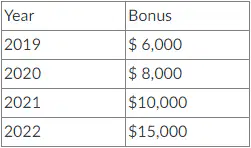
Your uncle has a job that paid him the following year-end cash bonuses shown in the table below. Since he was a finance major in college, he invested all the bonuses he received in a stock mutual fund that earns 10% per year. How much would he have in his mutual fund account at the end of 2030?
$70,325
$32,807
$29,825
$102,962
$93,602
Twenty years ago, Jill won a state lottery that paid $50,000 at the end of each year for the first 10 years, and $70,000 at the end of years 11 through year 20. A financial advisor recommended that Jill put all the winnings in an account earning 12% per year. How much will Jill have in the account at the end of year 30 i.e. 30 years from the day she won the lottery?
$3,953,597
$1,623,977
$409,857
$1,200,000
$12,279,272
You purchase a condominium for $125,000. The bank requires a 20% down payment. You borrow the remainder as a 30-year, 6.6% mortgage with monthly payments. What portion of the payments during the first 33 months goes toward principal?
16.65%
14.74%
15.17%
15.64%
15.59%
You just opened a brokerage account, depositing $4,500. You expect the account to earn an interest rate of 8.57%. You also plan on depositing $3,000 at the end of years 5 through 10. What will be the value of the account at the end of 20 years, assuming you earn your expected rate of return?
$74,108
$71,344
$80,026
$77,043
$76,207

