
NEW
Font size
S
M
L
XL
 Worksheets
Sound and Light Waves
Total questions: 18
Worksheet time: 9mins
Name
Class
Date
1.
Waves are a transfer of what?
a)
Heat
b)
Light
c)
Energy
d)
Food
2.
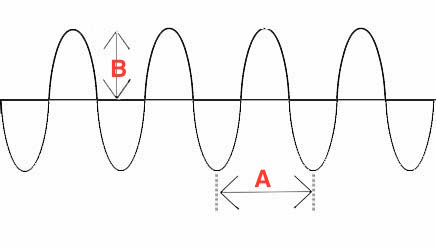
What property of this wave is represented by the letter "A"
a)
amplitude
b)
crest
c)
trough
d)
wavelength
3.
The highest point on a wave is:
a)
the crest
b)
the trough
c)
the top
d)
the coast
4.
The lowest point on a wave is the:
a)
Amplitude
b)
Crest
c)
Trough
d)
Wavelength
5.
The number of wavelengths that pass a point per second is:
a)
frequency
b)
period
c)
longitudinal
d)
transverse wave
6.
The type of waves that require medium to pass:
a)
Mechanical Waves
b)
Electromagnetic Waves
7.
When the frequency of a wave increases, what happens to the wavelength?
a)
The wavelength is not directly affected by the frequency of a wave.
b)
The wavelength increases.
c)
The wavelength decreases.
d)
More specific information is needed to form a conclusion about the wavelength.
8.
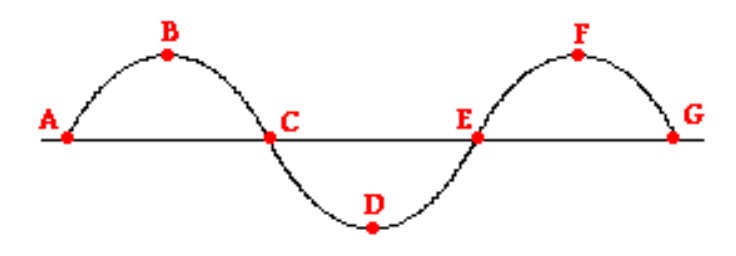
Which letter(s) represent the trough of the wave?
a)
A
b)
B & D
c)
D
d)
C & G
9.
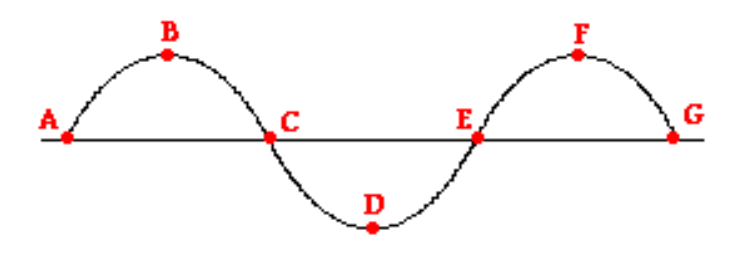
Which letter(s) represent the crest of the wave?
a)
A
b)
B & D
c)
B & F
d)
F
10.
Which letter marks the end of one complete wave that starts at A?
a)
C
b)
D
c)
E
d)
G
11.
Which of the following can sound travel through?
a)
solid
b)
liquid
c)
gas
d)
all of the above
12.
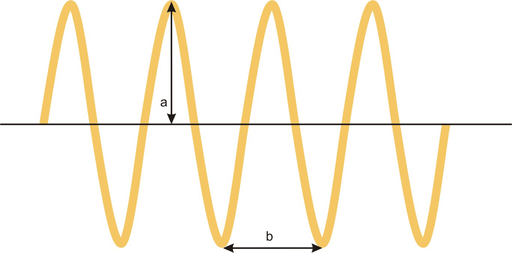
How many waves are in this wave chain?
a)
6
b)
3
c)
4
d)
5
13.
When I speak in a high-pitch voice, the sound waves have
a)
high amplitude
b)
low amplitude
c)
high frequency
d)
low frequency
14.
Frequency and Wavelength have inverse (opposite) relationships!
a)
True
b)
False
15.
Waves with a low frequency must have
a)
low amplitude
b)
long wavelength
c)
short wavelength
d)
low energy
16.

This is showing
a)
light absorption
b)
echolocation
c)
light refraction
d)
light reflection
17.
Light waves do NOT need a medium to travel.
a)
True
b)
False
18.
Sound waves DO need a medium to travel because
a)
sound waves always have high amplitude.
b)
sound can only travel through gas.
c)
sound can only travel through liquid.
d)
sound requires vibration.
Reset

