Wayground logo

Free Printable Worksheets

Font size

S
M
L
XL
Worksheets

North Island Rescue Lesson 2 Quiz Review

Total questions: 24

Worksheet time: 12mins

Name
Class
Date
1.
A brown mouse (Aa) is crossed with a white mouse (aa). What is the probability of the mouse having brown fur?
a)
25%
b)
50%
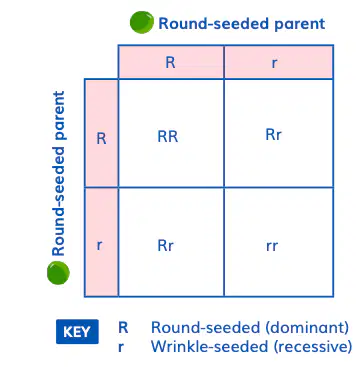
c)
75%
d)
100%
2.
A flowering shrub has two possible flower color traits: red and white. The dominant allele (R) codes for red flowers, the recessive allele (r) codes for white flowers. A heterozygous red- flowered shrub is cross-pollinated by a white-flowered shrub.Which Punnett square would you use to predict the probability of shrub offspring having red or white flowers?
a)
A
b)
B
c)
C
d)
D
3.
A flowering shrub has two possible flower color traits: red and white. The dominant allele (R) codes for red flowers, the recessive allele (r) codes for white flowers. A heterozygous red- flowered shrub is cross-pollinated by a white-flowered shrub.What is the probability that an offspring of the parent generation will have white flowers?
a)
0%
b)
25%
c)
50%
d)
75%
4.
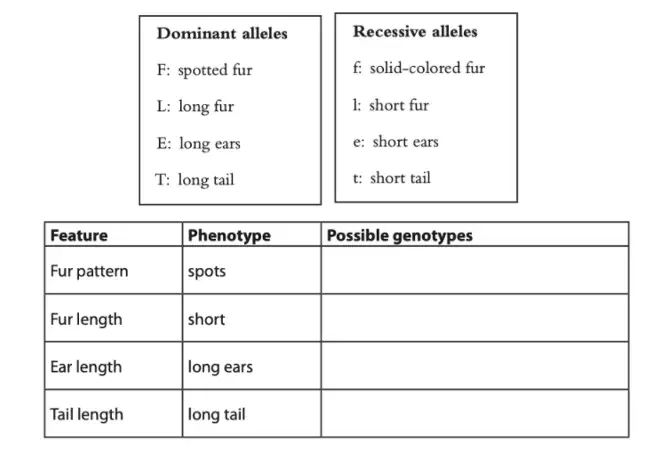
Use the information below. Two dogs mate and have puppies. Both parent dogs are heterozygous for spotted fur. What is the probability of puppies that will have solid colored fur?
a)
0%
b)
25%
c)
50%
d)
100%
5.

When 2 heterozygous parents are crossed, 75% of their offspring will have the dominant trait.

a)

True

b)

False

6.

When a homozygous dominant parent is crossed with any other genotype the offspring are guaranteed to have recessive traits.

a)

True

b)

False

7.

Recessive phenotypes are only expressed when an organism has two recessive alleles in the genotype

a)

True

b)

False

8.

The set of genes responsible for an organism's unique traits

a)

allele

b)

gene

c)

chromosome

d)

genotype

e)

phenotype

9.

Alternative forms of a gene which affect the expression of a particular trait

a)

allele

b)

gene

c)

chromosome

d)

genotype

e)

phenotype

10.

A DNA-containing coiled structure found in the nucleus of living cells that carries the genetic information in the form of genes

a)

allele

b)

gene

c)

chromosome

d)

genotype

e)

phenotype

11.

The physical traits of an organism, determined by the genotype

a)

allele

b)

gene

c)

chromosome

d)

genotype

e)

phenotype

12.

A unit of DNA that is located on a chromosome and determines which traits are inherited by an individual

a)

allele

b)

gene

c)

chromosome

d)

genotype

e)

phenotype

13.

aa

a)

heterozygous

b)

homozygous

14.

Rr

a)

heterozygous

b)

homozygous

15.

Ff

a)

heterozygous

b)

homozygous

16.

XX

a)

heterozygous

b)

homozygous

17.

Yy

a)

heterozygous

b)

homozygous

18.

DD

a)

heterozygous

b)

homozygous

19.
Gabriela has blue eyes and her parents have brown eyes. Based on this information, she develops the following Punnett square. How is it possible for her to have a different eye color than her parents?
a)
The blue eye color trait skipped a generation.
b)
She got her eye color from her mother’s DNA.
c)
Her eye color was affected by the environment.
d)
She received one blue allele from each parent.
20.
Gregor Mendel was an Austrian monk who studied heredity by doing experiments breeding pea plants with different features. In one experiment he found that the offspring of round-seeded parents produced a mixture of round-seeded and wrinkle-seeded offspring. How did he know that they had reproduced sexually and not asexually?
a)
The pea plants usually produced identical plants to the parents.
b)
Peas cannot reproduce sexually.
c)
The offspring were sometimes different than the parent plant.
d)
The wrinkliness of the seeds is determined by the amount of water the plants receive.
21.
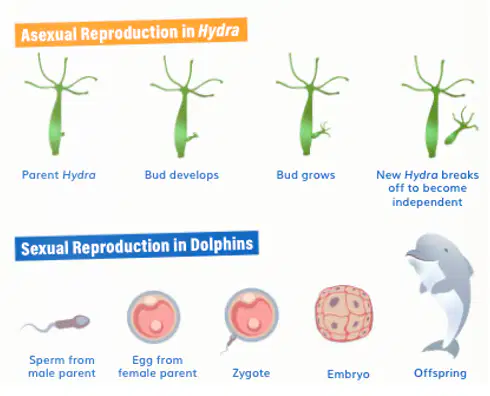
Zoologists are scientists who study the physical characteristics, behaviors, and interactions of animals-including reproduction. A team of zoologists is studying Hydra and dolphins. Hydra reproduces asexually, and dolphins reproduce sexually. The team developed models to compare the reproduction of the two organisms. Observe the models and decide which statement best describes how offspring produced by asexual reproduction compare to those produced by sexual reproduction.
a)
Sexual and asexual reproduction both produce offspring with genetic material identical to their parents.
b)
In sexual reproduction, offspring receive genetic material from two parents. In asexual reproduction, offspring receive offspring receive genetic material from one parent.
c)
In sexual reproduction, offspring receive genetic material from one parent. In asexual reproduction, offspring receive offspring receive genetic material from two parents.
d)
Sexual and asexual reproduction both produce offspring with genetic material different from their parents.
22.
Select the word to complete the sentence. In sexual reproduction, offspring receive DNA from __________________
a)
one parent
b)
both parents
23.
Select the word to complete the sentence. In asexual reproduction, the offspring's genetic material comes from ___________
a)
one parent
b)
both parents
24.
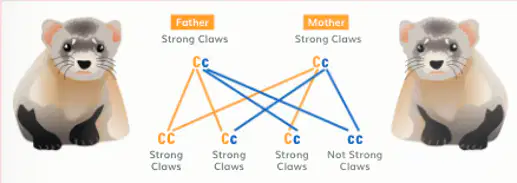
A group of scientists is working to increase a population of black-footed ferrets. The model shows how the gene determining claw strength is passed from parents to offspring through sexual reproduction. Use the model to select the statement that best describe why sexual reproduction results in offspring with genetic variation.
a)
The offspring receive both of the father's alleles, so the offspring will have all the same genes as the father.
b)
The offspring receive one allele from each parent, so the offspring won't have genes that are identical to either parent.
c)
The offspring can't have the same genetic information as either parent, so new genes are created.