
Font size
 Worksheets
Robotics I Unit 4 Test Review
Total questions: 15
Worksheet time: 10mins
What is an "if-then" block used for?
To repeat sections of the program flow.
To direct the program flow under certain conditions
To ensure that every line of the code runs
All of the above
An "if-then" condition that is not inside a loop is checked how many times?
0
1
as many times as it needs to
it depends on the program
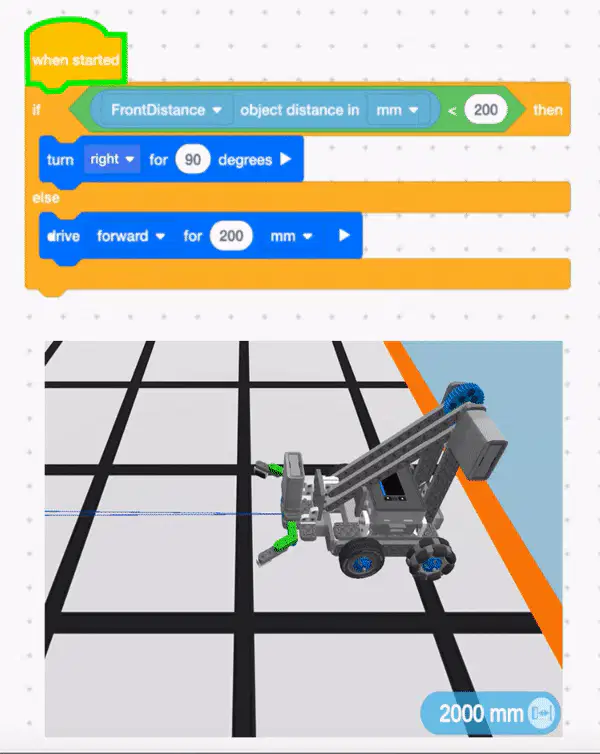
There is nothing in front of the robot when the program starts. What will the robot do.
Turn right
Go forward
Do nothing
Wait for you to press the TouchLED
The robot will only run the Else branch if...
the condition is true
the condition is false
the condition is neither true nor false
none of the above
What happens when you place a loop around an “if-then-else” block?
The robot makes a decision and then repeats it as many times as the loops says.
The robot makes a new decision each time the loop runs.
You cannot put a loop around an "if-then-else" block.
The robot defaults to "else."
What is a nested decision?
An "if-then-else" in a loop
An "if-then-else" in an "if-then-else"
A loop in an "if-then-else"
A loop in a loop
What are nested loops used for?
Making one-time decisions
Making multiple decisions
Repeating a decisions
Running two sequences at once
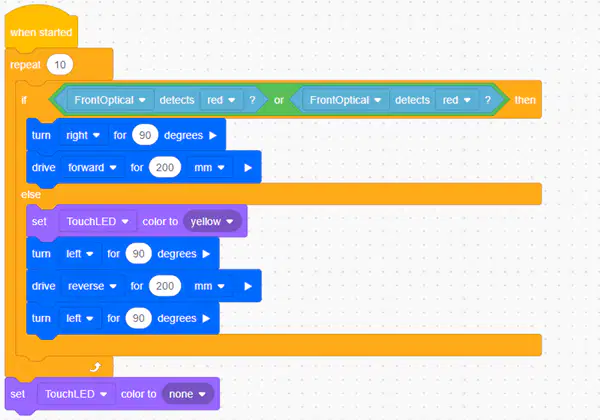
What will the robot do if it sees blue?
The TouchLED will turn yellow
The robot will drive in reverse
The robot will turn left
All of the above
How do repeated decisions allow the robot to watch both sensors at once?
The program resets and restarts at the beginning every time the readings of any sensor changes
The robot calculates the path with both sensors at first and runs algorithms for the best way to run the course
The robot activates a specific sensor at certain times throughout the course
Every operation is fast, and does not block other blocks from running
In your own words, what is a threshold value?
During line tracking, if the robot sees black, what do you know about its position?
It is above the line.
It is to the right of the line.
It is to the left of the line.
It is off the line.
Which basic program pattern is being used in this Line Tracking behavior?
Sequential Programming
Discrete Decisions
Continuous Decisions
My Blocks
It is better to think about Obstacle Detection as _________ rather than one big behavior.
One big decision
Many small decisions
A forever loop
Multitasking
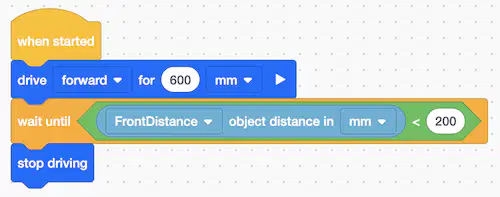
Why won't this program stop when an object is placed in front of it?
The movement block has control of program flow, preventing the sensor to be checked at the right time
The distance sensor cannot detect at that distance
All of the above
The “wait until” block should be placed above the movement block, then it will be able to detect obstacles
True or False: When line tracking, the robot will bobble its way down the line as it bounces back and forth on and off the line, detecting its edge.
True
False

