
NEW
Font size
 Worksheets
Electromotive Force : Basics
Total questions: 25
Worksheet time: 13mins
Zn/Zn+2 // Cu+2/Cu
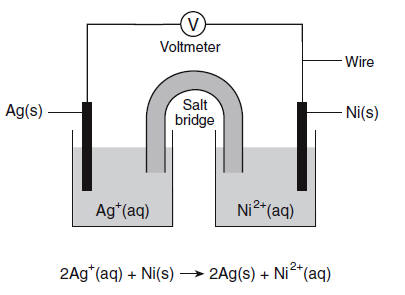
What reaction occurs at the anode?
Ag+/Ag = 0.80V
Ni2+/Ni = -0.25V
Ag+ + e- →Ag
Ag → Ag+ + e-
Ni2+ + 2e- → Ni
Ni → Ni2+ + 2e-

Galvanic cells convert
mechanical energy in to electrical energy
potential energy in to electrical energy
electrical energy in to chemical energy
chemical energy in to electrical energy
Reference electrode that is universally used whose reduction potential value is zero is
SHE
Calomel electrode
chlorine electrode
standard zinc electrode
What is oxidation?
It is the gain of electrons.
It is the loss of electrons.
It is the creation of electrons.
It is the destruction of electrons.
What is reduction?
It is the gain of electrons.
It is the loss of electrons.
It is the creation of electrons.
It is the destruction of electrons.
What is a half-reaction?
It is a reaction at equilibrium where half of the substances are reactants and half of the substances are products.
It is the reaction that occurs when the switch of a galvanic cell is open.
It shows EITHER the reduction component or the oxidation component of a redox reaction.
It shows BOTH the reduction and oxidation components of a redox reaction.
What is a standard half-cell?
It is one cell that comprises half of a whole battery.
It is a cell containing only a metal bar with no aqueous ion solution.
It is a cell containing only an aqueous ion solution and no metal bar.
It is a cell that generates half of a volt of electricity.
Electrons always flow from
cathode to anode
anode to cathode

Given their standard reduction potentials, which of the species is going to be oxidized?
Cu2+/Cu = 0.34V
Zn2+/Zn = -0.76V
Cu
Zn
CuSO4
ZnSO4
What occurs to the mass of copper electrode in the following reaction?
Zn/Zn2+ // Cu2+/Cu
increases
decreases
remains the same
Which metal is the negative electrode?
Zn/Zn2+ // Cu2+/Cu
zinc
copper
What would be the theoretical cell potential of the previous electrochemical cell?
Ag+/Ag = 0.80V
Ni2+/Ni = -0.25V
1.05V
-1.05V
0.55V
-0.55V
EO represents
Single electrode potential
Standard electrode potential
Standard hydrogen electrode
None
In electrochemical cell, oxidation takes place at
Right
Left
Top
Bottom
In electrochemical cell, reduction takes place at
Right
Left
Top
Bottom

In electrolysis of copper purification, at cathode
pure copper gets deposited
the object to be electroplated is kept
impure copper gets deposited
CuSO4 gets deposited

An electrolytic cell uses electrical energy to drive
chemical reaction
physical reaction
no reaction
none of above

