
 Worksheets
Week 8
Total questions: 10
Worksheet time: 5mins
Lesion to what cranial nerve would result in ptosis and the loss of the pupillary constriction light reflex to the left eye?
Right CN 2
Left CN 2
Right CN 3
Left CN 3
Which artery, when compromised, would limit blood supply to the labyrinthine artery?
basilar artery
anterior inferior cerebellar artery
posterior inferior cerebellar artery
posterior cerebral artery
Which statement best describes the vestibular apparatus?
There are three semicircular canals, arranged orthogonally to each other.
There are three semicircular canals, arranged in the sagittal, transverse, and frontal planes.
There are three labyrinths, the bony, membranous, and endolymph labyrinths
There are three labyrinths, arranged orthogonally to each other.
What serves as the efferent signal for the pupillary light reflex?
signals from the pretectal midbrain to ipsilateral iris sphincter muscles
signals from retinal photoreceptors to the pretectal midbrain region
signals from retinal photoreceptors to the lateral geniculate nucleus
signals from the pretectal midbrain to the bilateral iris sphincter muscles
Damage to what part of the visual pathway results in the loss of vision out of the left eye?
Optic Chiasm
Left optic nerve
Right optic nerve
Right optic tract
Left optic tract
Which vestibular nuclei send signals to the medial and lateral vestibulospinal tracts?
inferior and medial
medial and lateral
superior and lateral
superior and medial
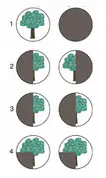
What impairment would be due to a partial lesion in the region labeled 4?
bitemporal hemianopsia
quadrantopia
loss of vision from one eye
homonymous hemianopsia
Which structure primarily detects the movement sensed during lift-off of a rocket ship blasting upwards into space?
anterior semicircular canal
horizontal semicircular canal
saccule
utricle
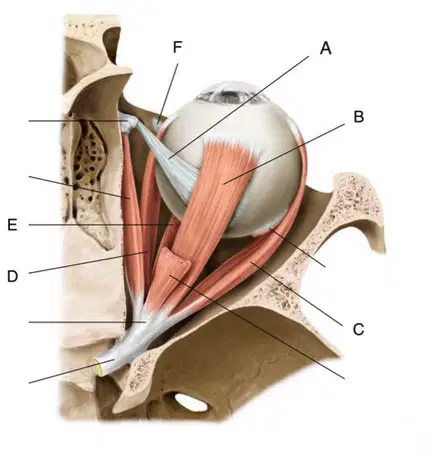
Which labeled structure would be significantly impaired by a cranial nerve 4 lesion?
A
C
D
F
Which best describes somatosensory ataxia?
Ataxia presenting as incoordination regardless of gravitational forces
Ataxia presenting as symptoms and functional limitations arising when challenged by gravity
Ataxia presenting as dysmetria, dysdiadochokinesia, and dysarthria
Ataxia presenting as the excessive reliance on visual and audio cueing

